

Cambridge IGCSE Additional Mathematics Notes 9: Circular Measure
Cambridge IGCSE Additional Mathematics notes on radians, arc length, sector area and segment problems.
Cambridge IGCSE Additional Mathematics 0606 Topic 9 requires arc-length and sector-area problem solving with radian measure, including compound shapes. The formulas are not supplied, so candidates must know when and why s = rθ and area = one half r²θ apply.
1. What a radian measures
One radian is the central angle subtended by an arc whose length equals the radius. Since a full circumference is 2πr, a full revolution is 2π radians. Therefore π radians = 180°.
Convert degrees to radians by multiplying by π/180. Convert radians to degrees by multiplying by 180/π. Preserve exact multiples of π where possible.
Radian measure is dimensionless because it is the ratio arc length ÷ radius, though angle units should still be stated when ambiguity is possible.
2. Arc length
For central angle θ in radians and radius r:
s = rθ.
This formula follows directly from the radian definition. If θ is supplied in degrees, convert first. For a major arc, use the reflex angle or subtract the minor arc from the full circumference.
When an arc length and angle are known, rearrange for radius. Keep all lengths in consistent units.
3. Sector area
A sector with angle θ radians has area
A = one half r²θ.
The relationship follows from the fraction θ/(2π) of a full circle. The formula is not given in the examination formula list, so it must be recalled.
For a major sector, use 2π - θ if θ describes the minor central angle. Distinguish sector area from the area of the triangle formed by the two radii and chord.
4. Chords and triangles
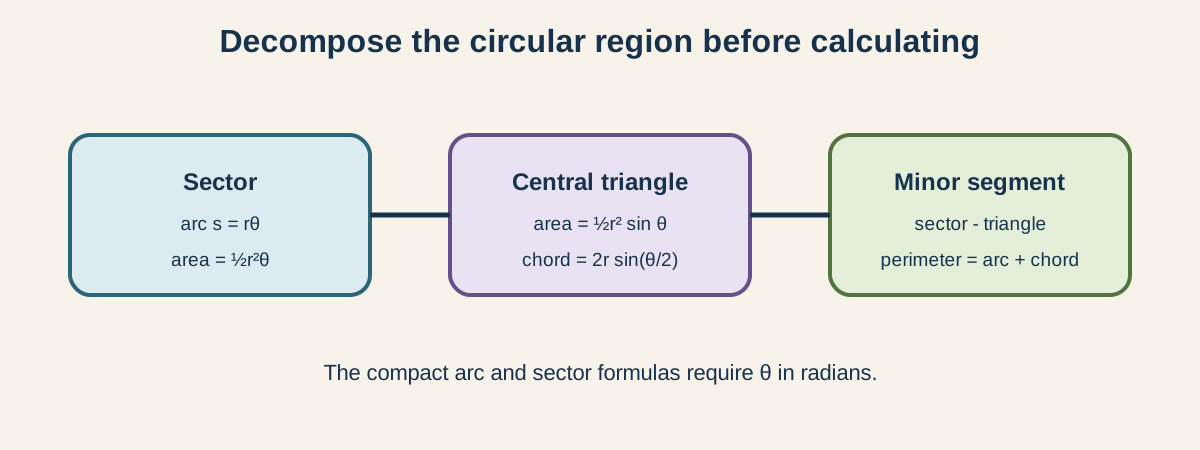
A chord joining the arc endpoints forms an isosceles triangle with the two radii. Bisecting that triangle creates right triangles. The chord length is 2r sin(θ/2).
The triangle area is one half r² sin θ. This is derived from one half ab sin C with both sides equal to r. Ensure the calculator is in radian mode when evaluating sin θ for a radian angle.
These relationships may be needed inside compound problems even though the official Topic 9 outcome is framed through arcs and sectors.
5. Segments
A minor segment lies between a minor arc and its chord. Its area is
minor sector area - triangle area
= one half r²(θ - sin θ).
A major segment is the whole circle minus the minor segment, or major sector plus the central triangle. Draw and shade the target region before choosing addition or subtraction.
The perimeter of a segment combines the relevant arc with the chord, not with two radii.
Check this topic from memory
Attempt the matching topic bank before reopening the notes. Use each missed idea to decide what to review next.
Start the topic quiz