

Cambridge IGCSE Additional Mathematics Notes 10: Trigonometry
Cambridge IGCSE Additional Mathematics notes on six trigonometric functions, transformed graphs, identities, equations and proofs.
Cambridge IGCSE Additional Mathematics 0606 Topic 10 covers sine, cosine, tangent, secant, cosecant and cotangent for angles of any magnitude. Candidates interpret transformed graphs in degrees or radians, use three supplied Pythagorean identities, solve equations over stated domains and prove relationships. Triangle rules and exact-value tables are not listed Topic 10 outcomes and are not treated as owners of this chapter.
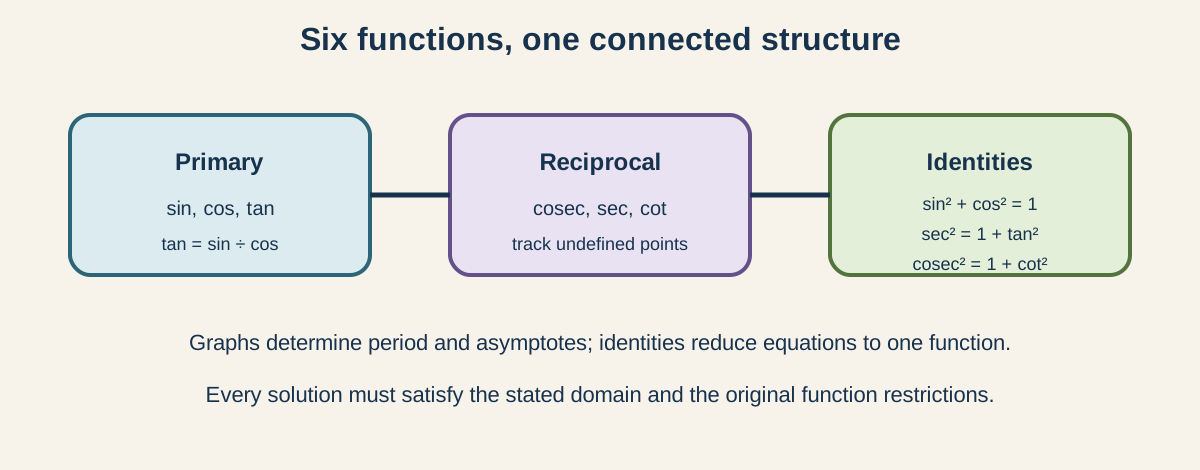
1. Six trigonometric functions
Sine, cosine and tangent extend beyond acute triangles through their periodic graphs. The reciprocal functions are:
- sec x = 1/cos x;
- cosec x = 1/sin x;
- cot x = 1/tan x = cos x/sin x.
These definitions create restrictions. Sec is undefined where cos x = 0, cosec where sin x = 0, and cot where sin x = 0. A reciprocal function has magnitude at least 1 whenever it is defined for sec or cosec.
2. Signs and angles of any magnitude
Reference angles and quadrant signs generate solutions beyond the first quadrant. Sine is positive in quadrants I and II, cosine in I and IV, and tangent in I and III. Reciprocal functions share the sign of their underlying function.
For negative angles and angles beyond one revolution, use periodicity. Sine and cosine repeat every 360° or 2π; tangent and cotangent repeat every 180° or π.
3. Amplitude, period and vertical shift
For y = a sin bx + c or y = a cos bx + c, amplitude is |a| and the centre line is y = c. The period is 360°/|b| in degrees or 2π/|b| in radians.
For y = a tan bx + c, amplitude is not defined. Its period is 180°/|b| or π/|b|, and its centre line is y = c. Vertical asymptotes occur where bx reaches an odd multiple of 90° or π/2.
The official forms use positive integer a, simple fractional or integer b, and integer c. Fractions for b have denominators from the stated set 2, 3, 4, 6 or 8.
4. Sketching transformed graphs
Start with one period of the parent graph. Apply horizontal scaling from b, vertical scaling from a and vertical translation c. Mark centre line, maxima and minima for sine or cosine, zeros and clearly labelled tangent asymptotes.
Extend the pattern across the requested domain. Keep degree and radian labels consistent. A graph of tangent must not be joined across an asymptote.
Related graphs can be compared through shifts and sign changes, for example cosine as a shifted sine graph. State the domain and transformation rather than relying on a memorised picture alone.
5. Supplied identities
The formula list provides:
Check this topic from memory
Attempt the matching topic bank before reopening the notes. Use each missed idea to decide what to review next.
Start the topic quiz