

Cambridge IGCSE Additional Mathematics Notes 11: Permutations and Combinations
Cambridge IGCSE Additional Mathematics notes on counting principles, arrangements, selections and restrictions.
Cambridge IGCSE Additional Mathematics 0606 Topic 11 distinguishes ordered arrangements from unordered selections and uses factorial, permutation and combination formulas in everyday or algebraic problems. The official boundary excludes repeated objects, circular arrangements and problems that combine permutations with combinations.
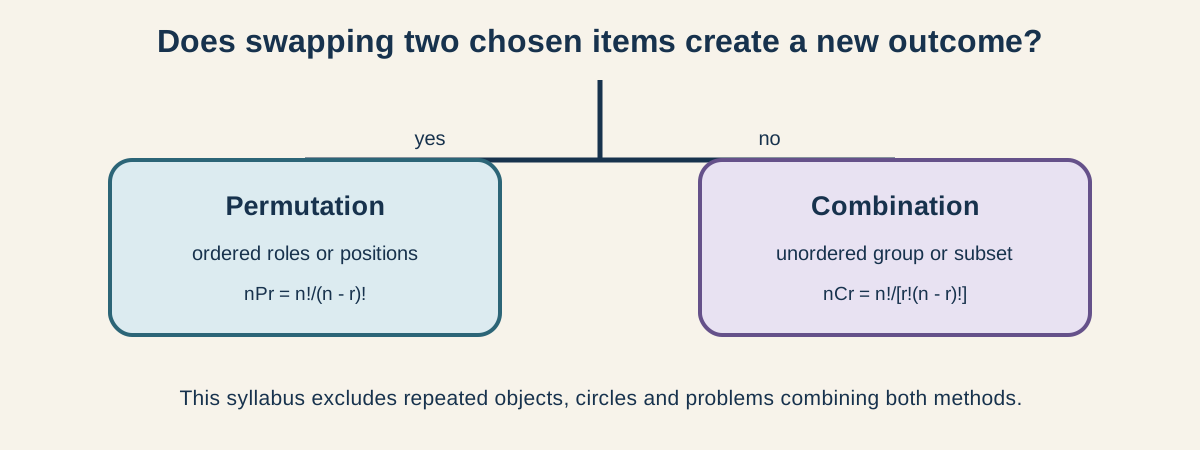
1. Define one outcome first
Before choosing a formula, describe what counts as one result. Selecting three students for an undifferentiated committee gives the same committee in any listing order. Awarding president, secretary and treasurer creates distinct roles, so order matters.
This verbal test prevents formula guessing. Ask whether swapping two selected items creates a new outcome. If yes, arrange; if no, select.
2. Multiplication and addition principles
If a process has successive independent choice stages with m, n and p options, the multiplication principle gives mnp outcomes. If disjoint cases offer m outcomes or n different outcomes, add m + n.
Cases must not overlap when added. If they do, either redesign them to be mutually exclusive or subtract the overlap. A tree or slot diagram helps make stages and cases visible.
3. Factorials
For positive integer n, n! = n(n - 1)(n - 2)...2 × 1, and 0! = 1. The value n! counts arrangements of n distinct objects in a row.
Factorials simplify by cancellation. For example, 8!/6! = 8 × 7. Expanding only the necessary factors reduces arithmetic and transcription errors.
Factorial equations require non-negative integer domains. A solution that makes a factorial argument negative is invalid.
4. Permutations
The number of ordered arrangements of r objects selected from n distinct objects is
nPr = n!/(n - r)!.
Think of r labelled positions: n choices for the first, n - 1 for the second, and so on. Use a permutation for rankings, codes without repeated symbols, or filling distinct roles.
The syllabus excludes repetition of objects. Therefore do not introduce multinomial division for identical letters or arrangements where symbols may be reused.
5. Combinations
The number of unordered selections of r objects from n distinct objects is
nCr = n!/[r!(n - r)!].
Each chosen group has r! internal orders, so dividing nPr by r! removes duplicates. The symmetry nCr = nC(n - r) reflects that selecting r included objects also determines the n - r excluded objects.
Use combinations for teams, committees or subsets with no roles or sequence.
6. Simple restrictions within the boundary
Restrictions may be handled when the overall problem remains solely an arrangement or solely a selection. For a committee containing at least one student from a specified group, count all allowed-size committees and subtract those containing none. For a row arrangement where one named item occupies a stated position, fix it and arrange the rest.
Check this topic from memory
Attempt the matching topic bank before reopening the notes. Use each missed idea to decide what to review next.
Start the topic quiz