

Cambridge IGCSE Additional Mathematics Notes 12: Series
Cambridge IGCSE Additional Mathematics notes on arithmetic and geometric progressions, sums, convergence and binomial expansion.
Cambridge IGCSE Additional Mathematics 0606 Topic 12 combines the positive-integer binomial theorem with arithmetic and geometric progressions. Candidates use general terms, finite sums and the convergence condition for a geometric sum to infinity. Greatest-term questions and coefficient-property investigations are excluded.
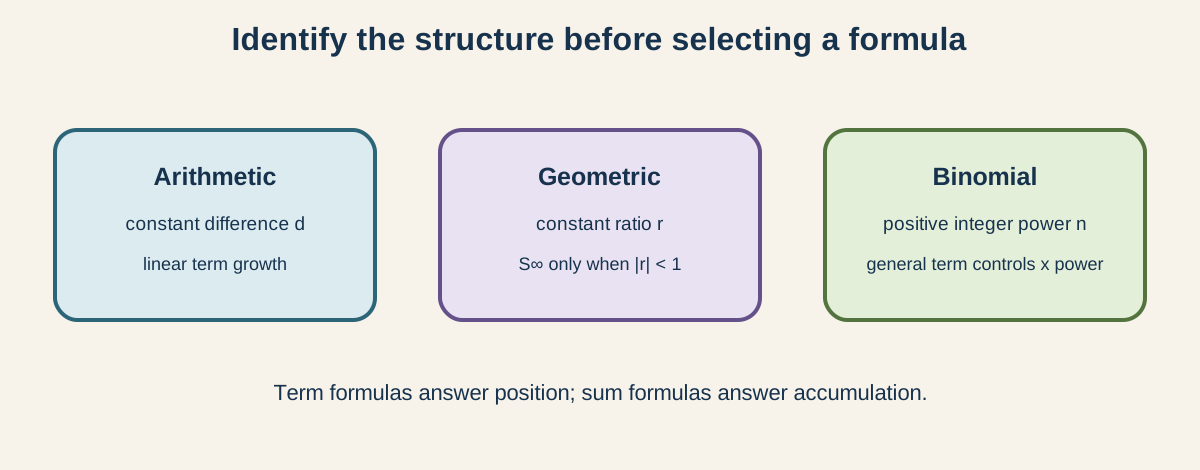
1. Sequence, progression and series
A sequence lists ordered terms. A progression follows a specified arithmetic or geometric rule. A series is a sum of terms.
The nth term answers “what is the value at position n?” while a partial sum answers “what is the total of the first n terms?” Distinguish Tₙ from Sₙ before selecting a formula.
Context determines whether the first observed quantity is term 1 or an initial term at n = 0. Define the indexing explicitly.
2. Arithmetic progressions
An arithmetic progression has constant difference d. With first term a:
Tₙ = a + (n - 1)d
Sₙ = n/2 [2a + (n - 1)d].
The sum can also be n/2(first term + last term). These formulas are supplied. A negative d produces a decreasing progression but remains arithmetic.
Use two known terms to form linear equations in a and d. Apply the position offset n - 1 carefully.
3. Arithmetic contexts
Arithmetic models suit quantities changing by a fixed amount per step, such as rows gaining the same number of seats or a monthly payment rising by a constant amount.
If asked when a term exceeds a threshold, solve an inequality in integer n and select the first valid position. If asked for total accumulated quantity, use Sₙ rather than Tₙ.
Check whether a model eventually predicts impossible negative values, which limits its contextual domain even if the algebraic sequence continues.
4. Geometric progressions
A geometric progression has constant ratio r. With first term a:
Tₙ = ar^(n - 1)
Sₙ = a(1 - rⁿ)/(1 - r) for r ≠ 1.
These formulas are supplied. A negative ratio alternates signs. A ratio between zero and one gives positive decay, while a ratio above one gives growth.
Use two known terms by division to eliminate a, but remember that even powers may allow positive and negative ratio cases.
5. Sum to infinity
A geometric progression has a finite sum to infinity only when |r| < 1. Then
S∞ = a/(1 - r).
The terms approach zero, and the remaining tail becomes arbitrarily small. Terms approaching zero are necessary but the geometric structure and |r| < 1 condition establish convergence here.
Check this topic from memory
Attempt the matching topic bank before reopening the notes. Use each missed idea to decide what to review next.
Start the topic quiz