

Cambridge IGCSE Additional Mathematics Notes 13: Vectors in Two Dimensions
Cambridge IGCSE Additional Mathematics notes on vector arithmetic, magnitudes, position vectors and geometric proofs.
Cambridge IGCSE Additional Mathematics 0606 Topic 13 covers vector notation in several forms, position and unit vectors, magnitude, arithmetic, scalar multiplication and vector geometry. It also requires composition and resolution of velocities, using velocity vectors to determine position and solve contexts such as particle collisions.
1. Scalars, vectors and notation
A scalar has magnitude only. A vector has magnitude and direction. Vectors may be written as a column, directed segment AB, bold or underlined symbol, or component form such as ai - bj. Use correct vector notation throughout.
The vector AB points from A to B. Reversing direction gives BA = -AB. A point is a location, while its position vector records the displacement from a chosen origin O to that point.
Equal vectors have the same magnitude and direction even when drawn at different positions.
2. Components and arithmetic
Add and subtract vectors component by component. Multiplying by scalar k multiplies every component. A positive scalar preserves direction, a negative scalar reverses it, and its magnitude scales by |k|.
Head-to-tail geometry matches component arithmetic. If AB = a and BC = b, then AC = a + b. Subtraction finds a missing route: BC = AC - AB.
Equating like vectors means equating corresponding components, producing simultaneous scalar equations.
3. Magnitude and unit vectors
For vector a = (x, y), its magnitude is |a| = √(x² + y²). Magnitude is a non-negative scalar.
The unit vector in the same direction as non-zero a is a/|a|. Dividing the zero vector by its magnitude is undefined, so a direction requires a non-zero vector.
Resolve a vector of magnitude V at angle θ from the positive horizontal as (V cos θ, V sin θ), adjusting component signs for its quadrant.
4. Position vectors
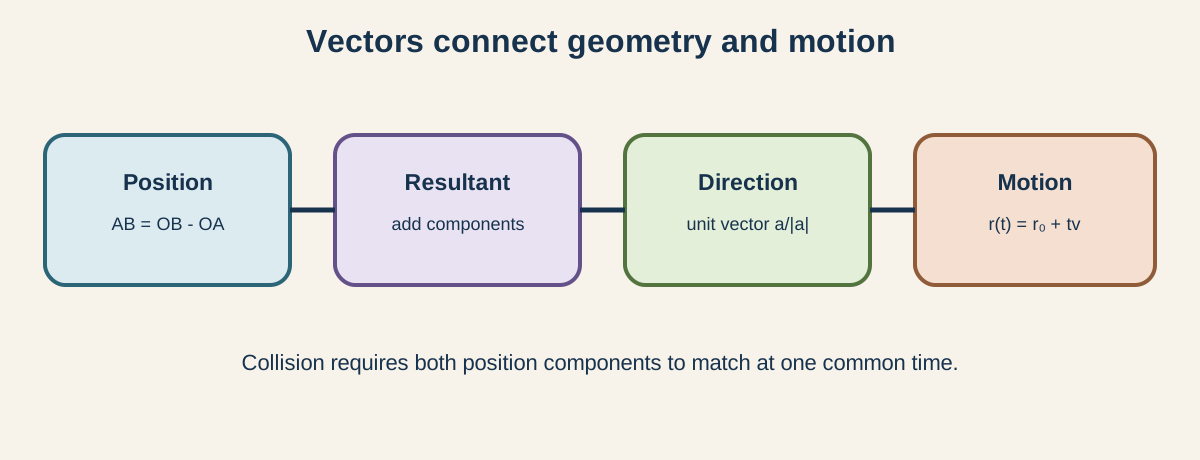
If OA = a and OB = b, then AB = b - a. This “destination minus start” rule follows from OA + AB = OB.
The position of a moving particle can be written r(t) = r₀ + tv for constant velocity v. Each component has its own linear equation in time. Units must be consistent, such as metres and metres per second.
5. Points dividing a line
For a point P on AB with AP:PB = m:n, P lies the fraction m/(m + n) of the way from A to B. Its position vector is
OP = [n OA + m OB]/(m + n).
The coefficient on each endpoint is the opposite segment ratio. Check that the coefficients sum to 1 and that P lies between endpoints for a positive internal ratio.
Although ratio division is a useful vector-geometry consequence, use it in service of the official position-vector and geometry outcomes rather than as a separate invented syllabus unit.
Check this topic from memory
Attempt the matching topic bank before reopening the notes. Use each missed idea to decide what to review next.
Start the topic quiz