

Cambridge IGCSE Biology Notes 13: Excretion in Humans
Cambridge IGCSE Biology 0610 and 0970 notes on excretion, kidneys, nephrons, filtration, reabsorption, urine, amino-acid assimilation and deamination.
Topic 13 of Cambridge IGCSE Biology 0610 and 0970 follows metabolic waste from its source to removal. The official section covers carbon dioxide excretion, the urinary system, kidney cortex and medulla, the limited filtration-reabsorption nephron model, amino-acid assimilation, deamination, urea formation and urea toxicity. ADH, dialysis and transplantation are not imported into this boundary.
Excretion is not egestion
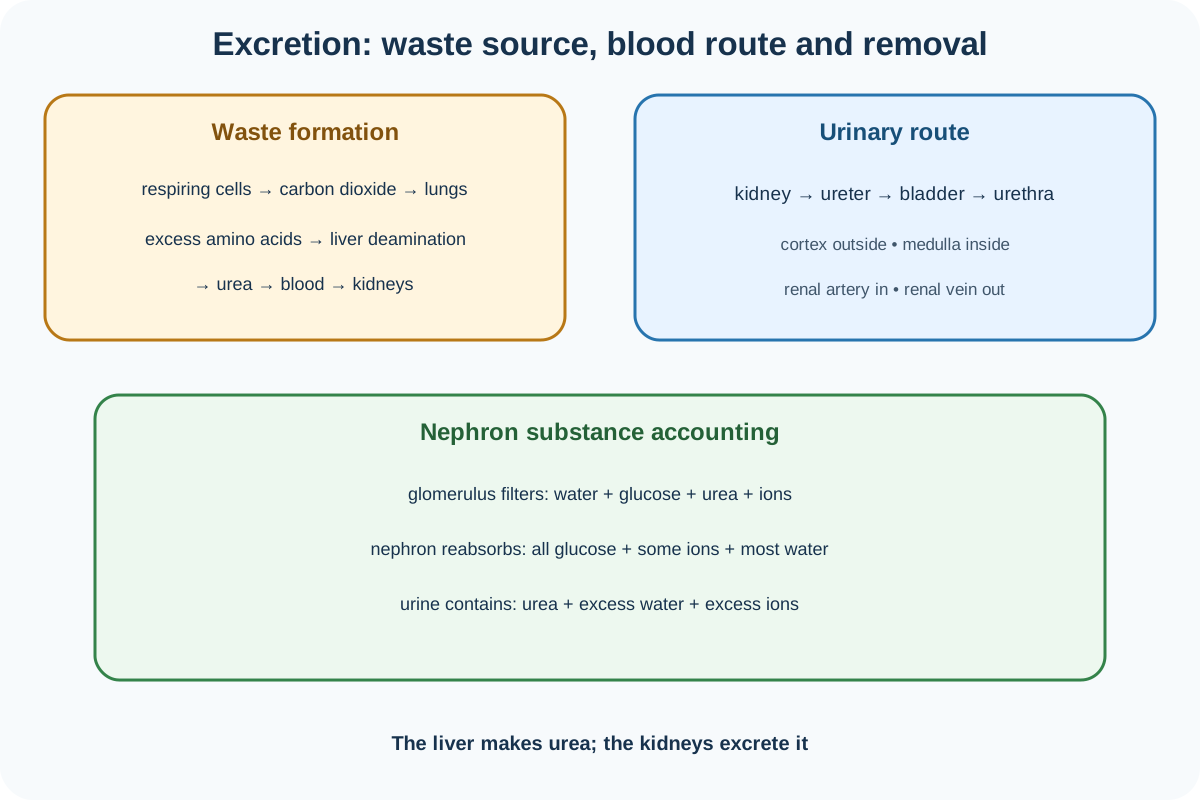
Excretion is removal of waste products of metabolism, toxic materials and substances in excess of requirements. Metabolism produces carbon dioxide and urea, while water and ions may be present in excess.
Egestion is removal of undigested food from the alimentary canal as faeces. Undigested fibre has not entered cells and is not a metabolic waste product. Defaecation is therefore not the main excretory process described in Topic 13.
The lungs excrete carbon dioxide. The kidneys excrete urea, excess water and excess ions in urine. These routes are matched to the substances carried in blood.
The urinary-system route
Two kidneys filter blood and form urine. Each ureter carries urine from one kidney to the bladder. The bladder stores urine. The urethra carries urine from the bladder to the outside of the body.
Do not reverse ureter and urethra. Ureters are paired tubes from kidneys; the urethra is the outlet from the bladder.
Blood reaches a kidney through the renal artery and leaves through the renal vein. Urine is not carried in either blood vessel.
In a kidney section, the cortex forms the outer region and the medulla lies deeper inside. Nephrons extend through these regions and are associated with blood vessels. The syllabus asks for cortex and medulla identification but does not require every kidney-zone detail.
The nephron's limited official model
A nephron is the functional unit that filters substances from blood and reabsorbs useful substances and required water and ions.
At the glomerulus, water, glucose, urea and ions are filtered from blood. Blood cells and large plasma proteins normally remain in the blood because they are too large to pass through the filtration barrier.
In a healthy person with blood glucose below the renal threshold, filtered glucose is normally reabsorbed, together with some ions and most water. Reabsorption prevents useful small molecules from being lost simply because they entered the filtrate.
The final urine contains urea, excess water and excess ions. The words "excess" matter. The body needs water and ions, but amounts beyond current requirements are removed.
Cambridge explicitly states that details of these processes are not required. A precise answer should therefore preserve the named substances and overall directions without importing unsupported pressure calculations, named tubule segments or hormone-control mechanisms.
Check this topic from memory
Attempt the matching topic bank before reopening the notes. Use each missed idea to decide what to review next.
Start the topic quiz