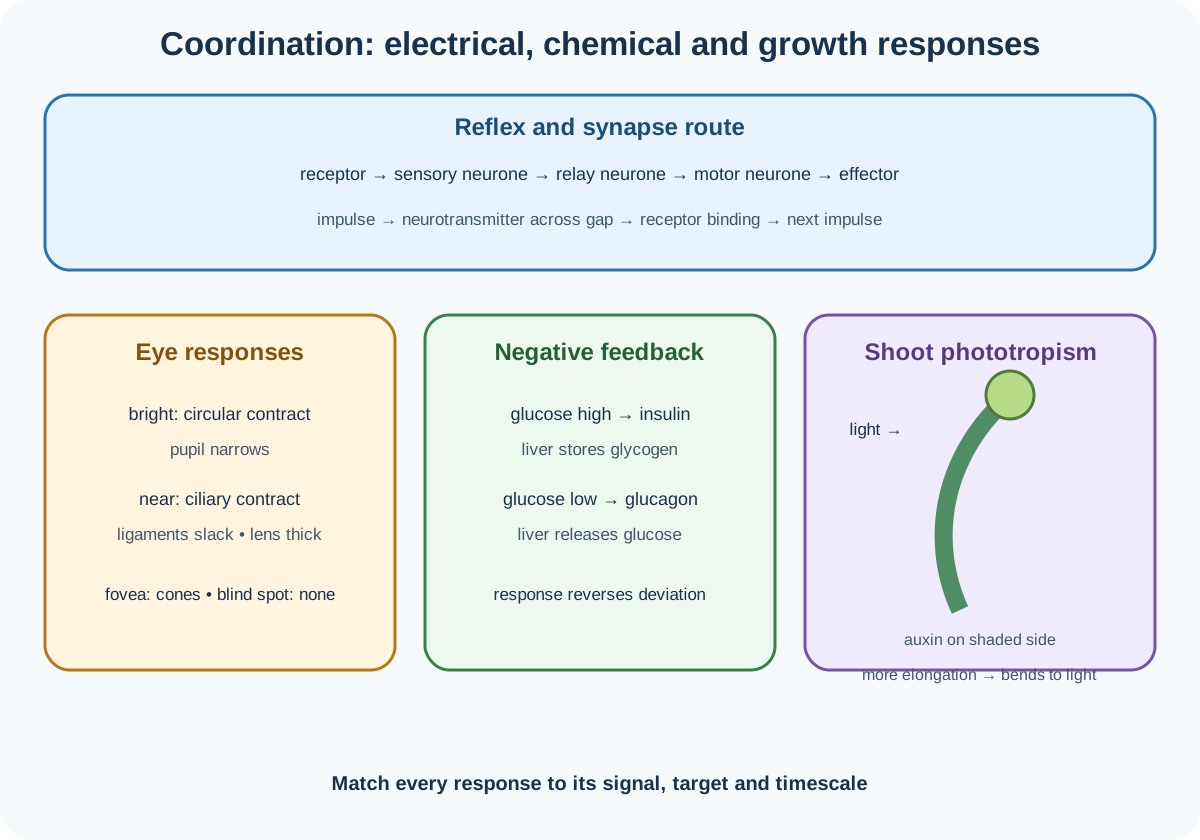
Topic 14 of Cambridge IGCSE Biology 0610 and 0970 joins rapid electrical coordination to slower chemical control and plant growth responses. Official sections 14.1 to 14.5 cover the nervous system and synapses, sense organs and the eye, named hormones, negative-feedback homeostasis, blood glucose, temperature control and auxin-controlled tropisms.
Nervous-system organisation
Electrical impulses travel along neurones. The mammalian nervous system coordinates and regulates body functions by detecting changes, processing information and producing responses.
The central nervous system, or CNS, consists of the brain and spinal cord. The peripheral nervous system, or PNS, consists of nerves outside the brain and spinal cord. Peripheral nerves connect receptors and effectors to the CNS.
Sensory neurones carry impulses from receptors toward the CNS. Relay neurones connect neurones within the CNS. Motor neurones carry impulses from the CNS to effectors. In diagrams, identify a neurone by the position of its cell body, direction of impulse and connections rather than by one memorised outline alone.
An effector is a muscle or gland. Muscles respond by contracting; glands respond by secreting. A receptor detects a stimulus, while an effector carries out the response.
The reflex arc
A reflex action automatically and rapidly integrates a stimulus with the response of an effector. A simple reflex arc follows this order:
For example, heat stimulates receptors in skin. A sensory neurone carries impulses to the spinal cord, a relay neurone transfers the signal to a motor neurone and the motor neurone stimulates an arm muscle to contract.
Rapid automatic action reduces delay and can protect the body. The brain may receive information about the stimulus, but conscious decision is not required before the initial reflex response. A reflex is therefore not accurately described as a pathway that completely excludes the CNS or brain awareness.
Synapses
A synapse is a junction between two neurones. At Supplement level, the transmitting ending contains vesicles filled with neurotransmitter molecules. A narrow synaptic gap separates the neurones, and receptor proteins occur on the next neurone.
The event sequence is precise:
An electrical impulse reaches the end of the first neurone.
The impulse stimulates vesicles to release neurotransmitter into the synaptic gap.
Neurotransmitter molecules diffuse across the gap.
They bind to complementary receptor proteins on the next neurone.
An electrical impulse is stimulated in the next neurone.
Transmission changes from electrical along a neurone to chemical across the gap and back to electrical in the next neurone. The neurotransmitter does not jump as an electrical impulse through empty space.
Synapses ensure one-way travel because transmitter vesicles and receptor proteins are arranged on opposite sides. Release occurs from the first neurone and binding stimulates the next.
Sense organs and stimuli
Sense organs are groups of receptor cells that respond to specific stimuli. Cambridge names light, sound, touch, temperature and chemicals. The eye is the detailed sense organ in this section.
The cornea refracts light as it enters. The iris controls how much light enters through the pupil. The pupil is an opening, not a structure that contracts. The lens focuses light onto the retina. The retina contains light receptors, including receptors sensitive to different colours. The optic nerve carries impulses from the retina to the brain. The blind spot is where the optic nerve leaves and contains no light receptors.
The pupil reflex
In bright light, circular muscles in the iris contract and radial muscles relax. The pupil becomes smaller, reducing light entry and protecting the retina from excessive light.
In dim light, radial muscles contract and circular muscles relax. The pupil becomes wider, allowing more light to reach the retina.
The two muscle groups are antagonistic because when one contracts the other relaxes. The iris changes pupil diameter; the pupil itself contains no muscle.
Accommodation
Accommodation changes lens shape to focus near and distant objects on the retina.
For a near object, ciliary muscles contract. Suspensory ligaments become slack, so the elastic lens becomes thicker and more convex. It refracts light more strongly.
For a distant object, ciliary muscles relax. Suspensory ligaments become taut, pulling the lens thinner and less convex. It refracts light less strongly.
Use the complete four-part chain: ciliary muscle state, suspensory-ligament tension, lens shape and degree of refraction. The lens does not move forward and backward as the main mechanism.
Rods, cones, fovea and blind spot
Rods are more sensitive to low light and support night vision. They occur widely through the retina but are absent from the fovea and blind spot in the syllabus-level distribution model.
There are three different kinds of cones that absorb light of different colours and enable colour vision. Cones work best at higher light intensity. They are concentrated at the fovea.
The fovea is the region of greatest cone concentration and provides the most detailed colour vision. The blind spot contains no rods or cones because the optic nerve exits there.
Do not call the fovea the point where no image forms. That is the blind spot.
Hormones and endocrine glands
A hormone is a chemical substance produced by a gland, carried by blood and altering the activity of one or more specific target organs.
The adrenal glands secrete adrenaline. The pancreas secretes insulin and, at Supplement level, glucagon. The testes secrete testosterone. The ovaries secrete oestrogen.
Hormones travel throughout the circulation, but only target organs with appropriate receptors respond. They do not travel along neurones.
Nervous control is generally faster and its effect shorter-lasting. Hormonal control is generally slower and its effect longer-lasting. Nervous impulses travel along specific neurones, while hormones travel in blood.
Adrenaline and fight or flight
Adrenaline is secreted in fight-or-flight situations. It increases breathing rate, heart rate and pupil diameter. Supplement candidates also relate it to increased metabolic activity by increasing blood glucose concentration and heart rate.
Higher heart rate moves oxygen and glucose to tissues more rapidly. Higher breathing rate supports gas exchange, and increased blood glucose makes respiratory substrate available. Wider pupils increase light entry.
Adrenaline prepares the body for rapid action; it does not directly supply energy as a material substance.
Homeostasis and negative feedback
Homeostasis is maintenance of a constant internal environment. "Constant" means kept within a suitable range around a set point, not absolutely unchanged every second.
Negative feedback reverses a departure from the set point. Receptors detect a change, a coordination centre processes it and effectors produce a response that reduces the original change. Once the variable returns toward the set point, the corrective response is reduced.
Negative feedback therefore opposes change. It is not "negative" because it is harmful.
Blood-glucose control
Insulin decreases blood glucose concentration. When concentration rises, the pancreas releases insulin. Insulin causes the liver to take up glucose and convert glucose to glycogen for storage, lowering blood glucose toward the set point.
When blood glucose concentration falls, the pancreas releases glucagon. Glucagon causes the liver to convert glycogen to glucose and release glucose into blood, raising concentration toward the set point.
Insulin and glucagon are antagonistic hormones. The liver is the target organ managing the glucose-glycogen store; the pancreas detects and secretes the controlling hormones.
Type 1 diabetes occurs when the pancreas does not produce sufficient insulin. Treatment is outlined through insulin administration, regular monitoring of blood glucose and management of carbohydrate intake and activity so glucose concentration remains within a safe range. Insulin is a protein and is commonly injected or delivered by a pump rather than swallowed and digested.
Temperature homeostasis
The brain coordinates responses to deviations in internal body temperature. Temperature receptors provide information, and effectors alter heat loss or heat production.
When the body is too hot, sweat glands release sweat. Evaporation transfers heat from skin to the environment. Arterioles supplying surface capillaries dilate, increasing blood flow near the surface and increasing heat transfer to the surroundings. Hair erector muscles relax so hairs lie flatter, trapping less insulating air.
When the body is too cold, skeletal muscles shiver. Repeated contractions release more heat through respiration. Arterioles supplying skin capillaries constrict, reducing surface blood flow and heat loss. Hair erector muscles contract, raising hairs and helping trap an insulating air layer. Fatty tissue beneath skin also provides insulation.
Vasodilation and vasoconstriction refer to arterioles supplying surface capillaries, not the capillaries actively widening themselves. Vasoconstriction reduces but does not necessarily stop all skin blood flow.
The required skin structures are hairs, hair erector muscles, sweat glands, receptors, sensory neurones, blood vessels and fatty tissue. Link each named part to detection, coordination, insulation or heat-loss control.
Tropic responses
Phototropism is a growth response in which part of a plant grows toward or away from the direction of a light source. Gravitropism is a growth response toward or away from gravity.
A positive response grows toward the stimulus; a negative response grows away. Shoots are generally positively phototropic and negatively gravitropic. Roots are generally positively gravitropic and often negatively phototropic.
Tropisms involve directional growth, not temporary bending caused only by water loss.
Auxin and shoot growth: Supplement
Auxin is made in the shoot tip and diffuses through the plant from the tip. Light or gravity can produce unequal auxin distribution. In shoots, auxin stimulates cell elongation.
With one-sided light, more auxin accumulates on the shaded side of a shoot. Cells there elongate more than cells on the lit side, so the shoot curves toward the light.
In a horizontal shoot, unequal auxin distribution causes greater elongation on the lower side, curving the shoot upward and away from gravity.
Cambridge limits the detailed auxin mechanism here to shoot growth. Investigations cover shoots and roots, but do not automatically transfer the shoot statement "auxin stimulates elongation" into an unqualified root mechanism.
Interpret response investigations
A phototropism investigation requires a directional light source and suitable controls, such as seedlings receiving light evenly or from above. Rotate or shield apparatus carefully so the direction of stimulus is known.
A gravitropism investigation changes orientation while controlling light direction, moisture, temperature and seedling stage. Curvature should be measured over time rather than inferred from one unlabelled final image.
Practical execution, sample size, safe handling, imaging and evaluation remain in the practical hub. The theory note owns predicted directions and auxin explanations.
Worked application: connect fast and slow coordination
A student touches a hot surface and withdraws a hand before consciously deciding. Skin receptors generate impulses that travel along a sensory neurone to the spinal cord, across synapses through a relay neurone and along a motor neurone to an arm muscle, which contracts. Synaptic neurotransmitter travels only across each gap and binds receptors on the next neurone. Later, stress releases adrenaline, increasing heart rate, breathing rate, pupil diameter and blood glucose concentration. In a separate plant trial, one-sided light causes unequal auxin distribution in a shoot; greater elongation on the shaded side bends the shoot toward light. The three responses use different timescales and signal types.
Common misconceptions and corrections
Saying impulses travel in blood. Electrical impulses travel along neurones.
Calling every nerve part of the CNS. Nerves outside brain and spinal cord form the PNS.
Sending sensory impulses from CNS to muscle. Motor neurones carry that direction.
Calling a relay neurone an effector. It connects neurones within the CNS.
Calling a receptor a muscle. Receptors detect; muscles respond.
Leaving the relay neurone out of the named simple reflex arc. It connects sensory and motor neurones.
Saying reflexes are always conscious decisions. They are rapid and automatic.
Saying a reflex bypasses the CNS. The simple arc is integrated through the CNS.
Calling a synapse a neurone. It is a junction between neurones.
Saying an electrical impulse diffuses across the synaptic gap. Neurotransmitter diffuses.
Putting receptor proteins on the releasing vesicles. Receptors are on the next neurone.
Saying synapses transmit equally in both directions. Their arrangement ensures one-way travel.
Calling the pupil a muscle. It is an opening controlled by iris muscles.
Saying the cornea detects colour. It refracts light.
Saying the iris focuses light on the retina. The lens focuses it.
Saying the optic nerve carries light. It carries electrical impulses.
Contracting radial muscles in bright light. Circular muscles contract in bright light.
Saying the lens becomes thinner for near vision. It becomes thicker and more convex.
Saying ciliary muscles relax for near vision. They contract.
Saying taut ligaments allow the lens to thicken. Slack ligaments allow it.
Calling rods the colour receptors. Three cone types support colour vision.
Saying rods work only in bright light. They are highly sensitive for night vision.
Calling the fovea the blind spot. The fovea has concentrated cones; the blind spot has no receptors.
Saying hormones travel along nerves. They are carried in blood.
Saying every organ responds to every hormone. Specific target organs respond.
Pairing adrenaline with the pancreas. Adrenal glands secrete it.
Pairing insulin with the adrenal gland. The pancreas secretes it.
Saying hormonal control is always faster. Nervous control is generally faster.
Saying adrenaline is energy. It alters activity and increases substrate availability.
Defining homeostasis as no internal change. Variables fluctuate around set points.
Calling negative feedback harmful feedback. It reverses deviations.
Saying insulin raises blood glucose. It lowers it.
Saying glucagon lowers blood glucose. It raises it.
Saying the pancreas stores glycogen. The liver manages the named glucose-glycogen conversion.
Treating insulin and glucagon as the same hormone. They have antagonistic effects.
Saying Type 1 diabetes is treated by swallowing insulin tablets. Protein insulin is normally delivered without digestion.
Saying sweat cools before it evaporates. Evaporation removes heat.
Saying vasodilation decreases skin blood flow. It increases surface flow.
Saying shivering reduces respiration. Muscle contraction increases energy transfer and heat production.
Saying fat increases heat loss. It insulates.
Calling tropism movement without growth. It is a directional growth response.
Saying positive tropism always means upward. It means toward the stimulus.
Saying auxin is made throughout the root in this mechanism. The required shoot account begins at the shoot tip.
Saying auxin accumulates on the lit side of a one-sided-light shoot. More occurs on the shaded side.
Saying greater shaded-side elongation bends away from light. It bends the shoot toward light.
Applying the shoot auxin elongation rule unqualified to roots. The detailed outcome is limited to shoot growth.
Assessment guidance
For nervous answers, preserve direction and signal form: impulse along neurone, neurotransmitter across synapse, impulse in the next neurone. Write reflex arcs in the exact receptor-to-effector order. In eye questions, pair each structure with its named function and give the full muscle-ligament-lens-refraction chain for accommodation. Define hormones through gland, blood and target organ, then compare control by speed and duration. Homeostasis answers need a set point and a response that reverses deviation. Keep insulin and glucagon antagonistic, and explain thermoregulation through the brain, sweat evaporation, shivering, insulation and arteriolar blood-flow changes. Limit detailed auxin explanation to shoot elongation.
Retrieval practice
Draw and annotate a reflex arc, synapse, eye and skin section. Reconstruct near and distant accommodation and bright and dim pupil responses. Build paired negative-feedback loops for glucose and temperature, compare nervous with hormonal control, and predict shoot and root curvature in four light-gravity arrangements while explaining only the required shoot auxin mechanism.
Theory and practical ownership
This theory note owns nervous and hormonal mechanisms, eye structure and response, homeostatic feedback, glucose and temperature control, tropism definitions and shoot auxin reasoning. The separate Biology practical hub owns reaction-time, pupil-observation and plant-response protocols, participant and eye safety, seedling handling, controls, time-course measurement, tables, graphs and evaluation.