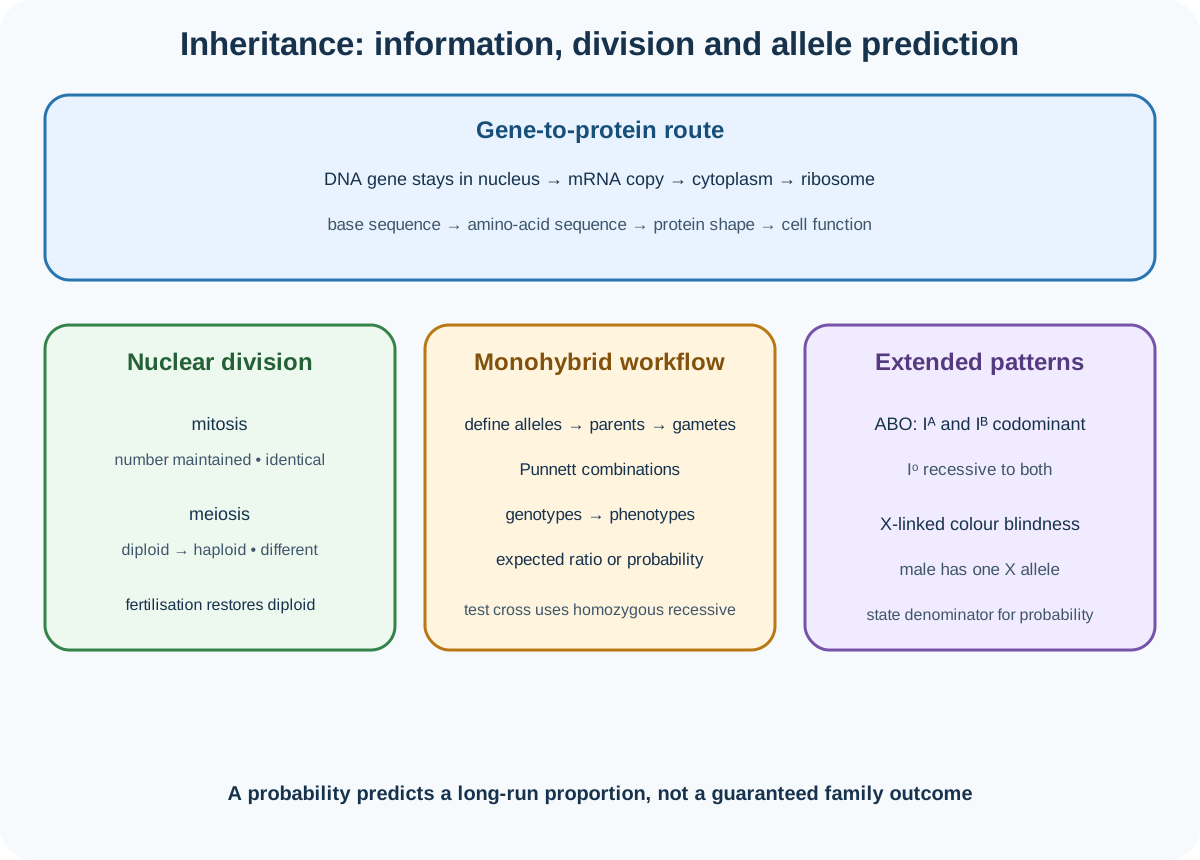
Topic 17 of Cambridge IGCSE Biology 0610 and 0970 links DNA information to protein production, cell function, nuclear division and allele transmission. Official sections 17.1 to 17.4 cover sex chromosomes, gene expression, mitosis, meiosis, pedigrees, monohybrid ratios, test crosses, ABO codominance and red-green colour-blindness sex linkage.
Chromosomes, genes and alleles
Chromosomes are made of DNA. DNA contains genetic information in lengths called genes. A gene is a length of DNA that codes for a protein. An allele is an alternative form of a gene.
Genes occur at corresponding positions on a pair of chromosomes in a diploid cell. The alleles may be identical or different. An allele is not an alternative chromosome and a gene is not the entire DNA content of an organism.
Inheritance is transmission of genetic information from generation to generation. Gametes carry alleles from parents, and fertilisation combines them in a zygote.
DNA sequence controls protein structure
At Supplement level, the sequence of bases in a gene determines the sequence of amino acids used to make a particular protein. Different amino-acid sequences fold into different protein shapes.
Shape affects function. An enzyme needs an active site with a suitable shape. A membrane carrier needs a structure that interacts with particular substances. A neurotransmitter receptor needs a binding site complementary to its signal.
DNA therefore controls cell function by controlling protein production. It does not carry out every cellular reaction directly.
The required protein-synthesis sequence
The gene coding for a protein remains in the nucleus. Messenger RNA, or mRNA, is made as a copy of the gene. The mRNA leaves the nucleus and moves to the cytoplasm.
The mRNA passes through a ribosome. The ribosome assembles amino acids into a protein. The sequence of bases in mRNA determines the specific amino-acid sequence.
The required chain is:
gene in nucleus→mRNA copy→cytoplasm→ribosome→amino-acid sequence→protein.
Check this topic from memory
Attempt the matching topic bank before reopening the notes. Use each missed idea to decide what to review next.
Detailed transcription and translation mechanisms are explicitly excluded. Preserve the named locations, molecule movements and sequence relationship without adding codon tables, transfer RNA or polymerase detail unless a separate course requires them.
Gene expression and specialised cells
Most body cells contain the same genes, but many genes are not expressed in a particular cell. A cell makes only the specific proteins it needs.
For example, a specialised cell can express genes for particular membrane carriers or enzymes while not producing every protein encoded in the genome. Different cell functions therefore arise from different patterns of gene expression, not usually from each cell having a completely different set of genes.
Haploid, diploid and human chromosomes
A haploid nucleus contains one set of chromosomes. A diploid nucleus contains two sets.
In a diploid cell, there is a pair of each chromosome type. A human diploid cell has 23 pairs, or 46 chromosomes. A normal human gamete is haploid and has 23 single chromosomes.
The chromosome number refers to chromosome structures, not DNA base pairs or individual genes.
Sex determination in humans
Human females normally have two X chromosomes, XX. Human males normally have one X and one Y, XY.
Egg cells carry an X chromosome. Approximately half of sperm carry X and half carry Y. Fertilisation by an X-bearing sperm gives XX and by a Y-bearing sperm gives XY, so the sperm chromosome determines chromosomal sex in this model.
Each fertilisation is an independent probability. A previous child's sex does not force the outcome of the next fertilisation.
Mitosis
Mitosis is nuclear division giving rise to genetically identical cells. Exact chromosome replication occurs before mitosis. During mitosis, chromosome copies separate, maintaining chromosome number in each daughter cell.
Mitosis supports growth, repair of damaged tissues, replacement of cells and asexual reproduction.
Stem cells are unspecialised cells that divide by mitosis. Their daughter cells can become specialised for particular functions.
Details of mitotic stages are not required. Focus on prior replication, copy separation, chromosome-number maintenance and genetically identical products.
Meiosis
Meiosis produces gametes. It is a reduction division in which chromosome number is halved from diploid to haploid, producing genetically different cells.
Fertilisation later joins two haploid nuclei and restores the diploid number. Without reduction, chromosome number would double each generation.
Meiosis differs from mitosis in chromosome-number outcome and genetic similarity. Stage names are not required.
Genotype and phenotype
Genotype is an organism's genetic make-up, described through the alleles present. Phenotype is an observable feature.
Phenotype can depend on genotype and environment. In a simple monohybrid model, the given allele relationship may be enough to predict a phenotype, but this does not mean every biological phenotype has a one-gene-only cause.
Homozygous means having two identical alleles of a gene. Two identical homozygous individuals breeding together are pure-breeding for that characteristic. Heterozygous means having two different alleles and is not pure-breeding.
A dominant allele is expressed when it is present in the genotype. A recessive allele is expressed only when no dominant allele of that gene is present.
Dominant does not mean common, stronger, healthier or evolutionarily better.
Build a monohybrid genetic diagram
For a complete cross:
Define allele symbols, normally using the same letter with uppercase for dominant and lowercase for recessive.
State parental phenotypes and genotypes.
List the allele in each possible gamete.
Combine gametes in a Punnett square or equivalent diagram.
State offspring genotypes.
Convert genotypes to phenotypes.
Give the requested ratio or probability.
Crossing two heterozygotes, Tt by Tt, gives TT, Tt, Tt and tt. The genotype ratio is 1 TT : 2 Tt : 1 tt and, with complete dominance, the phenotype ratio is 3 dominant : 1 recessive.
Crossing Tt by tt gives Tt and tt in equal expected proportions, a 1 : 1 phenotype ratio.
Ratios are expected across many offspring. A family of four is not guaranteed to show exactly three dominant and one recessive child.
Pedigree interpretation
A pedigree records a characteristic through generations. Standard diagrams usually use squares for males, circles for females, horizontal lines for reproductive pairs and vertical lines for descendants. A shaded symbol shows the stated phenotype.
Work from evidence. Two unaffected parents with an affected child can support a recessive model if both parents are heterozygous carriers. Two affected parents producing an unaffected child can support a dominant model if both are heterozygous.
Do not assign genotypes from shading alone until the dominant or recessive relationship and relatives constrain the possibilities.
Test crosses
An individual with a dominant phenotype may be homozygous dominant or heterozygous. A test cross breeds it with a homozygous recessive individual.
If any recessive offspring occur, the unknown parent must have supplied a recessive allele and is heterozygous. If all offspring show the dominant phenotype, a homozygous dominant genotype is supported, although a small sample cannot prove it with absolute certainty because a heterozygote could by chance produce only dominant-phenotype offspring.
The recessive tester is informative because its gametes reveal which allele came from the unknown parent.
Codominance and ABO blood groups
Codominance occurs when both alleles in a heterozygous organism contribute to the phenotype.
ABO blood groups have phenotypes A, B, AB and O. The alleles are Iᴬ, Iᴮ and Iᵒ. Iᴬ and Iᴮ are codominant with each other, and each is dominant over Iᵒ.
Group A genotypes are IᴬIᴬ or IᴬIᵒ.
Group B genotypes are IᴮIᴮ or IᴮIᵒ.
Group AB genotype is IᴬIᴮ.
Group O genotype is IᵒIᵒ.
If an IᴬIᵒ parent and IᴮIᵒ parent reproduce, possible offspring are IᴬIᴮ, IᴬIᵒ, IᴮIᵒ and IᵒIᵒ, giving AB, A, B and O phenotypes in equal expected proportions.
AB is not an intermediate blend. Both A and B allele contributions are expressed.
Sex linkage and colour blindness
A sex-linked characteristic is controlled by a gene on a sex chromosome. This can make the characteristic more common in one sex.
Red-green colour blindness is an X-linked example. Let Xᴮ carry the usual colour-vision allele and Xᵇ carry the recessive colour-blindness allele.
A male has one X chromosome, so XᵇY produces colour blindness because there is no second X allele to mask it. A female normally needs XᵇXᵇ to express the recessive condition. XᴮXᵇ is a carrier phenotype under this model.
An affected father passes his X chromosome to every daughter and his Y to every son. He therefore cannot pass his X-linked allele directly to a son. A carrier mother can pass either X allele to sons or daughters.
For a carrier mother XᴮXᵇ and unaffected father XᴮY, the equally likely genotypes are XᴮXᴮ, XᴮXᵇ, XᴮY and XᵇY. Among all children, one-quarter are expected to be colour-blind sons; among sons, one-half are expected to be colour blind.
Always state the denominator. "Half the sons" and "one-quarter of all children" describe the same cross but answer different questions.
Worked application: identify an unknown genotype and extend the cross
A tall plant has genotype TT or Tt, where T is dominant. It is crossed with a short tt tester. Among 40 offspring, 21 are tall and 19 short, close to a 1 : 1 ratio. Short offspring must be tt and received t from both parents, so the tall parent supplied t and must be Tt. Its gametes were T and t, while the tester supplied only t. If two Tt plants were crossed instead, expected genotypes would be 1 TT : 2 Tt : 1 tt and phenotypes 3 tall : 1 short. These are probabilities, not a guarantee for four seeds.
Common misconceptions and corrections
Calling a chromosome one gene. A chromosome contains many genes in DNA.
Calling an allele a different chromosome. It is an alternative form of a gene.
Saying a gene codes directly for a characteristic. The required definition is a length of DNA coding for a protein.
Saying amino-acid sequence determines DNA sequence in the stated direction. Gene base sequence determines amino-acid sequence.
Saying protein shape is unrelated to sequence. Different amino-acid sequences produce different shapes.
Saying DNA catalyses every cell reaction directly. It controls protein production.
Saying the gene leaves the nucleus. The gene remains; mRNA carries a copy.
Saying protein is assembled in the nucleus. Ribosomes in cytoplasm assemble it.
Saying mRNA assembles amino acids by itself. The ribosome performs assembly using the mRNA sequence.
Adding detailed transcription and translation stages as required. They are excluded.
Saying specialised cells contain entirely different genes. Most body cells contain the same genes.
Saying every gene is expressed in every cell. Cells make the proteins they need.
Calling a haploid nucleus one chromosome. It contains one set.
Calling a human diploid cell 23 chromosomes. It has 23 pairs, or 46.
Saying every sperm carries Y. Approximately half carry X.
Saying the egg determines XX or XY. Egg cells carry X; sperm provide X or Y.
Saying previous children change the next sex probability. Fertilisations are independent.
Saying mitosis halves chromosome number. It maintains it.
Saying chromosome replication occurs during the final separation only. Exact replication occurs before mitosis.
Saying mitosis produces genetically different nuclei. Products are genetically identical in the model.
Saying stem cells are already fully specialised. They are unspecialised.
Saying meiosis is used for growth. It produces gametes.
Saying meiosis maintains diploid number. It halves chromosome number.
Importing division-stage names as required. Details of mitosis and meiosis stages are excluded.
Using genotype and phenotype interchangeably. Genotype is alleles; phenotype is observable.
Calling homozygous two different alleles. It means identical alleles.
Calling every dominant-phenotype organism homozygous. It may be heterozygous.
Saying dominant means common or beneficial. It describes expression in a heterozygote.
Saying a recessive allele disappears in a heterozygote. It remains in the genotype.
Using different letters for two alleles of one gene. Use one symbol family unless a codominant notation is defined.
Leaving gametes out of a cross. They show allele transmission.
Reporting a 3 : 1 phenotype ratio as a genotype ratio. The genotype ratio is 1 : 2 : 1.
Treating expected ratios as guaranteed family sizes. Probability describes many outcomes.
Assigning pedigree genotype from sex alone in an autosomal cross. Use phenotype and family relationships.
Using a dominant tester in a test cross. Use homozygous recessive.
Calling ABO inheritance complete dominance only. Iᴬ and Iᴮ are codominant.
Calling AB a blended intermediate. Both allele effects contribute.
Giving group O one dominant allele. Its genotype is IᵒIᵒ.
Saying a male can be a carrier for recessive X-linked colour blindness without expressing it. One Xᵇ gives the phenotype.
Saying an affected father passes his X-linked allele to sons. Sons receive his Y.
Saying all daughters of a carrier mother are affected. Their paternal and maternal alleles both matter.
Reporting half of sons as half of all children. State the denominator.
Assessment guidance
Keep every biological level distinct: chromosome contains DNA, gene is a DNA length, allele is a gene form and base sequence determines amino-acid sequence and protein shape. Reproduce the limited nucleus-mRNA-ribosome pathway without imported mechanism. Compare mitosis and meiosis through replication, chromosome number, similarity and biological role. In inheritance problems, define symbols, state parents, show gametes, combine alleles and separate genotype from phenotype ratios. Use family evidence before assigning pedigree genotypes. For test crosses, explain why a recessive offspring reveals the unknown allele. Apply exact ABO notation and, for sex linkage, attach alleles to X chromosomes and state whether a probability concerns all children or one sex.
Retrieval practice
Build a gene-to-protein-to-function chain, compare mitosis with meiosis and reconstruct XX-XY inheritance. Complete monohybrid crosses that yield 3 : 1 and 1 : 1 ratios, infer genotypes from three pedigrees, design a test cross, solve four ABO crosses and calculate both all-child and within-sex probabilities for red-green colour blindness.
Theory and practical ownership
This theory note owns genetic vocabulary, protein production, gene expression, nuclear division, pedigrees and genetic diagrams. The separate Biology practical hub owns chromosome and pedigree modelling, data-table conventions, probability simulation, image interpretation, controls for model investigations and evaluation. No human genetic testing is performed in routine classroom work.