

IGCSE Chemistry Practical Skills 2: Titration and Burette Readings
Cambridge IGCSE Chemistry 0620 and 0971 practical notes on titration setup, burette readings, endpoints, concordant titres, preparation and evaluation.
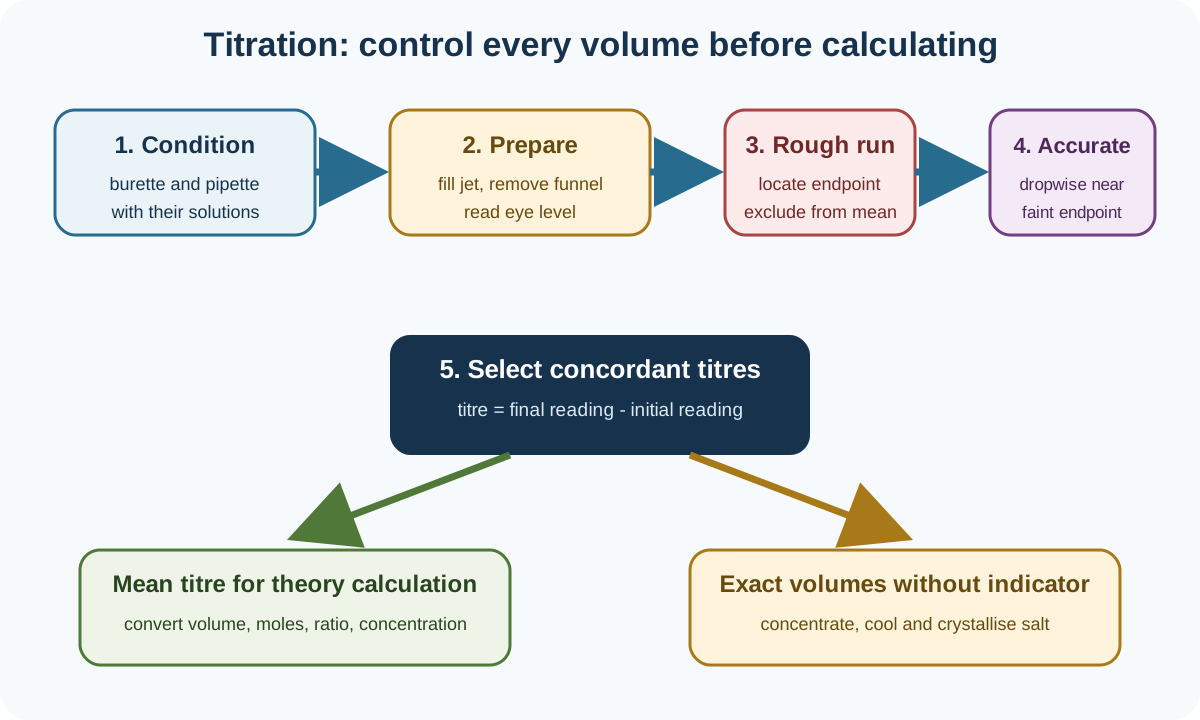
Practical Skill 2 develops the acid-base titration technique shared by Cambridge IGCSE Chemistry Papers 5 and 6. Official section 12.2 requires use of a burette, volumetric pipette and suitable indicator, plus identification of the endpoint. The wider AO3 contract adds precise readings, systematic tables, repeats, evaluation and preparation of a pure soluble salt by titration.
Match each item to its purpose
- A 50 cm³ burette delivers a variable volume and records how much leaves it.
- A volumetric pipette transfers one fixed accurate volume.
- A conical flask permits swirling without easy loss by splashing.
- A suitable indicator gives a visible colour change near the chemical endpoint.
- A white tile makes a faint endpoint colour easier to judge.
- A funnel helps fill the burette but must be removed before readings.
The burette is not used simply because it is tall. Its two readings determine a variable delivered volume. The pipette does not measure an unknown titre because it transfers only its calibrated volume.
Condition and fill apparatus
Rinse the burette with the solution it will contain, then run some through the jet. This prevents residual water from diluting the titrant and fills the jet.
Rinse the pipette with the solution it will transfer. Use a pipette filler, never mouth pipetting.
Rinse the conical flask with distilled water. Extra pure water changes total volume but not the moles delivered by the pipette, so it does not change the neutralising titre.
Clamp the burette vertically. Fill above the zero mark, remove the funnel, run liquid until the meniscus is on scale and check the jet for bubbles. A funnel left in place may release an unmeasured drop after the initial reading.
Read the burette correctly
The burette scale increases downwards. Read the bottom of the concave meniscus at eye level and interpolate to the nearest half of the smallest division.
Record initial and final readings with consistent decimal places. Calculate:
titre = final burette reading - initial burette reading
The initial reading does not need to be 0.00 cm³. A run from 1.20 cm³ to 25.85 cm³ has titre 24.65 cm³.
Record actual readings before subtracting. Writing only a titre removes evidence needed to diagnose transcription or subtraction errors.
Transfer the fixed aliquot
Use the volumetric pipette to transfer the measured solution to the conical flask. Allow it to drain as designed. Do not blow out liquid remaining in a pipette calibrated to leave that film.
Check this topic from memory
Attempt the matching topic bank before reopening the notes. Use each missed idea to decide what to review next.
Start the topic quiz