

IGCSE Chemistry Practical Skills 5: Chromatography
Cambridge IGCSE Chemistry 0620 and 0971 practical notes on paper chromatography, locating agents, chromatogram interpretation, purity and Rf.
Practical Skill 5 develops paper chromatography for Cambridge IGCSE Chemistry Papers 5 and 6. Official section 12.3 requires separation of soluble coloured mixtures, use of a locating agent for colourless substances, comparison with known substances, purity interpretation and calculation of Rf under controlled conditions.
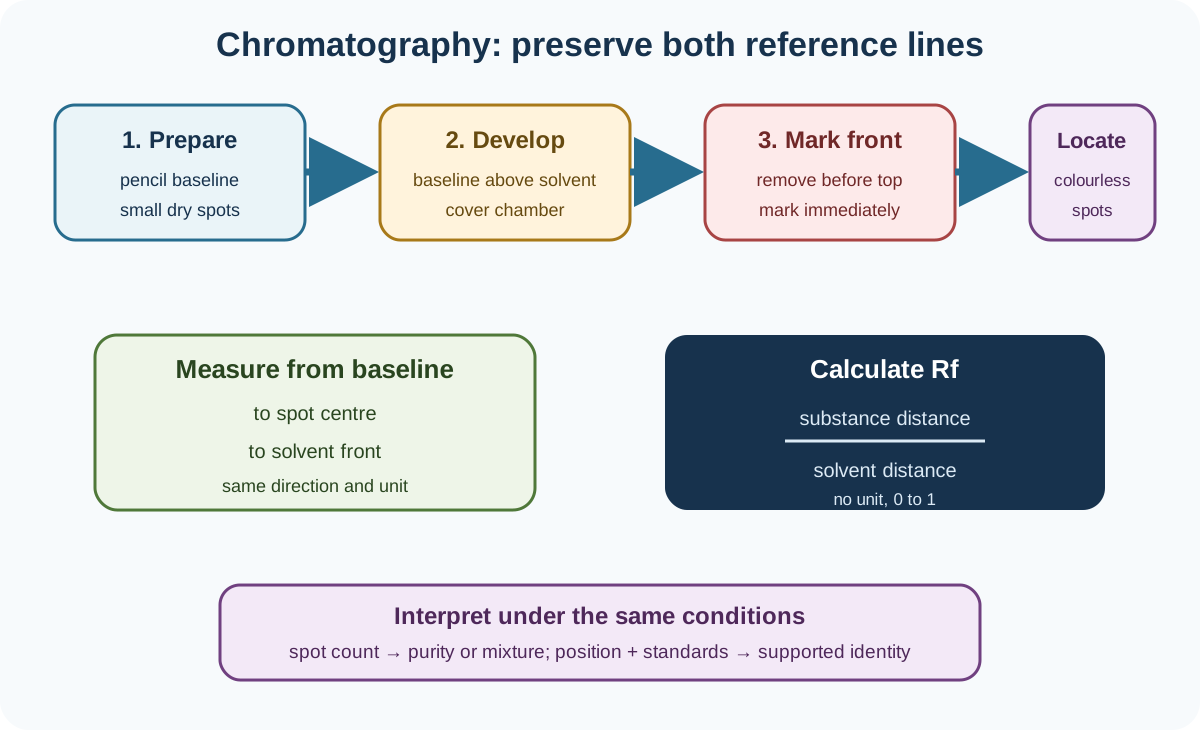
What chromatography separates
Paper chromatography separates components of a soluble mixture because they move differently with a solvent across the paper.
The solvent is the mobile phase. The paper acts as the stationary phase in the school model. A component that is more strongly carried by the solvent relative to its interaction with the paper usually travels farther under the same conditions.
The experiment establishes separation and comparative movement. Do not claim a component moved because it was simply lighter unless evidence is supplied; mass alone is not the required explanation.
Choose a suitable solvent
The mixture components must dissolve sufficiently in the chosen solvent. If they are insoluble, they remain near the baseline and separation fails.
A solvent that carries every component with the front may also give poor separation. Suitability is judged by clear, distinct spots within the paper's travel range.
Use the solvent specified by the question or centre. Do not improvise with an unknown or unsafe liquid.
Prepare the paper
Draw a thin pencil baseline near the bottom of the chromatography paper. Pencil graphite does not dissolve appreciably in the usual solvent, while ink can dissolve and create misleading spots.
Mark sample positions on the line with enough separation to prevent neighbouring spots overlapping. Label in pencil below or beside the positions.
Use a capillary or fine spotting tube to apply a small spot. Allow it to dry, then add another small application at the same point if concentration must be increased. A large wet spot spreads and produces broad or merged bands.
Arrange the development chamber
Place a shallow depth of suitable solvent in the container. The solvent surface must begin below the pencil baseline so the samples do not dissolve directly into the reservoir.
Suspend the paper vertically with its lower edge in the solvent and avoid contact with the container sides where possible. Cover the container to reduce evaporation and maintain a more stable solvent atmosphere.
The baseline is not the solvent front. The baseline remains fixed while the front moves upward.
Develop and mark the chromatogram
Allow the solvent to rise through the paper. Remove the paper before the solvent reaches the top.
Check this topic from memory
Attempt the matching topic bank before reopening the notes. Use each missed idea to decide what to review next.
Start the topic quiz