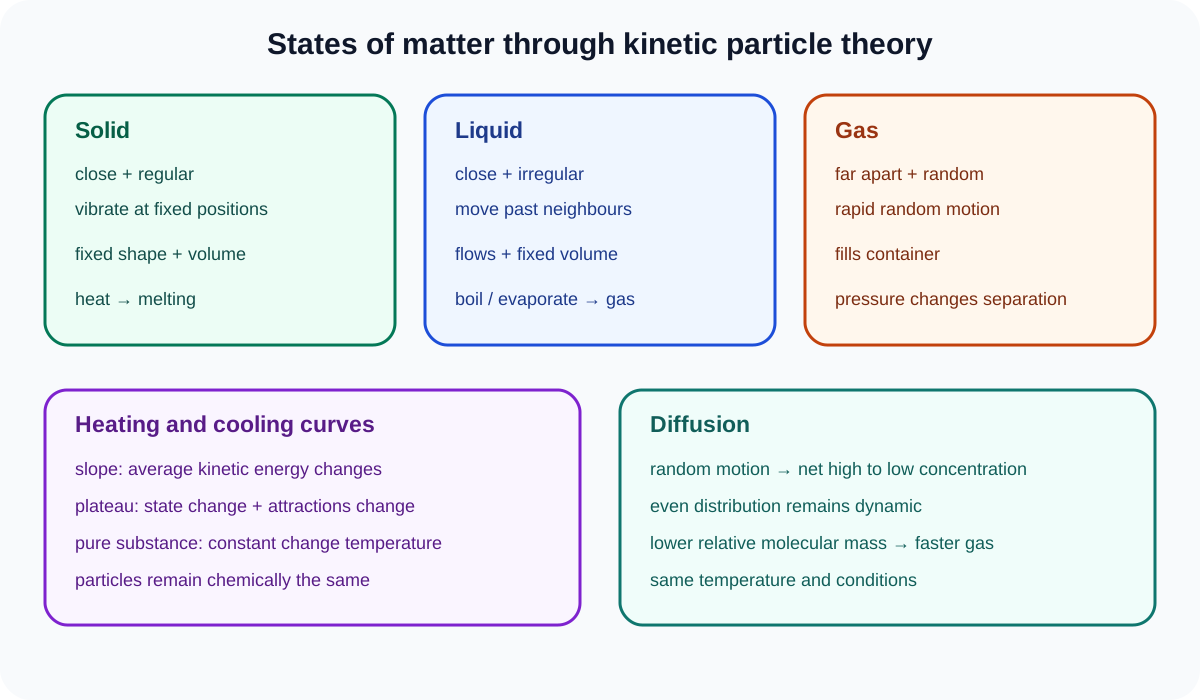
Topic 1 of Cambridge IGCSE Chemistry 0620 and 0971 uses kinetic particle theory to connect observable state properties with particle separation, arrangement and motion. Official sections 1.1 and 1.2 add change-of-state curves, gas-volume responses, diffusion and the effect of relative molecular mass on gas diffusion.
Compare the three states
State
Shape
Volume
Particle separation and arrangement
Particle motion
solid
fixed
fixed
very close in a regular arrangement
vibrate about fixed positions
liquid
takes container shape
fixed
close together in an irregular arrangement
move and slide past one another
gas
fills container
not fixed
far apart with no regular arrangement
move rapidly and randomly
Check this topic from memory
Attempt the matching topic bank before reopening the notes. Use each missed idea to decide what to review next.
A solid keeps its shape because its particles occupy fixed positions within an ordered structure, although they vibrate. A liquid flows because close particles can change neighbours and move past one another. A gas fills its container because widely separated particles move freely throughout the available space.
The particles themselves do not expand when heated. Their average kinetic energy and, depending on state and conditions, their average separation change.
Melting and freezing
Melting changes a solid to a liquid. Heating transfers energy to the substance. Particles vibrate more strongly until they can overcome enough attractive forces to leave fixed positions and move around each other.
Freezing changes a liquid to a solid. Energy transfers from the substance to the surroundings. Particle movement decreases and an ordered arrangement forms as attractive forces hold particles in fixed positions.
Both are physical changes. The chemical identity and particle type remain the same.
For a pure substance at fixed pressure, melting and freezing occur at the same characteristic temperature. A measured melting range can provide evidence about purity, but detailed purification belongs to experimental techniques.
Boiling, evaporation and condensation
Boiling changes liquid to gas throughout the liquid at its boiling point. Bubbles of vapour form within the liquid when particles have enough energy to overcome attractive forces.
Evaporation changes liquid to gas at the surface and can occur below the boiling point. Higher-energy surface particles escape. Because the remaining particles have a lower average kinetic energy, evaporation can cool the liquid.
Condensation changes gas to liquid. Gas particles lose kinetic energy, move more slowly and become close enough for attractions to hold them in the liquid state.
Do not treat boiling and evaporation as synonyms. Their location and temperature conditions differ.
Use kinetic particle theory for changes of state
Kinetic particle theory explains matter through moving particles and their energy. Heating usually increases average particle kinetic energy, shown by temperature rise. During a change of state, supplied energy is used to overcome attractive forces rather than increase average kinetic energy.
Cooling reverses the energy transfers. As energy leaves, particle kinetic energy decreases between changes of state. During condensation or freezing, energy is transferred while particles form stronger attractions and a more ordered or closely associated state.
State changes do not break the covalent bonds within molecules. The syllabus explanation concerns forces between particles unless the substance is described differently.
Interpret a heating curve
A heating curve plots temperature against time or energy supplied.
On a sloping solid section, particle vibration and average kinetic energy increase, so temperature rises. At the melting plateau, solid and liquid coexist. Energy continues entering, but it overcomes attractive forces, so temperature remains constant for a pure substance.
On the liquid slope, particles move faster and temperature rises. At the boiling plateau, liquid and gas coexist while energy separates particles into the gas state. The final gas slope shows rising particle kinetic energy.
A longer plateau under constant heating power indicates more energy is required for that state change, but it does not by itself identify the substance without further evidence.
Interpret a cooling curve
On sloping gas or liquid sections, average kinetic energy falls and temperature decreases. During condensation and freezing plateaux, state changes occur at constant temperature for a pure substance while energy transfers to the surroundings.
Cooling curves may show supercooling in experimental data, where temperature briefly falls below the freezing point before crystallisation begins. Interpret the supplied graph rather than forcing an ideal shape.
The horizontal axis might be time, and a constant rate of heat transfer is an assumption. If heating or cooling power varies, curve length does not translate directly into energy.
Explain temperature effects on gas volume
For a fixed amount of gas at constant pressure, heating increases average kinetic energy. Particles move faster and collide with container walls more frequently and forcefully. If the boundary can move, the gas expands until pressure balances the surroundings.
Cooling has the opposite effect: lower particle kinetic energy allows the gas volume to decrease at constant pressure.
Always state what is held constant. Heating a gas in a rigid sealed container cannot increase its container volume; pressure increases instead. The official outcome asks for effects of temperature and pressure on gas volume, so the apparatus context determines the response.
Explain pressure effects on gas volume
For a fixed amount of gas at constant temperature, increasing external pressure compresses the gas. Particles occupy a smaller volume and collide with the walls more frequently per unit area.
Reducing pressure allows the gas to expand. Gas particles are far apart, so there is substantial empty space to reduce during compression. Liquids and solids are much less compressible because their particles are already close together.
Do not say gas particles are squashed smaller. Their separation decreases.
Define and explain diffusion
Diffusion is the net movement of particles from a region of higher concentration to a region of lower concentration as a result of random particle motion.
Particles move randomly in all directions. More particles leave the high-concentration region than enter it, creating a net movement down the concentration gradient. Movement continues after an even distribution is reached, but there is no net concentration change.
Diffusion occurs in gases and liquids because particles can move. It is much slower in solids because particles occupy fixed positions.
Higher temperature usually increases diffusion rate because particles have greater average kinetic energy and move faster.
Compare gas diffusion by relative molecular mass
Under the same conditions, gas particles with lower relative molecular mass move faster on average and diffuse more rapidly than particles with higher relative molecular mass.
In the ammonia and hydrogen chloride experiment, ammonia has relative molecular mass 17 and hydrogen chloride about 36.5. Ammonia therefore diffuses farther in the same time. The white ammonium chloride ring forms closer to the hydrogen chloride end.
The gases do not attract the ring to one side. Its position results from unequal diffusion rates before the gases react.
Cambridge requires description and explanation of the relative-molecular-mass effect, not a quantitative diffusion-law calculation.
Connect macroscopic and particle evidence
State descriptions should join observation to particle cause. "A gas is compressible" is an observation. "Its particles are far apart, so pressure can reduce their separation" supplies the explanation.
For state changes, name energy transfer, particle kinetic energy or attractive forces and the resulting arrangement or motion. For diffusion, name random motion and concentration difference.
Avoid vague claims that particles "want" to spread or that cold particles stop moving.
Worked application: read a heating and diffusion scenario
A pure substance warms from -10 °C to 20 °C, remains at 20 °C for four minutes, then warms again. The plateau is melting: solid and liquid coexist while incoming energy overcomes attractive forces, so average kinetic energy and temperature remain constant. In a separate gas tube, substance X with relative molecular mass 16 forms a reaction ring nearer substance Y with relative molecular mass 64. X diffuses faster and travels farther because its lighter particles move faster on average under the same conditions. The ring location is evidence of unequal rates, not particles moving deliberately towards a reaction point.
Common misconceptions and corrections
Saying solid particles do not move. They vibrate about fixed positions.
Drawing liquid particles far apart. They remain close but irregular.
Drawing gas particles only at the container top. They fill the available volume.
Saying particles expand when heated. Motion and separation change.
Calling melting a chemical reaction. Particle identity remains unchanged.
Saying freezing creates new atoms. It changes arrangement and motion.
Calling evaporation boiling. Evaporation occurs at the surface below boiling point.
Saying boiling occurs only at the surface. Bubbles form throughout the liquid.
Saying condensation gains energy. The substance transfers energy out.
Saying temperature rises throughout a melting plateau. Energy overcomes attractions.
Saying particles stop at a plateau. Their arrangement changes while average kinetic energy remains constant.
Calling a plateau zero energy transfer. Energy continues transferring.
Breaking molecular covalent bonds during boiling. State change separates particles.
Assuming every experimental curve is perfectly flat. Interpret the evidence supplied.
Saying a longer time always means larger energy without constant power. Heating rate matters.
Heating a rigid gas and predicting larger container volume. Pressure rises if volume cannot change.
Compressing gas by shrinking particles. Their separation decreases.
Saying liquids compress like gases. Their particles are already close.
Defining diffusion as all random movement. It is net movement down a concentration gradient.
Saying particles deliberately move to empty space. Random motion creates the net effect.
Saying diffusion stops at even concentration. Random movement continues with no net change.
Using molecular mass without holding conditions constant. The comparison assumes the same conditions.
Saying ammonia is drawn towards hydrogen chloride. Unequal diffusion determines meeting position.
Giving a quantitative diffusion law as required. The syllabus requires qualitative description and explanation.
Assessment guidance
Particle explanations should name separation, arrangement and motion rather than repeat state properties. On curves, separate sloping regions where kinetic energy changes from plateaux where energy overcomes or forms attractions. State fixed amount, pressure, temperature or movable boundary when explaining gas volume. Define diffusion as net movement caused by random motion down a concentration gradient and explain that dynamic motion continues at even distribution. Relative-molecular-mass questions need a direct comparison: the lower-mass gas moves faster, diffuses farther in the same time and places a reaction ring nearer the heavier gas source.
Retrieval practice
Draw particle diagrams for all three states and narrate every change-of-state arrow. Label an unfamiliar heating and cooling curve with phases, energy transfer and particle changes. Explain gas compression and expansion under stated constraints. Reconstruct the ammonia-hydrogen-chloride comparison from relative molecular masses and predict ring position without using purposeful-particle language.
Theory and practical ownership
This theory note owns particle models, state-change mechanisms, curve interpretation, gas-volume reasoning and diffusion explanations. The Chemistry practical hub owns apparatus, temperature-time measurements, cooling-curve procedure, gas-diffusion setup, hazard control, tables, graphs and evaluation.