

Cambridge IGCSE Chemistry Notes 3: Stoichiometry
Cambridge IGCSE Chemistry 0620 and 0971 notes on formulae, equations, relative mass, moles, concentration, gas volume, titration, yield and purity.
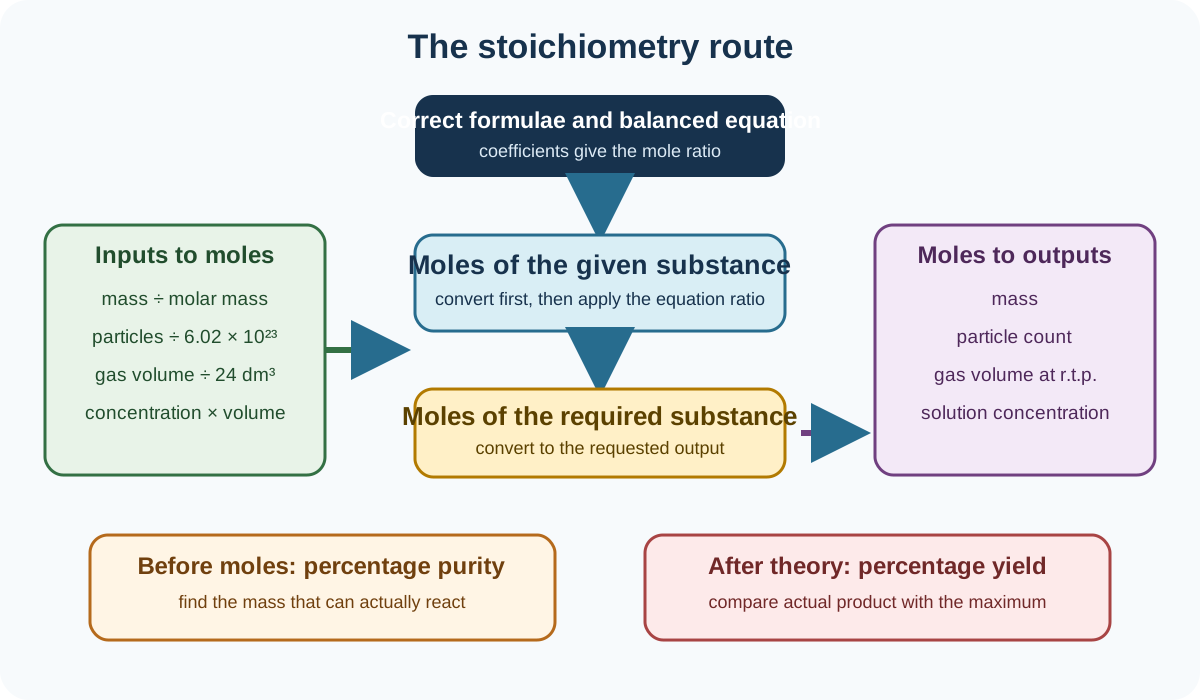
Topic 3 of Cambridge IGCSE Chemistry 0620 and 0971 turns chemical symbols into quantitative predictions. Official sections 3.1 to 3.3 move from formulae and balanced equations to relative mass, moles, particles, gases, solutions, titration and percentage calculations. The central discipline is to convert the given quantity to moles before applying an equation ratio.
Formulae name particles and proportions
A molecular formula gives the number and type of each atom in one molecule. For example, one molecule of ethene, C₂H₄, contains two carbon atoms and four hydrogen atoms.
An empirical formula gives the simplest whole-number ratio of the different atoms or ions in a compound. The molecular formula C₂H₄ therefore has empirical formula CH₂.
Ionic compounds form giant lattices rather than molecules. Their formula gives the simplest charge-balanced ratio of ions. Magnesium ions are Mg²⁺ and chloride ions are Cl⁻, so magnesium chloride is MgCl₂. Total positive and negative charge must cancel.
A model can also reveal a formula. Count the represented particles, reduce the ratio if the question asks for an empirical formula, and distinguish a finite molecule from a repeating lattice.
Write chemical equations
A word equation names reactants and products. A symbol equation replaces names with correct formulae. Balance a symbol equation by changing coefficients only. Never alter a formula to make atom counts match because that changes the substance.
For magnesium burning:
magnesium + oxygen → magnesium oxide
2Mg(s) + O₂(g) → 2MgO(s)
State symbols are (s), (l), (g) and (aq). They describe physical state or aqueous solution under the reaction conditions.
An ionic equation removes spectator ions that remain unchanged. For precipitation of silver chloride:
Ag⁺(aq) + Cl⁻(aq) → AgCl(s)
Check both atom count and total charge. A valid ionic equation balances each.
Relative atomic, molecular and formula mass
Relative atomic mass, Ar, is the average mass of the isotopes of an element compared with one twelfth of the mass of a carbon-12 atom.
Relative molecular mass, Mr, is the sum of the relative atomic masses in a molecule. The same symbol is used for relative formula mass of an ionic compound.
For CaCO₃, using Ca = 40, C = 12 and O = 16:
Mr = 40 + 12 + (3 × 16) = 100
Ar and Mr are relative values without units. Molar mass is the mass of one mole and is written in g/mol. It has the same numerical value as the relevant Ar or Mr.
Check this topic from memory
Attempt the matching topic bank before reopening the notes. Use each missed idea to decide what to review next.
Start the topic quiz