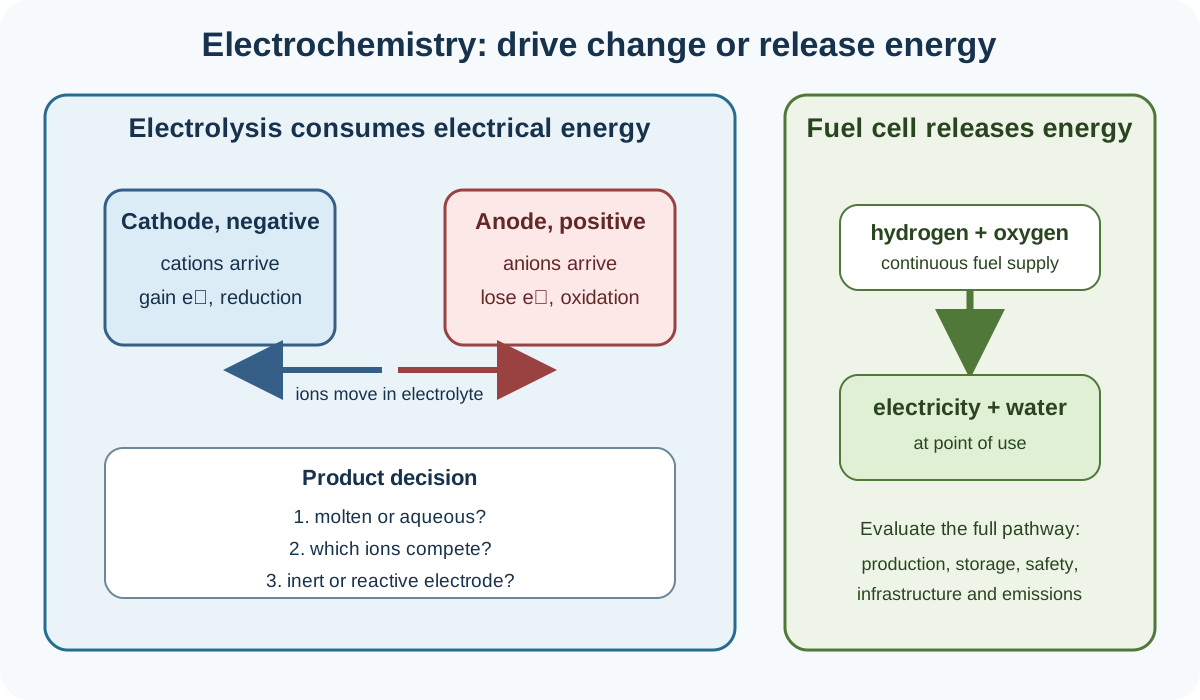
Topic 4 of Cambridge IGCSE Chemistry 0620 and 0971 explains how electrical energy drives non-spontaneous chemical change and how a hydrogen-oxygen fuel cell produces electrical energy. Official sections 4.1 and 4.2 require confident electrode identification, ion movement, product prediction, half-equations, electroplating and a balanced evaluation of vehicle fuel cells.
Electrolysis and the electrolytic cell
Electrolysis is the decomposition of an ionic compound, when molten or in aqueous solution, by passage of an electric current.
The electrolyte is the molten or aqueous substance that undergoes electrolysis. It must contain mobile ions. A solid ionic compound does not conduct because its ions are fixed in a lattice.
In an electrolytic cell:
the anode is the positive electrode
the cathode is the negative electrode
cations move through the electrolyte to the cathode
anions move through the electrolyte to the anode
The external power supply pushes electrons towards the cathode and draws electrons away from the anode.
Charge transfer at the electrodes
Reduction is gain of electrons. It occurs at the cathode. Oxidation is loss of electrons. It occurs at the anode.
A cation reaches the cathode and gains electrons. An anion reaches the anode and loses electrons. Half-equations show this transfer while conserving atoms and charge.
For copper deposition:
Cu²⁺(aq) + 2e⁻ → Cu(s)
For chlorine formation:
2Cl⁻(aq) → Cl₂(g) + 2e⁻
Electrons travel in the wires and electrodes. Ions move in the electrolyte. Electrons do not cross an aqueous solution as the charge carriers in this model.
Predict products from a molten binary compound
A molten binary ionic compound contains only its positive and negative ions. The positive ion forms its element at the cathode and the negative ion forms its element at the anode.
Molten lead(II) bromide contains Pb²⁺ and Br⁻:
cathode: Pb²⁺ + 2e⁻ → Pb
anode: 2Br⁻ → Br₂ + 2e⁻
The observations are grey molten lead at the cathode and orange-brown bromine vapour at the anode. Water is absent, so hydrogen and oxygen are not competing products.
Named aqueous electrolysis: concentrated sodium chloride
Concentrated aqueous sodium chloride contains Na⁺, Cl⁻ and ions associated with water.
Check this topic from memory
Attempt the matching topic bank before reopening the notes. Use each missed idea to decide what to review next.
Hydrogen forms at the cathode rather than sodium because sodium is much more reactive than hydrogen. Chlorine forms at the anode because chloride is present at high concentration.
Expected observations include colourless bubbles at the cathode and pale green chlorine at the anode. Chlorine has a choking smell, but gas must not be deliberately inhaled.
The remaining solution becomes alkaline as sodium and hydroxide ions remain, giving sodium hydroxide solution overall.
Named aqueous electrolysis: dilute sulfuric acid
Dilute sulfuric acid provides an aqueous conducting medium. Hydrogen forms at the cathode and oxygen forms at the anode.
Cathode reduction can be represented as:
2H⁺(aq) + 2e⁻ → H₂(g)
Anode oxidation can be represented as:
4OH⁻(aq) → O₂(g) + 2H₂O(l) + 4e⁻
Twice as much hydrogen as oxygen is formed by volume under the same conditions, consistent with the overall decomposition of water.
Predict products in aqueous halides
For an aqueous electrolyte, identify all ions before predicting discharge.
At the cathode, a metal less reactive than hydrogen can be deposited. If the relevant metal is more reactive than hydrogen, hydrogen generally forms instead in the syllabus model.
At the anode, concentrated chloride, bromide or iodide solutions form the halogen. In a dilute halide solution, oxygen may form instead. The question therefore may make concentration decisive.
Always connect the rule to the named ions. A memorised product without identifying the competing species does not show the prediction route.
Copper(II) sulfate with inert electrodes
In aqueous copper(II) sulfate with inert graphite or platinum electrodes, copper forms at the cathode and oxygen forms at the anode.
At the cathode, copper ions gain electrons:
Cu²⁺(aq) + 2e⁻ → Cu(s)
A pink-brown copper coating appears and the cathode gains mass. At the anode, colourless oxygen bubbles form. As Cu²⁺ ions are removed without replacement, the blue solution becomes paler.
An inert electrode conducts but does not intentionally supply ions to the electrolyte.
Copper(II) sulfate with copper electrodes
Changing the electrodes changes the chemistry. With copper electrodes, copper still deposits at the cathode:
Cu²⁺(aq) + 2e⁻ → Cu(s)
The copper anode dissolves:
Cu(s) → Cu²⁺(aq) + 2e⁻
Copper ions removed at the cathode are replaced at the anode. Under ideal conditions, the blue colour remains approximately constant, cathode mass increases and anode mass decreases.
This comparison shows why electrode material must be checked before applying an aqueous-product rule.
Electroplating
Electroplating covers an object with a thin layer of metal to improve appearance or resistance to corrosion.
The object to be plated is the cathode. The electrolyte contains ions of the coating metal. A soluble anode made from the coating metal can replace ions deposited from solution.
For copper plating, the object receives electrons and attracts Cu²⁺ ions, which form copper metal on its surface. Cleaning the surface promotes an even, adherent coating. Current and time influence how much metal is deposited, but the practical design and safety details belong in the practical hub.
Do not make the object the anode. Oxidation there would tend to remove material rather than plate it.
Hydrogen-oxygen fuel cells
A hydrogen-oxygen fuel cell uses hydrogen and oxygen to produce electricity, with water as the only chemical product at the point of use.
The overall chemical equation is:
2H₂(g) + O₂(g) → 2H₂O(l)
A fuel cell is not the same as electrolysis. Electrolysis consumes electrical energy to drive decomposition. A fuel cell releases electrical energy from a chemical reaction while reactants continue to be supplied.
Evaluate fuel cells for vehicles
Advantages compared with gasoline or petrol engines include water as the only chemical product at the vehicle, no carbon dioxide from the vehicle exhaust, high usefulness where local air pollution matters, and continuous operation while fuel is supplied.
Disadvantages include energy and emissions associated with producing hydrogen, especially if fossil fuels provide the source energy; difficult storage because hydrogen has low density and may require high pressure or low temperature; transport and refuelling infrastructure; flammability; and cost of cells or catalysts.
The environmental conclusion depends on the full energy pathway. Hydrogen made using renewable electricity can have a different overall carbon impact from hydrogen made from fossil fuels. Saying only that the exhaust contains water is therefore incomplete.
Worked application: changing one part changes the products
An aqueous copper(II) sulfate cell first uses graphite electrodes. Copper deposits at the cathode through Cu²⁺ + 2e⁻ → Cu, oxygen forms at the anode and the blue solution fades because Cu²⁺ is removed. The graphite anode is inert. It is then replaced with copper while the cathode remains copper. The cathode reaction stays the same, but the anode now follows Cu → Cu²⁺ + 2e⁻. Copper ions are replenished, so solution colour remains approximately constant. The comparison proves that aqueous product prediction requires ion inventory and electrode identity, not electrolyte name alone.
Common misconceptions and corrections
Calling electrolysis conduction without decomposition. Chemical change occurs at electrodes.
Saying a solid ionic compound conducts. Its ions are not mobile.
Calling the anode negative in electrolysis. It is connected to the positive terminal.
Calling the cathode positive in electrolysis. It is connected to the negative terminal.
Sending anions to the cathode. Negative ions move to the positive anode.
Saying oxidation occurs at the cathode. Reduction occurs there.
Saying electrons move through the electrolyte. Ions carry charge in it.
Writing electrons on the wrong side of a half-equation. Gain places electrons on the left; loss places them on the right.
Balancing atoms but not charge. A half-equation must conserve both.
Predicting hydrogen from molten lead bromide. No water is present.
Predicting sodium from aqueous sodium chloride. Hydrogen forms at the cathode.
Predicting oxygen from concentrated brine. Chlorine forms at the anode.
Using the concentrated-halide rule without checking concentration. Dilution can change the anode product.
Calling graphite a source of ions. It is inert in the named setup.
Predicting sulfate at the anode as a product. Oxygen forms in the named inert-electrode case.
Saying copper electrodes behave like graphite. A copper anode dissolves.
Expecting copper sulfate to fade with two copper electrodes. Cu²⁺ is replenished ideally.
Placing the object to be plated at the anode. It must be the cathode.
Using pure water as the copper-plating electrolyte. The solution must contain coating-metal ions.
Saying plating makes the whole object from the coating metal. It adds a thin surface layer.
Calling a fuel cell rechargeable electrolysis. Reactants are supplied and chemically react.
Saying fuel cells produce no water. Water is the chemical product.
Claiming hydrogen is automatically carbon-free. Production route matters.
Ignoring hydrogen storage and infrastructure. These are central disadvantages.
Assessment guidance
Start every electrolysis prediction by listing ions and stating whether the electrolyte is molten or aqueous. Identify the electrode material before choosing products. Then name the species discharged, state oxidation or reduction, write a charge-balanced half-equation and give the expected observation. For comparative questions, hold the electrolyte constant and explain what the changed electrode alters. Electroplating answers must identify the object as cathode and the coating-metal ions in solution. Fuel-cell evaluations should separate vehicle emissions from whole-pathway impacts, present linked advantages and disadvantages, and finish with a conclusion conditional on hydrogen production, storage and infrastructure rather than an absolute claim.
Retrieval practice
Label an electrolytic cell from memory and trace electrons and ions separately. Predict products and observations for molten lead(II) bromide, concentrated sodium chloride, dilute sulfuric acid and copper(II) sulfate with each electrode type. Write six half-equations and check charge. Design a copper-plating cell in words. Finally, compare a hydrogen-oxygen fuel-cell vehicle with a petrol vehicle at the exhaust, fuel-production and infrastructure stages.
Theory and practical ownership
This theory note owns ion movement, electrode reactions, product prediction, half-equations, electroplating principles and fuel-cell evaluation. The Chemistry practical hub owns apparatus assembly, electrode cleaning, gas tests, current control, observations, hazards, measurement and evaluation.