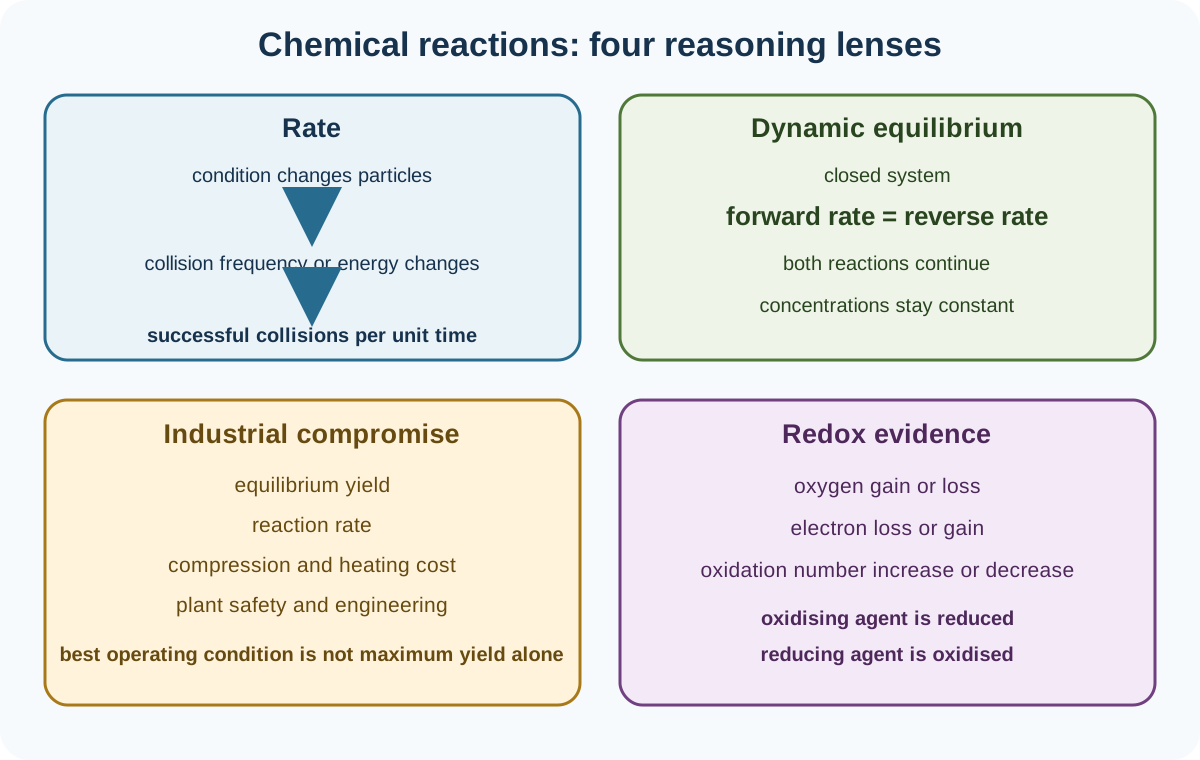
Topic 6 of Cambridge IGCSE Chemistry 0620 and 0971 connects observable change to collision theory, dynamic equilibrium and redox. Official sections 6.1 to 6.4 require rate methods and graphs, reversible hydration, industrial equilibrium choices, three redox models, oxidation numbers, colour evidence and oxidising or reducing agents.
Physical and chemical changes
A physical change does not form a new substance. State, shape or arrangement may change, and the process is often reversible by a physical method. Melting ice is physical because the substance remains water.
A chemical change forms one or more new substances. Evidence may include a persistent colour change, gas formation, precipitate, light or temperature change, but evidence must be interpreted in context. Boiling also forms bubbles, yet it is physical.
Reversibility alone is not a perfect definition. Some physical changes are difficult to reverse and some chemical reactions are reversible. The decisive question is whether chemical composition changes.
Rate of reaction
Rate describes how quickly reactants are used or products are formed. It can be represented as change in a measured quantity divided by time.
Common measurements include loss of mass when gas escapes, increase in gas volume, decrease in reactant concentration, increase in product concentration, or time to a visible endpoint.
On a product-against-time graph, gradient gives rate. A steeper gradient means faster reaction. The curve becomes horizontal when no further measured product forms. For the same limiting reactant, different rates can reach the same final quantity.
An initial rate is found from a tangent at time zero. An average rate over an interval uses change in quantity divided by change in time.
Collision theory
Particles must collide to react, and a successful collision must have energy at least equal to the activation energy, Ea, with a suitable collision arrangement.
Collision theory explanations should identify which of these changes:
number of particles per unit volume
frequency of collisions
kinetic energy distribution
fraction of collisions reaching Ea
activation energy itself
Avoid saying simply that particles collide more. Explain why the tested condition changes successful collisions per unit time.
Concentration and gas pressure
Increasing solution concentration places more reactant particles in each unit volume. Collision frequency rises, so successful collisions occur more often and rate increases.
Check this topic from memory
Attempt the matching topic bank before reopening the notes. Use each missed idea to decide what to review next.
Increasing pressure of reacting gases compresses particles into a smaller volume. The number per unit volume and collision frequency increase, so rate increases.
Neither explanation requires particles to move faster. At constant temperature their kinetic-energy distribution is not raised merely by concentration or pressure.
Surface area
For a solid reactant, smaller pieces or powder expose a greater total surface area for the same mass. More solid particles are available for collisions at the boundary, increasing successful collisions per unit time.
The number of solid particles in the sample has not necessarily increased. Their exposure has. Final product remains controlled by reactant amount, not surface area, when all other amounts are unchanged.
Temperature
Increasing temperature raises particles' average kinetic energy. They move faster, collide more frequently and, more importantly, a greater fraction of collisions has energy at least equal to Ea. Rate increases.
A complete explanation names both collision frequency and the increased successful fraction. Temperature does not lower Ea.
Catalysts and enzymes
A catalyst increases reaction rate and is unchanged at the end. It provides an alternative pathway with lower activation energy, so a larger fraction of collisions is successful at the same temperature.
Enzymes are biological catalysts. They can be affected by temperature and pH, but detailed biological enzyme models are not required in this Chemistry section unless supplied by the question.
A catalyst does not change ΔH, equilibrium position or equilibrium composition. In a reversible reaction it speeds forward and reverse reactions, so equilibrium is reached sooner.
Investigate reaction rate
Mass-loss and gas-volume methods are explicitly required contexts.
A mass-loss setup places a reacting flask on a balance while gas escapes through a cotton-wool plug. It can collect frequent readings without gas-pressure buildup, but is unsuitable when mass change is too small or hazardous gas would escape.
A gas-volume setup uses a gas syringe or displacement where appropriate. It measures gas directly but must be airtight, have suitable capacity and avoid dissolution or reaction of the gas with a collection liquid.
Evaluation should connect a limitation to its effect and a targeted improvement. A leaking bung loses gas before measurement, making recorded volume too low; checking seals before mixing addresses that mechanism. Practical ownership, hazards and variable control sit in the dedicated practical note.
Reversible reactions
Some chemical reactions proceed in both directions and use the symbol ⇌.
Heating hydrated copper(II) sulfate removes water and changes blue hydrated crystals to white anhydrous copper(II) sulfate. Adding water reverses the change and restores blue.
Hydrated cobalt(II) chloride is pink, while anhydrous cobalt(II) chloride is blue. Heating favours dehydration; adding water favours hydration.
Describe the direction from the condition applied rather than calling one colour permanently the reactant.
Dynamic equilibrium
In a closed system, a reversible reaction is at equilibrium when forward and reverse rates are equal and reactant and product concentrations no longer change.
Both reactions continue. Equal rates do not mean equal concentrations. Constant macroscopic composition results because each direction changes substances at the same rate.
An open system can lose substances, preventing the stated equilibrium condition from being maintained.
Change equilibrium position
When a condition changes, the equilibrium position shifts in the direction that opposes that change.
Increasing a reactant concentration favours the direction that uses that reactant. Removing a product favours the direction that replaces it.
Increasing pressure favours the side with fewer moles of gas. Decreasing pressure favours the side with more gas moles. If gaseous mole totals are equal, pressure does not favour either side.
Increasing temperature favours the endothermic direction because it absorbs added thermal energy. Decreasing temperature favours the exothermic direction.
A catalyst does not shift equilibrium. It lowers activation energy for both directions and allows equilibrium to be reached faster.
Haber process
The Haber equilibrium is:
N₂(g) + 3H₂(g) ⇌ 2NH₃(g)
Nitrogen comes from air. Hydrogen comes from methane. Typical conditions are 450 °C, 20,000 kPa or 200 atm, and an iron catalyst.
The forward reaction is exothermic and changes four gas moles to two. Lower temperature would improve equilibrium yield but make rate too slow, so 450 °C is a compromise. Higher pressure improves yield and rate but raises compression cost, plant strength requirements and safety risk, so 200 atm is an economic and engineering compromise. Iron increases rate without changing equilibrium yield.
Ammonia can be removed and unreacted gases recycled, allowing continuous production despite incomplete conversion per pass.
Contact process equilibrium
The sulfur trioxide equilibrium is:
2SO₂(g) + O₂(g) ⇌ 2SO₃(g)
Sulfur dioxide comes from burning sulfur or roasting sulfide ores. Oxygen comes from air. Typical conditions are 450 °C, 200 kPa or 2 atm, and vanadium(V) oxide catalyst.
The forward reaction is exothermic and changes three gas moles to two. Lower temperature favours sulfur trioxide but slows rate, so 450 °C is a compromise. Higher pressure would favour product, but the yield is already satisfactory at modest pressure and further compression costs may not justify the gain. The catalyst improves rate without shifting equilibrium.
Industrial explanations should combine rate, equilibrium, safety and economics rather than claiming that the highest yield condition is automatically best.
Redox through oxygen transfer
A redox reaction involves simultaneous oxidation and reduction.
At Core level, oxidation is gain of oxygen and reduction is loss of oxygen. In CuO + H₂ → Cu + H₂O, hydrogen gains oxygen and is oxidised, while copper(II) oxide loses oxygen and is reduced.
The oxidising agent causes another substance to be oxidised and is itself reduced. CuO is the oxidising agent here. The reducing agent causes another substance to be reduced and is itself oxidised. H₂ is the reducing agent.
Redox through electron transfer
Oxidation is loss of electrons and reduction is gain of electrons.
For Zn + Cu²⁺ → Zn²⁺ + Cu:
Zn → Zn²⁺ + 2e⁻, so zinc is oxidised and is the reducing agent
Cu²⁺ + 2e⁻ → Cu, so copper ions are reduced and are the oxidising agent
Electrons lost and gained must balance. Oxidation and reduction therefore occur together.
Oxidation numbers
Oxidation is an increase in oxidation number; reduction is a decrease.
Use these official rules:
an element in its uncombined state has oxidation number 0
a monatomic ion has oxidation number equal to its charge
oxidation numbers in a neutral compound sum to 0
oxidation numbers in a polyatomic ion sum to the ion charge
In SO₂, oxygen is -2, so sulfur is +4 because S + 2(-2) = 0. In SO₄²⁻, sulfur is +6 because S + 4(-2) = -2.
Roman numerals in names communicate oxidation number. Iron(III) oxide contains iron at +3; they do not state the number of iron atoms.
Redox colour evidence
Acidified aqueous potassium manganate(VII) is purple and becomes colourless when its manganate(VII) ions are reduced under the expected test conditions.
Aqueous potassium iodide can act as a reducing agent. Oxidation of iodide to iodine produces a brown colour in aqueous conditions.
Use the observed before-and-after colours supplied by the question to identify which species changed, then connect that change to electron or oxidation-number evidence. Do not treat colour alone as a universal proof without context.
Worked application: equilibrium and redox in one reasoning style
For the Contact equilibrium 2SO₂ + O₂ ⇌ 2SO₃, increasing pressure shifts the position right because three gas moles become two, but industry uses only 200 kPa because extra compression cost and engineering risk may outweigh the added yield. A vanadium(V) oxide catalyst improves rate but not equilibrium composition. Separately, oxidation of SO₂ to SO₃ raises sulfur from +4 to +6, so sulfur is oxidised. If another species supplies oxygen and is reduced, that species is the oxidising agent. Both questions require a direction, chemical evidence and consequence rather than a memorised label.
Common misconceptions and corrections
Calling every colour change chemical. Interpret whether a new substance forms.
Using bubbles alone as proof of reaction. Boiling is physical.
Reading graph height as rate. Gradient represents rate.
Saying a flat product graph means equilibrium. It may mean completion.
Explaining concentration by faster particles. It raises particles per unit volume.
Explaining pressure by higher kinetic energy. Compression raises gas particle density.
Saying powder contains more reactant. Equal mass exposes more surface.
Saying temperature lowers Ea. It raises kinetic energy and successful fraction.
Saying a catalyst is used up. It is unchanged at the end.
Saying a catalyst changes ΔH. It changes the pathway, not energy levels.
Saying a catalyst shifts equilibrium. It speeds both directions.
Ignoring gas leaks in a volume method. Leaks give systematically low readings.
Calling a reversible arrow two separate equations. It represents both directions.
Saying equilibrium reactions stop. Both directions continue.
Equating forward and reverse concentrations. Rates are equal, not amounts.
Ignoring the closed-system condition. It is required for dynamic equilibrium.
Saying pressure always favours products. It favours fewer gas moles.
Counting solids and liquids in a gas-mole comparison. Compare gaseous coefficients.
Saying heating always favours products. It favours the endothermic direction.
Claiming the Haber process uses room temperature for yield. Rate would be too slow.
Calling 200 atm the Contact-process pressure. The stated value is 2 atm.
Saying a catalyst increases equilibrium yield. It shortens time to equilibrium.
Ignoring safety and cost in industrial conditions. Both are assessed considerations.
Defining redox as oxidation only. Oxidation and reduction are simultaneous.
Calling oxygen loss oxidation. Oxygen loss is reduction.
Saying electron gain is oxidation. It is reduction.
Calling an oxidising agent oxidised. It is itself reduced.
Calling a reducing agent reduced. It is itself oxidised.
Giving an uncombined element its ion charge. Its oxidation number is zero.
Forcing oxidation numbers in an ion to sum to zero. They sum to ion charge.
Reading a Roman numeral as atom count. It gives oxidation number.
Calling any purple solution potassium manganate(VII). Use the stated reagent context.
Assessment guidance
For rate explanations, name the changed particle quantity, link it to collision frequency or the fraction reaching Ea, and finish with successful collisions per unit time. Interpret graphs with gradients and plateaus separately. Equilibrium answers should state the direction, use heat, concentration or gaseous-mole evidence, and distinguish yield from rate. Industrial answers need the actual equation, sources, conditions and compromise among equilibrium, rate, safety and economics. For redox, show the oxygen, electron or oxidation-number change for both partners, then identify agents by what they cause and what happens to them. Colour-test answers should record the observed transition before drawing a redox conclusion.
Retrieval practice
Classify ten physical or chemical changes. Sketch product-time curves for five rate changes and explain each with collision theory. Evaluate both named rate methods. Predict equilibrium shifts from temperature, pressure, concentration and catalyst changes. Reconstruct Haber and Contact equations, sources, conditions and compromises. Assign oxidation numbers in ten species, split three equations into electron changes, identify both agents and interpret the two named colour-test contexts.
Theory and practical ownership
This theory note owns rate mechanisms, graph interpretation, equilibrium predictions, industrial compromises, redox definitions, oxidation numbers and agent identification. The Chemistry practical hub owns apparatus, timing, gas collection, mass measurement, variable control, hazards, observation quality and method evaluation.