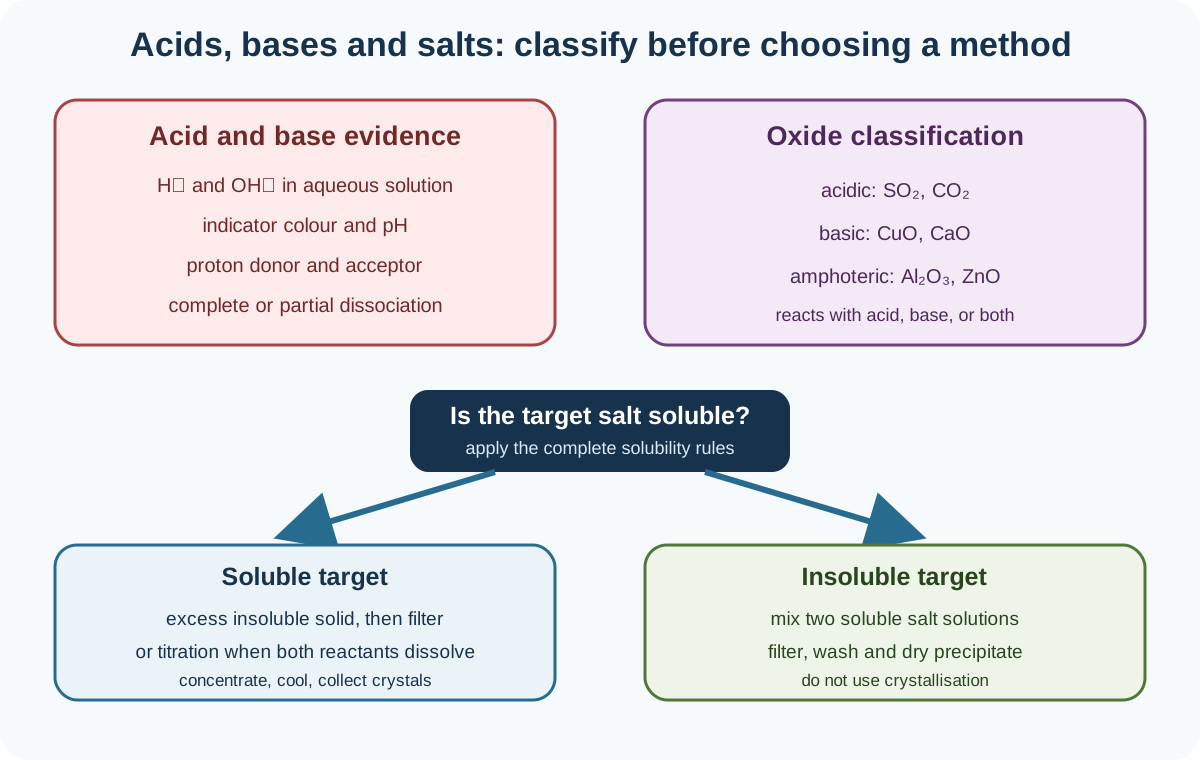
Topic 7 of Cambridge IGCSE Chemistry 0620 and 0971 links acidic and alkaline behaviour to ions, proton transfer, oxides and salt preparation. Official sections 7.1 to 7.3 require indicator and pH evidence, strong and weak acid distinction, oxide classification, complete solubility rules, method selection, hydration and water of crystallisation.
Characteristic acid reactions
Aqueous acids contain H⁺ ions. Their characteristic reactions include:
acid + reactive metal gives salt + hydrogen
acid + base gives salt + water
acid + carbonate gives salt + water + carbon dioxide
The acid name helps identify the salt: hydrochloric acid forms chlorides, sulfuric acid forms sulfates and nitric acid forms nitrates.
Bases and alkalis
Bases are oxides or hydroxides of metals in this syllabus definition. An alkali is a soluble base, so every alkali is a base but not every base is an alkali.
Aqueous alkalis contain OH⁻ ions. They neutralise acids. Bases also react with ammonium salts on warming to release ammonia:
NH₄⁺(aq) + OH⁻(aq) → NH₃(g) + H₂O(l)
Ammonia turns damp red litmus paper blue. The paper must be damp so the gas can dissolve and show alkaline behaviour.
Indicators
Indicators distinguish acidic and alkaline conditions by colour.
Indicator
Acidic condition
Alkaline condition
litmus
red
blue
thymolphthalein
colourless
Check this topic from memory
Attempt the matching topic bank before reopening the notes. Use each missed idea to decide what to review next.
At intermediate transition conditions, an indicator may show a mixed colour. Use the expected endpoint colour for the named indicator rather than transferring colours from a different indicator.
Universal indicator paper gives an approximate pH through a colour scale. Low pH means greater hydrogen-ion concentration and stronger acidic condition for the compared solutions. pH 7 is neutral. High pH means more alkaline condition.
pH is not a direct measure of acid concentration alone because dissociation strength also matters.
Neutralisation
Acid and alkali neutralisation produces water. The net ionic equation is:
H⁺(aq) + OH⁻(aq) → H₂O(l)
Other ions may remain in solution and form the salt. They are spectators in the net ionic equation but still determine the identity of the product salt.
Neutral does not always mean that equal volumes were mixed. Volumes depend on concentrations and stoichiometric ratio.
Proton donors and acceptors
At Supplement level, an acid is a proton donor and a base is a proton acceptor. A proton here is H⁺.
In HCl + H₂O → H₃O⁺ + Cl⁻, HCl donates a proton and acts as the acid, while water accepts it and acts as the base.
This model focuses on the transferred proton, not merely whether a formula contains hydrogen or hydroxide.
Strong and weak acids
A strong acid is completely dissociated in aqueous solution. Hydrochloric acid is represented by:
HCl(aq) → H⁺(aq) + Cl⁻(aq)
A weak acid is partially dissociated in aqueous solution. Ethanoic acid is represented by:
CH₃COOH(aq) ⇌ H⁺(aq) + CH₃COO⁻(aq)
Strong and weak describe degree of dissociation, not concentration. A dilute strong acid can contain less acid per unit volume than a concentrated weak acid. The single arrow for HCl and reversible arrow for ethanoic acid express the required distinction.
Acidic, basic and amphoteric oxides
Acidic oxides react with bases. Non-metal oxides such as SO₂ and CO₂ are classified as acidic.
Basic oxides react with acids. Metal oxides such as CuO and CaO are basic.
Amphoteric oxides react with both acids and bases to produce salt and water. Aluminium oxide, Al₂O₃, and zinc oxide, ZnO, are the required examples.
Metallic or non-metallic character gives the general acidic or basic pattern, but amphoteric examples must be remembered as exceptions to a simple two-way classification.
Solubility rules
Method selection depends on whether the target salt is soluble.
all sodium, potassium and ammonium salts are soluble
all nitrates are soluble
chlorides are soluble except lead and silver chlorides
sulfates are soluble except barium, calcium and lead sulfates
carbonates are insoluble except sodium, potassium and ammonium carbonates
hydroxides are insoluble except sodium, potassium and ammonium hydroxides; calcium hydroxide is partially soluble
Apply every relevant rule. Silver nitrate is soluble because all nitrates are soluble, while silver chloride is insoluble because it is the named chloride exception.
Prepare a soluble salt using excess solid
If a soluble salt can be made from an acid and an excess metal, insoluble base or insoluble carbonate:
Warm the dilute acid gently where suitable.
Add the solid in small portions until no more reacts and some remains.
Filter to remove unreacted excess solid.
Heat the filtrate to concentrate it to near saturation.
Allow it to cool so crystals form.
Filter, wash with a little cold distilled water and dry the crystals.
Excess solid ensures all acid is consumed. Filtration works because the excess reagent is insoluble. Do not evaporate to complete dryness when hydrated crystals or well-formed crystals are required.
For copper(II) sulfate, use sulfuric acid with excess copper(II) oxide or carbonate, not copper metal because copper does not react suitably with dilute sulfuric acid in this context.
Prepare a soluble salt by titration
If both reactants are soluble, excess cannot be removed by filtration. To prepare a pure sodium, potassium or ammonium salt from acid and alkali, first use titration to find the exact neutralising volumes.
Repeat using those measured volumes without indicator, because indicator would contaminate the crystals. Then concentrate, cool, crystallise, filter, wash and dry.
Titration is selected because neither soluble reagent can simply be filtered away. Technique, concordant titres and apparatus ownership belong in the practical note.
Prepare an insoluble salt by precipitation
An insoluble salt is made by mixing two suitable soluble solutions that supply its ions. The solid precipitate forms immediately.
For silver chloride:
AgNO₃(aq) + NaCl(aq) → AgCl(s) + NaNO₃(aq)
Net ionic equation:
Ag⁺(aq) + Cl⁻(aq) → AgCl(s)
Filter the precipitate, wash it with distilled water to remove soluble ions and dry it. Crystallisation is not used because the desired product is already the insoluble solid.
Choose reactants that are soluble, using nitrates or sodium, potassium and ammonium salts where helpful.
Hydrated and anhydrous substances
A hydrated substance is chemically combined with water. An anhydrous substance contains no water.
Water of crystallisation means water molecules present in hydrated crystals. Required examples include CuSO₄·5H₂O and CoCl₂·6H₂O.
The dot does not mean ordinary wetness or surface water. It records a fixed formula ratio within the crystal. Heating can remove water of crystallisation and change properties; adding water can reverse the named hydration changes.
Worked application: choose routes from solubility
To prepare copper(II) sulfate crystals, the target is soluble and copper(II) oxide is insoluble, so add excess CuO to warm dilute sulfuric acid, filter, concentrate and cool. To prepare sodium sulfate crystals, both sodium hydroxide and sulfuric acid are soluble, so first titrate for exact volumes, repeat without indicator, then crystallise. To prepare barium sulfate, the target is insoluble, so mix soluble barium nitrate and sodium sulfate, then filter, wash and dry the precipitate. Washing removes soluble spectator ions without redissolving much product. One decision, target solubility and reagent removability, selects three different methods.
Common misconceptions and corrections
Calling every hydrogen-containing substance acidic. Acid behaviour requires proton donation in context.
Calling every base an alkali. Only soluble bases are alkalis.
Saying acids contain OH⁻ in water. Aqueous acids contain H⁺.
Saying alkalis contain H⁺ as their characteristic ion. They contain OH⁻.
Predicting oxygen from acid plus metal. Hydrogen forms.
Omitting water from acid-carbonate products. Salt, water and carbon dioxide form.
Using dry litmus for ammonia gas. Damp paper is required.
Giving methyl orange the litmus colours. It is red in acid and yellow in alkali.
Calling pH 7 strongly acidic. It is neutral.
Equating neutralisation with equal volumes. Amounts and ratios matter.
Defining a strong acid as concentrated. Strength is degree of dissociation.
Using a single arrow for partial ethanoic-acid dissociation. Use a reversible arrow.
Calling all metal oxides basic. Al₂O₃ and ZnO are amphoteric.
Calling amphoteric oxides neutral. They react with both acids and bases.
Saying all chlorides are soluble. Lead and silver chlorides are exceptions.
Saying all sulfates are soluble. Barium, calcium and lead sulfates are exceptions.
Calling calcium hydroxide fully insoluble. It is partially soluble.
Choosing titration when excess insoluble solid can be filtered. Use the simpler excess route.
Using excess alkali and filtering it off. A soluble excess remains in solution.
Stopping solid addition before excess remains. Acid may remain and contaminate product.
Filtering before excess solid is present. Completion has not been assured.
Evaporating a crystal solution to dryness. Concentrate and cool.
Keeping indicator in a preparative titration. Repeat exact volumes without it.
Crystallising an insoluble precipitate from solution. Filter it directly.
Using insoluble starting salts for precipitation. Reactant solutions must supply mobile ions.
Calling water of crystallisation surface moisture. It is chemically associated in a fixed ratio.
Reading the dot in CuSO₄·5H₂O as multiplication. It denotes hydrated composition.
Assessment guidance
For reaction questions, name every product and include a balanced equation where requested. Distinguish indicator colour from universal-indicator pH evidence. Strong-versus-weak answers must discuss complete or partial dissociation, not concentration. Oxide classification should cite reaction with acid, base or both. For salt preparation, first state whether the target is soluble, then justify the route from reagent solubility. Write the sequence through separation, concentration or washing and drying, explaining why each stage removes an impurity. In precipitation equations, verify that starting salts are soluble and cancel spectator ions correctly. Hydration answers must distinguish fixed water of crystallisation from ordinary liquid water.
Retrieval practice
Complete word and symbol equations for each characteristic acid and base reaction. Recall all three indicator colour pairs and compare five pH values. Explain strong versus concentrated using HCl and ethanoic acid equations. Classify six oxides. Rebuild the full solubility list, then choose and justify preparation methods for six named salts. Write two precipitation ionic equations and explain every filtration, washing, concentration and crystallisation step.
Theory and practical ownership
This theory note owns definitions, characteristic equations, indicator interpretation, pH, acid strength, oxide classification, solubility rules and preparation-route selection. The Chemistry practical hub owns titration technique, heating, addition, filtration, crystallisation, washing, drying, hazards, observations and evaluation.