

Cambridge IGCSE Chemistry Notes 8: The Periodic Table
Cambridge IGCSE Chemistry 0620 and 0971 notes on periods, groups, Group I, Group VII, transition elements, noble gases and periodic predictions.
Topic 8 of Cambridge IGCSE Chemistry 0620 and 0971 uses electronic structure and evidence to organise and predict element behaviour. Official sections 8.1 to 8.5 cover periodic arrangement, Group I and VII trends, halogen displacement, transition-element properties and noble-gas stability.
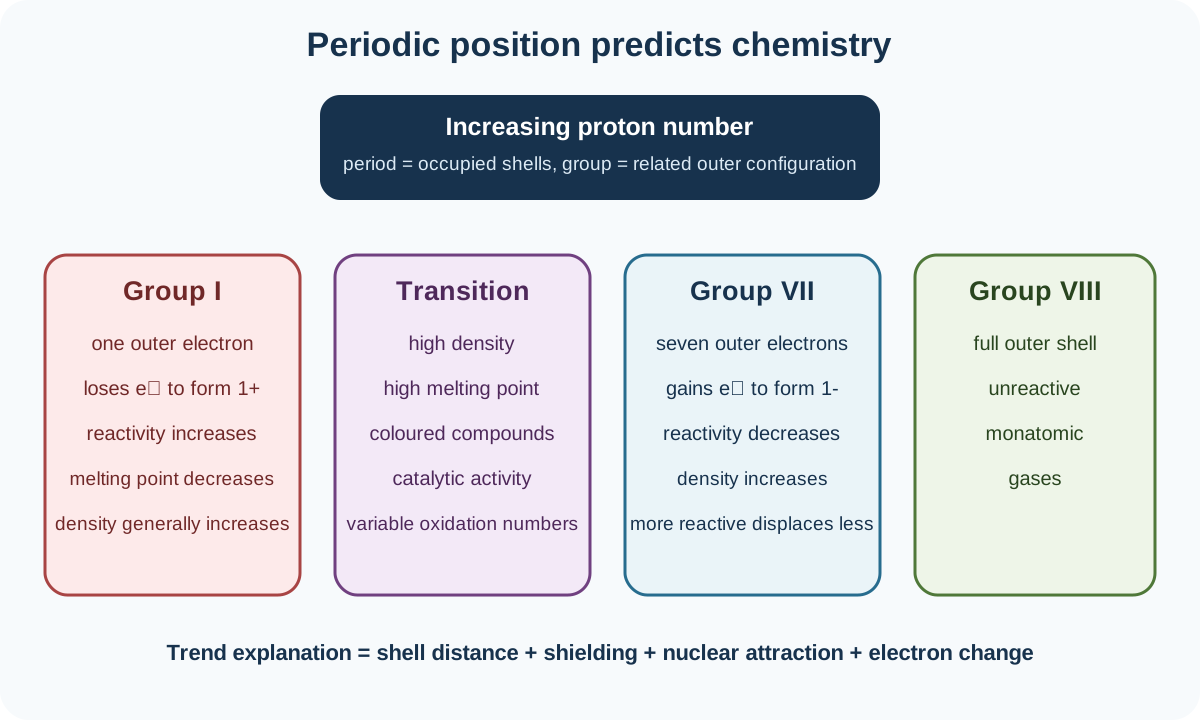
How the Periodic Table is arranged
The Periodic Table arranges elements in order of increasing proton number, also called atomic number.
Horizontal rows are periods. For the first 20 elements, period number equals the number of occupied electron shells. Sodium has configuration 2,8,1 and is in Period 3.
Vertical columns are groups. Elements in a group have similar chemical properties because they have the same number of outer-shell electrons in the main-group model. Group I atoms have one outer electron, Group VII atoms have seven and Group VIII noble gases have full outer shells.
Across a period, character generally changes from metallic to non-metallic. Position therefore supports predictions about bonding, ion formation and reactions.
Group number and ion charge
Main-group metals lose outer electrons to form positive ions. Group I forms 1+ ions and Group II forms 2+ ions.
Main-group non-metals gain electrons to complete an outer shell. Group VII forms 1- ions. The group-to-charge relationship must be interpreted through electron loss or gain rather than copied as the same signed number.
Elements in Group VIII generally do not form simple ions because their outer shells are complete.
Predict from position and supplied data
An unfamiliar element in the same group as known elements should show related chemical behaviour. Trends in melting point, density or reactivity can be extended cautiously from supplied data.
State the pattern, locate the unknown relative to known entries, then predict. Do not assume every numerical trend is perfectly linear. Cambridge may provide evidence so a group trend can be identified without prior recall.
Group I alkali metals
Lithium, sodium and potassium are relatively soft metals. Down Group I:
- melting point decreases
- density generally increases
- reactivity increases
Their softness and relatively low melting points distinguish them from many common structural metals.
Group I metals react with water to form a metal hydroxide and hydrogen:
2Na(s) + 2H₂O(l) → 2NaOH(aq) + H₂(g)
The hydroxide makes the solution alkaline. As reactivity increases from lithium to potassium, reaction becomes more rapid and energetic under comparable conditions.
Check this topic from memory
Attempt the matching topic bank before reopening the notes. Use each missed idea to decide what to review next.
Start the topic quiz