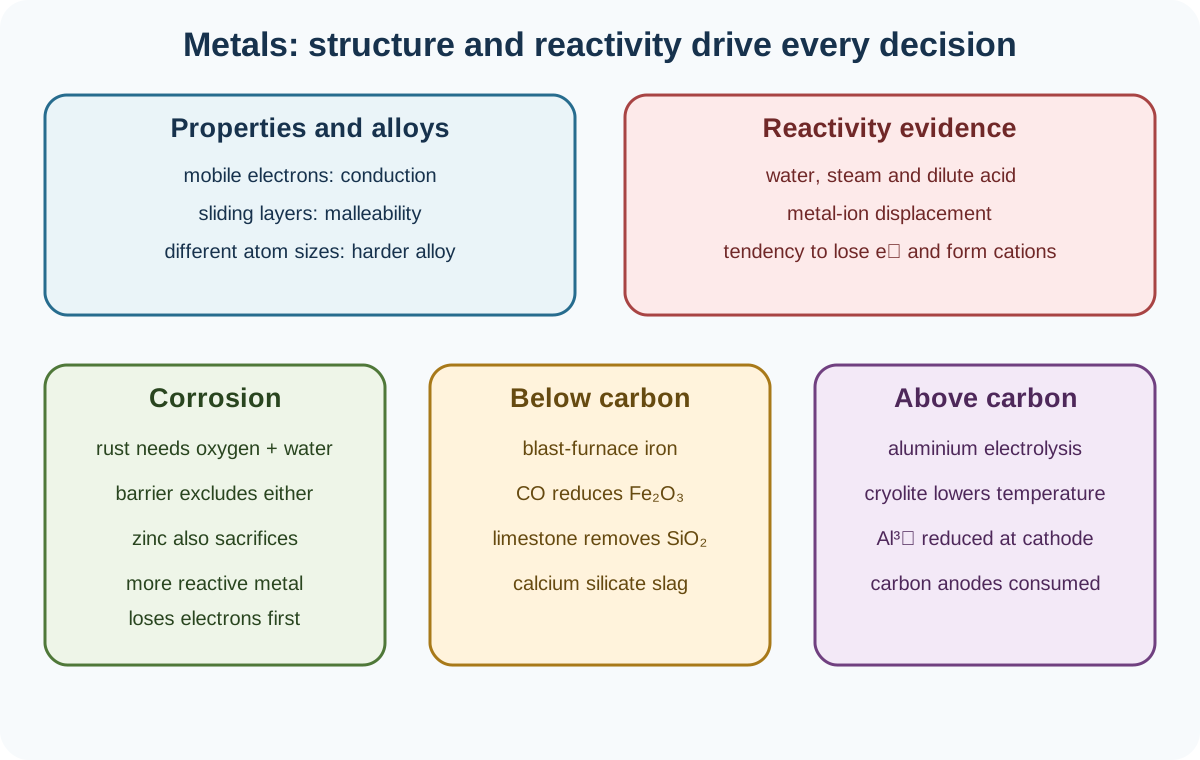
Topic 9 of Cambridge IGCSE Chemistry 0620 and 0971 connects metallic structure and reactivity to uses, alloys, corrosion and extraction. Official sections 9.1 to 9.6 require named applications, evidence-led reactivity, rust prevention, the full blast-furnace sequence and aluminium electrolysis from purified bauxite.
Compare metals and non-metals
Metals generally conduct thermal energy and electricity well, are malleable and ductile, and have relatively high melting and boiling points. Non-metals generally conduct poorly, are brittle when solid and often have lower melting and boiling points.
These are broad patterns, not definitions without exceptions. Use supplied evidence when a particular element differs.
Metallic electrical conduction comes from mobile delocalised electrons. Malleability and ductility arise because layers of positive ions can slide while attraction to the electron sea remains.
General chemical properties
Metal reactions depend on position in the reactivity series.
With dilute acids, a sufficiently reactive metal forms a salt and hydrogen. With water or steam, a metal may form an oxide or hydroxide and hydrogen, depending on the metal and conditions. With oxygen, metals form oxides.
Equations and observations should be written for the named metal rather than presented as one universal rate.
Uses linked to physical properties
Required examples are:
aluminium for aircraft because its low density reduces mass
aluminium for overhead electrical cables because it has low density and good electrical conductivity
aluminium for food containers because it resists corrosion
copper for electrical wiring because it conducts well and is ductile, so it can be drawn into wires
A use answer should state the property and why it matters in that application. Conductivity alone does not explain why aluminium is favoured for a long suspended cable; low density is also relevant.
Alloys
An alloy is a mixture of a metal with other elements. It does not have to be a fixed-ratio compound.
Brass is a mixture of copper and zinc. Stainless steel is a mixture of iron with other elements such as chromium, nickel and carbon.
Pure metals have regular layers of similarly sized atoms or ions that can slide. In an alloy, differently sized atoms disrupt the regular arrangement, making layer movement more difficult. The alloy can therefore be harder and stronger.
Structure diagrams of alloys show more than one atom size distributed through a metallic arrangement, not separate molecular groups.
Check this topic from memory
Attempt the matching topic bank before reopening the notes. Use each missed idea to decide what to review next.
Carbon and hydrogen are included as reference points although they are not metals. Carbon helps predict extraction by reduction, while hydrogen helps predict reaction with dilute acid.
More reactive metals form positive ions more readily because they have a greater tendency to lose electrons.
Reactions with water and steam
Potassium, sodium and calcium react with cold water. They form hydroxides and hydrogen, with potassium generally more vigorous than sodium and calcium lower in the stated sequence.
For sodium:
2Na(s) + 2H₂O(l) → 2NaOH(aq) + H₂(g)
Magnesium reacts slowly with cold water but reacts more readily with steam to form magnesium oxide and hydrogen:
Mg(s) + H₂O(g) → MgO(s) + H₂(g)
The product distinction between hydroxide with cold water and oxide with steam must follow the named reaction.
Reactions with dilute hydrochloric acid
Magnesium, zinc and iron lie above hydrogen and react with dilute hydrochloric acid to form chlorides and hydrogen. Magnesium reacts faster than zinc, and zinc faster than iron under comparable conditions.
Copper, silver and gold lie below hydrogen and do not react with dilute hydrochloric acid in the required comparison.
For zinc:
Zn(s) + 2HCl(aq) → ZnCl₂(aq) + H₂(g)
Reaction rate is evidence about relative reactivity only when surface area, acid conditions and other variables are controlled.
Metal displacement
A more reactive metal displaces a less reactive metal from its aqueous ions.
Zn(s) + Cu²⁺(aq) → Zn²⁺(aq) + Cu(s)
Zinc loses electrons and forms positive ions more readily, so it is oxidised. Copper ions gain electrons and are reduced.
Required comparison ions include those of magnesium, zinc, iron, copper and silver. Build a reactivity order from reactions and non-reactions. If X displaces Y²⁺, X is more reactive than Y. If no displacement occurs, X is not more reactive under the stated conditions.
Aluminium's protective oxide
Aluminium is high in the reactivity series but can appear unreactive because it rapidly forms a thin, adherent aluminium oxide layer. This layer blocks oxygen and water from reaching fresh metal and resists further corrosion.
The apparent unreactivity does not place aluminium below iron or hydrogen. It is a kinetic barrier at the surface, not evidence that aluminium has lost its underlying tendency to oxidise.
Rusting and corrosion
Iron and steel rust only when both oxygen and water are present. Rust is hydrated iron(III) oxide.
Salt can speed corrosion, but it is not one of the two essential conditions. Experiments that exclude oxygen or water show that rusting fails when either is absent.
Painting, greasing and plastic coating are barrier methods. They prevent rust by excluding oxygen or water from the iron surface. A damaged barrier can expose metal and allow corrosion at the scratch.
Galvanising and sacrificial protection
Galvanising coats iron or steel with zinc. Zinc provides a barrier, and because zinc is more reactive than iron it also gives sacrificial protection.
If the coating is scratched while zinc remains in electrical contact, zinc loses electrons preferentially:
Zn → Zn²⁺ + 2e⁻
The iron is protected from oxidation. Sacrificial blocks of a more reactive metal can similarly protect steel structures and are replaced after they corrode.
A less reactive coating such as tin can act as a barrier while intact but does not sacrificially oxidise in preference to iron.
Choose an extraction method
The more reactive a metal, the more difficult it is to obtain from its compound.
Metals below carbon in the series can often be extracted from oxides by reduction with carbon or carbon monoxide. Metals above carbon, including aluminium, require electrolysis of molten ionic material in the required model. Very unreactive metals may occur native.
Extraction method is predicted from metal position, not ore abundance alone.
Iron from hematite in the blast furnace
Hematite contains iron(III) oxide. Coke, limestone and hot air are used.
Coke burns to provide heat and carbon dioxide: C + O₂ → CO₂.
Carbon dioxide reacts with more hot carbon to form carbon monoxide: C + CO₂ → 2CO.
Limestone thermally decomposes: CaCO₃ → CaO + CO₂.
Calcium oxide reacts with silicon dioxide impurity to form slag: CaO + SiO₂ → CaSiO₃.
Molten iron and slag separate because they form different layers. Carbon monoxide is the reducing agent in the key hematite reaction because it removes oxygen and is oxidised to carbon dioxide.
Limestone is not added to reduce iron oxide. Its role is to remove acidic silicon dioxide impurity as calcium silicate slag.
Aluminium from bauxite
Bauxite is the main ore of aluminium. Aluminium is extracted by electrolysis of purified bauxite, which provides aluminium oxide. Details of bauxite purification are outside the boundary.
Aluminium oxide is dissolved in molten cryolite. Cryolite lowers the operating temperature and improves process practicality compared with melting pure aluminium oxide at its very high melting point.
At the cathode:
Al³⁺ + 3e⁻ → Al
Aluminium ions gain electrons and molten aluminium forms.
At the anode, oxide ions lose electrons:
2O²⁻ → O₂ + 4e⁻
The oxygen reacts with hot carbon anodes to form carbon dioxide, so the anodes are consumed and need regular replacement. The carbon anode is therefore not permanently inert.
Electrolysis is energy intensive, which helps explain why recycling aluminium can reduce energy demand compared with extraction from ore.
Worked application: one reactivity order, several consequences
An unknown metal M displaces Cu²⁺ but not Zn²⁺, so M lies above copper but at or below zinc in the evidence set. It reacts slowly with dilute hydrochloric acid, placing it above hydrogen, and could be iron. Iron below carbon can be extracted from oxide using carbon monoxide, whereas aluminium above carbon needs electrolysis. To protect an iron structure, zinc is suitable because it lies above iron and loses electrons preferentially if the coating is scratched. Copper would provide only a barrier and could not give the same sacrificial protection. Each decision follows the same tendency to form positive ions.
Common misconceptions and corrections
Calling all metals high-melting without exception. It is a general comparison.
Explaining conductivity through moving positive ions. Delocalised electrons carry charge in solid metal.
Giving aluminium aircraft use only as strength. The required link is low density.
Omitting low density for overhead aluminium cable. Both mass and conductivity matter.
Calling an alloy a compound. It is a mixture.
Saying alloy atoms make layers slide more easily. Different sizes obstruct sliding.
Calling stainless steel pure iron. It includes chromium, nickel, carbon or other elements.
Removing carbon and hydrogen from the series. They are required reference points.
Saying more reactive metals gain electrons. They form cations by losing electrons.
Making magnesium hydroxide with steam. The named steam reaction forms MgO.
Predicting copper plus dilute HCl reaction. Copper lies below hydrogen.
Using acid rate evidence without controlling surface area. The comparison may be invalid.
Reversing displacement direction. More reactive metal displaces less reactive ions.
Treating no reaction as no information. It constrains order.
Moving aluminium down the series because it seems unreactive. Its oxide layer protects it.
Saying rusting needs oxygen only. Water is also required.
Saying salt is essential for rusting. It accelerates but is not essential.
Calling rust iron oxide without hydration. The required product is hydrated iron(III) oxide.
Saying barriers remove rust chemically. They exclude oxygen or water.
Saying galvanising is only a barrier. Zinc also protects sacrificially.
Using copper as a sacrificial metal for iron. Copper is less reactive.
Saying zinc gains electrons during sacrifice. Zinc loses electrons.
Extracting aluminium by carbon reduction. Aluminium lies above carbon.
Saying coke only makes carbon monoxide. It first burns and provides heat.
Using limestone as the iron reducing agent. Carbon monoxide reduces hematite.
Calling slag calcium oxide. The stated slag product is calcium silicate.
Omitting the carbon dioxide regeneration in the furnace. The sequence cycles CO and CO₂.
Calling cryolite the aluminium ore. Bauxite is the ore; cryolite assists electrolysis.
Saying cryolite raises the operating temperature. It lowers it.
Writing aluminium oxidation at the cathode. Al³⁺ gains electrons there.
Calling carbon anodes inert. They react with oxygen and are replaced.
Assessment guidance
For uses, link each named property to a functional requirement. Reactivity answers should quote the relevant positions and then predict product, rate or displacement; where evidence is supplied, use both reactions and non-reactions. Alloy explanations need differently sized atoms and obstructed layer sliding. Corrosion questions must separate essential conditions, barriers and sacrificial electron loss. For blast-furnace responses, keep coke heating, carbon-monoxide formation, hematite reduction, limestone decomposition and slag formation in order with their distinct roles. Aluminium extraction answers need bauxite, purified aluminium oxide, cryolite, electrode half-equations and carbon-anode consumption. Do not substitute generic electrolysis statements for the named industrial details.
Retrieval practice
Reconstruct the full reactivity series and predict every named water, steam and acid reaction. Order five metals from displacement results. Explain all four required metal uses and both alloys. Design rusting controls and compare painting with galvanising. Write the five blast-furnace equations in sequence and annotate each purpose. Then label an aluminium cell, write both half-equations and explain cryolite and anode replacement.
Theory and practical ownership
This theory note owns property-use links, alloy structure, reactivity order, corrosion mechanisms and extraction chemistry. The Chemistry practical hub owns reaction setup, gas testing, displacement observations, rusting controls, electrolysis apparatus, hazards, measurement and evaluation.