Cambridge IGCSE Chemistry Notes 10: Chemistry of the Environment
Cambridge IGCSE Chemistry Notes 10: Chemistry of the Environment
Study guide/
Cambridge IGCSE Chemistry 0620 and 0971 notes on water, fertilisers, air pollutants, greenhouse gases, mitigation, catalytic converters and photosynthesis.
Topic 10 of Cambridge IGCSE Chemistry 0620 and 0971 connects chemical evidence and human activity to water quality, plant nutrition, air pollution and climate. Official sections 10.1 to 10.3 require exact tests, treatment stages, source-effect-strategy chains, the greenhouse mechanism, catalytic-converter chemistry and photosynthesis.
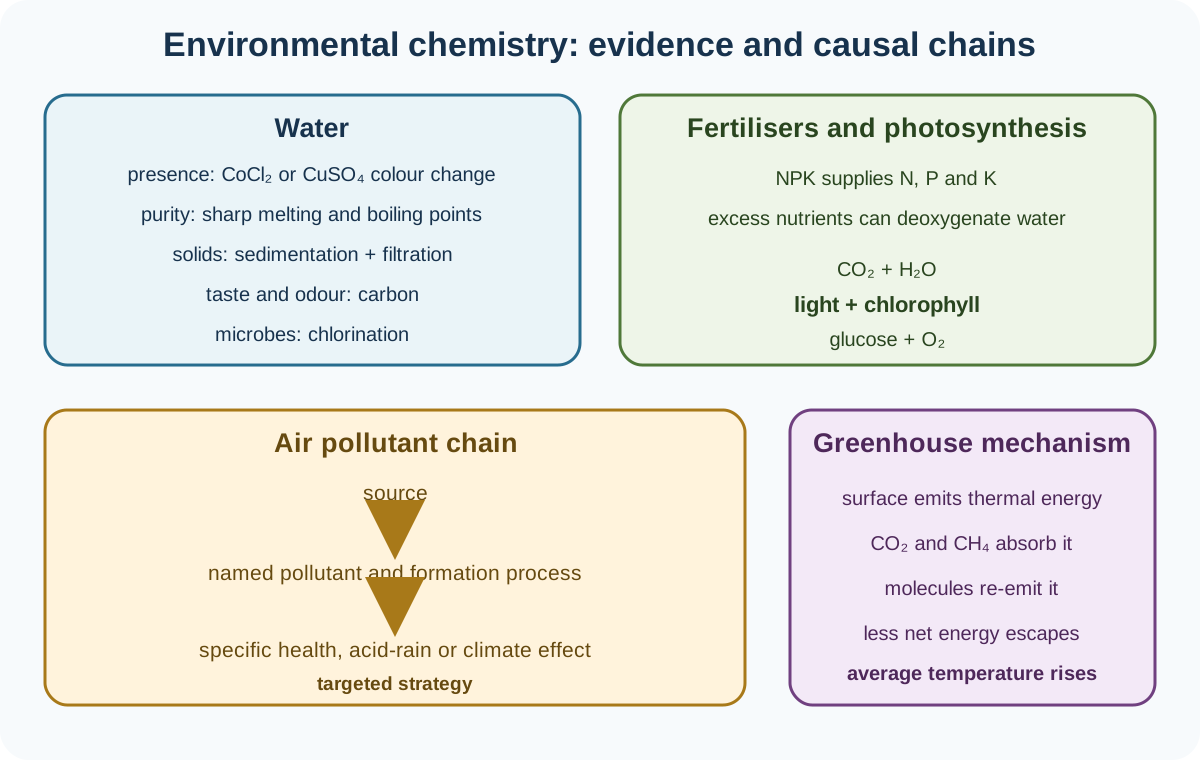
Test for the presence of water
Anhydrous cobalt(II) chloride changes from blue to pink when water is present.
Anhydrous copper(II) sulfate changes from white to blue when water is present.
These tests show that water is present. They do not by themselves show that a liquid is pure water, because an aqueous solution also produces the colour change.
Test water purity
Pure water has sharp melting and boiling points at a stated pressure. At standard atmospheric pressure, expected values are 0 °C and 100 °C.
Impurities can change the measured melting or boiling behaviour. A value close to the expected constant point supports purity, while a range or shifted result suggests impurities.
Pressure affects boiling point, so a careful conclusion uses the conditions provided rather than treating 100 °C as universal at every altitude and pressure.
Distilled water is used in practical chemistry because it contains fewer chemical impurities than tap water. Fewer dissolved ions reduce unwanted reactions and contamination.
Substances in natural water
Natural water may contain dissolved oxygen, metal compounds, plastics, sewage, harmful microbes, nitrates from fertilisers, and phosphates from fertilisers and detergents.
Some contents are beneficial. Dissolved oxygen supports aquatic life, and some metal compounds provide essential minerals.
Others can be harmful. Some metal compounds are toxic; plastics can injure or be consumed by aquatic organisms; sewage can contain disease-causing microbes; and excess nitrates or phosphates can lead to deoxygenation and damage aquatic life.
The detailed stages of eutrophication are outside this Chemistry boundary. The assessed link is nutrient pollution to deoxygenation and aquatic harm.
Domestic water treatment
Domestic water treatment makes water safer and acceptable to use. It does not necessarily make it chemically pure.
Sedimentation allows larger suspended solids to settle.
Filtration removes remaining solid particles.
Carbon removes tastes and odours by adsorption.
Chlorination kills harmful microbes.
Check this topic from memory
Attempt the matching topic bank before reopening the notes. Use each missed idea to decide what to review next.
Each stage addresses a different problem. Filtration does not reliably kill microbes, while chlorination does not remove suspended stones or sand. Distillation and domestic treatment therefore have different purposes and products.
Fertilisers
Ammonium salts and nitrates are used as fertilisers.
NPK fertilisers provide nitrogen, phosphorus and potassium for improved plant growth. Nitrogen supports production of amino acids and proteins, phosphorus supports roots and energy-transfer compounds, and potassium supports healthy growth and enzyme-related functions in the general plant context.
The official Topic 10 boundary requires their supply and use, not manufacture of ammonia. Haber-process manufacture belongs to Topic 6.
Overapplication can increase nitrate and phosphate runoff, creating the water-quality harm described in section 10.1.
Composition of clean, dry air
Clean, dry air is approximately:
78% nitrogen, N₂
21% oxygen, O₂
the remainder a mixture of noble gases and carbon dioxide, CO₂
Dry air excludes variable water vapour. Percentages are approximate, so do not force the remainder to one named gas.
Pollutant sources and effects
Pollutant
Required source
Required adverse effect
carbon dioxide
complete combustion of carbon-containing fuels
increased global warming and climate change
carbon monoxide
incomplete combustion of carbon-containing fuels
toxic gas
particulates
incomplete combustion of carbon-containing fuels
respiratory problems and increased cancer risk
methane
decomposing vegetation and digestive waste gases from animals
increased global warming and climate change
oxides of nitrogen
car engines
acid rain, photochemical smog and respiratory problems
sulfur dioxide
combustion of fossil fuels containing sulfur compounds
acid rain
Complete combustion produces carbon dioxide when oxygen is sufficient. Incomplete combustion produces carbon monoxide and carbon particulates when oxygen is limited.
Carbon monoxide toxicity and carbon dioxide climate effects are different causal chains. Particulates are solid or liquid particles suspended in air, not simply another gas.
Greenhouse gases and global warming
Carbon dioxide and methane are greenhouse gases. Earth's surface absorbs incoming energy and emits thermal energy.
Greenhouse-gas molecules absorb some outgoing thermal energy, then emit it in different directions. Some is returned towards the surface and lower atmosphere. This reduces net thermal-energy loss to space.
Increasing greenhouse-gas concentrations strengthens this effect and raises average global temperature, contributing to climate change.
Do not describe the atmosphere as a solid blanket or claim that greenhouse gases create energy. They alter absorption, emission and the rate at which thermal energy escapes to space.
Reduce climate-change effects
Required strategies include planting trees, reducing livestock farming, decreasing fossil-fuel use, increasing hydrogen use and increasing renewable energy such as wind and solar.
Planting trees can increase carbon-dioxide uptake through photosynthesis, though land, time and permanence matter. Reducing livestock can lower methane emissions. Reducing fossil-fuel combustion cuts carbon-dioxide release. Renewable energy avoids combustion during electricity generation. Hydrogen's benefit depends on how it is produced, so its full pathway should be considered.
A strategy answer should link action to the specific source or gas it changes.
Reduce acid rain
Low-sulfur fuels reduce sulfur dioxide formation. Flue-gas desulfurisation uses calcium oxide to remove acidic sulfur dioxide from power-station gases.
Catalytic converters reduce harmful vehicle emissions, including oxides of nitrogen. High temperatures inside engines allow nitrogen and oxygen from air to react, forming nitrogen oxides.
One stated converter reaction is:
2CO + 2NO → 2CO₂ + N₂
Carbon monoxide is oxidised to carbon dioxide while nitrogen monoxide is reduced to nitrogen. The converter changes pollutants into less harmful products but does not eliminate all environmental impacts of fuel use.
Photosynthesis
Photosynthesis is the reaction between carbon dioxide and water to produce glucose and oxygen, using light energy in the presence of chlorophyll.
Word equation:
carbon dioxide + water → glucose + oxygen
Symbol equation:
6CO₂ + 6H₂O → C₆H₁₂O₆ + 6O₂
Light supplies energy and chlorophyll enables absorption. They are conditions, not reactants consumed in the balanced equation.
Photosynthesis removes carbon dioxide locally and stores chemical energy, linking the process to tree-planting strategy. It does not mean every planted tree permanently cancels a fixed quantity of fossil-fuel emissions.
Worked application: trace source, process, effect and response
A poorly adjusted engine burns fuel incompletely, producing carbon monoxide and particulates. Carbon monoxide is toxic, while particulates increase respiratory and cancer risk. Its high temperature also allows nitrogen and oxygen to form nitrogen oxides, which contribute to acid rain, smog and respiratory problems. A catalytic converter can use 2CO + 2NO → 2CO₂ + N₂, reducing CO and NO but producing CO₂. Lower fuel use and renewable transport energy address the upstream carbon source, while the converter controls selected exhaust pollutants. The best evaluation separates local toxicity from climate impact rather than calling every emission a greenhouse gas.
Common misconceptions and corrections
Using a water test as proof of pure water. It proves presence only.
Saying cobalt chloride changes pink to blue with water. Anhydrous blue becomes pink.
Saying anhydrous copper sulfate starts blue. It starts white and becomes blue.
Treating 100 °C as the boiling point at every pressure. Pressure affects it.
Calling distilled water impurity-free in absolute terms. It contains fewer chemical impurities.
Saying all dissolved metal compounds are harmful. Some provide essential minerals.
Calling dissolved oxygen a pollutant. It supports aquatic life.
Giving the full eutrophication mechanism as required. Detailed stages are excluded.
Saying filtration kills microbes. Chlorination performs that role.
Saying chlorination removes suspended solids. Sedimentation and filtration do.
Calling treated water pure distilled water. Treatment targets safety and acceptability.
Saying NPK names three compounds. It names supplied elements.
Moving Haber-process detail into Topic 10. It belongs to Topic 6.
Including water vapour in clean dry air. Dry air excludes it.
Calling oxygen 78% of air. Nitrogen is approximately 78%.
Saying complete combustion produces carbon monoxide. It produces carbon dioxide.
Giving methane only as a fuel-combustion product. Required sources include decomposition and animal digestion.
Calling all pollutants greenhouse gases. CO, particulates, NOx and SO₂ have other main effects.
Saying carbon dioxide is directly toxic at ordinary pollutant context. Its required issue is warming.
Saying greenhouse gases trap all thermal energy. They reduce net loss to space.
Saying they create thermal energy. They absorb and re-emit it.
Listing planting trees without mechanism. Link it to CO₂ uptake.
Calling hydrogen automatically emission-free overall. Production pathway matters.
Saying low-sulfur fuel removes nitrogen oxides. It targets SO₂.
Saying catalytic converters prevent nitrogen oxide formation. They remove pollutants after formation.
Omitting high engine temperature from NOx formation. It enables N₂ and O₂ reaction.
Putting light or chlorophyll on the reactant side of photosynthesis. They are conditions.
Leaving the photosynthesis symbol equation unbalanced. Use coefficients of six.
Assessment guidance
For environmental questions, build a source-process-effect-response chain and keep distinct pollutants separate. Water answers should distinguish presence tests, purity evidence, laboratory distilled water and domestic treatment. When comparing treatment stages, state exactly what each removes or kills. Use the official air percentages and named source-effect pairs. Greenhouse explanations need absorption, emission and reduced loss to space, not a blanket analogy. Strategy evaluations should identify the targeted gas and acknowledge pathway limitations. For catalytic converters, explain both nitrogen-oxide formation and redox removal with the balanced equation. Photosynthesis answers need reactants, products, chlorophyll and light energy in their correct roles.
Retrieval practice
Recall both water tests and design a purity comparison. Rebuild the natural-water and treatment-stage lists. Explain NPK and one runoff consequence. Reproduce clean dry-air composition and the six pollutant source-effect chains. Draw the greenhouse-energy sequence, match every required mitigation to its source, balance the converter equation and both photosynthesis equations, then evaluate one transport scenario across health, acid rain and climate outcomes.
Theory and practical ownership
This theory note owns environmental source-effect mechanisms, treatment-stage purposes, fertiliser roles, air composition, mitigation chemistry and photosynthesis. The Chemistry practical hub owns test procedures, apparatus, observations, sample handling, hazards, measurement and evaluation.