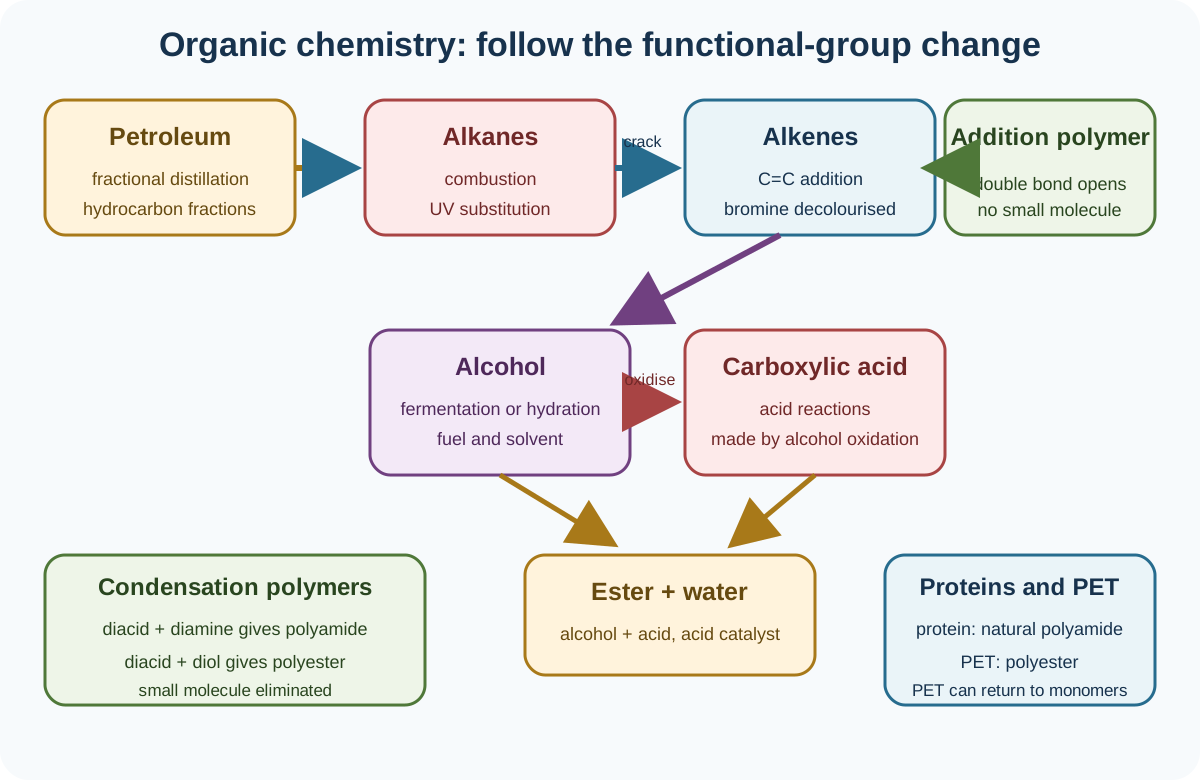
Topic 11 of Cambridge IGCSE Chemistry 0620 and 0971 organises carbon compounds by structure, functional group and reaction. Official sections 11.1 to 11.8 cover formulae and naming, petroleum, four homologous series, ethanol manufacture, carboxylic acids, esters, addition and condensation polymers, PET recycling and proteins.
Formulae and functional groups
A displayed formula shows every atom and every bond. A structural formula gives an unambiguous compact description of atom arrangement, such as CH₂=CH₂, CH₃CH₂OH or CH₃COOCH₃.
A functional group is an atom or group of atoms that determines the characteristic chemical properties of a homologous series.
Series
General formula
Characteristic structure
alkanes
CₙH₂ₙ₊₂
carbon-carbon single bonds only
alkenes
CₙH₂ₙ
at least one C=C in this series
alcohols
CₙH₂ₙ₊₁OH
-OH
carboxylic acids
CₙH₂ₙ₊₁COOH
-COOH
A homologous series has the same functional group and general formula, similar chemical properties, a trend in physical properties, and neighbouring members that differ by -CH₂-
Check this topic from memory
Attempt the matching topic bank before reopening the notes. Use each missed idea to decide what to review next.
A saturated compound contains only single carbon-carbon bonds. An unsaturated compound contains at least one carbon-carbon bond that is not single.
Structural isomers have the same molecular formula but different structural formulae.
For C₄H₁₀:
CH₃CH₂CH₂CH₃, butane
CH₃CH(CH₃)CH₃, methylpropane
For the required unbranched C₄H₈ examples:
CH₃CH₂CH=CH₂, but-1-ene
CH₃CH=CHCH₃, but-2-ene
Changing only how a formula is drawn without changing connectivity does not create an isomer.
Name and draw organic compounds
The prefix gives carbon-chain length: meth-, eth-, prop- and but- for one to four carbon atoms. The suffix identifies series: -ane, -ene, -ol and -oic acid.
Number from the end that gives the principal functional group or multiple bond the lower position. Required alcohol distinctions include propan-1-ol, propan-2-ol, butan-1-ol and butan-2-ol.
An ester name has two parts. The alkyl part comes from the alcohol and the alkanoate part from the carboxylic acid. Ethanol plus ethanoic acid forms ethyl ethanoate.
Candidates must name and draw unbranched alkanes, alkenes, alcohols and carboxylic acids up to four carbons, plus unbranched esters made from alcohols and acids each containing up to four carbons.
Fossil fuels and hydrocarbons
Coal, natural gas and petroleum are fossil fuels. Methane is the main constituent of natural gas.
A hydrocarbon contains hydrogen and carbon only. Petroleum is a mixture of hydrocarbons rather than one pure compound.
Oxygen-containing ethanol and ethanoic acid are organic compounds but are not hydrocarbons.
Fractional distillation of petroleum
Petroleum is heated so much of it vaporises. Vapours enter a fractionating column that is hot at the bottom and cooler at the top. Compounds condense at levels where temperature falls below their boiling ranges. Fractions are mixtures with similar boiling points.
From bottom to top of the column, average chain length decreases, volatility increases, boiling point decreases and viscosity decreases.
Fraction
Required use
refinery gas
heating and cooking gas
gasoline or petrol
fuel for cars
naphtha
chemical feedstock
kerosene or paraffin
jet fuel
diesel oil or gas oil
diesel-engine fuel
fuel oil
fuel for ships and home heating
lubricating oil
lubricants, waxes and polishes
bitumen
road making
Fractional distillation is physical separation. It does not break covalent bonds or create shorter hydrocarbons.
Alkanes
Alkanes are saturated hydrocarbons with only single covalent bonds. They are generally unreactive except for combustion and substitution by chlorine.
Complete combustion in excess oxygen forms carbon dioxide and water. Incomplete combustion can form carbon monoxide or carbon particulates plus water.
In substitution, one atom or group is replaced by another. Methane reacts with chlorine under ultraviolet light:
CH₄ + Cl₂ → CH₃Cl + HCl
Ultraviolet light provides activation energy. The required scope is monosubstitution, so draw one chlorine replacing one hydrogen, not every possible further-substitution product.
Cracking
Cracking breaks larger alkane molecules into smaller alkanes, alkenes and hydrogen using high temperature and a catalyst.
A possible equation is:
C₁₀H₂₂ → C₈H₁₈ + C₂H₄
Cracking makes more useful shorter-chain fuels and produces alkenes needed as chemical feedstocks and polymer monomers. Atom counts must balance, but product combinations can vary.
Cracking is chemical decomposition, not fractional distillation or combustion.
Alkenes and the bromine test
Alkenes are unsaturated hydrocarbons containing a carbon-carbon double bond.
Aqueous bromine distinguishes a typical alkene from a saturated hydrocarbon. Orange or brown bromine water is decolourised by an alkene because bromine adds across the C=C bond. An alkane shows no change under the ordinary test conditions.
The observation is decolourisation, not that the alkene itself becomes colourless.
Alkene addition reactions
In an addition reaction, two reactants form only one product as atoms add across the double bond.
ethene plus bromine forms 1,2-dibromoethane
ethene plus hydrogen forms ethane with a nickel catalyst
ethene plus steam forms ethanol with an acid catalyst
The C=C becomes C-C in the product. Draw both new attachments on the former double-bond carbons and preserve every atom.
Hydrogen addition is hydrogenation. Steam addition is hydration. Conditions matter when the question requests a manufacturing route.
Manufacture ethanol by fermentation
Aqueous glucose ferments at 25 to 35 °C with yeast and without oxygen:
C₆H₁₂O₆ → 2C₂H₅OH + 2CO₂
Advantages include renewable sugar feedstock and relatively low temperature and pressure. Disadvantages include a slow batch process, dilute ethanol requiring purification, yeast sensitivity and land or crop demand.
Oxygen must be absent for the stated ethanol-producing fermentation. Temperatures much above the range can damage yeast enzymes.
Manufacture ethanol from ethene
Ethene reacts with steam at 300 °C and 6000 kPa or 60 atm using an acid catalyst:
C₂H₄ + H₂O ⇌ C₂H₅OH
Advantages include a fast continuous process and purer product. Disadvantages include non-renewable ethene feedstock, high temperature and pressure, energy demand and incomplete equilibrium conversion.
Comparison answers should use process evidence rather than calling one route universally better.
Ethanol combustion and uses
Complete ethanol combustion forms carbon dioxide and water:
C₂H₅OH + 3O₂ → 2CO₂ + 3H₂O
Ethanol is used as a fuel because combustion releases energy and as a solvent because it dissolves a range of substances.
Calling bioethanol carbon neutral without qualification is too absolute because farming, processing and transport may use energy and cause emissions.
Ethanoic acid reactions
Ethanoic acid reacts with metals, bases and carbonates like other acids, forming ethanoate salts.
with magnesium: magnesium ethanoate and hydrogen
with sodium hydroxide: sodium ethanoate and water
with calcium carbonate: calcium ethanoate, water and carbon dioxide
Use the CH₃COO⁻ ion and balance charges when writing salt formulae. Calcium ethanoate is Ca(CH₃COO)₂.
Oxidise ethanol to ethanoic acid
Ethanol can be oxidised with acidified aqueous potassium manganate(VII) to ethanoic acid. Bacterial oxidation also forms ethanoic acid during vinegar production.
The organic change can be represented as:
CH₃CH₂OH + 2[O] → CH₃COOH + H₂O
Acidified manganate(VII) provides oxidising conditions. Do not confuse this oxidation with complete combustion, which breaks the carbon framework to carbon dioxide and water.
Esterification
A carboxylic acid reacts with an alcohol using an acid catalyst to form an ester and water.
ethanoic acid + ethanol ⇌ ethyl ethanoate + water
CH₃COOH + C₂H₅OH ⇌ CH₃COOC₂H₅ + H₂O
The reaction is reversible. Ester names record the alcohol-derived alkyl group first and the acid-derived alkanoate second.
Addition polymers
A polymer is a large molecule built from many smaller monomer molecules. Plastics are made from polymers.
In addition polymerisation, many alkene monomers join and no small molecule is eliminated. The double bond opens to form single bonds in the backbone.
Ethene forms poly(ethene), whose repeat unit can be written [-CH₂-CH₂-]ₙ. The repeat-unit brackets cut through the two backbone bonds that continue to neighbouring units.
To deduce a polymer from an alkene, open C=C and retain substituents on the same carbons. To deduce the monomer from a repeat unit, identify two backbone carbons and restore their double bond.
Condensation polymers
Condensation polymerisation joins monomers with two functional groups and eliminates a small molecule such as water at each linkage.
A dicarboxylic acid plus a diamine forms a polyamide with -CO-NH- links. Nylon is the required synthetic polyamide example.
A dicarboxylic acid plus a diol forms a polyester with -CO-O- links. PET is the required polyester example. Its repeat structure contains alternating diol-derived and dicarboxylic-acid-derived sections joined by ester linkages.
Identify the linkage before trying to reconstruct monomers. Break each -CO-NH- or -CO-O- link and restore the appropriate end groups.
Addition polymerisation uses alkene double bonds, forms one polymer product and retains all monomer atoms. Condensation polymerisation uses bifunctional monomers and forms the polymer plus a small molecule.
PET recycling and proteins
PET can be converted back into monomers and re-polymerised. This chemical recycling differs from simply melting and reshaping plastic.
Proteins are natural polyamides formed from amino acid monomers. An amino acid has both an amino group and a carboxylic acid group, represented generally as H₂N-CH(R)-COOH, where R is a variable side chain.
Protein chains contain peptide or amide links, -CO-NH-, formed by condensation. The changing R groups remain attached to the carbon backbone and give different amino acids.
Plastics and environmental challenges
Useful plastic properties such as durability and chemical resistance can make disposal difficult.
Required challenges are occupation of landfill sites, accumulation in oceans and formation of toxic gases when some plastics burn.
Evaluation should connect the property to the problem. Slow degradation permits accumulation; low density can aid transport into aquatic systems; uncontrolled burning can release hazardous products. Recycling can reduce waste and raw-material demand but requires collection, sorting, suitable polymer streams and energy.
Worked application: trace carbon through reactions and polymers
Decane from petroleum can be cracked as C₁₀H₂₂ → C₈H₁₈ + C₂H₄, producing useful octane and ethene. Ethene decolourises bromine water because bromine adds across its double bond. With steam, an acid catalyst, 300 °C and 6000 kPa, ethene forms ethanol. Oxidising ethanol gives ethanoic acid; reacting that acid with ethanol gives ethyl ethanoate and water. Alternatively, ethene undergoes addition polymerisation to [-CH₂-CH₂-]ₙ, where the double bond opens and no small molecule forms. One starting alkene therefore supports fuel, alcohol, ester and polymer routes, each identified by its functional-group change.
Common misconceptions and corrections
Calling a displayed formula a molecular formula. Displayed formula shows every bond.
Treating a functional group as any atom in a molecule. It determines series chemistry.
Saying homologues have identical physical properties. They show a trend.
Forgetting the -CH₂- difference between neighbours. It is a defining pattern.
Calling every compound with C and H a hydrocarbon. It must contain only those elements.
Calling structural isomers different molecular formulae. Their molecular formula is the same.
Numbering from the end giving the larger locant. Use the lower position.
Naming an ester acid part first. Alcohol-derived alkyl comes first.
Calling petroleum a compound. It is a mixture of hydrocarbons.
Saying fractions are pure compounds. They are boiling-range mixtures.
Saying chain length increases up the column. It decreases.
Saying viscosity rises up the column. It decreases.
Calling fractional distillation cracking. It is physical separation.
Calling alkanes unsaturated. They have only C-C single bonds.
Omitting ultraviolet light from chlorine substitution. It supplies activation energy.
Drawing multiple chlorine substitutions. Required scope is monosubstitution.
Calling cracking combustion. It decomposes large molecules.
Producing only smaller alkanes in cracking. Alkenes or hydrogen are also formed.
Saying bromine water tests any organic compound. It tests unsaturation in this context.
Saying bromine water turns milky. It is decolourised.
Leaving C=C in an addition product. It becomes C-C.
Calling addition a two-product reaction. Only one product forms.
Including oxygen in ethanol fermentation. It is absent.
Using room temperature without the stated range. Fermentation uses 25 to 35 °C.
Calling ethene hydration low-pressure. The stated pressure is 6000 kPa.
Saying fermentation produces pure ethanol directly. The product mixture is dilute.
Calling ethanol combustion oxidation to ethanoic acid. Complete combustion forms CO₂ and water.
Writing calcium ethanoate without two ethanoate ions. Use charge balance.
Omitting the acid catalyst from esterification. It is required.
Naming ethyl ethanoate as ethanoic ethyl. Follow ester order.
Leaving the alkene double bond in an addition-polymer repeat unit. It opens.
Omitting continuation bonds through repeat brackets. The chain must continue.
Saying addition polymerisation releases water. It produces polymer only.
Using monomers with one functional group for condensation chains. They need two.
Confusing ester and amide links. They are -CO-O- and -CO-NH-.
Calling PET a polyamide. It is a polyester.
Calling proteins polyesters. They are natural polyamides.
Treating R as one fixed atom. It represents different side chains.
Calling PET depolymerisation simple physical recycling. It returns polymer to monomers.
Saying plastics are harmless because durable. Durability contributes to accumulation.
Assessment guidance
Identify the functional group before naming, applying a general formula or predicting a reaction. Draw displayed formulae with every atom and bond, and check carbon valency of four. Petroleum answers should state temperature-gradient separation and all requested trend directions. Organic transformations need reactant, condition, reaction type and product structure. Compare ethanol routes using feedstock, temperature, pressure, rate, process mode and product concentration. For polymer deductions, mark the broken double bond or condensation linkage, preserve substituents, show continuation bonds and identify eliminated small molecules where relevant. Environmental answers should link polymer property to a disposal consequence rather than list generic pollution.
Retrieval practice
Name and draw every unbranched member up to four carbons in the four series and enumerate the required isomers. Rebuild all petroleum fractions, trends and uses. Complete alkane substitution, three alkene additions, both ethanol routes, ethanol oxidation, acid reactions and esterification with conditions. Convert six alkene monomers to repeat units and back. Identify polyamide and polyester links, reconstruct monomers, sketch nylon, PET and a protein segment, then compare addition, condensation and PET chemical recycling.
Theory and practical ownership
This theory note owns formulae, naming, petroleum, reaction mechanisms and conditions, manufacture comparisons, polymer structures and environmental interpretation. The Chemistry practical hub owns heating, gas and bromine tests, fermentation setup, oxidation observations, purification, hazards, measurements and evaluation.