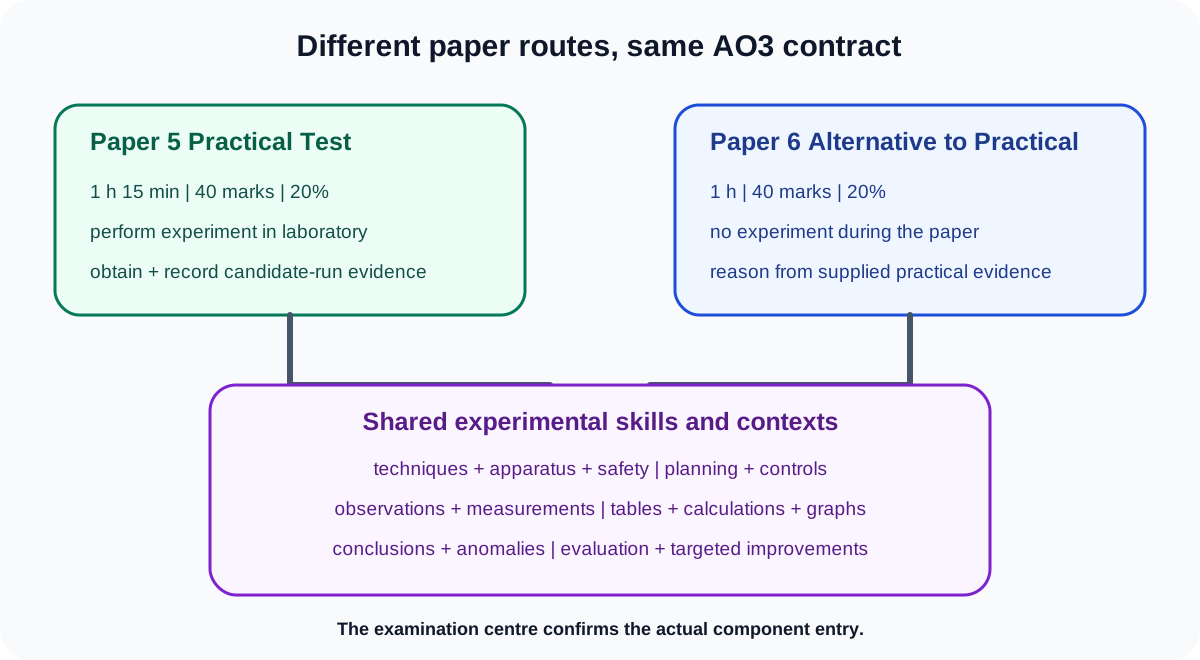
Q: What does Cambridge IGCSE Biology Paper 5 assess? A: Paper 5 is the one-hour-15-minute Practical Test. Candidates perform experiments, make observations and measurements, present and interpret data, and demonstrate the same AO3 skills and biological contexts assessed through written material in Paper 6.
TL;DR For the 2026-2028 Biology syllabuses, Paper 5 has 40 marks and contributes 20%. It is a candidate-run laboratory examination. Confirm the syllabus code and Paper 5 component entry with the examination centre before choosing papers or making practical arrangements.
Last reviewed: 20 August 2026. This guide is bounded to Cambridge's published 0610 and 0970 specifications. The syllabuses define assessable skills and contexts, but they do not publish the exact experiments, specimens, or question order for a future paper.
1. Paper 5 at a glance
Feature
Published 2026-2028 position
Paper name
Practical Test
Duration
1 hour 15 minutes
Marks
40
Weighting
20%
Assessment objective
AO3 Experimental skills and investigations
Candidate-run experiments in the paper
Check this topic from memory
Attempt the matching topic bank before reopening the notes. Use each missed idea to decide what to review next.
12 noon to 2pm, 2pm to 4pm, 4pm to 6pm, or 6pm to 8pm
Jurong East Centre (Vision Exchange)
Weekdays
12 noon to 2pm or 2pm to 4pm
Weekends
6pm to 8pm or 8pm to 10pm
Timings last updated: 17 July 2026. Confirm the venue and exact session before travelling.
Pricing
Yes
Alternative route
Paper 6 Alternative to Practical, 1 hour
All candidates take one practical paper from a choice of Paper 5 or Paper 6. Cambridge says both papers require the same experimental skills, require understanding of the same experimental contexts, and test the same assessment objective.
The papers are not identical. Paper 5 requires candidates to perform experiments in a laboratory. Paper 6 presents practical work through questions, diagrams, images, observations, readings, tables, or other supplied material.
2. Confirm the entry and centre arrangements
Do not infer Paper 5 from school type, candidate status, or access to a laboratory outside the examination centre. The centre makes and administers the entry and provides the examination arrangements.
Ask the centre to confirm in writing:
the syllabus code, 0610 or 0970;
the examination series and administrative zone;
whether the entry uses Paper 5 or Paper 6;
the final component code on the Statement of Entry;
the centre's reporting time, permitted items, and local instructions.
Cambridge describes 0970 as graded 9 to 1 and otherwise the same as 0610. Its current overview limits availability to specified administrative zones and locations. Use the live availability notice and the candidate's actual entry rather than a general assumption about country, school type, or candidate status.
The syllabus gives centres a general list of apparatus, materials, and reagents and states that detailed Practical Test requirements appear in Confidential Instructions sent before the examination. Candidates should follow the centre's instructions rather than trying to predict or bring an unpublished setup.
3. The practical skills Cambridge may assess
The current syllabus groups the requirements into five areas.
Selecting and safely using techniques, apparatus, and materials
Candidates may need to identify, complete, or label apparatus and specimens; use or explain common techniques; choose and justify a method; describe food tests or pH tests; address hazards; or explain how observation and data accuracy can be improved.
Planning experiments and investigations
The specification includes identifying independent and dependent variables, explaining how and why variables should be kept constant, choosing a suitable number and range of values, justifying apparatus, describing a procedure and suitable control, identifying risk, recording and processing results, and making a reasoned prediction.
Cambridge does not publish one mandatory planning paragraph or state that every response must begin with a separately labelled hypothesis. Answer the actual task and give the method, measurements, controls, safety decisions, and processing detail being assessed.
Making and recording observations, measurements, and estimates
Candidates may read analogue or digital apparatus with appropriate precision, take sufficient observations or measurements, use repeats or replicates where appropriate, record qualitative test observations, and organise results systematically with suitable units and precision.
Interpreting and evaluating observations and data
This includes calculations, graphing, interpolation, extrapolation, gradients, intercepts, conclusions supported by observations and data, identification of anomalies, and appropriate action on anomalous results.
Evaluating methods and improvements
Candidates may evaluate arrangements, methods, techniques, and controls, identify a specific source of error, and suggest an improvement to the apparatus or procedure. A phrase such as "human error" does not identify which observation, measurement, or step is limited.
4. Published experimental contexts
Cambridge says candidates should be familiar with practical work involving:
measurement of gas and liquid volumes, masses, temperatures, times, and lengths;
diffusion, osmosis, and food tests;
enzyme-catalysed reaction rates, including colour-change end-points, and pH testing with published indicators;
photosynthesis, transpiration, heart rate, breathing rate, respiration, and tropic responses;
observation and dissection of seeds and flowers, and germination;
continuous and discontinuous variation, and representative sampling that avoids bias;
observing, recording, measuring, and drawing familiar and unfamiliar specimens, including labels, magnification, and actual size;
unfamiliar methods using simple apparatus.
These are syllabus contexts, not a promise that every paper contains microscopy, a food test, osmosis, an enzyme investigation, and a graph. Confidential Instructions and the live question paper determine a particular examination setup.
5. Biological observations, drawings, and magnification
Follow the specimen, image, apparatus, and question actually supplied.
Use a sharp pencil to make fine, clear, unbroken drawing lines.
Use most of the available space.
Show the features observed in the supplied specimen or image.
Do not shade or use colour.
Draw label lines with a ruler and make each line touch the labelled feature.
Record qualitative observations precisely, including an actual colour or other visible change when relevant.
Where a question supplies the necessary measurements, use the relationship magnification = image size / actual size. Put image size and actual size in the same units before dividing. Follow the requested unit and rounding rather than applying one fixed unit-change or decimal-place rule to every task.
6. Tables, charts, and graphs
Cambridge publishes the following data-presentation conventions.
Record data at a precision supported by the measuring instrument.
Put the observation or quantity and its unit in the table heading, such as time / s.
Do not repeat units in the body of the table.
Use an appropriate number of significant figures.
Label graph axes with the observation or quantity and unit where applicable.
Unless instructed otherwise, plot the independent variable on the horizontal axis and the dependent variable on the vertical axis.
Unless instructed otherwise, use more than half the grid in both directions and choose a sensible scale. The axes do not have to include the origin.
Mark points as crosses or encircled dots of suitable size and plot within half a smallest square.
Draw a single thin, smooth best-fit straight line or curve only when intermediate values can reasonably be predicted.
Where data are scattered, place the best-fit line with a roughly even distribution of points on either side over its length.
Ignore a clearly anomalous point when drawing the best-fit line, but identify it as anomalous.
Show on the graph how an interpolated or extrapolated reading was obtained when asked.
Use a bar chart for categorical or discrete data, with equal-width bars that do not touch. Use a histogram for continuous data, with bars that touch. Do not force a line through the origin unless the data or question justifies it.
7. A source-bounded preparation method
The following is study advice, not a Cambridge rule.
Verify the syllabus and component code before selecting papers.
Become familiar with the published apparatus and reagent list and their safe use under supervision.
Practise setting up, adjusting, observing, measuring, and troubleshooting apparatus under supervision.
Describe the observation actually made rather than adding a memorised expected result.
Redraw tables, charts, graphs, and biological drawings using Cambridge's published conventions.
For a plan, connect the variable, method, measurement, control, safety step, and result-processing method to the actual task.
For an evaluation, name the limited step, explain its effect, and propose a change that addresses that limitation.
The syllabus does not require one commercial course, provider, mock schedule, or fixed number of laboratory sessions.
Worked application: execute, record, then evaluate
A Paper 5 task asks how temperature affects amylase activity. Set water baths across the specified range, equilibrate separate amylase and starch tubes, mix them and start timing at the same event. Sample at fixed intervals into separate iodine wells and record the first orange-brown endpoint. Preserve raw times, repeat each temperature and calculate reciprocal time only because every trial uses the same fixed endpoint. If the 40 °C repeats are 62 s, 65 s and 144 s, retain the anomalous value, check timing and contamination, and repeat that condition. Do not erase it simply to improve the graph.
Common misconceptions and corrections
Assuming Paper 5 always contains one named experiment. Cambridge publishes contexts, not a future question sequence.
Treating Paper 5 as a memory test only. Candidates must obtain and record laboratory evidence.
Starting work before reading the complete task. Apparatus, quantities and recording requirements may appear across the question.
Changing a supplied method without justification. Follow instructions unless asked to plan or improve it.
Recording observations from expectation. Write what is actually seen.
Adding units after every table value. Put units in quantity headings.
Replacing raw repeats with only a mean. Preserve all measured values.
Using inconsistent decimal places for one instrument. Reflect its precision consistently.
Calling a different result automatically anomalous. Compare it with repeats and trend.
Silently discarding an anomaly. Retain, investigate and justify action.
Joining graph points dot to dot. Use an appropriate best-fit line or curve.
Forcing a graph through the origin. Do so only when evidence or instruction supports it.
Drawing remembered biological structures. Record only visible features.
Shading a biological line drawing. Use clear unbroken pencil lines without shading.
Using freehand label lines. Rule them and make them touch features.
Calling every limitation human error. Identify the affected step and mechanism.
Suggesting more repeats for an apparatus leak. Repair the seal first.
Writing a safety phrase without a hazard. Match precaution to possible harm.
Assuming laboratory access determines component entry. Confirm the centre's actual entry.
Trying to predict confidential apparatus. Follow centre instructions and published familiar equipment.
Assessment guidance
Paper 5 rewards the complete evidence chain: follow the supplied method safely, read apparatus at supported precision, record raw observations immediately, process only after preserving measurements and base conclusions on obtained data. Before drawing a graph, identify variable type, headings and scale. Before a biological drawing, inspect the actual specimen. Planning responses need operational variables, controls with reasons, range, repeats, risk and processing. Evaluation responses should connect one specific limitation to its effect and a targeted correction. Manage time by reading each task fully and preparing the results table before the first reading where possible.
Retrieval practice
Rehearse setting up tables before data collection, reading unfamiliar apparatus, timing fixed endpoints, drawing biological specimens and constructing graphs from raw results. For diffusion, enzymes, photosynthesis and sampling, write one variable-control-reason set, one hazard-risk-precaution chain and one limitation-effect-improvement chain. Practise preserving anomalies and deciding what evidence would justify repeating or excluding them.
8. What this guide does not establish
The syllabuses do not establish:
that a particular Singapore centre offers Paper 5;
that school or private-candidate status determines the practical component;
the exact apparatus, specimen, experiment, or question order in a future paper;
a guaranteed microscopy, food-test, osmosis, enzyme, or graph pattern;
a fixed practical-mock or laboratory-session requirement;
grade improvement from laboratory tuition or any other preparation format.
Use the syllabus for the assessment contract, the centre for the candidate's entry and examination arrangements, and live examination documents for series-specific administration.