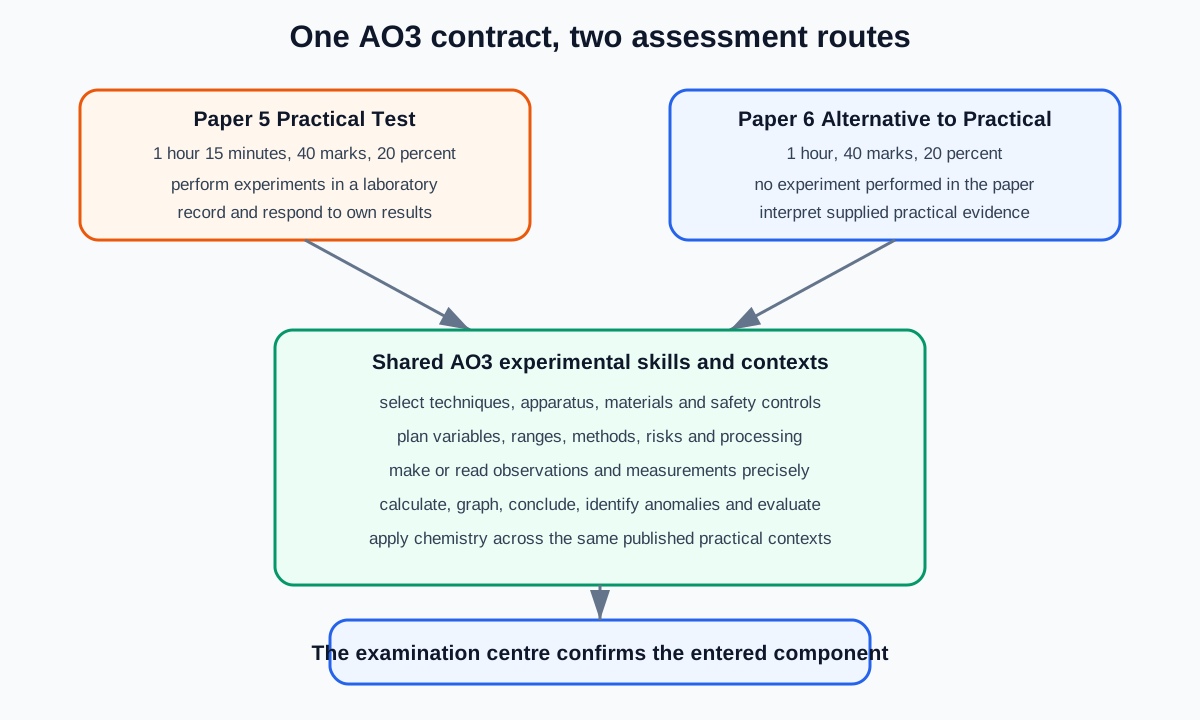
Q: What does Cambridge IGCSE Chemistry Paper 5 assess? A: Paper 5 is the one-hour-15-minute Practical Test. Candidates perform experiments, make observations and measurements, process data, and demonstrate the same AO3 skills and chemistry contexts assessed through written material in Paper 6.
TL;DR For the 2026-2028 Chemistry syllabuses, Paper 5 has 40 marks, contributes 20%, and contains compulsory items. It is a candidate-run laboratory examination. Confirm the syllabus code and Paper 5 component entry with the examination centre before choosing papers or making practical arrangements.
Last reviewed: 24 July 2026. This guide is bounded to Cambridge's published 0620 and 0971 specifications. The syllabuses define assessable skills and contexts, but they do not publish the exact experiments or question order for a future paper.
12 noon to 2pm, 2pm to 4pm, 4pm to 6pm, or 6pm to 8pm
Jurong East Centre (Vision Exchange)
Weekdays
12 noon to 2pm or 2pm to 4pm
Weekends
6pm to 8pm or 8pm to 10pm
Timings last updated: 17 July 2026. Confirm the venue and exact session before travelling.
Pricing
Yes
Question status
All items compulsory
Alternative route
Paper 6 Alternative to Practical, 1 hour
All candidates take one practical paper from a choice of Paper 5 or Paper 6. Cambridge says both papers require the same experimental skills, require understanding of the same experimental contexts, and test the same assessment objective.
The papers are not identical. Paper 5 requires candidates to perform experiments in a laboratory. Paper 6 presents practical work through questions, apparatus diagrams, observations, readings, tables, graphs, or other supplied material.
2. Confirm the entry and centre arrangements
Do not infer Paper 5 from school type, candidate status, or access to a laboratory outside the examination centre. The centre makes and administers the entry and provides the examination arrangements.
Ask the centre to confirm in writing:
the syllabus code, 0620 or 0971;
the examination series and administrative zone;
whether the entry uses Paper 5 or Paper 6;
the final component code on the Statement of Entry;
the centre's reporting time, permitted items, and local instructions.
Cambridge describes 0971 as graded 9 to 1 and otherwise the same as 0620, with availability limited to specified zones and locations. Use the live notice and actual entry rather than a country, school-type, or candidate-status assumption.
The syllabus gives centres a general apparatus and reagent list; detailed Practical Test requirements appear in Confidential Instructions. Follow the centre's instructions rather than predicting an unpublished setup. Centres are responsible for safety and must provide appropriate equipment including eye protection.
3. The AO3 skills Cambridge may assess
The current syllabus groups the practical requirements into five areas.
Selecting and safely using techniques, apparatus, and materials
Candidates may need to identify or label apparatus, follow instructions, explain a common technique, choose and justify a method, describe a qualitative or gas test, address a hazard, or explain how observation and data accuracy can be improved.
Planning experiments and investigations
The specification includes identifying independent and dependent variables, explaining controlled variables, choosing a suitable number and range of values, justifying apparatus, describing a procedure, identifying risk, recording and processing results, and making a reasoned prediction.
Cambridge does not publish one mandatory planning template or require a separately labelled hypothesis in every response. Answer the particular task and supply the detail it assesses.
Making and recording observations, measurements, and estimates
Candidates may read analogue or digital apparatus, read to the nearest half-scale division where required, take sufficient measurements, repeat readings where appropriate, record qualitative chemical-test observations, and organise results with suitable units and precision.
Interpreting and evaluating observations and data
This includes calculations, graphing, best-fit lines where appropriate, interpolation, extrapolation, gradients, intercepts, conclusions supported by observations and data, identification of anomalies, and appropriate action on anomalous results.
Evaluating methods and improvements
Candidates may evaluate arrangements, methods, techniques, and control of variables, identify a specific source of error, and suggest an improvement to the apparatus or procedure. A phrase such as "human error" does not identify which observation, measurement, or step is limited.
4. Published experimental contexts
Cambridge says candidates should be familiar with practical work involving:
measurement of gas or liquid volumes, masses, temperatures, times, and lengths;
rates of reaction and salt preparation;
filtration, crystallisation, simple and fractional distillation, and chromatography;
electrolysis and identification of metal ions, non-metal ions, and gases;
tests for water, dilute acids, oxidising agents, and reducing agents;
heating and cooling curves, temperature changes, titrations, and solubility;
melting and boiling points, displacement reactions, rusting, and corrosion;
unfamiliar procedures using simple apparatus.
These are syllabus contexts, not a guaranteed future-paper pattern. Confidential Instructions and the live question paper determine a particular examination setup.
5. Qualitative analysis and laboratory observations
Cambridge provides its Notes for use in qualitative analysis for both Paper 5 and Paper 6. The current notes cover prescribed tests and observations for anions, aqueous cations, gases, and flame tests.
Use the version supplied for the examination. Carry out only the stated or permitted test, follow safety instructions, and record the actual observation before making an inference. A precipitate colour alone may not identify an ion unless the reagent, order, excess-reagent behaviour, gas test, or other observation is also considered.
The notes do not establish that every listed ion or gas will be tested, and an older memorised version should not replace the supplied table.
6. Readings, tables, and calculations
Cambridge publishes data-recording conventions.
Read an instrument to one half of its smallest division where interpolation is required.
Record values at the precision supported by the measuring instrument.
Put the quantity and unit in a table heading, such as time / s.
Repeat and record readings where appropriate.
Do not include units in the body of a table.
Use significant figures appropriate to the raw data and instrument.
Give a calculated quantity the same number of significant figures as the least precise raw value used in that calculation.
Do not impose one universal titration, rate, or energy-calculation routine. The question and supplied apparatus determine the required precision, readings, averaging, equation, constants, sign, and units. Rinsing a burette with its solution, reading at eye level, switching off heating, or using a particular concordance threshold may be appropriate when the setup and instructions support it, but these are not interchangeable rules for every task.
7. Graphs
The current Chemistry specification gives these conventions.
Label axes with the measured or calculated quantity and unit.
Unless instructed otherwise, plot the independent variable on the horizontal axis and the dependent variable on the vertical axis.
Unless instructed otherwise, use more than half the grid in both directions and choose a sensible scale.
Mark points as crosses or encircled dots of suitable size and plot within half a smallest square.
Draw a single thin, smooth best-fit straight line or curve.
Where data are scattered, place the best-fit line with a roughly even distribution of points on either side over its length.
Ignore a clearly anomalous point when drawing the best-fit line, but identify it as anomalous.
Read a line, intercept, interpolated value, or extrapolated value to the precision supported by the grid.
For the gradient of a straight line, mark a triangle whose hypotenuse spans at least half the length of the candidate's best-fit line.
Do not force a straight line, origin, tangent, or gradient calculation unless the data and question require it.
8. A source-bounded preparation method
The following is study advice, not a Cambridge rule.
Verify the syllabus and component code before selecting papers.
Become familiar with the published apparatus and reagent list and their safe use under supervision.
Practise setting up, adjusting, observing, measuring, and troubleshooting apparatus under supervision.
Use the current qualitative-analysis notes to connect the performed test sequence to the complete observation.
Redraw tables and graphs using Cambridge's published conventions.
For a plan, connect the variable, method, measurement, control, safety step, and result-processing method to the actual task.
For an evaluation, name the limited step, explain its effect, and propose a change that addresses that limitation.
The syllabus does not require one commercial course, provider, mock schedule, or fixed number of laboratory sessions.
Worked application: turn observations into a defensible conclusion
A Paper 5 candidate adds aqueous sodium hydroxide to an unknown solution. A light blue precipitate forms and remains insoluble when excess reagent is added. The candidate should first record both observations, including the excess-reagent result, then use the supplied qualitative-analysis notes to identify copper(II) ions. Writing only “copper is present” loses the evidence chain. If the precipitate is described merely as blue, the observation is incomplete because shade and excess behaviour matter. A strong evaluation also notes that contaminated droppers could create misleading results and proposes rinsed, separately labelled droppers for each reagent rather than the vague instruction to “be more careful.”
Common misconceptions and corrections
Assuming Paper 5 always contains the same experiment sequence. The syllabus publishes contexts, not a guaranteed future paper pattern.
Treating Paper 5 as a theory paper with apparatus nearby. Candidates must perform and respond to actual experiments.
Assuming private candidates cannot take Paper 5. The examination centre confirms the entered component.
Using old qualitative-analysis notes from memory. Use the version supplied in the examination.
Writing an ion name instead of an observation. Record colour, state and reagent behaviour first.
Calling a rough reading an accurate repeat. Use the question and observed consistency to select valid readings.
Recording unsupported decimal places. Match the instrument scale or display.
Putting units in every table cell. Put quantity and unit in the heading.
Forcing all graphs through the origin. Follow the evidence and instruction.
Joining continuous data point to point. Draw the appropriate thin best-fit line or curve.
Hiding an anomalous point. Plot it, identify it and handle it as instructed.
Using a tiny gradient triangle. For a straight best-fit line, span at least half its length.
Calling repeats a control condition. Repeats assess reliability; a control provides a baseline.
Writing “human error.” Name the limited observation, measurement or operation.
Suggesting repeats as the cure for systematic bias. Correct the apparatus or method causing the bias.
Giving a safety slogan. Link a named hazard to a specific precaution.
Inventing apparatus not available in the task. Work from the centre-provided setup and question.
Continuing after an unsafe or faulty setup is noticed. Follow invigilator and centre instructions.
Assuming a result must match the expected value. Record what actually occurs and evaluate discrepancies.
Leaving calculations until every experiment is finished. Process and check data while following the paper's sequence and time constraints.
Assessment guidance
In Paper 5, marks depend on the candidate's own observations, readings and experimental decisions as well as written processing. Read the entire instruction before changing apparatus, preserve raw data, use supported precision and keep observation separate from inference. For planning, connect the independent variable, measured outcome, operational controls, safe method, repeats and processing route. For graphs, follow the published conventions but do not force a line shape or calculation that the question does not request. For evaluation, identify the exact step, predict its effect on the data and propose a feasible change using available apparatus.
Retrieval practice
Reconstruct the five AO3 skill areas without notes. Label twenty common apparatus diagrams and practise half-division readings. Complete blank qualitative-analysis evidence chains. Build tables from prose instructions, plot mixed straight and curved datasets, calculate large-triangle gradients and identify anomalies. Write ten plan skeletons and twenty limitation-effect-improvement chains, then rehearse a timed sequence that includes setup checks, raw-data recording, calculation checks and safe shutdown.
13. What this guide does not establish
The syllabuses do not establish:
that a particular Singapore centre offers Paper 5;
that school or private-candidate status determines the practical component;
the exact apparatus, reagents, experiment, or question order in a future paper;
a guaranteed titration, qualitative-analysis, rates, or energetics pattern;
universal burette, concordance, tangent, or calorimetry rules for every question;
a fixed practical-mock or laboratory-session requirement;
grade improvement from laboratory tuition or any other preparation format.
Use the syllabus for the assessment contract, the centre for the candidate's entry and examination arrangements, and live examination documents for series-specific administration.