Cambridge IGCSE Combined Science Practical 1: Paper 5 and Paper 6
Cambridge IGCSE Combined Science Practical 1: Paper 5 and Paper 6
Study guide/
Cambridge IGCSE Combined Science 0653 practical guide to Paper 5 and Paper 6, their shared AO3 skills, route differences, contexts and response demands.
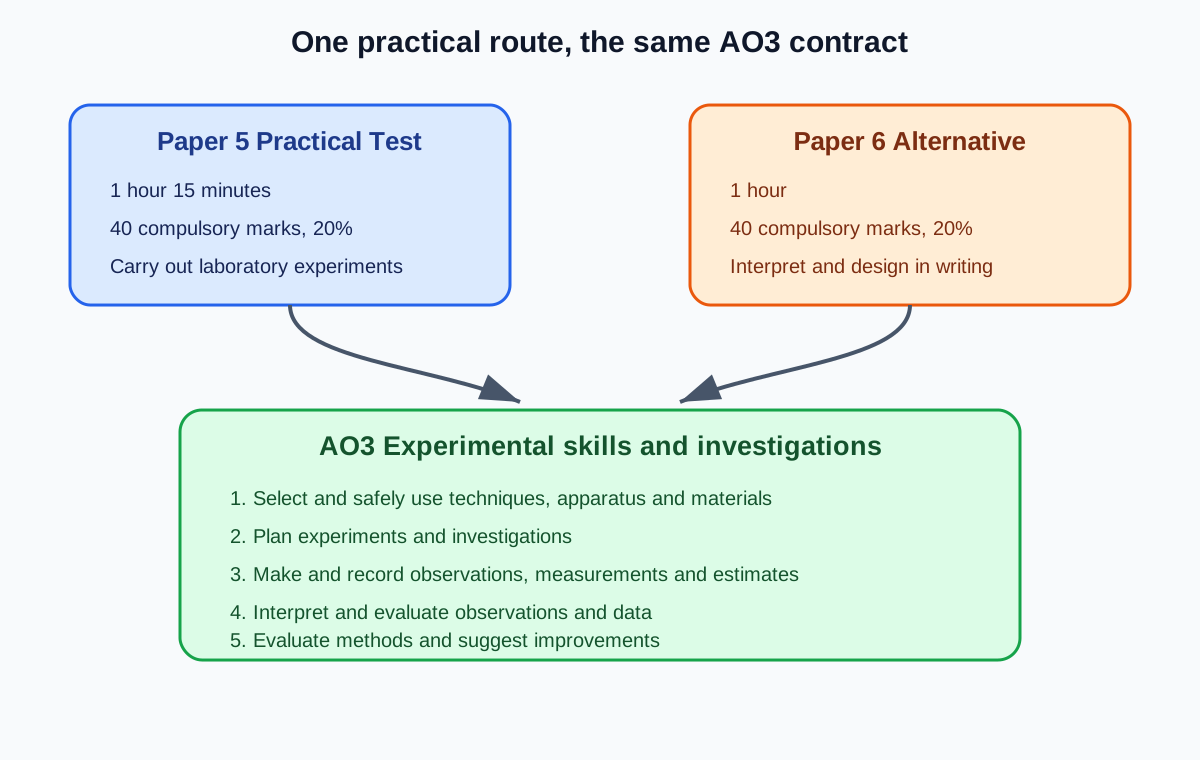
Cambridge IGCSE Combined Science 0653 requires every candidate to take one practical paper. Paper 5 Practical Test and Paper 6 Alternative to Practical use different delivery formats but assess the same AO3 experimental skills, the same experimental contexts and the same qualification weighting. Route choice changes what happens in the examination room, not what a candidate must understand.
Every candidate takes one practical paper
All candidates take either Paper 5 or Paper 6 alongside their multiple-choice and theory papers.
Paper 5 is the Practical Test. Paper 6 is the Alternative to Practical. A candidate does not take both routes for the same qualification entry.
Both routes are available to Core and Extended candidates. The Core or Extended theory route does not create a separate practical syllabus.
Both papers carry 40 marks and 20 percent
Paper 5 and Paper 6 each carry 40 marks and contribute 20 percent of the IGCSE qualification.
The practical component assesses AO3 only. The official component weighting assigns 100 percent of Papers 5 and 6 to Experimental skills and investigations.
This does not mean scientific knowledge is irrelevant. Candidates apply knowledge to understand apparatus and contexts, but marks target experimental reasoning and performance.
Paper 5 is a 1 hour 15 minute Practical Test
Paper 5 lasts 1 hour 15 minutes. All items are compulsory, and candidates carry out experiments in a laboratory as part of the test.
The route therefore combines physical execution with written recording and reasoning. Time is spent assembling or using apparatus, observing changes, taking measurements and completing the question paper.
An accurate experiment with an incomplete table or unsupported conclusion can still lose marks because AO3 includes both performance and communication.
Paper 6 is a 1 hour Alternative to Practical
Paper 6 lasts 1 hour. It also has 40 compulsory marks, but candidates do not perform experiments during the examination.
Instead, questions can present apparatus diagrams, methods, results, observations or unfamiliar experimental situations. Candidates must show how the investigation should work and how evidence should be processed and evaluated.
“Alternative” describes the examination format. It does not reduce the need for practical experience during the course.
Both routes assess the same five AO3 strands
The first strand is selecting and safely using techniques, apparatus and materials, including following instructions where appropriate.
The second is planning experiments and investigations. The third is making and recording observations, measurements and estimates.
Check this topic from memory
Attempt the matching topic bank before reopening the notes. Use each missed idea to decide what to review next.
The fourth is interpreting and evaluating observations and data. The fifth is evaluating methods and suggesting possible improvements.
Study should connect these strands as one workflow rather than revise each as isolated vocabulary.
Selection includes recognition and justification
Candidates may identify apparatus from a diagram or description, draw or label apparatus, explain how an item is used, and select the most appropriate method.
When a question asks for a justification, name the feature that makes the choice suitable. For example, a gas syringe contains gas and measures its changing volume directly.
The longest or most complicated apparatus is not automatically best. Suitability depends on quantity, range, precision and experimental purpose.
Safe use needs a hazard-specific precaution
Candidates may need to identify a hazard, explain the associated risk and state a precaution that reduces that risk.
A hot liquid can burn, so use suitable handling and allow it to cool where the method permits. A corrosive reagent can damage skin or eyes, so use eye protection and avoid contact.
“Be careful” is not a controlled action. Match each precaution to the actual source of harm.
Planning turns a question into a reproducible test
A plan identifies the independent and dependent variables, explains controlled variables, chooses a suitable number and range of independent-variable values, selects apparatus, describes a procedure and includes a control experiment where appropriate.
It also explains how results will be recorded and processed, predicts an expected pattern with reasoning, and addresses risks.
Another trained student should be able to follow the plan without guessing important quantities or decisions.
Recording preserves raw evidence
Candidates may read analogue or digital apparatus, use appropriate precision, read to the nearest half-scale division where required and correct zero errors.
They should make sufficient measurements, repeat where appropriate and record qualitative observations rather than inferred conclusions alone.
Tables need headings, units, consistent precision and a logical arrangement. Calculated values should not replace the raw readings from which they came.
Interpretation links claims to data
Candidates process data for calculations or graphs, draw best-fit lines where appropriate, analyse patterns, and use graphical interpolation, extrapolation, gradient or intercept.
A conclusion should cite the evidence and give an appropriate scientific explanation. It should not claim more than the tested range supports.
An anomaly should be identified from the pattern, investigated where possible and handled transparently rather than erased without explanation.
Evaluation diagnoses method-specific weaknesses
Evaluation covers arrangements, techniques and variable control. Candidates distinguish measurement, random and systematic error and identify uncertainty in data or conclusions.
An improvement must address a named limitation. Repeating can reduce the influence of random variation, but it does not repair a zero error or an uncontrolled variable.
Better evaluation states the source, likely effect on evidence and a feasible corrective change.
Paper 5 makes execution observable
In Paper 5, organise the workspace so the question paper stays readable and raw results are recorded immediately. Follow the instructed sequence unless a permitted choice is requested.
Check scale range before measuring, observe from the proper position and keep apparatus stable. If a reading seems anomalous, record it and repeat when time and instructions allow.
Do not silently invent ideal results. Marks depend on credible observations and the reasoning built from them.
Paper 6 makes method visualisation essential
In Paper 6, translate each apparatus diagram into a physical process. Ask what is changed, what is measured, what could leak, move, cool, react or be misread, and where each result would be recorded.
Descriptions should use executable verbs and named apparatus. “Measure accurately” is weaker than identifying the instrument and how readings are obtained.
Practical rehearsal helps because it gives meaning to diagrams and exposes realistic sources of error.
Qualitative-analysis notes are provided for both routes
The official notes for use in qualitative analysis are provided in both Paper 5 and Paper 6.
Candidates still need to choose relevant tests, follow or describe reagent sequences, make observations and interpret results. The table does not answer which fresh portion to use or how an observation supports an ion.
Preparation should therefore focus on the logic of test selection and exact observation language, not only memorising the table.
Biology contexts cover measurement, processes and specimens
The official contexts include measurements of gas and liquid volumes, mass, temperature, time and length. They also include diffusion, osmosis, food tests, enzyme rate and endpoints, pH indicators, photosynthesis, transpiration, heart and breathing rates, respiration, seeds, flowers and germination.
Candidates may observe, record and measure familiar or unfamiliar specimens, produce clear line drawings, and calculate magnification or actual size.
Unfamiliar apparatus does not place a task outside scope when the required experimental reasoning is transferable.
Chemistry contexts span measurement, preparation and analysis
Chemistry contexts include measurements, reaction rates, salt preparation, filtration, crystallisation, simple and fractional distillation, chromatography and electrolysis.
They also include ion and gas identification, water tests, dilute-acid reactions, oxidising and reducing agents, titrations, solubility, melting and boiling points, displacement, temperature changes and corrosion conditions.
This is a context list, not a promise that every examination repeats a familiar classroom recipe.
Physics contexts focus on quantities and relationships
Physics contexts include measuring length, volume and force; small distances or short times; determining derived quantities; and testing relationships between variables.
They include comparisons of angles or density, heating and cooling, springs and balances, motion and oscillations, circuit construction and electrical measurements, and optics with mirrors, lenses, prisms, blocks and different transmitting materials.
Strong preparation practises both obtaining a reading and explaining what its pattern means.
Procedures may be unfamiliar on either route
For all three sciences, candidates can meet procedures using simple apparatus in situations where the method is unfamiliar.
This tests transfer. Read the provided method and diagrams, identify the purpose of each step and apply measurement, control, recording and evaluation principles.
Memorising named experiments without understanding variables and evidence is therefore fragile preparation.
Equal results can be judged within experimental accuracy
The syllabus states that candidates may comment on whether results are equal within limits of experimental accuracy, assumed to be plus or minus 10 percent at this level.
This is not permission to round every disagreement away. Compare the values quantitatively and explain whether the difference falls within the relevant tolerance.
Preserve original values so the judgement can be checked.
Build one preparation cycle for both routes
Perform an experiment where facilities permit, then redraw or interpret its apparatus, write a concise plan, construct the results table, plot or process evidence, form a conclusion and evaluate the method.
This cycle prepares Paper 5 execution and Paper 6 representation at the same time.
Use unfamiliar variants to check transfer rather than repeating only a memorised setup.
Worked application: convert one investigation between routes
Consider an investigation of how wire length affects resistance. In Paper 5, the candidate builds the circuit safely with the supply off, changes measured wire length, records current and potential difference, calculates resistance and preserves raw readings. In Paper 6, the circuit and results may be supplied, but the candidate must still identify the independent variable, explain meter placement, process values, plot a graph and evaluate heating or contact-position errors. Both routes assess the same AO3 chain. The format changes from direct execution to represented evidence, while suitable apparatus, controlled variables, precision, interpretation and targeted improvements remain common.
Common misconceptions and corrections
Saying all candidates take both practical papers. They take either Paper 5 or Paper 6.
Saying Core candidates take one route and Extended candidates the other. Both routes can serve either tier.
Calling Paper 6 a theory paper. It is an AO3 practical assessment in written form.
Saying Paper 6 requires no practical learning. It assesses the same skills and contexts.
Saying Paper 5 is worth more because it is longer. Both are 40 marks and 20 percent.
Giving Paper 5 one hour. It lasts 1 hour 15 minutes.
Giving Paper 6 one hour 15 minutes. It lasts one hour.
Saying some practical items are optional. All items are compulsory.
Calling AO3 only safe apparatus use. It contains five connected strands.
Assuming correct readings alone secure all marks. Recording, processing and evaluation also matter.
Choosing apparatus without justification. Link its feature to the task.
Using “be careful” as a precaution. Name a hazard-specific action.
Naming variables without operational detail. State how each is changed, measured or controlled.
Giving one independent-variable value. A relationship needs a suitable range and number.
Writing a plan that depends on guesses. Make it reproducible.
Replacing raw readings with averages. Preserve raw and processed evidence.
Using inconsistent precision in one measurement column. Match the instrument resolution.
Writing an ion name instead of a colour or precipitate. Record observation before inference.
Deleting an anomaly silently. Identify and investigate it.
Drawing point-to-point zigzags when a trend line is required. Use an appropriate best fit.
Giving a conclusion without data. Cite the pattern or values.
Extrapolating as if it were direct measurement. It extends beyond observed data.
Saying repeats fix a zero error. They address random variation, not systematic offset.
Suggesting “better equipment” without naming it. Specify the replacement and benefit.
Assuming every listed context is a fixed prescribed experiment. Unfamiliar procedures remain possible.
Memorising Paper 6 diagrams without physical understanding. Visualise the real process.
Inventing ideal Paper 5 readings. Record credible observations.
Ignoring qualitative-analysis notes because they are supplied. Test logic and observations are still assessed.
Treating plus or minus 10 percent as universal rounding. Use it only for the stated equality judgement.
Revising subjects separately from AO3. Transfer the same skills across all three sciences.
Assessment guidance
Begin by identifying whether a task targets selection, planning, recording, interpretation or evaluation, then answer at that level. Paper 5 responses must preserve genuine raw evidence while Paper 6 responses must turn diagrams into executable actions. In both routes, use named apparatus, operational variables, justified ranges, units and realistic precautions. Conclusions require data; improvements require a diagnosed limitation. Remember the fixed facts: one practical route, 40 compulsory marks, 20 percent, 1 hour 15 minutes for Paper 5 and one hour for Paper 6.
Retrieval practice
Reconstruct the two route boxes with duration, marks, weighting and laboratory requirement. List and explain all five AO3 strands. Sort forty prompts into selection, planning, recording, interpretation or evaluation. Convert one biology, chemistry and physics experiment from Paper 5 execution into a Paper 6 diagram-and-data question, preserving variables, safety, raw evidence, processing and improvement logic.
Topic ownership
This route guide owns the official component facts, common AO3 contract, route-specific examination demands, supplied qualitative-analysis notes and the full subject-context overview. Practical notes 2 to 8 develop planning, recording, subject investigations, analysis, safety and evaluation in depth. Theory hubs own syllabus explanations; this practical hub owns how experimental evidence is generated, represented and judged.