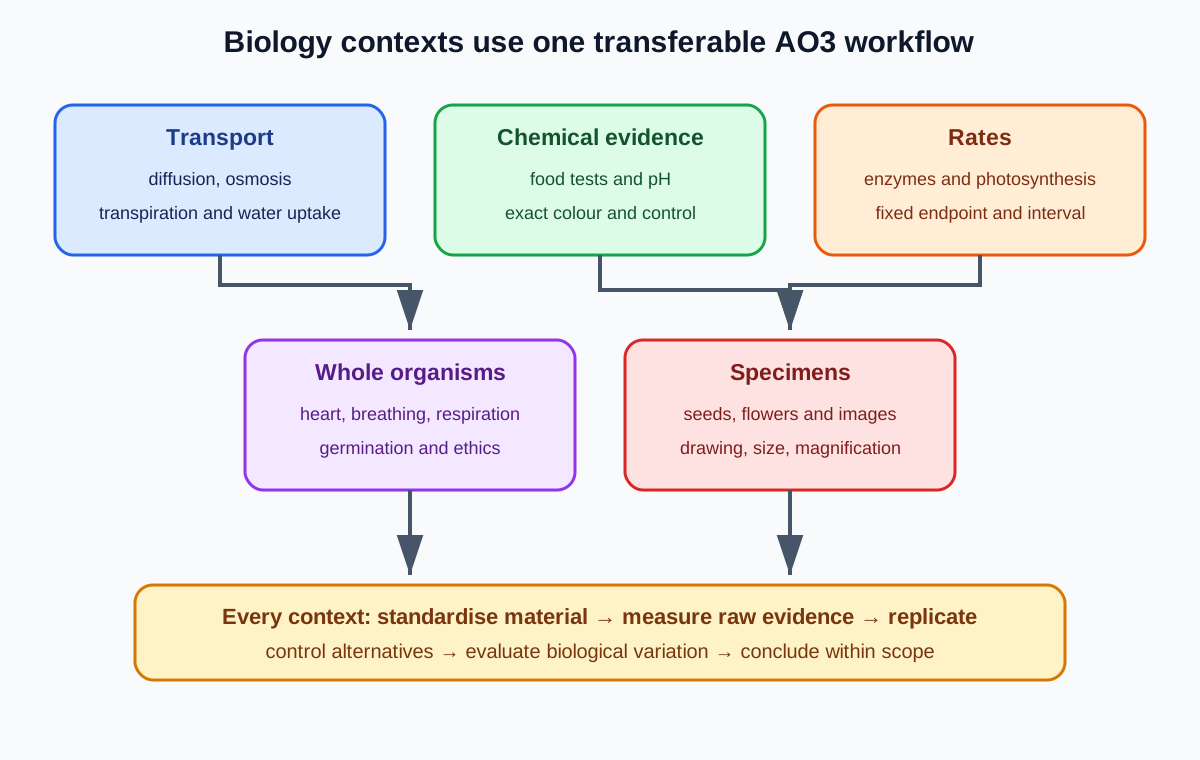
Cambridge IGCSE Combined Science 0653 Biology practical questions apply transferable AO3 skills to a stated set of experimental contexts. The list guides preparation but does not prescribe fixed recipes. Candidates may need to use simple apparatus in an unfamiliar procedure, so every investigation must be understood through variables, measurement, evidence, safety and evaluation.
Quantitative Biology begins with suitable measurement
Official contexts include measuring gas and liquid volumes, masses, temperatures, times and lengths.
Choose apparatus for range and resolution, then standardise the biological material. Equal starting mass does not guarantee equal surface area, age or physiological condition, so identify the characteristics that could affect the response.
Record raw values before derived rates or percentages and expect natural biological variation.
Diffusion investigations track net particle movement
A diffusion setup may use dye, agar or partially permeable material to show movement down a concentration gradient.
Define a visible or measurable endpoint, such as distance travelled by a colour boundary over time. Control sample dimensions, temperature, starting concentration and observation interval.
Cutting unequal blocks changes diffusion distance and surface-area relationships, so measure dimensions rather than relying on visual similarity.
Osmosis investigations compare water movement
Osmosis contexts may use plant tissue or partially permeable tubing in solutions of different concentration.
Measure initial and final mass, length or volume using a consistent blotting and timing method. Percentage change supports comparison when samples begin at different sizes.
State direction carefully: a mass increase supports net water entry; a mass decrease supports net water loss. Solute itself is not assumed to cross the partially permeable membrane.
Food tests require exact observations
For starch, add iodine solution; a positive result is blue-black. For reducing sugar, add Benedict's solution and heat using a water bath; a positive result can progress from blue through green, yellow or orange to brick-red depending on conditions and amount.
For protein, use biuret reagent; a positive result is purple or lilac. For lipid, mix with ethanol and then add water; a white emulsion supports lipid.
Record starting and final appearance rather than writing only “positive”. Use fresh portions to avoid reagent contamination.
Food-test controls strengthen interpretation
Check this topic from memory
Attempt the matching topic bank before reopening the notes. Use each missed idea to decide what to review next.
A known positive sample checks that reagent and procedure can produce the expected result. Distilled water or another known negative sample checks for contamination or a reagent background.
Use equal sample and reagent volumes when comparing intensity. Colour strength can suggest a difference, but an ordinary visual test is not automatically a calibrated concentration measurement.
Ethanol is flammable, so keep it away from naked flames and use a water bath where heating is required elsewhere.
Enzyme investigations need a fixed endpoint
Official contexts include rates of enzyme-catalysed reactions and judging endpoints such as colour changes.
Possible independent variables include temperature, pH, enzyme concentration or substrate concentration. Change one while controlling enzyme and substrate quantities, total volume and endpoint method.
If rate is represented by reciprocal time, every trial must reach the same defined endpoint.
Temperature must be set and checked
Use a controlled water bath to establish temperature, allow solutions to equilibrate and check the reaction mixture where feasible.
Starting solutions at different temperatures or allowing rapid cooling confounds the intended comparison.
Use a safe range. A pilot can identify temperatures that produce measurable times without making the reaction immediate or excessively slow.
pH investigations require controlled conditions
Universal indicator, litmus and hydrogencarbonate indicator are among the official contexts and familiar materials.
When pH is the independent variable, prepare or use stated conditions consistently and keep temperature and reactant quantities constant. When pH is the dependent evidence, match the indicator to the required range and record exact colour.
Indicator colour is an observation; pH is the inference or measured estimate.
Photosynthesis rate can be estimated in several ways
The official context includes rate and limiting factors. A setup may count bubbles, collect gas volume or measure another stated response.
Gas volume is more direct than bubble count because bubble sizes can vary. If bubbles are used, keep the plant species and length, water conditions, counting interval and orientation constant.
Changing lamp distance affects light intensity but can also change temperature, so monitor or control heating.
Distance from a lamp is not itself light intensity. A question may provide a relationship or ask candidates to compare distance as a practical proxy.
Shielding or a water heat screen can reduce temperature change. Background light should be controlled.
Do not claim carbon dioxide is the limiting factor unless the design changes or measures it and holds alternatives appropriately.
Transpiration measurements often estimate water uptake
A potometer can track movement of an air bubble as an estimate of water uptake, which is related to but not identical to water loss by transpiration.
Make connections watertight, cut plant material appropriately under supervision and allow the setup to settle. Control leaf area, temperature, air movement, humidity and light when another factor is tested.
A leak can move the bubble without the intended biological process and is a method failure, not biological variation.
Heart rate and breathing rate involve human participants
Measure a resting baseline, use a standardised safe activity and intensity, and record heart rate or breathing rate over a defined interval. Allow adequate recovery.
Obtain consent, avoid unsuitable participants or extreme exercise, and use a stop rule if anyone feels unwell.
Individual fitness creates variation. Repeated measures on one person answer a different question from comparisons across a larger participant sample.
Respiration contexts require a valid indicator
Respiration may be investigated through temperature change, gas exchange or indicators such as limewater, hydrogencarbonate indicator or methylene blue in a stated setup.
Use a living experimental sample and an appropriate non-living or no-organism control where it isolates the biological cause. Control sample mass, temperature and duration.
Gas-tight apparatus may be essential, but completely sealing living organisms without a safe, suitable design is not acceptable.
Germination needs suitable conditions and controls
Investigations may compare water, oxygen or temperature conditions, or observe changes during germination.
Use seeds of the same species and similar starting condition, enough seeds to reduce the influence of one abnormal individual, and a consistent germination criterion.
A percentage germinated is often more comparable than raw count when group sizes differ.
Seeds and flowers should be observed, not recalled
The practical context includes observation and dissection of seeds and flowers.
Follow the supplied specimen and use forceps, mounted needles or a cutting tool appropriately. Identify visible structures from position and appearance rather than drawing an idealised textbook memory.
Handle sharp tools on a cutting surface and away from fingers.
Biological drawings communicate visible evidence
Use clear, continuous single lines, no shading and a size large enough to show the required detail. Draw only what is visible in the specimen or image.
Keep proportions and spatial relationships accurate. Label lines should be ruled, point exactly to the structure and avoid crossing where possible.
A title or stated view clarifies what was drawn.
Magnification and actual size must use common units
Magnification is image size divided by actual size. Rearrange to find actual size as image size divided by magnification.
Measure the image along the requested dimension and convert image and actual size to the same unit before dividing.
Magnification has no unit because it is a ratio of two lengths in the same unit.
Unfamiliar specimens still use familiar skills
Candidates may observe, record and measure images of familiar or unfamiliar biological specimens.
Start with visible features: count, shape, relative size, boundary, branching, colour where relevant and labelled dimensions. Do not invent functions or identities when the question asks only for observations.
Transfer measurement, drawing and comparison rules even when the organism has not been memorised.
Evaluate biological variation explicitly
Different organisms and tissue pieces can vary despite careful preparation. Use independent replicates, random or systematic selection appropriate to the question and sufficient sample size.
Standardisation reduces known differences but cannot make living material identical.
An improvement should name the variation, its effect and how selection, matching or replication reduces its influence.
Worked application: investigate amylase and temperature
Prepare equal volumes and concentrations of amylase and starch, buffer them at the same pH and use at least five safe water-bath temperatures. Allow both solutions to reach each temperature before mixing. At fixed intervals, place a sample onto iodine on a spotting tile and stop timing when iodine remains brown, showing the same starch-disappearance endpoint. Repeat each temperature and calculate mean time or reciprocal time. If samples cool during transfer, actual temperature differs from the intended value and weakens the comparison; keep reaction vessels in controlled baths and check mixture temperature rather than merely adding repeats.
Common misconceptions and corrections
Treating the context list as guaranteed fixed experiments. Unfamiliar procedures can be used.
Ignoring biological variation. Standardise and use independent replicates.
Calling every different specimen an error. Genuine variation is expected.
Comparing raw mass change for unequal samples. Use percentage change where appropriate.
Saying mass gain means solute entered. It supports net water entry in the osmosis context.
Using unequal tissue dimensions. Diffusion distance and surface area then differ.
Writing “positive” for a food test. Record the colour or emulsion.
Heating ethanol over a flame. It is flammable.
Using the same portion for every food test. Reagents contaminate later tests.
Calling visual colour intensity an exact concentration. It is not automatically calibrated.
Changing pH and temperature together in an enzyme test. The cause is confounded.
Using reciprocal time with different endpoints. Fix the endpoint.
Starting enzyme timing before mixing. Define the reaction start.
Setting a bath temperature without equilibrating solutions. The reaction may begin elsewhere.
Counting bubbles as exact gas volume. Bubble size varies.
Calling lamp distance light intensity. It is a distance used to alter illumination.
Ignoring lamp heating. Temperature can become a confounding variable.
Claiming a factor is limiting without testing alternatives. Scope the inference.
Calling potometer uptake identical to transpiration. It is an estimate related to water loss.
Ignoring a potometer leak. Bubble movement may be invalid.
Using extreme exercise to enlarge results. Human investigations must remain safe.
Skipping consent and stop rules. Ethical controls are required.
Comparing participants without standardised activity. Intensity must be controlled.
Using no control in a respiration setup. Isolate the living cause where appropriate.
Using different numbers of seeds but comparing raw counts. Use percentage germination.
Drawing a remembered flower. Draw the supplied specimen.
Shading a biological drawing. Use clear line work.
Sketching label lines freehand across one another. Rule and place them clearly.
Calculating magnification with mixed units. Convert first.
Giving magnification a length unit. It is a ratio.
Inventing features on an unfamiliar specimen. Report visible evidence.
Saying more repeats correct every flaw. They do not repair confounding, leaks or bias.
Handling a scalpel toward fingers. Use a tile and cut away.
Sealing living organisms without considering safety. Use the specified safe setup.
Generalising one species' result to all organisms. Keep the conclusion scoped.
Assessment guidance
Biology practical answers should operationalise variables, standardise living material and preserve exact observations. Food tests need reagent, condition and final appearance. Rate investigations need one changing factor, a fixed endpoint, repeats and a suitable rate measure. For transport or gas setups, identify leaks and confounding temperature. Human work requires consent, standardised safe activity and stop rules. Drawings must represent the supplied specimen with clear lines and accurate proportions. Magnification calculations require common units. Evaluate biological variation through independent replication rather than dismissing it as error.
Retrieval practice
Reconstruct all four food tests with controls and safety. Plan one diffusion, osmosis, enzyme, photosynthesis, transpiration, exercise, respiration and germination investigation using operational variables and targeted evaluation. Produce a specimen drawing checklist, solve five magnification conversions and diagnose thirty context-specific errors involving variation, endpoints, leaks, heat, contamination, ethics and unsupported conclusions.
Topic ownership
This note owns the complete official Biology experimental-context list and representative application of AO3 across those contexts. It does not claim a prescribed experiment inventory. Practical 2 owns generic planning and evaluation, Practical 3 owns generic data presentation, and Practical 8 owns consolidated apparatus and safety. Biology theory notes own mechanisms used to predict and explain the observed patterns.