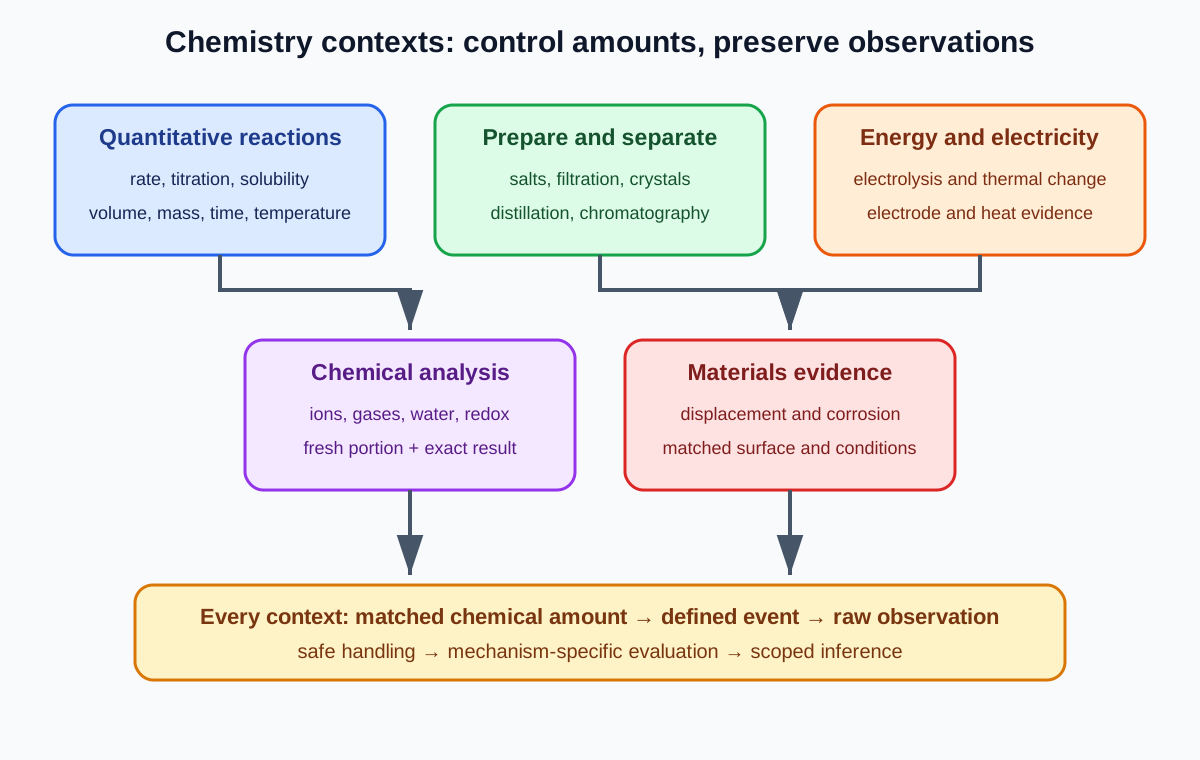
Cambridge IGCSE Combined Science 0653 Chemistry practical questions apply AO3 to quantitative work, reaction rates, salt preparation, separation, electrolysis, chemical tests, titration, solubility, thermal change, displacement and corrosion. These are official contexts, not guaranteed recipes. Candidates must transfer method, observation and evaluation skills to unfamiliar simple apparatus.
Official contexts include measuring gas or liquid volume, mass, temperature, time and length.
Choose apparatus for range and precision, use consistent units and preserve raw readings. Chemical comparisons also require controlled concentration, volume, mass, particle size and temperature unless one is deliberately changed.
Start and stop measurement at defined physical events such as mixing, first electrical connection or a stated endpoint.
Reaction rate can be measured in several ways
Gas-producing reactions can be followed with a gas syringe. Reactions that release gas can also be followed by mass loss when safe and appropriate. A visible change can provide a fixed endpoint.
Rate concerns change per unit time, not simply final product. Compare the same stage of reaction or obtain gradients from a quantity-time graph.
Each method has a different limitation: leaks lower gas volume, drafts disturb mass readings and visual endpoints introduce observer judgement.
A gas-volume rate setup must be sealed
Connect the reaction vessel to a gas syringe with gas-tight tubing and a suitable bung. Check free syringe movement and begin timing at mixing.
Record gas volume at regular intervals without exceeding syringe capacity. Keep reactant amounts and temperature controlled.
A leak systematically lowers collected volume and cannot be repaired by taking more repeats of the same leaking setup.
A mass-loss method must let gas escape safely
Place the reacting vessel on a balance and use a loose plug only if it prevents spray without sealing the gas path.
Record mass at regular times. The decrease estimates gas leaving the system.
The method is unsuitable when loss by evaporation or splashing is significant because mass change would no longer represent only the intended gas product.
Visible endpoints must be standardised
A cross-disappearance, colour change or precipitate threshold can provide a reaction time.
Use the same observer position, lighting, vessel, volumes and endpoint criterion. Stop timing at the same defined appearance for every trial.
Check this topic from memory
Attempt the matching topic bank before reopening the notes. Use each missed idea to decide what to review next.
A light sensor or colorimeter may reduce subjective judgement when it measures the relevant change, but the instrument and benefit must be named.
Salt preparation depends on solubility and reactant type
For a soluble salt made from acid and an excess insoluble solid, add the solid until no more reacts, filter off excess and crystallise the filtrate.
For an acid-alkali route, use titration to find neutral reacting volumes because both reactants are soluble and excess cannot be removed by filtration. Repeat using measured volumes without indicator if pure crystals are required.
For an insoluble salt, mix suitable soluble solutions and collect the precipitate by filtration, washing and drying.
Crystallisation preserves the wanted solute
Concentrate the solution by controlled heating, then allow cooling or further evaporation to form crystals.
Do not heat automatically to complete dryness. Strong heating can decompose some solids or produce powder instead of well-formed crystals.
Separate crystals from mother liquor and dry them using an appropriate method stated in the question.
Filtration separates an insoluble solid
Fold and place filter paper correctly in a funnel. The insoluble solid remains as residue while solution passes as filtrate.
Filtration cannot remove a dissolved solute. Select it only when the target difference includes insolubility or solid particle size.
Wash a precipitate with a suitable small volume of solvent to remove soluble contamination without dissolving substantial product.
Simple distillation collects a volatile liquid
Heat the mixture so the more volatile component vaporises, then cool vapour in a condenser and collect the distillate.
Ensure the apparatus is not sealed. Position cooling-water connections as instructed and use anti-bumping measures only where supplied or directed.
Distillation is selected when the liquid is wanted; evaporation would lose it to the surroundings.
Use a fractionating column when miscible liquids have different boiling points and repeated vaporisation-condensation improves separation.
Record temperature where the question requires fraction identification or collection ranges.
Do not confuse fractional distillation with cracking. The practical separation does not create new molecules.
Chromatography needs a suitable solvent
Place small concentrated spots on a pencil baseline above the solvent. Cover the container where instructed and mark the solvent front promptly.
Compare unknowns with references under the same conditions and measure both spot and solvent-front distance from the baseline for Rf.
Ink baselines dissolve and interfere, while spots immersed in solvent can wash away rather than travel through the paper.
Electrolysis links apparatus to observations
Identify the electrolyte, inert or reactive electrodes, power supply and electrode polarity. Keep electrode area, separation, current or potential difference and time controlled when comparing products or amounts.
Record gas, colour, coating or mass change at the named electrode. Test products safely with small quantities.
Switch off before reconnecting apparatus and avoid short circuits or direct contact with hazardous electrolytes.
Qualitative analysis uses fresh portions
Identification of metal ions, non-metal ions and gases is an official context. Use a fresh portion for each branch, add reagents in the stated order and record colour, precipitate, solubility in excess or gas-test result before inferring identity.
The provided qualitative-analysis notes support both practical routes but do not choose the correct test sequence.
Practical 6 owns the complete prescribed workflow and observation matrix.
Water tests require dry starting reagents
Anhydrous cobalt(II) chloride changes from blue to pink in the presence of water. Anhydrous copper(II) sulfate changes from white to blue.
Keep the reagent dry before testing or a pre-existing colour change invalidates the observation.
A positive result shows water is present, not that the sample is pure water.
Dilute-acid reactions need gas confirmation
Acids can be tested with metals, bases, carbonates or other specified substances. Record warming, dissolving, effervescence, colour and residue where relevant.
Do not identify a gas from bubbles alone. Apply the correct confirmatory test to a safely collected or presented sample.
Control acid volume and concentration when comparing reactivity.
Oxidising and reducing tests depend on stated reagents
The official context includes tests for oxidising and reducing agents. Follow the reagent and observation information supplied or required by the question.
Use separate clean portions so one redox reagent does not contaminate the next. Record the actual colour transition rather than only “oxidised”.
Do not invent a universal test when the task provides a specific system.
Titration needs accurate delivered volume
Use a volumetric pipette and filler for the fixed aliquot and a burette for variable titrant volume. Remove the filling funnel before readings, read at eye level and obtain delivered volume from final minus initial reading.
Use an indicator appropriate to the stated titration, add it sparingly and approach the endpoint dropwise while swirling.
Repeat to obtain consistent titres according to the task, preserving all raw readings rather than reporting only a selected mean.
Solubility investigations require temperature control
Solubility may be investigated by mass dissolved in a fixed solvent quantity at a stated temperature or by crystallisation evidence from saturated solutions.
Maintain temperature, allow sufficient mixing and distinguish undissolved solid from dissolved material.
Evaporation changes solvent amount and can falsely raise apparent concentration, so cover or shorten exposure where appropriate.
Melting and boiling evidence needs a defined criterion
Record temperature during a state change using appropriate apparatus and heating control. A pure substance is expected to change over a sharper range than an impure sample in common school interpretation.
Keep thermometer position consistent and avoid touching the container wall if the intended measurement is the sample.
Do not copy the heater setting as though it were sample temperature.
Displacement comparisons need matched conditions
For metals or halogens, use equal solution volumes and concentrations, comparable solid amount or surface preparation, equal time and the same observation criteria.
Evidence may include coating, colour change, dissolving or temperature change. A no-visible-change result is valid when properly controlled.
Use the observation to infer relative reactivity within the tested substances only.
Use an insulated cup, lid where compatible, measured reactant quantities and a thermometer or temperature probe. Record an initial temperature and the highest or lowest reached after mixing.
Stir consistently and use the same timing method. Heat loss lowers an exothermic maximum, while heat gain raises an endothermic minimum toward room temperature.
Insulation and extrapolation can address heat exchange more directly than repeats alone.
Corrosion conditions need oxygen and water controls
Compare matched cleaned metal samples under conditions that isolate oxygen, water or another tested factor. Use a suitable control and allow the same duration.
Record rust or corrosion consistently by visible coverage, mass change or another defined measure.
Do not treat one unsealed container as oxygen-free or infer causation when temperature and moisture also differ.
Worked application: compare acid concentration and rate
Place equal masses of same-size marble chips in identical flasks and react them with equal volumes of acid at five concentrations while keeping temperature constant. Collect carbon dioxide in a gas syringe, start timing at mixing and record volume every ten seconds. Repeat each concentration and compare initial graph gradients rather than only final volume, which should depend mainly on limiting amount. A leaking bung would lower collected volumes and distort gradients; test connections before each run and replace a poor seal. More repeats cannot correct gas that consistently escapes before reaching the syringe.
Common misconceptions and corrections
Treating official contexts as guaranteed recipes. Unfamiliar simple methods can be assessed.
Calling final product amount the rate. Rate is change per time.
Comparing rate methods at different reaction stages. Use a common interval or gradient definition.
Ignoring a gas leak. Collected volume becomes systematically low.
Sealing a mass-loss setup. Gas must escape for mass to decrease.
Allowing splashes in mass-loss work. Mass change then has another cause.
Using a different visual endpoint each time. Standardise the criterion.
Saying a sensor is simply better. Name how it reduces judgement or improves resolution.
Using excess soluble alkali and filtering it off. Dissolved excess passes through.
Skipping filtration after excess insoluble solid. Unreacted solid contaminates the filtrate.
Heating every salt solution to dryness. Use controlled crystallisation.
Washing a precipitate with excessive solvent. Product may be lost.
Using filtration to separate dissolved salt. It passes with the filtrate.
Using evaporation when the solvent is wanted. Use distillation.
Sealing a distillation apparatus. Pressure can build dangerously.
Calling distillation a reaction. It is physical separation.
Calling fractional distillation cracking. Molecules are not chemically changed.
Drawing a chromatography baseline in ink. Ink can dissolve.
Submerging sample spots. They can wash into the solvent.
Measuring Rf from the paper edge. Measure from the baseline.
Reconnecting a live electrolysis circuit. Switch off first.
Recording only an inferred electrolysis product. State the electrode observation.
Using one sample portion for all ion tests. Reagents contaminate later tests.
Writing only the ion name in qualitative work. Record observation first.
Treating a positive water test as purity. It proves presence only.
Using already hydrated water-test reagent. The test is invalid.
Identifying a gas from effervescence. Confirm it.
Inventing one universal redox test. Use the specified reagent system.
Pipetting by mouth. Use a pipette filler.
Leaving the burette funnel in during readings. Extra drops can alter volume.
Reading a burette as direct volume remaining. Delivered volume is final minus initial.
Adding large titrant portions near endpoint. Approach dropwise.
Reporting only an average titre. Preserve raw readings.
Ignoring evaporation in solubility work. Solvent amount changes.
Reading the heater setting as sample temperature. Measure the sample.
Comparing displacement with unmatched surface areas. Conditions must be comparable.
Rejecting a no-change result. It can be valid evidence.
Using an uninsulated beaker for precise energetics. Heat exchange weakens the result.
Saying repeats remove heat loss. Insulation targets the mechanism.
Changing moisture and temperature together in corrosion tests. The cause is confounded.
Assessment guidance
Chemistry practical answers need quantities, concentrations, apparatus, a defined start and endpoint, exact observations and context-specific hazards. Rate work must separate speed from final yield and diagnose leaks, splashes or visual judgement. Preparation and separation questions should name the physical or solubility basis for each stage. Titration requires fixed and variable volume roles plus raw readings. Thermal and corrosion evaluations must identify heat exchange or uncontrolled conditions. Use fresh portions for analysis, preserve negative observations, and never replace observation with inference alone.
Retrieval practice
Design gas-volume, mass-loss and visual-endpoint rate methods and compare their limitations. Reconstruct three salt-preparation routes and five separation choices. Explain electrolysis, titration, solubility, thermal-change, displacement and corrosion controls. Build hazard-observation-evaluation chains for each context, then diagnose forty errors involving leaks, contamination, endpoint judgement, heat exchange, mismatched quantities and unsupported identification.
Topic ownership
This note owns the complete official Chemistry experimental-context list and representative AO3 application across preparation, measurement and reaction systems. Practical 6 owns the full prescribed qualitative-analysis sequence. Practical 2 owns generic planning, Practical 3 owns generic data presentation and Practical 8 consolidates apparatus and safety. Chemistry theory notes own the mechanisms used to explain observations.