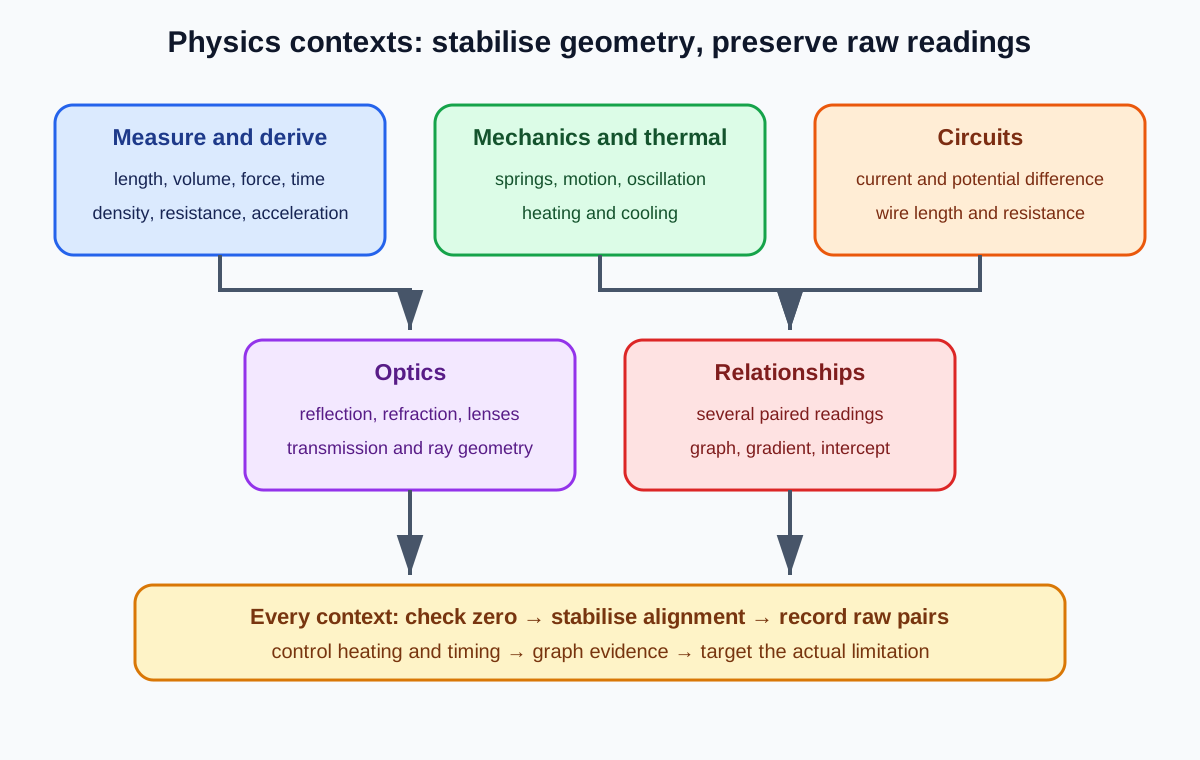
Cambridge IGCSE Combined Science 0653 Physics practical questions test measurement, derived quantities, relationships, comparisons, heating and cooling, springs, motion, circuits and optics. These contexts are not guaranteed recipes. Strong preparation connects stable geometry, correct instruments, raw readings, graphical evidence and method-specific evaluation so the same AO3 reasoning transfers to unfamiliar simple apparatus.
Physical measurements begin with a defined quantity
Official contexts include length, volume and force. Select a ruler, measuring cylinder, force meter or other stated instrument whose range and resolution fit the expected value.
Check zero, units and scale divisions before reading. Keep the eye perpendicular to the scale and use a set square or fixed pointer where alignment matters.
Record the raw reading before a difference, ratio or derived quantity.
Repeated objects improve a small-distance estimate
When one thickness or diameter is too small for a reliable direct measurement, measure many identical items together and divide by their number.
This makes the measured total larger relative to the ruler division. Keep objects tightly packed without gaps or overlap.
The method reduces percentage uncertainty from scale resolution, but it does not correct a damaged ruler zero or consistently compressed material.
Repeated cycles improve a short-time estimate
Time ten or more oscillations, then divide the total duration by the number of complete cycles to estimate one period.
Use a fixed fiducial marker and define the same phase of motion as the start and finish. Repeat the multi-cycle timing and calculate a representative value.
Counting an extra half-cycle creates a large method error that averaging cannot repair.
Derived quantities preserve their input evidence
Resistance may be calculated from potential difference divided by current; density from mass divided by volume; acceleration from change in velocity divided by time when the necessary data are supplied.
Keep the measured quantities in the table before the derived column. Use consistent units and show the calculation.
Uncertainty in the derived result depends on its inputs, so evaluate the weakest measurement rather than only the calculator output.
Density requires matched mass and volume
Measure mass with a balance. For a regular solid, calculate volume from carefully measured dimensions. For an irregular solid, use displacement when the material and setup make it suitable.
Avoid trapped air and read liquid volume at eye level. Dry the object before mass measurement if surface water would add unwanted mass.
Check this topic from memory
Attempt the matching topic bank before reopening the notes. Use each missed idea to decide what to review next.
When comparing densities, use the same unit system and do not confuse mass with weight.
Relationship tests need several paired values
To identify how two variables are related, choose a useful range of at least several independent-variable values, record paired results and plot an appropriate graph.
Control other factors and change one variable at a time. A straight line through the origin can support direct proportionality only when the fit and intercept evidence justify it.
Do not infer a complete relationship from two readings.
Angle comparisons need a common reference
For reflection or refraction, angles are measured from the normal, not from the surface.
Draw thin lines, mark ray points precisely and use a protractor whose centre and baseline align with the intersection and normal.
Repeat for several angles where a relationship is tested. Wide point separation reduces angular sensitivity to a small plotting error.
Heating and cooling require timed temperature evidence
Measure initial temperature, start timing at the defined heating or cooling event and record at regular intervals.
Control liquid mass or volume, container material, exposed area, heater power and surroundings when comparing one factor. Stir gently where instructed to reduce temperature gradients.
Heat exchange with the room is part of many limitations, so use insulation or a lid when compatible with the question.
Cooling comparisons need equal starting conditions
Begin compared samples at the same checked temperature and use identical thermometer position and timing.
A sample starting hotter can show a larger decrease without the tested container or insulation being more effective.
Plot temperature against time or compare temperature decrease over the same interval, then scope the conclusion to the tested range.
Spring investigations need a fixed reference
Clamp the spring securely, place a ruler beside it and use a pointer or set square to read length without parallax.
Record original length before loading. Extension is loaded length minus original length. Add masses safely and allow oscillations to settle before reading.
Use several loads within a safe range and do not exceed the region or maximum load specified.
Force-extension graphs separate reading from inference
Plot force against extension in the orientation requested. A straight region supports a constant relationship; its gradient depends on which variable is placed on each axis.
Do not use mass as force without applying the relationship or conversion supplied by the course context.
Permanent extension after unloading indicates that the spring did not return fully, which affects repeat use.
Motion experiments need a precise event definition
Measure a known distance and the time to travel it, or use supplied sensors or timing marks. Release objects consistently without adding an uncontrolled push.
For acceleration, collect enough time, distance or velocity evidence to apply the stated processing method.
Human reaction time is significant for short intervals, so longer travel, automated sensing or repeats can improve the design depending on the setup.
Pendulum geometry uses the effective length
Measure from the pivot to the centre of the bob, not to its top or bottom. Use a small consistent displacement and release without pushing.
Time multiple complete oscillations from a fiducial marker. Keep bob, amplitude and release method controlled while changing length.
Do not start or stop at different phases of the cycle.
Build circuits with the supply off
Connect or reconnect components while the switch is open or the supply is off. Check the circuit against the diagram before energising.
An ammeter is placed in series with the component so the same current passes through it. A voltmeter is connected in parallel across the component.
Select safe meter ranges and observe polarity for direct-current apparatus.
Measure current and potential difference correctly
Read analogue meters perpendicular to the scale and interpret the selected range. Record digital readings with supported precision.
Keep meter placement constant and record paired current and potential-difference values before calculating resistance.
Connecting an ammeter directly across a supply can produce a dangerously large current and invalidate the circuit.
Wire investigations must control heating and geometry
When testing potential difference, current or resistance against wire length, keep material and diameter constant and measure the effective length between contacts.
Use low current, switch off between readings and take measurements promptly to reduce heating, because temperature can change resistance.
Contact resistance and loose clips can add unwanted variation; clean and secure contacts consistently.
Optics pins define ray direction
Place pins vertically and sufficiently far apart. Align images or pins at eye level to reduce parallax.
Mark pin positions as small points, remove the block or mirror only after tracing its outline, then draw rays through the recorded points with a ruler.
Thick lines and closely spaced points make angle measurements less precise.
Mirror reflection needs a normal
Trace the mirror line or use the supplied reference, draw the incident ray and construct a normal at the point of incidence.
Measure incident and reflected angles from the normal. Compare them within experimental accuracy and repeat at several incident angles where required.
Do not measure either angle from the mirror surface.
Refraction work preserves the block position
Trace the rectangular or semicircular block accurately before placing pins or marking rays. Do not move it during the observation sequence.
After removing the block, join precise points to reconstruct the ray path and measure angles from the normal.
If the outline is displaced, the reconstructed entry and exit points no longer represent the actual path.
Lens investigations need sharp-image criteria
Align object, converging lens and screen along one axis. Adjust positions to produce the sharpest image, then measure stated object, image or focal distances from consistent reference planes.
Darkening the surroundings can improve image visibility, but it does not correct misalignment.
Repeat measurements from different starting positions to reduce subjective focusing effects.
Light-transmission comparisons require a detector rule
Transparent, translucent and opaque materials may be compared by visible image, transmitted brightness or a supplied detector.
Keep source distance, detector distance, material area, thickness where relevant and ambient light controlled.
Do not infer exact transmitted intensity from a subjective label unless the method provides a calibrated measurement.
Unfamiliar apparatus still follows measurement logic
Identify what each component changes, measures, supports or controls. Trace the physical pathway: force, motion, heat, current or light.
Then locate likely scale, alignment, timing, connection and environmental errors.
Do not reject a procedure because its apparatus arrangement was not memorised; transfer the same AO3 principles.
Worked application: test resistance against wire length
Build a circuit with the test wire and ammeter in series and a voltmeter across the selected wire length. With the supply off, set at least five measured lengths using secure contacts while keeping wire material and diameter fixed. Switch on briefly, record current and potential difference, then switch off to reduce heating. Calculate resistance for each length and plot resistance against length. If contact clips add variable resistance, points scatter and the gradient becomes uncertain; clean contacts, use firm identical clips and repeat the circuit readings rather than merely measuring wire length more carefully.
Common misconceptions and corrections
Treating the context list as guaranteed recipes. Unfamiliar simple apparatus may be used.
Reading a ruler from a damaged zero without correction. Start elsewhere and subtract.
Measuring one tiny object directly. Measure many and divide where suitable.
Leaving gaps between repeated objects. The total becomes too large.
Saying repeated objects correct zero error. They reduce percentage resolution uncertainty only.
Timing one fast oscillation. Time many complete cycles.
Counting half-cycles inconsistently. Define a complete cycle.
Using different start and stop phases. Use the same fiducial crossing and direction.
Reporting only a derived value. Preserve measured inputs.
Mixing units in density or resistance work. Convert explicitly.
Leaving air attached during displacement. Measured volume becomes too large.
Using two points to establish a relationship. Collect several pairs.
Calling any straight line direct proportion. It must be consistent with the origin.
Measuring reflection angle from the mirror. Measure from the normal.
Using thick ray lines. They increase positional uncertainty.
Starting cooling samples at different temperatures. The comparison is confounded.
Moving a thermometer between depths. Position affects readings.
Placing optics pins close together. Small position error creates large angular error.
Allowing pins to lean. Alignment becomes ambiguous.
Moving an optics block before marking. The reconstructed path is invalid.
Drawing rays before marking actual points. Record evidence first.
Measuring lens distance from inconsistent positions. Use the specified reference.
Calling the brightest guessed image the sharpest without repeats. Refocus from multiple starts.
Changing material distance in a transmission comparison. Geometry must remain controlled.
Saying more repeats fix misalignment. Correct the geometry first.
Assessment guidance
Physics practical responses should name the measured quantity, instrument, range, reading method and controlled geometry. Preserve raw inputs before density, resistance, acceleration or gradient calculations. Relationship claims need several paired values and a graph. For springs, separate length from extension; for oscillations, time multiple complete cycles. Circuits require supply-off reconnection, correct series or parallel meters and heating control. Optics answers need thin marks, wide point spacing, stable outlines and angles from the normal. Improvements must address the actual scale, timing, alignment, contact or heat-transfer limitation.
Retrieval practice
Plan measurements for small thickness, period, density and resistance, including raw tables and derived units. Design spring, cooling, motion, wire and light-transmission relationship tests. Reconstruct safe circuit and optics workflows, then diagnose forty errors involving zero, parallax, timing phase, start conditions, meter placement, heating, contact length, normals, pin spacing, moved outlines and unsupported proportionality.
Topic ownership
This note owns the complete official Physics experimental-context list and representative AO3 application across mechanics, thermal, spring, motion, circuit and optics systems. It does not claim a fixed prescribed-experiment inventory. Practical 2 owns generic planning, Practical 3 owns generic data presentation and Practical 8 consolidates apparatus and safety. Physics theory notes own the principles used to explain the measured patterns.