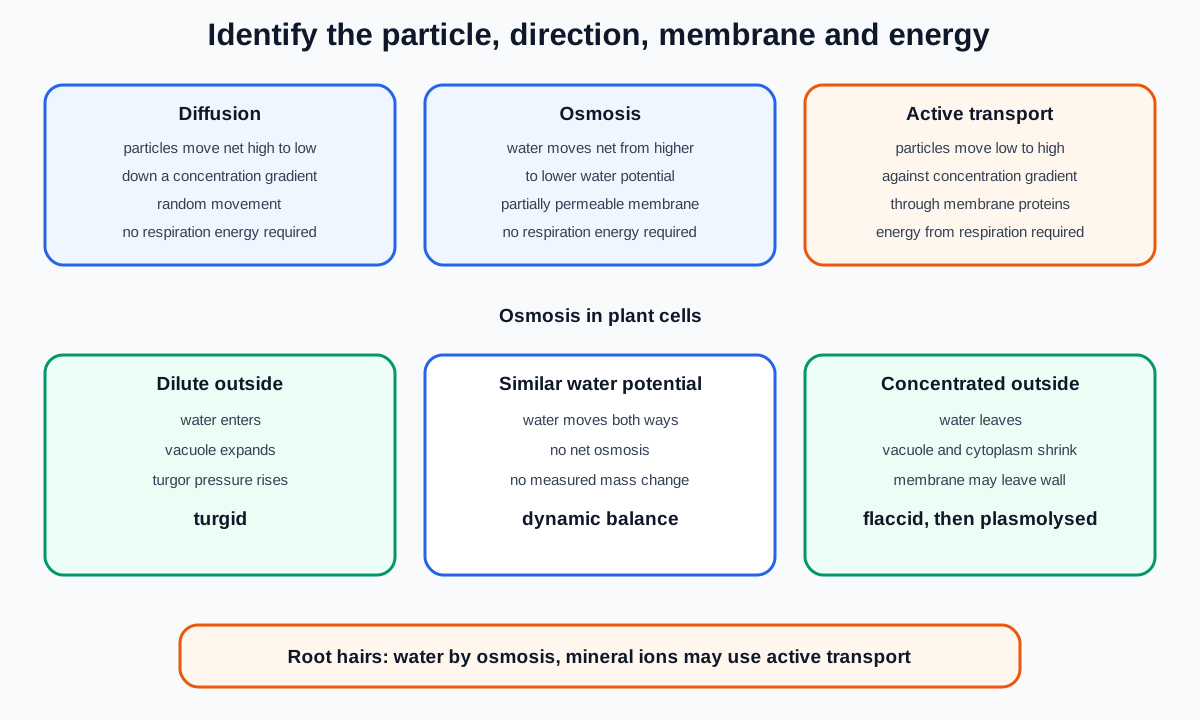
Cambridge IGCSE Combined Science Biology B3 covers diffusion, osmosis and active transport. The three processes differ in which particles move, the direction relative to a gradient, whether a partially permeable membrane is essential and whether energy from respiration is used.
Diffusion is net movement down a concentration gradient
Diffusion is the net movement of particles from a region of higher concentration to a region of lower concentration, down a concentration gradient, as a result of random movement.
Particles move randomly in all directions. More particles leave the high-concentration region than return to it, so there is a net movement down the gradient. Diffusion does not mean every particle travels in one direction.
As particles spread, the concentration difference decreases. At an even distribution, particles still move randomly, but there is no net movement between regions.
Diffusion is passive: it does not require energy from respiration. Temperature can change the kinetic energy and rate, but that is different from cells supplying metabolic energy to transport proteins.
Diffusion across cell membranes
Some gases and dissolved substances move into and out of cells by diffusion through the cell membrane.
Oxygen can diffuse from a higher concentration in alveolar air into blood and then into respiring cells. Carbon dioxide can diffuse in the opposite overall direction. Dissolved products of digestion can diffuse across surfaces when a suitable concentration gradient exists.
A cell membrane is not required for diffusion in general, but it is the boundary through which substances diffuse into and out of cells. The membrane's permeability affects which substances can cross.
Diffusion can supply or remove substances only while a gradient exists. Blood flow, ventilation and cellular reactions can help maintain gradients by continually transporting or using substances.
Four named factors affect diffusion rate
Surface area
A larger surface area gives more space across which particles can move at the same time, increasing overall diffusion rate. Folded exchange surfaces and many small structures can provide a large area.
Compare total exposed area, not merely the size of one face. Cutting the same volume into smaller pieces increases total surface area.
Temperature
At higher temperature, particles have greater average kinetic energy and move more rapidly. Random movement and successful crossing occur more frequently, so diffusion is faster.
Temperature can also affect membranes or biological material, so a practical should use a safe range and avoid changing the system itself.
Check this topic from memory
Attempt the matching topic bank before reopening the notes. Use each missed idea to decide what to review next.
A steeper concentration gradient means a larger concentration difference across a given distance. The imbalance between movement in opposite directions is greater, so net movement is faster.
Use “steeper gradient” rather than saying simply “more concentration.” Rate depends on the difference between regions.
Distance
A shorter diffusion distance reduces how far particles must travel. Thin exchange surfaces therefore support faster transfer than thick ones under otherwise equal conditions.
Distance is sometimes called diffusion path length. Keep surface area and gradient separate when explaining its effect.
Investigate diffusion with one changed factor
A model investigation may use coloured particles moving through a gel or a substance leaving pieces of biological material. Define the measurable outcome, such as distance travelled in a fixed time or time to reach a stated colour endpoint.
When testing surface area, use pieces with the same total volume or mass but different dimensions, then recognise that diffusion distance may also change. When testing temperature, keep piece size, initial concentration, solution volume and endpoint rule constant.
Independent repeats show reliability. A fair comparison requires the same starting material and consistent timing, mixing and measurement.
The model does not prove that all living membranes behave identically. State which transport feature the setup represents.
Osmosis is water movement
Osmosis is the net movement of water molecules from a region of higher water potential, a dilute solution, to a region of lower water potential, a concentrated solution, through a partially permeable membrane.
Only water is named in the definition. Do not describe sugar, salt or another solute as moving by osmosis.
A partially permeable membrane allows water through more readily than the solute involved. Without this selective boundary, water and solute may mix by other processes, but the setup does not demonstrate osmosis as defined.
Water moves in both directions through the membrane. Net movement is towards the lower water potential until the driving difference is reduced or opposed by pressure.
Water enters and leaves cells by osmosis
The cell membrane is partially permeable. If the solution outside a cell has higher water potential than the cell contents, net water movement is into the cell. If the outside has lower water potential, net water movement is out.
Avoid the vague phrase “water follows salt.” Compare water potential or, at this level, dilute and concentrated solutions on the two sides of the membrane.
Equal water potential gives no net osmosis, although individual water molecules continue moving both ways.
Plant cells in dilute solution
Water enters through the cell membrane by osmosis. The vacuole expands and pushes the cytoplasm and membrane against the cell wall.
The wall resists further expansion, producing turgor pressure. The cell becomes turgid. Turgid cells support non-woody plant tissues.
The wall prevents the cell from bursting under ordinary conditions. Do not say it stops water entering completely; it creates opposing pressure.
Plant cells in concentrated solution
Water leaves by osmosis. The vacuole and cytoplasm shrink, turgor pressure falls and the cell becomes flaccid.
With greater water loss, the cell membrane and cytoplasm pull away from the cell wall. This is plasmolysis. The wall retains its general shape while the living contents shrink.
Flaccid and plasmolysed are not synonyms. A flaccid cell has lost turgor; plasmolysis describes visible separation of the membrane or contents from the wall after more substantial water loss.
Investigate osmosis in plant tissue
Use equal-sized pieces from the same potato or other supplied plant tissue. Measure initial mass or length, place pieces in a range of solution concentrations for the same time, remove them, blot surfaces consistently and remeasure.
Control:
tissue source and initial dimensions
solution identity and volume
immersion time
temperature
blotting method
balance or ruler
A gain in mass supports net water entry. A loss supports net water exit. Surface solution left after removal makes final mass too high, so blot gently and consistently without squeezing water from the tissue.
Plot change against solution concentration. The point of no measured change estimates a concentration with similar water potential to the tissue under those conditions; it does not prove that water molecules stopped moving.
Active transport moves against a gradient
Active transport is movement of particles through a cell membrane from lower concentration to higher concentration, against a concentration gradient, using energy from respiration.
The process uses membrane transport proteins. It allows a cell to accumulate a substance even when its internal concentration is already higher.
Root hair cells can absorb mineral ions from dilute soil solution when ion concentration is lower outside than inside. Energy from respiration supports this uptake.
Active transport does not mean any fast movement or movement by an active organism. Its defining evidence is transport against a gradient using cellular energy.
If respiration is reduced by lack of oxygen or unsuitable temperature, active transport may slow. Diffusion itself does not directly require respiration.
Compare the three processes
Diffusion: particles move net from higher to lower concentration because of random movement; no metabolic energy is required.
Osmosis: water moves net from higher to lower water potential through a partially permeable membrane; no metabolic energy is required.
Active transport: particles move from lower to higher concentration through a membrane using energy from respiration.
All three can occur across cell membranes. Only osmosis is restricted to water, and only active transport moves against the concentration gradient in this syllabus model.
Worked application: interpret a potato experiment
Equal potato cylinders begin at 5.00 g. After one hour, the cylinder in dilute solution is 5.45 g, while the cylinder in concentrated sucrose is 4.55 g. The first gains water because the external solution has higher water potential, so net osmosis is into the cells and they become more turgid. The second loses water to the lower external water potential, so cells become flaccid and may plasmolyse. The result is not caused by sucrose moving by osmosis. If the pieces were not blotted consistently, retained surface solution could make final masses too high and weaken the comparison.
Common misconceptions and corrections
Saying diffusion is movement from high to low without “net.” Particles move both ways randomly.
Saying diffusion stops at even concentration. Random movement continues without net transfer.
Saying diffusion uses energy from respiration. It is passive.
Using “high concentration” without naming the substance. State which particles form the gradient.
Saying larger pieces always diffuse faster. Total surface area and path length matter.
Saying higher temperature makes particles larger. It raises average kinetic energy.
Omitting distance from the diffusion factors. A shorter path increases rate.
Defining osmosis as movement of any substance. It is net movement of water molecules.
Saying solute moves by osmosis. Solute may move by diffusion or transport, not osmosis.
Omitting the partially permeable membrane. It is essential to the definition.
Saying water moves from concentrated to dilute solution. Net movement is from dilute to concentrated solution.
Saying water potential is highest in the concentrated solution. Added solute lowers water potential.
Saying equal water potential means no molecular movement. It means no net osmosis.
Saying the plant wall controls osmosis. The cell membrane is partially permeable.
Saying a turgid cell has lost water. It has gained water and developed turgor pressure.
Calling every flaccid cell plasmolysed. Plasmolysis is a more specific membrane-wall separation.
Saying plant cells burst in dilute water. The wall resists expansion.
Weighing wet potato surfaces as tissue gain. Blot consistently first.
Calling active transport movement from high to low concentration. It moves against the gradient.
Saying active transport is active because particles move quickly. It is defined by gradient direction and energy use.
Saying root hairs absorb water by active transport. Water enters by osmosis; mineral ions may use active transport.
Saying respiration has no link to transport. It supplies energy for active transport.
Assessment guidance
Definitions need every discriminator: net direction and random movement for diffusion; water potential, water molecules and a partially permeable membrane for osmosis; movement against the concentration gradient using energy from respiration for active transport. Rate explanations should name the factor and connect it to particle movement or path length. Plant-cell questions need water direction, vacuole or cytoplasm change, turgor pressure and the correct term. Practical answers should control tissue dimensions, solution volume, time, temperature and blotting, then link mass change to net water movement rather than to solute movement.
Retrieval practice
Write and compare all three definitions from memory. Draw particle diagrams showing random movement and net direction. Explain each named diffusion factor through paired comparisons. Predict plant-cell states in six solutions and annotate wall, membrane and vacuole changes. Design a five-concentration potato investigation, diagnose ten method faults and interpret graphs containing mass gain, mass loss and a no-net-change point.
Topic ownership
This note owns diffusion, osmosis, active transport, the four diffusion factors, plant-cell water effects and the required plant-tissue investigation. B2 owns cell structures, B6 and B8 own plant nutrition and transport systems, and the practical hub owns general planning, graphing and evaluation conventions.