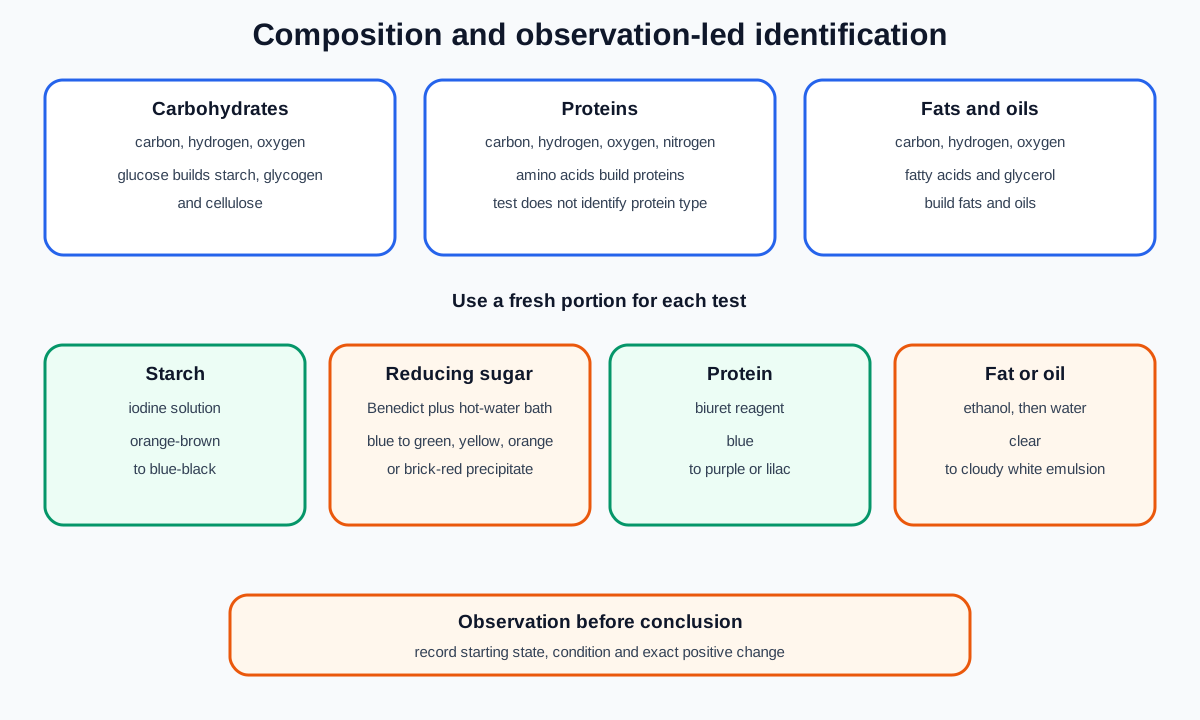
Cambridge IGCSE Combined Science Biology B4.1 links the elements in carbohydrates, fats and proteins to named small and large molecules, then requires four food tests: iodine for starch, Benedict's solution for reducing sugars, biuret for proteins and the ethanol emulsion test for fats and oils. This topic is about composition, building blocks and observation-led identification.
Elements in the three molecule groups
Carbohydrates contain carbon, hydrogen and oxygen.
Fats and oils also contain carbon, hydrogen and oxygen.
Proteins contain carbon, hydrogen, oxygen and nitrogen. Some proteins contain other elements, but nitrogen is the additional element required by this syllabus comparison.
Element lists do not describe molecular arrangement. Carbohydrates and fats can contain the same three elements while having different structures and properties.
Do not say food tests detect carbon, hydrogen, oxygen or nitrogen directly. They test for particular groups of biological molecules through characteristic reagent changes.
Large carbohydrate molecules are built from glucose
Starch, glycogen and cellulose are large molecules made from glucose units.
They are not interchangeable names:
starch is a glucose-based carbohydrate found as a storage molecule in plants
glycogen is a glucose-based storage molecule in animals and fungi
cellulose is a glucose-based structural molecule in plant cell walls
The official B4 boundary requires the building-block relationship. Their detailed bonding and chemical structures are not required here.
Glucose itself is a reducing sugar. Starch is not identified by the Benedict test in the same direct way because it is a different, larger carbohydrate.
Proteins are built from amino acids
Proteins are large molecules made from amino acids.
Different amino-acid sequences allow different proteins to form. The biuret test detects protein rather than identifying which protein or amino-acid sequence is present.
Do not call every nitrogen-containing substance a protein. The required evidence is the appropriate protein test under controlled conditions.
Enzymes are proteins, but their action and temperature or pH response belong to B5.
Fats and oils are built from fatty acids and glycerol
Fats and oils are made from fatty acids and glycerol.
The syllabus groups fats and oils together for this building-block relationship and for the ethanol emulsion test. A positive emulsion result does not distinguish a fat from an oil or identify a particular fatty acid.
Check this topic from memory
Attempt the matching topic bank before reopening the notes. Use each missed idea to decide what to review next.
Ethanol can dissolve lipids that do not dissolve in water. When water is added, tiny lipid droplets form a cloudy white emulsion if lipid is present.
Food tests need a complete evidence chain
For every test, write:
the prepared food sample
reagent and order of addition
any heating or mixing condition
starting appearance
exact positive result
molecule identified
Use a separate clean sample for each test. Reagents from one test can contaminate another and create misleading colours or precipitates.
A conclusion such as “protein present” is not an observation. Record the reagent change first, then infer the molecule.
Iodine solution test for starch
Add a few drops of iodine solution to the sample.
A positive result is a colour change from orange-brown to blue-black. If starch is absent, the iodine remains orange-brown.
No heating is required. Use a light-coloured spotting tile or test tube where the colour can be seen clearly.
The blue-black result identifies starch, not all carbohydrates. Glucose does not give the same positive iodine result.
Benedict's solution test for reducing sugars
Add Benedict's solution to the food sample, then heat the test tube in a hot-water bath for the stated time.
The starting solution is blue. A positive result may progress through green, yellow and orange to a brick-red precipitate as reducing-sugar concentration increases. Record the observed final colour and whether a precipitate forms.
Heating supplies the test condition. Do not heat a sealed tube, point it at people or heat it directly with an uncontrolled flame.
A blue result after correct heating supports no detectable reducing sugar under those conditions. It does not prove the sample contains no carbohydrate because starch requires its own test.
Colour intensity can support comparison only when sample volume, Benedict's volume, heating time, temperature and starting concentration are controlled. It is not automatically a precise concentration measurement.
Biuret test for proteins
Use the supplied biuret reagent or the reagent sequence specified by the question. Mix it with a fresh food sample.
The reagent is blue. A positive protein result is purple or lilac. If protein is absent, it remains blue.
No heating is required. Adding iodine or Benedict's solution to the same sample beforehand would contaminate the test.
State “purple” or “lilac” rather than “blue gets darker,” because the positive result is a distinct colour change.
Ethanol emulsion test for fats and oils
Add ethanol to a dry or suitably prepared sample and shake so any lipid dissolves. Then add water or pour the ethanol extract into water.
A positive result is a cloudy white or milky emulsion. If lipid is absent, the mixture remains clear.
Ethanol is flammable. Keep it away from naked flames and do not heat it directly. Stopper and shake only when the apparatus and instruction permit safe pressure release.
The positive appearance is an emulsion, not a white chemical precipitate formed by a new insoluble compound. Tiny lipid droplets scatter light.
Prepare an unknown food sample consistently
If the sample is solid, grind a measured mass with a measured volume of distilled water where the test permits, then filter or decant if a clear extract is required. Use the same preparation for samples being compared.
Label tubes before adding reagents. Include a known positive control if the investigation asks whether reagents are working, and a water negative control if appropriate.
Use equal sample and reagent volumes. A very dark original food colour can mask a test change; use a suitable diluted extract or compare with a sample blank when instructed.
Do not taste laboratory food samples. Treat all reagents and unknowns as laboratory chemicals.
Compare tests without mixing their conditions
Only Benedict's test among these four requires heating. Iodine and biuret are direct reagent-colour tests. The emulsion test requires ethanol followed by water.
The same starting colour word can have different meaning in different tests. Benedict's and biuret reagents both begin blue, but their positive outcomes differ.
A white emulsion is not the same observation as a brick-red precipitate. Use precise state terms: solution, precipitate and emulsion.
Interpret negative and weak results cautiously
A correct negative result supports that the tested molecule is not detected under the method conditions. It is not absolute proof of absence.
False or weak negatives can result from too little sample, excessive dilution, insufficient Benedict heating, expired reagent or failure to extract lipid into ethanol.
False positives can result from contaminated droppers, reused tubes or mixing test portions. Improve validity with clean labelled apparatus, fresh portions and controls.
Repeat unexpected outcomes. Do not change an observation merely because it conflicts with the food label or prediction.
Worked application: identify molecules in two samples
Sample A turns iodine solution from orange-brown to blue-black but remains blue after Benedict's solution is added and heated correctly. The observations support starch present but no detectable reducing sugar. Sample B gives a purple biuret result and forms a cloudy white emulsion after ethanol extraction and water addition, supporting protein and lipid. The emulsion tube must be kept away from flames because ethanol is flammable. If the same dropper had transferred biuret reagent into the Benedict tube, the results would be unreliable, so each reagent needs a clean separately labelled dropper and every test needs a fresh sample portion.
Common misconceptions and corrections
Saying proteins contain only carbon, hydrogen and oxygen. Nitrogen is also required in the syllabus list.
Saying carbohydrates and fats must be the same because they share elements. Molecular arrangements differ.
Saying starch is made from amino acids. Starch is made from glucose.
Saying glycogen is made from glycerol. It is made from glucose.
Saying proteins are made from fatty acids. They are made from amino acids.
Saying fats contain glucose building blocks. They are made from fatty acids and glycerol.
Using one sample sequentially for all tests. Use fresh portions to prevent contamination.
Writing only the molecule name. Record procedure and positive observation first.
Calling iodine solution blue before the test. It begins orange-brown.
Saying iodine tests every carbohydrate. It identifies starch.
Heating the iodine test. Heating is not required.
Forgetting to heat Benedict's test. Use a hot-water bath.
Calling every Benedict positive result brick red. Lower amounts may give green, yellow or orange.
Calling Benedict's final solid a solution colour only. A precipitate may form.
Using Benedict's test to rule out starch. It tests reducing sugars.
Heating the biuret test. No heating is required.
Calling unchanged blue a positive protein result. Positive is purple or lilac.
Adding water before ethanol in the lipid extraction without following the method. Extract into ethanol, then add water.
Calling the lipid result a coloured solution. It is a cloudy white emulsion.
Heating ethanol over a flame. Ethanol is flammable.
Saying a negative test proves complete absence. Detection and method limits matter.
Tasting an unknown food sample. Laboratory samples must not be consumed.
Assessment guidance
Composition questions require the exact element lists and the correct small-to-large molecule relationships. For food tests, state reagent, order, heating or mixing condition, starting appearance and positive result. Distinguish a precipitate from an emulsion and observation from conclusion. When comparing samples, keep sample mass, extract volume, reagent volume, heating time and temperature consistent. Evaluation answers should identify contamination, masking, extraction or heating failures and propose a matched correction. Safety answers should name ethanol flammability, hot-water or reagent hazards rather than use a generic caution statement.
Retrieval practice
Reconstruct the element and building-block map from memory. Make a four-row test table containing sample preparation, reagent, condition, negative result and positive result. Diagnose fifteen flawed methods involving shared portions, wrong order, missing heat, direct ethanol heating and vague colour language. Interpret twelve unknown-sample result sets and design a controlled comparison with positive and negative controls.
Topic ownership
This note owns elemental composition, the named building blocks and the four official food tests. B5 owns enzyme action, B6 and B7 own plant and human nutrition, and the practical hub owns general apparatus, table, safety and evaluation conventions beyond these specific procedures.