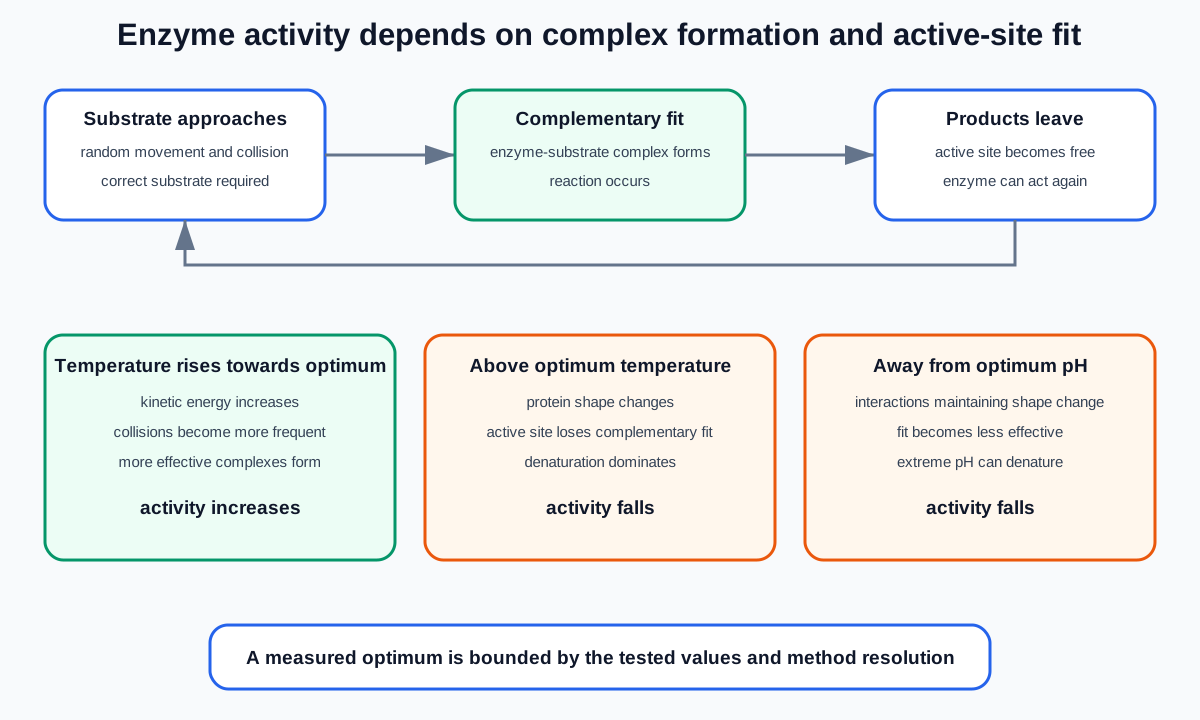
Cambridge IGCSE Combined Science Biology B5.1 defines enzymes as proteins that function as biological catalysts in metabolic reactions. It then develops active-site action, specificity, temperature and pH effects, effective collisions, denaturation and investigations of enzyme activity.
Enzymes are protein biological catalysts
Enzymes are proteins involved in metabolic reactions, where they function as biological catalysts.
A catalyst increases reaction rate without being used up overall. The enzyme can act again after products leave, although it may be damaged by unsuitable conditions.
Metabolism means the chemical reactions occurring in cells and organisms. Enzymes catalyse both breakdown and synthesis reactions. They do not supply energy to make an impossible reaction occur; they provide a route that allows the reaction to proceed faster under biological conditions.
Because enzymes are proteins, their three-dimensional shape matters. The region directly involved in substrate binding is the active site.
Substrate, active site and product
The substrate is the molecule or molecules on which an enzyme acts.
The active site is a region of the enzyme with a particular shape and chemical environment.
When a suitable substrate collides with the active site in the correct orientation, it binds and forms an enzyme-substrate complex.
The reaction occurs, converting substrate into product or products. Products have different shapes or interactions and leave the active site. The enzyme remains available for another cycle.
Do not draw the substrate permanently attached to the enzyme. A catalyst must be available again after the cycle.
Specificity comes from complementary shape and fit
An enzyme is specific because its active site has a complementary shape to its substrate.
“Complementary” means the shapes fit appropriately; it does not mean they are identical. A substrate with the wrong shape cannot form the required complex effectively.
Specificity helps cells control many reactions at the same time. Different substrates normally require different active sites and therefore different enzymes.
The simplified lock-and-key representation shows shape matching. It is a model, so diagrams should communicate fit and complex formation rather than suggest that enzymes and substrates are rigid household objects.
Check this topic from memory
Attempt the matching topic bank before reopening the notes. Use each missed idea to decide what to review next.
Collision frequency controls opportunities to react
Substrate particles move randomly and collide with enzyme molecules. Only collisions that bring a suitable substrate to an active site with enough energy and a useful orientation can form an effective complex.
More effective collisions per unit time produce a higher enzyme-controlled reaction rate, provided substrate, enzyme and other conditions are not limiting.
Increasing substrate concentration can raise collision frequency until active sites are occupied frequently. This is useful reasoning in supplied data, but the official B5 named investigations focus on temperature and pH.
Temperature below the optimum
At low temperature, enzyme and substrate particles have less kinetic energy. They move more slowly and collide less often. Fewer collisions form enzyme-substrate complexes per unit time, so activity is lower.
As temperature rises, average kinetic energy increases. Collision frequency increases and a greater number of collisions can be effective. Activity therefore rises towards an optimum under otherwise constant conditions.
Low temperature does not normally denature the enzyme. The active-site shape remains available, so activity can increase again if the system is warmed safely.
The optimum is a maximum under stated conditions
The optimum temperature is the temperature at which measured activity is greatest for that enzyme under the investigation conditions.
It is not one universal temperature for all enzymes. Enzymes from organisms living in different environments can have different optima.
An experimental optimum is also limited by the temperature values tested. If measurements use ten-degree intervals, the true maximum may lie between them. Use smaller intervals around the apparent peak to estimate it more precisely.
High temperature can denature the enzyme
Above the optimum, heat disrupts bonds maintaining the enzyme's three-dimensional shape. The active site changes shape.
The substrate is no longer complementary and cannot fit as effectively. Fewer enzyme-substrate complexes form, so activity decreases rapidly.
This shape change is denaturation. It is often irreversible under school-experiment conditions. Do not say the enzyme is killed because enzymes are molecules, not living organisms.
Temperature still increases particle movement, but loss of active-site fit becomes the dominant effect. A complete explanation includes both collision behaviour and shape.
pH changes active-site shape and fit
Each enzyme has an optimum pH or pH range under specified conditions.
Changing pH alters interactions that maintain protein shape. Away from the optimum, the active site's shape and charge environment become less suitable, so substrate fit and enzyme-substrate complex formation decrease.
At extreme pH, the enzyme can denature. Activity falls because the active site is no longer complementary to the substrate.
pH does not change because an enzyme “prefers a colour.” Indicators merely measure pH; hydrogen-ion conditions affect the protein structure.
Different enzymes can have different optimum pH values. Do not assume neutral pH is best for every enzyme.
Measure enzyme activity through a defined signal
Choose a dependent variable that changes as substrate disappears or product forms:
volume of gas produced per unit time
time to produce a fixed amount of product
time for a substrate test to become negative
colour or light-transmission change measured consistently
Rate is change per unit time. For a fixed common endpoint, reciprocal time can compare activity: a shorter time means a higher comparative rate.
Define the start event and endpoint. “Stop when it looks finished” is not reproducible.
Investigate temperature
Use the same enzyme and substrate amounts for every run. Place separate enzyme and substrate portions in a water bath at the chosen temperature long enough to equilibrate, then mix and start timing.
Test a safe range with several values and repeat each independently. Measure actual mixture temperature rather than assuming it equals the water-bath label.
Control:
enzyme source, concentration and volume
substrate source, concentration and volume
pH, often with a suitable buffer
total volume
mixing and sampling procedure
endpoint and observation interval
Changing temperature during the run weakens validity. Keep the reaction vessel in the controlled bath where the method allows.
Investigate pH
Use buffer solutions to set a range of pH values while keeping enzyme, substrate, temperature, volumes and timing constant.
Buffers help resist pH change during the reaction. Adding different uncontrolled volumes of acid or alkali can change both pH and total volume, introducing another variable.
Use enough pH values to reveal a peak, then repeat near the apparent optimum if greater resolution is required.
Do not reuse enzyme or substrate portions after exposure to an extreme pH. Denaturation may persist and contaminate the next condition.
Example endpoint: starch disappearance
A supplied method may combine amylase and starch, then place samples onto iodine solution at fixed intervals. Iodine remains orange-brown when no starch is detected; a blue-black result shows starch remains.
Place iodine drops on a spotting tile before starting. Sample with a clean method at regular intervals. Do not add iodine directly to the reaction mixture because iodine may affect the enzyme and prevents repeated independent sampling.
The endpoint is the first sample that remains orange-brown. The true completion time lies between that sample and the preceding blue-black sample, so a shorter sampling interval reduces timing uncertainty.
This is one valid context, not a promise that every examination uses amylase or starch.
Record and graph activity
Use a table with temperature or pH and unit where applicable, repeated endpoint times and processed rate.
Plot the independent variable horizontally and activity vertically. A temperature curve generally rises towards an optimum and falls more sharply when denaturation dominates. A pH curve shows reduced activity away from the optimum.
Do not force a symmetric curve or one exact optimum if the data do not support it. Mark anomalous results and investigate them rather than deleting them solely to improve the shape.
The vertical axis must show what was actually measured or calculated. Time to endpoint decreases as activity increases, whereas reciprocal time increases.
Evaluate common limitations
Temperature drift changes activity during the run. Equilibrate reagents and keep the vessel in a controlled water bath.
Slow sampling gives a wide endpoint interval. Sample more frequently with the same clean technique.
Different drop sizes change the amount tested. Use the same pipette and controlled drop volume.
Subjective colour judgement creates observer variation. Use the same endpoint reference or an instrumented colour measurement if available.
Unbuffered pH may change during reaction. Use an appropriate buffer and verify pH.
Biological enzyme sources may vary between portions. Prepare one well-mixed stock and divide equal volumes.
Safety
Wear eye protection and use a water bath rather than direct flame for controlled heating. Hot water and glassware can burn, so use a safe temperature range and stable vessels.
Buffers, acids, alkalis, iodine and enzyme preparations may be irritating. Use the supplied hazard information, small quantities and clean droppers. Do not consume laboratory enzymes or food substrates.
Worked application: explain a temperature dataset
An enzyme gives comparative rates of 0.020, 0.045, 0.080, 0.060 and 0.010 per second at 10, 20, 30, 40 and 60 degrees Celsius. Activity rises to the highest tested value at 30 degrees because particles gain kinetic energy, collision frequency increases and more effective enzyme-substrate complexes form. Above this point, activity falls despite faster particle movement because the enzyme's active site changes shape and loses complementary fit. The data identify 30 degrees only as the optimum among tested values. More temperatures near 30 degrees and independent repeats would locate the peak more precisely and test reliability.
Common misconceptions and corrections
Calling enzymes living organisms. They are protein molecules.
Saying enzymes are used up as reactants. They remain available overall.
Saying enzymes provide energy to reactions. They act as catalysts.
Calling every protein an enzyme. Enzymes are a functional group of proteins.
Calling the substrate the final product. It is the starting molecule acted upon.
Omitting the enzyme-substrate complex. It is the bound stage before products form.
Saying active site and substrate have identical shapes. Their shapes are complementary.
Saying one enzyme acts on every substrate. Active-site fit produces specificity.
Drawing products permanently attached. They leave and the enzyme can act again.
Saying low temperature denatures enzymes. It normally slows particle movement reversibly.
Explaining warming only as “the enzyme works harder.” Use kinetic energy and effective collisions.
Assuming 37 degrees is every enzyme's optimum. Optimum depends on enzyme and conditions.
Saying high temperature kills the enzyme. The protein is denatured.
Saying denaturation means the substrate changes shape. The enzyme active site changes.
Ignoring collision increase above the optimum. Shape loss outweighs it.
Assuming neutral pH is always optimum. Different enzymes have different optima.
Saying pH merely changes indicator colour. It affects protein shape and fit.
Changing pH with unequal liquid volumes without control. Use buffers and constant total volume.
Using endpoint time as if larger means faster. For a common endpoint, shorter time means higher activity.
Adding iodine directly to an amylase reaction. Test removed samples separately.
Taking only one trial per condition. Independent repeats are needed for reliability.
Removing an unexpected point without evidence. Investigate and repeat it.
Assessment guidance
Definitions should state that enzymes are proteins and biological catalysts in metabolic reactions. Mechanism answers need substrate, complementary active site, enzyme-substrate complex, product and enzyme reuse. Temperature explanations should separate the rising kinetic-energy and effective-collision effect from high-temperature shape change, lost fit and denaturation. pH explanations should connect changed conditions to active-site shape and fit. Investigation answers need a measurable rate signal, operational controls, equilibration or buffers, independent repeats and a defined endpoint. Graph conclusions should describe the measured pattern without claiming an optimum more precise than the tested values.
Retrieval practice
Draw the full enzyme cycle from memory and annotate specificity. Explain six temperature points and six pH points using active-site and collision language. Convert endpoint times into comparative rates. Design separate temperature and pH investigations, diagnose twelve faults and sketch expected graphs with axes. Write limitation-effect-improvement chains for temperature drift, unbuffered pH, irregular sampling, subjective colour, variable biological source and missing repeats.
Topic ownership
This note owns enzyme definition, action, specificity, temperature and pH explanations and the named investigation requirements. B4 owns biological molecule tests, B7 owns digestive enzymes and the practical hub owns general planning, graphing, risk and evaluation conventions.