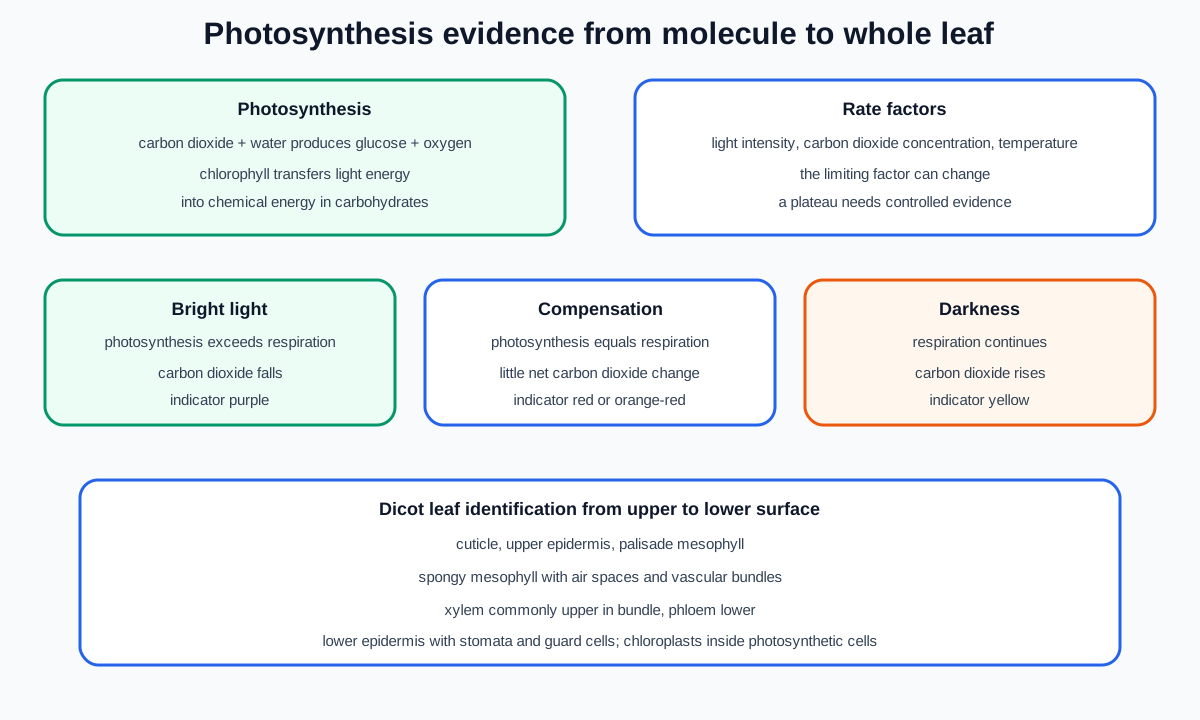
Cambridge IGCSE Combined Science Biology B6 covers photosynthesis, its equations, chlorophyll's energy-transfer role, investigations showing the need for chlorophyll, light and carbon dioxide, three rate factors, aquatic-plant gas exchange using hydrogencarbonate indicator and identification of a dicot leaf's listed structures.
Photosynthesis makes carbohydrates
Photosynthesis is the process by which plants synthesise carbohydrates from raw materials using energy from light.
The raw materials are carbon dioxide and water. The first named carbohydrate product in the equation is glucose, and oxygen is also produced.
The word equation is:
carbon dioxide + water produces glucose + oxygen, in the presence of light and chlorophyll.
Light is the energy source, not a material reactant. Chlorophyll enables energy transfer, so neither appears as a substance on the reactant side of the equation.
Balanced symbol equation
The Supplement equation is:
6COX2+6HX2OCX6HX12OX6+6OX2
Check this topic from memory
Attempt the matching topic bank before reopening the notes. Use each missed idea to decide what to review next.
Check atom balance rather than memorising coefficients in isolation. There are six carbon atoms, twelve hydrogen atoms and eighteen oxygen atoms on each side.
Do not confuse this equation with aerobic respiration. The photosynthesis arrow points from carbon dioxide and water to glucose and oxygen under light and chlorophyll conditions.
Chlorophyll transfers light energy
Chlorophyll is a green pigment found in chloroplasts.
It transfers energy from light into energy in chemicals for synthesis of carbohydrates. The chemical energy becomes associated with the products made by photosynthesis.
Avoid saying chlorophyll is an enzyme or a raw material. It is a pigment with an energy-transfer role.
Leaves can contain differently coloured regions. A variegated leaf provides a way to compare chlorophyll-containing green tissue with non-green tissue while other conditions are shared.
Test a leaf for starch
Starch testing provides evidence that photosynthesis produced carbohydrate over time.
Place the leaf briefly in hot water to stop reactions and disrupt cells.
Heat it in ethanol using a hot-water bath to remove chlorophyll.
Rinse or soften the decolourised leaf in water.
Spread it on a light surface and add iodine solution.
A blue-black result shows starch. Orange-brown iodine indicates no detectable starch.
Ethanol is flammable, so never heat it directly over a flame. The leaf becomes brittle in ethanol, which is why rinsing helps flatten it for observation.
The test detects starch, not photosynthesis at that exact instant. Experimental controls establish why starch accumulated.
Destarch before testing a requirement
Keep a healthy plant in darkness long enough for stored leaf starch to be used in respiration. This creates a low-starch starting point.
After the treatment, expose the plant to the experimental conditions, then test the relevant leaves for starch. Without destarching, pre-existing starch could produce a blue-black result even when the tested factor was absent.
Use a control plant or leaf region that receives all necessary conditions. A negative experimental result is meaningful only if the plant and test method can produce a positive control.
Investigate the need for light
Destarch a plant. Cover part of a leaf on both surfaces with opaque material while leaving the rest exposed. Place the plant in light, then test the leaf for starch.
The exposed region should turn blue-black if photosynthesis produces starch. The covered region should remain orange-brown because light was excluded.
Covering both surfaces prevents light entering from the other side. Keep chlorophyll, carbon dioxide, water and temperature shared across the same leaf.
Do not conclude that darkness destroys starch directly during the short exposure. The evidence supports light being needed for net starch production under the conditions.
Investigate the need for chlorophyll
Destarch a plant with variegated leaves. Record or trace which regions are green before decolourising because ethanol removes the visible chlorophyll pattern.
Expose the plant to light with carbon dioxide and water available. Test the leaf for starch.
Green regions should turn blue-black, while non-green regions remain orange-brown. The comparison supports chlorophyll being needed for photosynthesis.
Use regions of the same leaf where possible, while recognising that tissue differences other than colour may be a limitation. A matching green control region shows that the leaf and test were functional.
Investigate the need for carbon dioxide
Use two destarched plants in sealed transparent containers under the same light and temperature. Place a carbon-dioxide absorber in one container and a suitable control material in the other, following the supplied safe method.
After exposure, test leaves for starch. The leaf deprived of carbon dioxide should remain orange-brown, while the control can turn blue-black.
The absorber must not contact the plant, and the containers should be otherwise comparable. Sealing both setups controls gas exchange with room air.
Do not use an unsealed setup, because atmospheric carbon dioxide would replace what the absorber removes.
Light intensity affects rate
At low light intensity, increasing light provides more energy transfer through chlorophyll, so photosynthesis rate increases.
At higher light, the curve may level because carbon dioxide concentration or temperature becomes limiting. More light then produces little or no further increase.
In an aquatic-plant investigation, distance from a lamp can change light intensity. Count bubbles only as a rough rate measure because bubble sizes vary. Gas volume collected per unit time is usually stronger evidence.
Control temperature because a lamp can warm the water. Use a heat shield, water bath or monitored temperature as the setup permits.
Carbon dioxide concentration affects rate
At low carbon dioxide concentration, increasing it provides more raw material and can raise photosynthesis rate.
The rate eventually levels if light intensity, temperature or another requirement becomes limiting.
An aquatic setup may use different controlled hydrogencarbonate concentrations to supply carbon dioxide. Keep plant length, species, light, temperature, time and solution volume constant.
Do not say carbon dioxide is energy. It is a carbon-containing raw material.
Temperature affects rate
Photosynthesis contains enzyme-controlled reactions. At low temperature, lower kinetic energy produces fewer effective enzyme-substrate collisions, so rate is lower.
Raising temperature can increase rate towards an optimum. Above the optimum, enzyme active sites lose suitable shape through denaturation and rate decreases.
Temperature is therefore not simply “the hotter, the faster.” Use a controlled safe range and separate temperature effects from light intensity.
Limiting factors explain plateaus
A limiting factor is the condition in shortest effective supply relative to the rate. It restricts photosynthesis at that moment.
If increasing light no longer increases rate, light is not limiting over that range. Carbon dioxide or temperature may be limiting instead.
The limiting factor can change as conditions change. Do not identify it by whichever numerical value looks smallest because light, temperature and concentration use different units.
Use controlled comparisons: change one factor and observe whether rate changes while the others remain constant.
Light and dark gas exchange in an aquatic plant
Hydrogencarbonate indicator shows carbon dioxide level relative to atmospheric conditions. The usual reference colour is red or orange-red. Higher carbon dioxide turns it yellow; lower carbon dioxide turns it purple.
In bright light, photosynthesis can remove carbon dioxide faster than respiration releases it. Carbon dioxide falls and the indicator becomes purple.
In darkness, photosynthesis stops while respiration continues. Carbon dioxide rises and the indicator becomes yellow.
At a compensation condition, photosynthesis and respiration may balance, leaving little net carbon dioxide change and a reference colour.
Use equal plant material, indicator volume, time, temperature and sealed tubes. Include an indicator-only control to distinguish plant gas exchange from environmental change.
Identify a dicot leaf cross-section
The official identification list is:
cuticle, the thin outer layer above the epidermis
upper epidermis, the upper boundary cell layer
palisade mesophyll, closely arranged elongated cells below the upper epidermis
spongy mesophyll, more irregular cells with visible air spaces
air spaces, gaps among spongy mesophyll cells
lower epidermis, the lower boundary layer
guard cells and stomata, paired cells around a pore, commonly shown in the lower epidermis
vascular bundles, vein regions containing xylem and phloem
xylem, commonly shown toward the upper side of a vascular bundle
phloem, commonly shown toward the lower side of a vascular bundle
chloroplasts, organelles within photosynthetic cells
Use relative position and tissue pattern rather than colour alone. Diagrams can rotate or omit decorative colours.
The syllabus requires identification of these structures in diagrams and images. Their positional relationships help identification without creating a separate extended function list.
Worked application: interpret two rate curves
An aquatic plant produces 8, 16, 24 and 25 cubic centimetres of oxygen per hour as light intensity rises through four values. Rate increases strongly at first because more light energy is transferred by chlorophyll. The final small increase shows that light is no longer the main limiting factor; carbon dioxide concentration or temperature may now restrict rate. This cannot be decided from the light data alone. Repeat each value, measure gas volume rather than bubble count and keep plant length, carbon dioxide supply and temperature constant. If the lamp warms the water, an apparent light effect could partly be a temperature effect.
Common misconceptions and corrections
Calling light a reactant. It supplies energy rather than material.
Putting chlorophyll on the product side. It is a pigment enabling energy transfer.
Saying chlorophyll is an enzyme. It is a green pigment in chloroplasts.
Reversing the photosynthesis equation. Carbon dioxide and water form glucose and oxygen.
Leaving the symbol equation unbalanced. Use six carbon dioxide and six water molecules.
Saying starch is produced only during the iodine test. Iodine reveals starch already present.
Skipping leaf decolourisation. Chlorophyll can mask the iodine result.
Heating ethanol directly. Use a hot-water bath because ethanol is flammable.
Skipping destarching. Stored starch can create a false positive.
Covering only one leaf surface in a light test. Light may enter from the other side.
Forgetting to record green variegated regions before decolourising. Ethanol removes their visible pattern.
Using an unsealed carbon-dioxide test. Room air can replace carbon dioxide.
Omitting a positive control. A negative result then may reflect an unhealthy plant or failed test.
Saying increasing light always increases rate. Another factor can become limiting.
Calling carbon dioxide an energy source. It is a raw material.
Saying higher temperature always increases rate. High temperature can denature enzymes.
Choosing the limiting factor by the smallest number. Units differ; use response evidence.
Treating bubble count as exact gas volume. Bubble size varies.
Saying plants do not respire in light. Respiration occurs in both light and dark.
Saying a purple indicator means more carbon dioxide. Purple indicates lower carbon dioxide.
Saying a dark plant produces no gas exchange. Respiration releases carbon dioxide.
Identifying leaf layers by colour alone. Use position and cell arrangement.
Swapping xylem and phloem positions in a typical bundle. Xylem is commonly upper, phloem lower.
Assessment guidance
Photosynthesis definitions and equations must distinguish raw materials from light energy and chlorophyll. Investigation answers need destarching, one missing factor, a valid positive control, comparable conditions and the complete starch-test sequence. Rate questions should describe the actual trend, identify when a factor ceases to limit and avoid naming a replacement limiter without evidence. Indicator questions must compare photosynthesis and respiration rates in light and dark. Leaf-identification answers should use tissue order, cell arrangement, air spaces and vascular-bundle position rather than relying on diagram colour.
Retrieval practice
Write both equations and explain chlorophyll's role. Reconstruct the complete starch-test method and three requirement investigations from blank apparatus lists. Interpret six limiting-factor curves and design controlled aquatic-plant trials. Predict hydrogencarbonate-indicator colours in light, dark and compensation conditions. Draw a dicot leaf cross-section, label every official structure and practise identifying each from rotated or monochrome images.
Topic ownership
This note owns photosynthesis, equations, chlorophyll, the three requirement investigations, rate factors, indicator gas exchange and official leaf-structure identification. B5 owns general enzyme mechanisms, B8 owns transport in plants, and the practical hub owns general measurement and evaluation conventions.