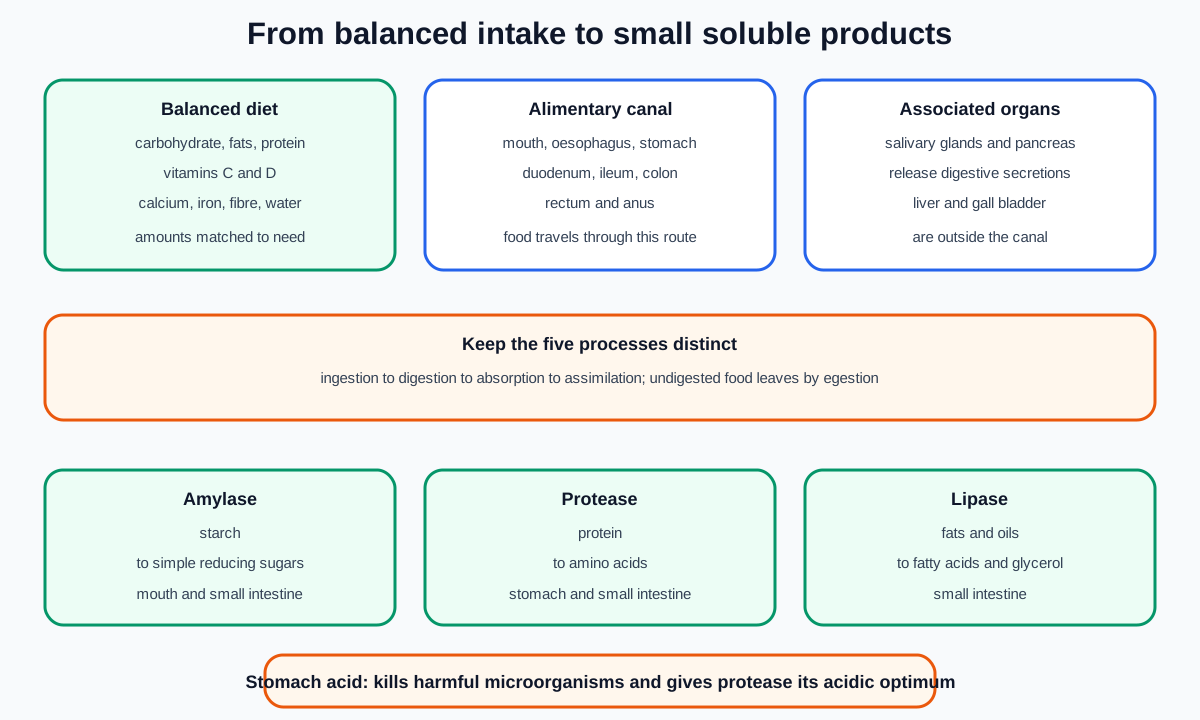
Cambridge IGCSE Combined Science Biology B7 covers balanced diet, the sources and importance of seven nutrient groups, identification and functions of named digestive organs, five nutrition processes, physical and chemical digestion, three enzyme routes and the two specified functions of hydrochloric acid in gastric juice.
A balanced diet matches supply to need
A balanced diet provides the different nutrients, fibre and water in suitable amounts and proportions to meet an individual's needs.
Balance does not mean equal masses of every food type. Energy and nutrient requirements vary with age, body size, activity, growth and health. A person who is growing or physically active may require a different total intake from a less active adult.
Both deficiency and excess can cause problems. A diet can supply enough energy but remain unbalanced if vitamins, mineral ions, fibre or water are insufficient.
Use food sources as examples rather than rigid categories. Many foods supply more than one nutrient.
Carbohydrates
Principal sources include rice, bread, pasta, cereals and potatoes.
Carbohydrates provide an important source of energy through respiration. Digestion converts large carbohydrate molecules into small soluble sugars that can be absorbed.
Do not describe fibre as a digestible carbohydrate energy source in this syllabus context. It has a separate dietary role.
Fats and oils
Principal sources include plant oils, butter, nuts, seeds and fatty foods.
Fats and oils provide energy and can form an energy store. Fat beneath the skin can reduce heat loss, and lipids contribute to cell structures.
They contain much energy per unit mass, so both deficiency and excessive intake matter when considering balance.
Proteins
Principal sources include meat, fish, eggs, milk, beans, lentils and other pulses.
Proteins provide amino acids for growth and repair and for making proteins such as enzymes.
Protein is not mainly stored as a dedicated energy reserve. It can contribute to energy metabolism, but growth, repair and synthesis are the central importance statements.
Vitamin C
Principal sources include citrus fruits and many fresh fruits and vegetables.
Vitamin C is needed for healthy connective tissues, skin and gums. Deficiency can cause scurvy, including poor wound healing and bleeding gums.
Vitamins are needed in relatively small amounts, but “small” does not mean unimportant.
Vitamin D
Dietary sources include oily fish, egg yolk and fortified foods. The body can also make vitamin D in skin exposed to suitable sunlight, although this is not a dietary source.
Check this topic from memory
Attempt the matching topic bank before reopening the notes. Use each missed idea to decide what to review next.
Vitamin D supports calcium absorption and healthy bone formation. Deficiency in growing children can cause rickets and weak, poorly formed bones.
Do not confuse vitamin D with calcium. One is a vitamin; the other is a mineral ion. Their roles are connected but not identical.
Calcium ions
Principal dietary sources include milk and other dairy products, fortified foods and some green vegetables.
Calcium is important for strong bones and teeth and also contributes to processes such as muscle function and blood clotting.
Vitamin D deficiency can impair calcium use even when some calcium is present in the diet.
Iron ions
Principal sources include red meat, liver, beans and green leafy vegetables.
Iron is required to make haemoglobin for oxygen transport in red blood cells. Deficiency can cause iron-deficiency anaemia, leading to tiredness because oxygen transport is reduced.
Iron is not itself haemoglobin; it is a required component.
Fibre or roughage
Sources include wholegrain cereals, fruit and vegetables.
Fibre adds bulk to food and helps movement of material through the alimentary canal, reducing constipation risk.
It is not digested into absorbable sugars by human digestive enzymes. Its importance comes from its physical role in the gut.
Water
Sources include drinks and water contained in foods.
Water acts as a solvent, supports transport in blood and provides the medium for many chemical reactions. It is also involved in temperature regulation through sweating.
Water requirement varies with temperature, activity and losses. A balanced diet includes adequate fluid rather than treating water as optional because it supplies no energy.
Identify the alimentary canal in order
The alimentary canal is a continuous passage through the body:
mouth, oesophagus, stomach, small intestine, large intestine, rectum and anus.
The small intestine includes the duodenum followed by the ileum. The large intestine includes the colon, rectum and anus in the required identification list.
Track the lumen as one continuous route in diagrams. The liver and pancreas are associated organs, not sections through which food travels.
Identify the associated organs
The required associated organs are the salivary glands, pancreas, liver and gall bladder.
Salivary glands release saliva containing amylase into the mouth. The pancreas releases digestive enzymes into the small intestine. The liver produces bile, and the gall bladder stores it before release.
The official B7.3 chemical-digestion list specifies amylase, protease, lipase and hydrochloric-acid functions. It does not separately prescribe extended bile chemistry, so do not substitute imported bile-detail memorisation for the named enzyme and acid requirements.
Ingestion begins the sequence
Ingestion is taking substances such as food and drink into the body.
It occurs at the mouth. Ingestion is not the same as digestion: putting food into the mouth does not by itself break large insoluble molecules into absorbable products.
The mouth also begins physical digestion by chewing and chemical digestion of starch through salivary amylase.
Digestion breaks down food
Digestion is breakdown of food.
Physical digestion breaks food into smaller pieces without chemical change to the food molecules. Teeth and stomach movement can perform physical breakdown.
Chemical digestion breaks large insoluble molecules into small soluble molecules. Enzymes catalyse this chemical change.
The two processes cooperate. Physical digestion increases food surface area for enzyme action during chemical digestion.
Absorption moves nutrients into blood
Absorption is movement of nutrients from the intestines into the blood.
Small soluble digestion products can cross the intestinal surface. Large insoluble food molecules cannot be absorbed efficiently and must first be digested.
Within this 0653 boundary, focus on the process and principal location rather than importing an unlisted detailed villus-adaptation specification.
Water is also absorbed, including in the large intestine. The colon compacts the remaining undigested material as water is removed.
Assimilation is uptake and use by cells
Assimilation is uptake and use of nutrients by cells.
It occurs after absorption and transport. For example, absorbed amino acids can be used to make proteins, and absorbed glucose can enter respiration.
Do not describe assimilation as nutrients merely entering the blood. That is absorption. Assimilation requires use by cells and tissues.
The liver has important roles in processing absorbed nutrients, but detailed liver metabolism is outside the named B7 statements.
Egestion removes undigested food
Egestion is removal of undigested food from the body as faeces.
The rectum stores faeces before removal through the anus.
Egestion is not excretion. Undigested food was not produced as waste by cell metabolism, whereas excretion removes metabolic waste and excess substances.
Trace organ functions along the route
Mouth: ingestion, chewing and salivary-amylase action.
Oesophagus: transports swallowed food to the stomach through muscular action.
Stomach: stores and mixes food, carries out physical digestion and provides acidic conditions for stomach protease.
Duodenum: receives pancreatic secretions and is an important site of chemical digestion.
Ileum: completes much digestion and is the main named region for nutrient absorption into blood.
Colon: absorbs water from the remaining contents.
Rectum and anus: store and egest faeces.
Use the actual organ name and process. “The gut digests everything” lacks location and mechanism.
Physical digestion increases surface area
Breaking one large piece into many smaller pieces increases total exposed surface area without changing the food molecules chemically.
More enzyme molecules can contact substrate at the same time, increasing the rate of chemical digestion.
Physical digestion does not itself produce amino acids, simple reducing sugars, fatty acids or glycerol. Those require chemical bond changes catalysed by enzymes.
Amylase digests starch
Amylase breaks down starch into simple reducing sugars.
It is secreted by salivary glands and the pancreas. It acts in the mouth and small intestine.
Stomach acid stops salivary-amylase activity as conditions become too acidic. Pancreatic amylase acts after entering the small intestine under suitable conditions.
Use the required endpoint “simple reducing sugars” rather than leaving the product as unspecified carbohydrate.
Proteases digest protein
Proteases break down proteins into amino acids.
Protease is secreted in the stomach and by the pancreas. It acts in the stomach and small intestine, with different proteases adapted to their local conditions.
Stomach protease works best in acidic conditions provided by gastric juice. Pancreatic protease contributes later in the small intestine.
Do not say one protease must have the same optimum pH in both organs.
Lipase digests fats and oils
Lipase breaks down fats and oils into fatty acids and glycerol.
It is secreted by the pancreas and acts in the small intestine.
The products are smaller molecules suitable for absorption after digestion. Do not call glycerol an enzyme or confuse fatty acids with hydrochloric acid.
Hydrochloric acid has two specified functions
Hydrochloric acid in gastric juice kills harmful microorganisms in food.
It also provides an acidic pH for optimum activity of proteases in the stomach.
The acid does not perform the protease's catalytic role. It creates the condition in which the stomach enzyme acts effectively.
Avoid saying acid kills every microorganism or makes the stomach sterile. The syllabus wording is limited to killing harmful microorganisms in food.
Worked application: trace starch through the system
A student eats bread containing starch. Ingestion occurs at the mouth, where chewing physically breaks food into smaller pieces and increases surface area. Salivary amylase begins chemical digestion, converting starch to simple reducing sugars. The bolus passes down the oesophagus to the stomach, where acidic conditions reduce salivary-amylase activity. Pancreatic amylase enters the small intestine and continues starch digestion. The resulting small soluble sugars can be absorbed from the intestine into blood, then assimilated when cells take them up and use them, for example in respiration. Undigested material is eventually egested, not excreted.
Common misconceptions and corrections
Defining a balanced diet as equal amounts of every nutrient. Amounts must suit individual needs.
Saying vitamins provide most dietary energy. Carbohydrates and fats are major energy sources.
Saying protein's only role is energy. It supports growth, repair and protein synthesis.
Confusing vitamin D with calcium. They are different nutrients with connected bone roles.
Saying iron is haemoglobin. Iron is needed to make haemoglobin.
Saying fibre is digested into glucose. It provides bulk in the gut.
Ignoring water because it has no energy value. It is essential as solvent and transport medium.
Putting the liver in the alimentary canal. It is an associated organ.
Saying food passes through the pancreas. The pancreas releases enzymes into the intestine.
Confusing ingestion with digestion. Ingestion is taking substances into the body.
Confusing absorption with assimilation. Absorption enters blood; assimilation is cell uptake and use.
Calling egestion excretion. Faeces contain undigested material, not metabolic waste.
Saying chemical digestion makes large soluble molecules. It makes small soluble molecules.
Omitting the surface-area benefit of physical digestion. Smaller pieces expose more area to enzymes.
Saying amylase digests protein. It breaks starch into simple reducing sugars.
Saying protease produces glucose. It produces amino acids.
Saying lipase produces amino acids. It produces fatty acids and glycerol.
Locating all enzyme secretion in the stomach. Salivary glands, stomach and pancreas have different roles.
Saying hydrochloric acid is an enzyme. It supplies acidic pH and kills harmful microorganisms.
Saying stomach acid digests every nutrient directly. Named enzymes perform chemical digestion.
Importing villus or bile detail as if it were a named B7.3 requirement. Follow the exact 0653 boundary.
Assessment guidance
Diet answers need both principal sources and biological importance for the seven listed groups. Diagram questions require the alimentary canal in order and associated organs kept outside its lumen. Process definitions should preserve their distinct endpoints: entry, breakdown, movement into blood, cellular use and removal of undigested food. Digestion answers must separate physical size change from chemical molecular change and explain surface-area benefit. Enzyme questions need substrate, product, secretion site and action site. For hydrochloric acid, state both specified functions and do not call it an enzyme.
Retrieval practice
Build a seven-row source-importance-deficiency grid from memory. Label the full digestive system on rotated diagrams and trace the lumen. Sort fifty statements into ingestion, digestion, absorption, assimilation or egestion. Construct amylase, protease and lipase routes with substrate, product, secretion and action sites. Diagnose twenty misconceptions and write complete starch, protein and lipid journey explanations.
Topic ownership
This note owns the balanced-diet list, digestive-organ identification and functions, five nutrition processes, physical and chemical digestion, three enzyme routes and stomach-acid functions. B4 owns food tests, B5 owns general enzyme mechanism and B9 owns blood transport. Unlisted extended villus and bile chemistry is not promoted into this Combined Science boundary.