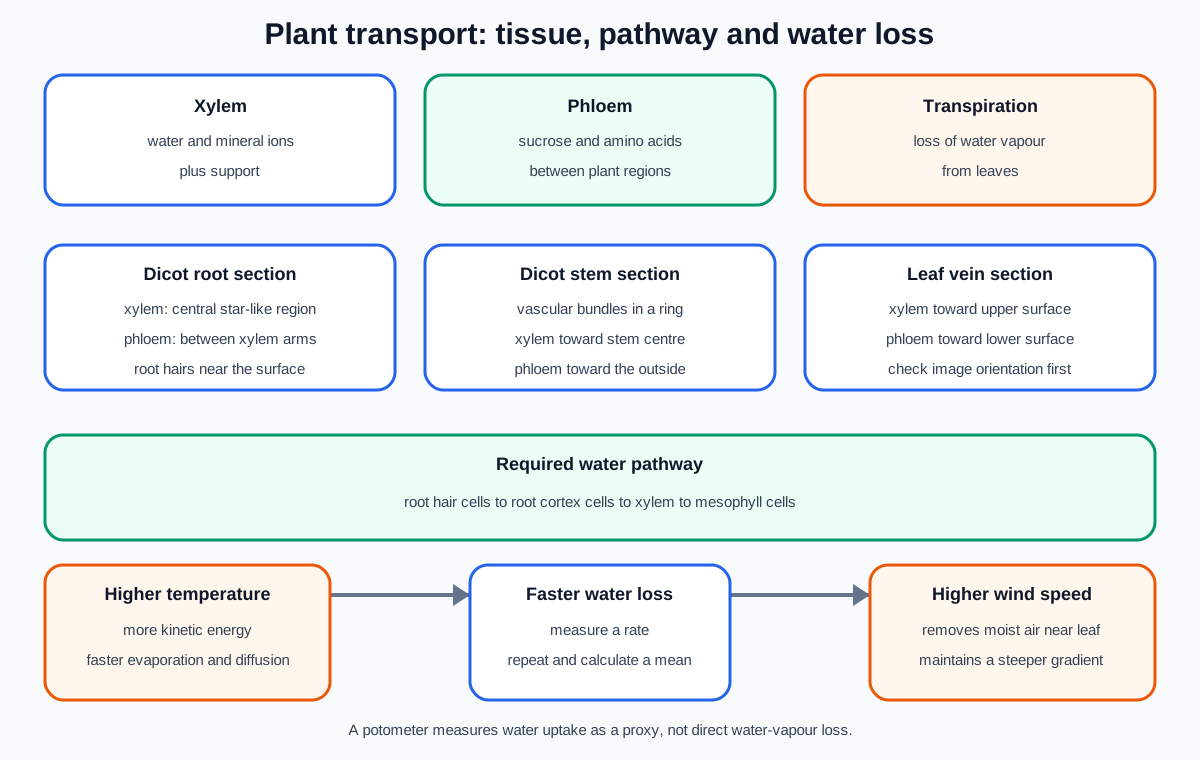
Cambridge IGCSE Combined Science Biology B8 connects three ideas: xylem and phloem have different transport functions, root hair cells begin a defined water pathway, and water vapour is lost from leaves by transpiration. The required environmental investigation is limited to temperature and wind speed.
A plant needs two transport tissues
Multicellular plants have roots that obtain water and mineral ions, leaves that produce sucrose, and growing or storage tissues that use transported substances. Diffusion alone would be too slow across the full height and width of a large plant.
Xylem and phloem form vascular tissue. They often occur close together, but their contents and functions are different. Questions may test those functions directly or ask you to identify the tissues in sections of a non-woody dicotyledonous root, stem or leaf.
Do not use the vague statement that both tissues “carry food and water”. Name the substance, tissue and purpose precisely.
Xylem transports water and mineral ions and supports the plant
Xylem transports water and dissolved mineral ions from roots into stems and leaves. It also provides support.
Water is needed by cells, contributes to cell turgidity and supplies photosynthesis. Mineral ions are raw materials used in plant growth and metabolism. These ions are not food made by photosynthesis.
The supporting role matters as much as transport in the official statement. A complete function answer therefore includes all three elements: water, mineral ions and support.
Within this Combined Science topic, recognise xylem as a tissue rather than importing detailed vessel-wall chemistry from a wider Biology syllabus.
Phloem transports sucrose and amino acids
Phloem transports sucrose and amino acids between plant regions.
Leaves can load sucrose made from photosynthesis into phloem. Growing tissues can receive sucrose for respiration or synthesis, while storage organs can receive it for conversion into stored material. Amino acids provide building blocks for proteins.
The syllabus function is transport, not a requirement to memorise an extended pressure-flow mechanism. Avoid replacing the named substances with “glucose”. Sucrose is the required transported carbohydrate.
Transport in phloem is sometimes called translocation, but the mark-bearing information is the movement of sucrose and amino acids. Different phloem routes can serve different plant regions, so “phloem always moves downward” is not a safe rule.
Identify xylem and phloem in a root section
In a transverse section of a typical non-woody dicot root, vascular tissue lies near the centre.
Check this topic from memory
Attempt the matching topic bank before reopening the notes. Use each missed idea to decide what to review next.
Xylem commonly forms a central star-like or cross-like region. Phloem occurs in groups between the arms of the xylem.
Use relative position rather than colour alone. Biological stains, drawing styles and image orientation vary. First decide whether the section is a root, then locate the central vascular region and distinguish the central xylem from phloem between its arms.
The outer region contains root tissues including root hair cells near the surface. Do not place root hairs in the central vascular bundle.
Identify xylem and phloem in a stem section
In a transverse section of a typical non-woody dicot stem, vascular bundles form a ring near the outside of the stem rather than one central star.
Within each bundle, xylem is nearer the centre of the stem. Phloem is nearer the outside.
A useful decision rule is “xylem inside, phloem outside” after you have identified the structure as a dicot stem. The rule does not mean that xylem forms the outer surface or that phloem lies outside the stem.
Avoid applying the root pattern to a stem. Root and stem questions deliberately test whether you can use organ context as well as tissue names.
Identify xylem and phloem in a leaf section
In a leaf, xylem and phloem lie in vascular bundles forming veins.
In a typical cross-section shown with the upper surface at the top, xylem lies toward the upper side of a vein and phloem toward the lower side.
Always check the diagram orientation. If the image is rotated, identify upper and lower surfaces from the surrounding tissues or labels before assigning the vascular tissues.
The vein brings water close to mesophyll cells and carries transported organic substances away from sources toward other regions.
Root hair cells begin water uptake
Root hair cells are cells near the root surface with long, thin projections extending between soil particles.
Their function is to absorb water and mineral ions from the soil. The projections give the root a large surface area in contact with the thin film of water around soil particles.
A larger surface area allows more simultaneous contact for uptake. It does not increase the concentration of water or mineral ions in the soil, and it is not best explained as “making the root longer”.
Root hairs are extensions of individual cells, not separate multicellular roots. Their thin shape helps them reach between soil particles, while their large total surface area increases uptake.
Water uptake and mineral-ion uptake should not be treated as identical mechanisms. B8 requires their uptake function and the surface-area advantage. Detailed transport mechanisms belong to the relevant membrane-transport ideas in B3.
Trace the required water pathway in order
The official pathway is:
root hair cells, root cortex cells, xylem and mesophyll cells.
Water first enters root hair cells from the soil. It then passes across root cortex cells toward the centre of the root. It enters xylem, travels through root and stem xylem, and reaches leaf veins. From the xylem it reaches mesophyll cells.
Order matters. Do not jump directly from soil to xylem, and do not place phloem in the water pathway.
The pathway combines movement across cells in the root with long-distance transport through xylem. In an explanation, link each named stage rather than listing disconnected tissue functions.
Transpiration is loss of water vapour from leaves
Transpiration is the loss of water vapour from leaves.
Water reaches mesophyll cells from leaf xylem. Some water evaporates from wet cell surfaces into air spaces inside the leaf. Water vapour then diffuses out, mainly through stomata, into the surrounding air.
The definition must include water vapour and leaves. “Water moving up the xylem” describes transport associated with the process but is not the definition of transpiration. “Evaporation from the roots” is also incorrect.
Water loss from the leaf helps maintain movement through the plant, but an answer about environmental factors should focus on how the factor changes evaporation or removal of water vapour.
Temperature changes transpiration rate
Increasing temperature usually increases transpiration rate when other conditions remain controlled.
At higher temperature, water molecules have more kinetic energy. Evaporation from mesophyll cell surfaces occurs faster, and water vapour particles move and diffuse faster. This usually increases water-vapour loss from the leaf.
At lower temperature, evaporation and diffusion are usually slower, so the transpiration rate falls.
Do not state that temperature always increases without limit. Extreme conditions may cause biological responses or damage. In the required investigation, use a sensible temperature range and describe the observed relationship for that range.
Wind speed changes transpiration rate
Increasing wind speed usually increases transpiration rate when other conditions remain controlled.
Still air near a leaf can become humid as water vapour accumulates. Moving air removes this moist air and replaces it with drier surrounding air. This maintains a steeper water-vapour concentration gradient from the leaf air spaces to the surroundings, so diffusion out of the leaf occurs faster.
At low wind speed, moist air remains near the leaf and the gradient becomes less steep, slowing net water-vapour loss.
Do not explain wind as physically pulling liquid water through open stomata. Its direct effect in this explanation is removal of humid air around the leaf.
Investigate temperature fairly
A leafy shoot can be connected to a potometer, which measures water uptake as a proxy for transpiration. Alternatively, a plant or leafy shoot can be weighed over a fixed interval to estimate water loss.
For a potometer investigation:
Cut and connect the shoot so the apparatus remains filled with water.
Seal every joint so air cannot leak into the system.
Introduce one air bubble into the capillary tube and record its starting position.
Place the shoot at a chosen temperature and allow conditions to stabilise.
Measure bubble distance over a fixed time.
Reset the bubble, repeat, calculate a mean and test several temperatures.
Control wind speed, light intensity, exposed leaf area, time interval and the shoot used. Temperature can be monitored close to the leaves. Do not heat the shoot so strongly that tissues are damaged or water supply becomes unsafe to handle.
Bubble movement shows water uptake, not direct water-vapour loss. Most absorbed water may replace transpired water, but some is used or retained. State this limitation when evaluating the method.
Investigate wind speed fairly
Place a fan at measured distances from a leafy shoot or use controlled fan settings. Measure wind speed at leaf position if suitable equipment is available, because fan distance is only an indirect way to vary it.
At each setting, measure potometer bubble movement or mass loss over the same interval. Repeat and calculate a mean.
Control temperature, light intensity, leaf area, shoot identity and measurement time. The fan can alter temperature as well as air movement, so monitor temperature and keep it stable. Use a shield or suitable arrangement if surrounding draughts would make the conditions inconsistent.
Plot mean rate against wind speed. A rate must include change divided by time. Bubble distance per minute is acceptable only when the same capillary and setup are used; bubble volume per unit time gives a more comparable uptake measure when tube dimensions matter.
Interpret results and evaluate evidence
A faster bubble movement or greater mass decrease per unit time indicates a higher estimated transpiration rate.
Look for the overall pattern, repeat consistency and anomalous results. A result is not anomalous merely because it differs slightly. It is anomalous when it departs substantially from the pattern or repeats and there is a defensible reason to investigate it.
Useful improvements address a named limitation. Seal leaks to prevent unmeasured air entry, measure actual wind speed rather than relying only on fan distance, allow equilibration after changing conditions, use the same leaf area, collect more repeated measurements and use a wider sensible range.
Do not write “use more accurate equipment” without saying what is measured more precisely and why that improves the evidence.
Worked application: diagnose a wind-speed investigation
A student places one potometer 20 cm from a fan and another 80 cm away. The nearer bubble moves farther in five minutes, so the student concludes that wind alone caused the difference. The conclusion is not secure because different shoots and possible differences in leaf area create confounding variables. A stronger design uses the same shoot at several measured wind speeds, allows stabilisation, resets the bubble, keeps temperature and light constant, and repeats each setting. If mean bubble speed rises with measured wind speed, the evidence supports increased water uptake as a proxy for increased transpiration. It does not prove that every absorbed water molecule was transpired.
Common misconceptions and corrections
Saying xylem transports sucrose. Xylem transports water and mineral ions and gives support.
Forgetting xylem support. Support is one of its specified functions.
Saying phloem transports glucose. The named substances are sucrose and amino acids.
Saying phloem always moves downward. Different routes connect different source, use and storage regions.
Placing xylem outside phloem in a dicot stem bundle. Xylem is nearer the centre and phloem nearer the outside.
Applying the stem ring to a root. A dicot root commonly has central star-like xylem.
Putting phloem in the centre of a dicot root. Phloem groups lie between xylem arms.
Ignoring image orientation in a leaf. Determine upper and lower surfaces before identifying vein tissues.
Calling a root hair a separate root. It is an extension of a root hair cell.
Saying root hairs make mineral ions more concentrated. Their large surface area increases contact for uptake.
Skipping cortex cells in the water pathway. Water passes through root hair cells, cortex cells, xylem and mesophyll cells.
Including phloem in the water pathway. Long-distance water transport uses xylem.
Defining transpiration as water movement in xylem. It is loss of water vapour from leaves.
Describing liquid water leaving through stomata. Water evaporates and leaves mainly as vapour.
Saying wind adds heat to the leaf. Its required explanation is removal of moist air near the leaf.
Saying stronger wind reduces the gradient. Removal of humid air maintains a steeper gradient.
Saying temperature has no effect on particle movement. Higher temperature increases kinetic energy.
Claiming a potometer directly measures transpiration. It measures water uptake as a proxy.
Ignoring air leaks in a potometer. Leaks can move the bubble without plant uptake.
Changing fan distance without controlling temperature. A fan can alter more than wind speed.
Comparing distance moved over unequal times. Calculate a rate using a common time basis.
Discarding any inconvenient result. Identify anomalies from the evidence and report them transparently.
Suggesting vague accuracy improvements. Name the limitation, its effect and the specific correction.
Assessment guidance
Function questions need the exact cargo and the support role of xylem. Identification questions require organ context before positional rules: central xylem in roots, xylem inside stem bundles and xylem toward the upper side of leaf veins. Write the water pathway in the specified order. Define transpiration with water vapour and leaves. For temperature, connect kinetic energy to evaporation and diffusion. For wind, connect removal of moist air to a steeper gradient. Investigation answers need a measured rate, one changed factor, named controls, repeats, means, safety and method-specific evaluation. Call potometer data a water-uptake proxy rather than direct transpiration.
Retrieval practice
Draw and label root, stem and leaf vascular positions from three rotated images. Write xylem and phloem functions without using “food”. Reconstruct the four-stage water pathway forwards and backwards. Explain temperature and wind effects using particle and gradient language. Design both investigations with variables, controls, repeats, safety and graphs. Diagnose twenty potometer errors and convert raw bubble distances into comparable rates.
Topic ownership
This theory note owns the B8 functions and positions of xylem and phloem, root-hair identification and surface-area advantage, the named water pathway, the transpiration definition, and temperature and wind effects. B3 owns detailed membrane transport. B6 owns photosynthesis and leaf identification. The dedicated Combined Science practical hub owns extended apparatus practice, planning templates and full uncertainty treatment; the investigation reasoning here remains only what is needed to understand B8 theory and assessment.