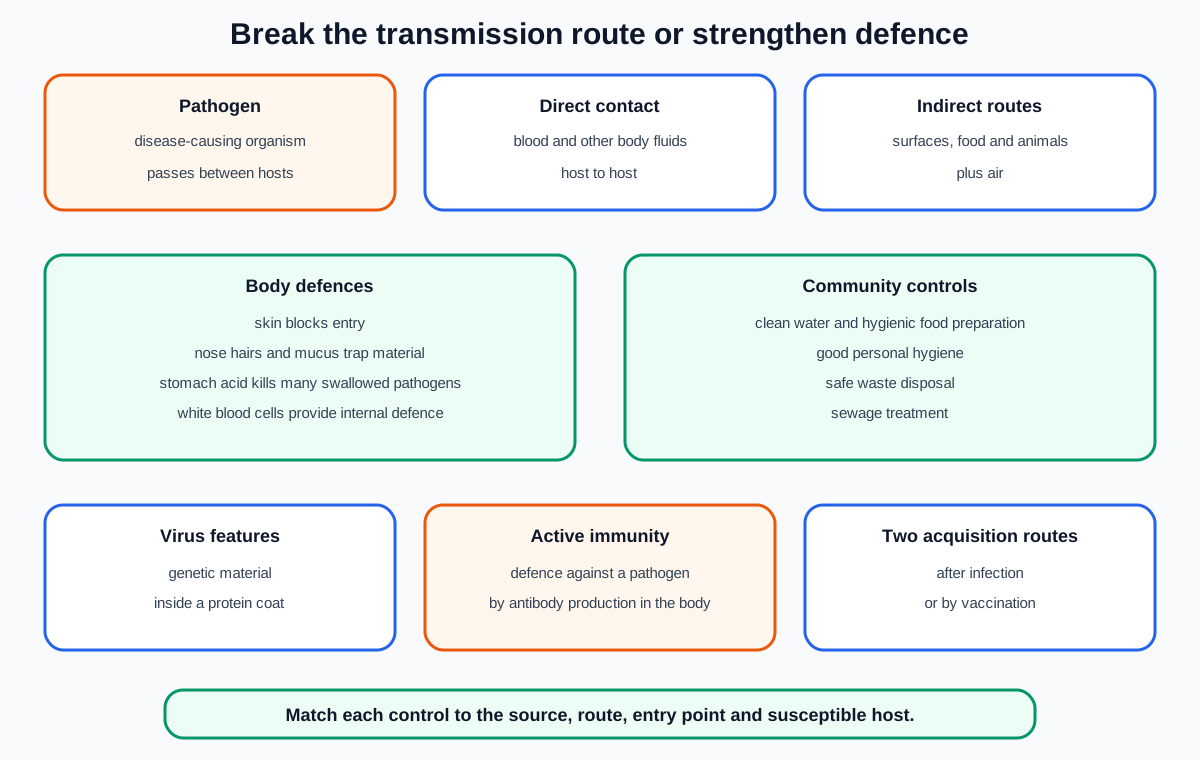
Cambridge IGCSE Combined Science Biology B10 distinguishes pathogens from transmissible diseases, sorts transmission into direct and indirect routes, develops five specified body defences and five community controls, identifies the two required virus features, and explains how infection or vaccination can produce active immunity.
A pathogen is a disease-causing organism
A pathogen is a disease-causing organism.
The definition links the organism to disease. Not every microorganism is a pathogen: many microorganisms do not cause disease, and some are useful.
Examples of pathogen groups can help illustrate transmission, but the official definition is more important than producing a long list. Viruses receive a separate feature statement in this topic.
Do not define a pathogen as the disease itself. The pathogen causes the disease in a host.
A transmissible disease can pass between hosts
A transmissible disease is a disease in which the pathogen can be passed from one host to another.
The host is the organism in which the pathogen lives or reproduces. Transmission moves the pathogen, directly or indirectly, to a new host.
“Transmissible” does not mean that every exposed person becomes ill. Entry route, pathogen dose, body defences and immunity can affect whether infection and symptoms follow.
Not every disease is transmissible. A condition caused only by inherited variation, nutrient deficiency or physical injury is not passed by transferring a pathogen.
Direct contact transfers pathogens between hosts
Direct contact includes transfer through blood and other body fluids.
The route can involve close contact between an infected host and another person, or movement of infected body fluid into the body.
The mark-bearing idea is an unbroken direct route from one host to another. Name the fluid or contact where the context supplies it rather than writing only “touching”.
Control measures should match the route. Preventing contact with infected blood, using appropriate barriers and applying safe hygiene can interrupt direct transmission.
Indirect transmission uses an intermediate route
The specified indirect routes are contaminated surfaces, food, animals and air.
On a contaminated surface, pathogens can be transferred to hands and then to an entry point such as the mouth. Contaminated food can be eaten. An animal can carry a pathogen between hosts. Air can contain droplets or other pathogen-bearing material that reaches a new host.
Indirect does not mean the pathogen is harmless or travels without a source. It means transfer occurs through an intermediate surface, material, organism or medium.
Check this topic from memory
Attempt the matching topic bank before reopening the notes. Use each missed idea to decide what to review next.
A good application answer identifies the source, route, entry into the new host and the control point that breaks that route.
Skin forms a physical barrier
Intact skin blocks many pathogens from entering body tissues.
Its defence depends on remaining continuous. A cut or abrasion creates a route through the barrier, so cleaning and covering a wound can reduce entry.
Skin does not kill every pathogen touching it, and it does not prevent routes through food, air or body fluids by itself.
The B10 defence list is limited. Blood clotting supports wound sealing in B9, but the named B10 response should begin with skin as a barrier.
Hairs in the nose trap material
Hairs in the nose help trap particles and pathogen-containing material from inhaled air.
This reduces the amount travelling deeper into the breathing system. It is a first-line physical defence, not an immune response involving antibodies.
Nasal hairs do not filter every particle, and they are not located inside the alveoli. Use their correct location and trapping role.
The defence works with mucus, which traps material on moist surfaces.
Mucus traps pathogens
Mucus is a sticky secretion that traps pathogens and particles.
In breathing passages it helps prevent trapped material from reaching delicate gas-exchange surfaces. Removal mechanisms can move the mucus away, but detailed cilia action is not one of the listed B10 defence statements for this Combined Science topic.
Do not say mucus is an antibody or white blood cell. It is a physical and chemical barrier secretion.
The important chain is trapping, reduced entry and removal rather than a claim that mucus instantly kills every pathogen.
Stomach acid destroys many swallowed pathogens
The acidic conditions in the stomach kill many pathogens swallowed with food or mucus.
This is a chemical defence. It reduces the chance that viable pathogens survive passage through the stomach.
The stomach is not sterile, and acid does not guarantee that every pathogen is killed. Avoid absolute wording.
Stomach acid also has a digestive role in B7. In B10, focus on defence against pathogens.
White blood cells act after pathogens enter
White blood cells defend against pathogens. B9 names phagocytosis and antibody production as their two functions.
Phagocytosis involves surrounding and digesting pathogens. Antibodies are produced in the body as part of the defence against a pathogen.
White blood cells are an internal defence, unlike skin, nose hairs and mucus at body surfaces.
Do not treat all five defences as identical barriers. They act at different stages: blocking entry, trapping, destroying swallowed pathogens or responding after entry.
Viruses have genetic material and a protein coat
The required features of viruses are genetic material and a protein coat.
Keep the answer to those two named features when the question says “limited to”. Do not replace genetic material with a nucleus or claim that a virus is a complete cell.
The protein coat surrounds or encloses the genetic material. A labelled diagram should make the two components visually distinct.
Virus structure does not change the pathogen definition: a disease-causing virus is a pathogen within the syllabus treatment.
Clean water interrupts water-borne transmission
A clean water supply reduces the chance that people drink or prepare food with water contaminated by pathogens.
This is a population-level control because it protects many users before exposure occurs.
It must remain clean during collection, storage and distribution. A treated supply can be contaminated again by unsafe containers or damaged infrastructure.
Do not confuse clean water with water that merely looks clear. Pathogens can be present without visible dirt.
Hygienic food preparation reduces contamination
Hygienic food preparation reduces pathogens reaching food and limits their transfer between raw and ready-to-eat foods.
Useful measures include clean hands and surfaces, separating contaminated raw material from prepared food, and cooking or storing food appropriately for the context.
The explanation should link the measure to the route. Separate utensils, for example, reduce transfer from a contaminated surface or raw food.
Food hygiene cannot correct every source of infection, but it is important for preventing indirect transmission through food.
Good personal hygiene breaks contact routes
Good personal hygiene reduces pathogens carried on hands or body surfaces and transferred to food, objects or other people.
Handwashing is most effective as an explanation when linked to a transmission event: it removes pathogens before eating, preparing food or touching an entry point.
Personal hygiene is not a judgement about a person's character. It is a set of behaviours that changes exposure probability.
Avoid vague advice such as “be clean”. Name the behaviour and how it interrupts the route.
Waste disposal prevents contamination and vectors
Safe waste disposal separates human activity from material that may contain pathogens or attract animals that carry them.
Uncontrolled waste can contaminate water or food and create breeding or feeding sites for animals involved in indirect transmission.
Collection, containment and safe processing or disposal reduce these routes.
Do not write that waste disposal directly vaccinates a population. It reduces exposure rather than producing immunity.
Sewage treatment reduces pathogen release
Sewage can contain human waste and pathogens. Treatment reduces the release of pathogens into water and the wider environment.
The detailed stages of sewage treatment are explicitly not required. The examination point is why treating sewage controls disease spread.
Untreated sewage entering a water source can create a route from infected waste to new hosts. Treatment interrupts that route and supports a clean water supply.
Avoid inventing named treatment stages when the question asks only for importance.
Active immunity is antibody defence made in the body
Active immunity is defence against a pathogen by antibody production in the body.
The word “active” refers to the person's own body producing the antibodies. The definition must include the pathogen, antibody production and production in the body.
Active immunity can be gained after infection by a pathogen or by vaccination.
The official boundary does not require a detailed account of memory-cell formation. Do not let imported detail replace the exact active-immunity definition.
Infection can lead to active immunity
When a pathogen infects the body, an immune response can include antibody production. After this response, active immunity to that pathogen may result.
Natural infection can carry serious risk, so it should not be recommended as a deliberate way to gain immunity.
The route to immunity does not mean the disease itself protects immediately. The body's antibody response is the required mechanism.
Avoid saying antibodies remain at a permanently high concentration without evidence. The syllabus claim is active immunity after infection, not a fixed antibody graph.
Vaccination can produce active immunity
Vaccination exposes the immune system in a controlled way so the body produces antibodies and gains active immunity without relying on the full disease process.
The body still performs the antibody production, which is why vaccination produces active rather than passive immunity.
Vaccination controls disease at the individual level by increasing protection and can reduce opportunities for a pathogen to spread when many people are protected.
Do not describe vaccination as an antibiotic treatment or as an instant cure for an existing infection. B13 separately owns antibiotic use and resistance.
Match controls to the chain of transmission
Disease control is strongest when it targets the actual route.
A water-borne outbreak calls for a clean supply, safe storage and sewage control. Food-borne transmission calls for hygienic preparation. Surface transfer calls for personal and environmental hygiene. Animal transmission calls for controlling contact with the carrier or its breeding opportunities. Direct body-fluid transmission calls for barriers and safe handling.
Several controls can operate together. Clean water without sewage control may fail if the source is repeatedly contaminated. Food hygiene without hand hygiene may leave another route open.
Evaluation should therefore identify source, route, control point and limitation.
Worked application: trace and interrupt an outbreak
After flooding, several households draw apparently clear water from a damaged communal pipe. Sewage has entered the supply, and people develop the same transmissible disease. The pathogen moved indirectly from infected waste through contaminated water to new hosts. Appearance alone did not prove that the water was clean. Immediate control requires a safe alternative supply and hygienic storage, while repair and sewage treatment remove the source and protect the distribution route. Personal hygiene and hygienic food preparation reduce additional transfer within households. Vaccination would help only if an appropriate vaccine exists and it produces active immunity; it does not make contaminated water safe.
Common misconceptions and corrections
Calling a pathogen the disease. It is the disease-causing organism.
Saying every microorganism causes disease. Many are harmless or useful.
Calling every disease transmissible. A pathogen must be passable between hosts.
Assuming exposure guarantees illness. Defences, immunity and dose affect outcomes.
Saying body-fluid transmission is indirect. It is listed under direct contact.
Saying contaminated surfaces are direct contact. They are an intermediate indirect route.
Forgetting animals and air. Both are specified indirect routes.
Saying skin kills every pathogen. Intact skin primarily blocks entry.
Putting nose hairs in alveoli. They act near the entrance to the breathing system.
Calling mucus an antibody. It is a sticky secretion that traps material.
Claiming stomach acid sterilises the body. It kills many swallowed pathogens, not necessarily all.
Treating white blood cells as surface barriers. They provide internal defence.
Giving cilia as a replacement for a named defence. Preserve skin, nose hairs, mucus, stomach acid and white cells.
Giving a nucleus as a virus feature. The required features are genetic material and a protein coat.
Saying clear water must be pathogen-free. Pathogens may be invisible.
Describing food hygiene without a route. Link each measure to reduced contamination or transfer.
Using “be clean” as a full explanation. Name the behaviour and control point.
Saying waste disposal produces immunity. It reduces environmental exposure.
Listing sewage-treatment stages as required. The stages are explicitly not required.
Defining active immunity as receiving antibodies. The body produces antibodies itself.
Forgetting the pathogen in the immunity definition. It is defence against a pathogen.
Saying only infection produces active immunity. Vaccination can also produce it.
Calling vaccination an instant treatment. It is a route to active immunity, not an immediate cure.
Importing memory cells as the required definition. Use antibody production in the body.
Putting antibiotic resistance in B10. Antibiotics and resistance belong to B13.
Assuming one control closes every route. Match combined controls to the transmission chain.
Assessment guidance
Definitions must preserve causation and transfer: a pathogen causes disease, while a transmissible disease allows its pathogen to pass between hosts. Route questions need direct contact, including blood and body fluids, or the exact indirect categories of surfaces, food, animals and air. For defences, state where each acts and how it blocks, traps, destroys or responds. Virus questions require only protein coat and genetic material. Public-health explanations should link each named control to an interrupted route without adding sewage-process detail. Active-immunity answers need defence against a pathogen by antibody production in the body and both acquisition routes: infection and vaccination.
Retrieval practice
Sort sixty scenarios into direct contact, contaminated surface, food, animal or air routes. Build a location, mechanism and limitation grid for the five body defences. Label the two virus features from varied diagrams. Design a control package for water, food and surface outbreaks and justify each link. Reconstruct the active-immunity definition exactly, compare infection with vaccination, and diagnose twenty-five boundary and mechanism errors.
Topic ownership
This note owns B10 pathogen and transmissible-disease definitions, direct and indirect routes, the five named defences, virus features, the five community controls and active immunity after infection or vaccination. B9 owns white-cell mechanisms and clotting. B13 owns drugs, antibiotics and antibiotic resistance. Detailed memory-cell mechanisms are not promoted into the required Combined Science B10 boundary.