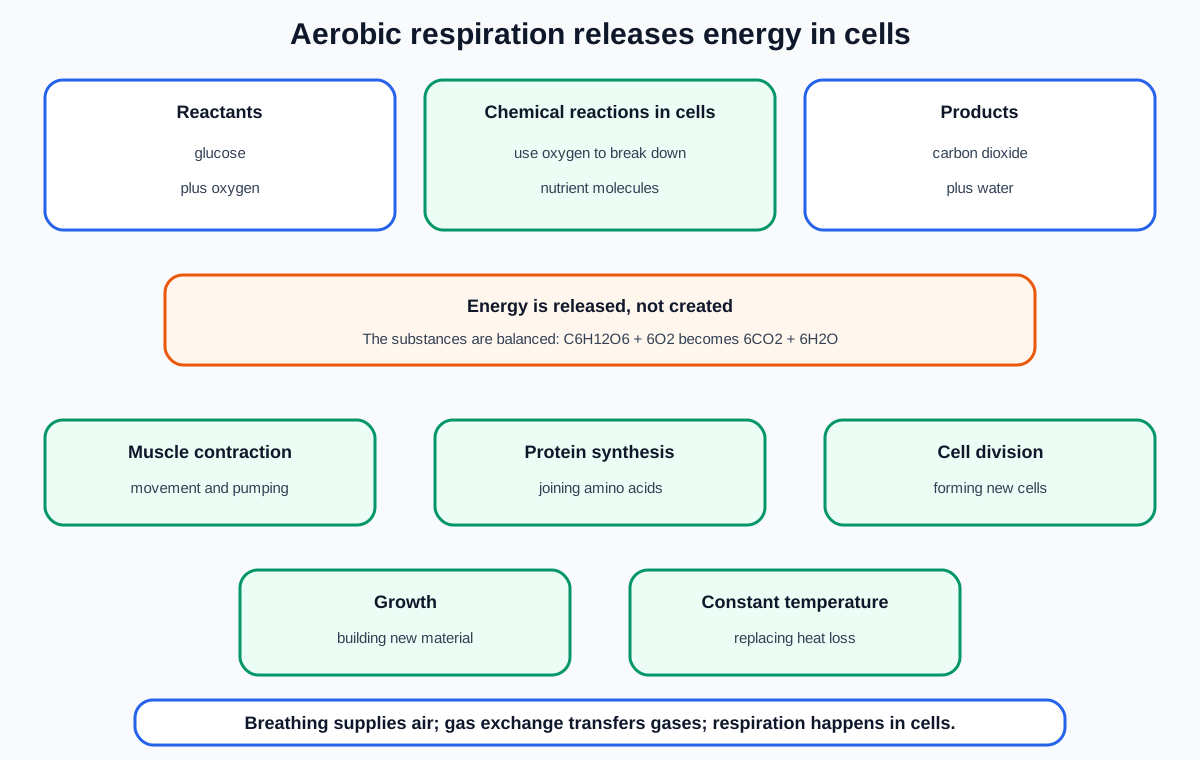
Cambridge IGCSE Combined Science Biology B12 focuses on five uses of energy in living organisms, the definition of aerobic respiration, and its word and balanced symbol equations. It does not include the separate Biology treatment of anaerobic respiration.
Respiration is not breathing
Respiration is a chemical process in cells. Breathing moves air into and out of lungs, while gas exchange moves oxygen and carbon dioxide across exchange surfaces.
The processes connect because breathing and gas exchange can supply oxygen for aerobic respiration and remove carbon dioxide. They are still different biological levels.
Plants, animals and other living organisms respire. A plant does not stop respiring when it is not photosynthesising.
Use the phrase “chemical reactions in cells” whenever a definition question asks about respiration. “Taking in oxygen” alone describes only one input, not the process.
Aerobic respiration uses oxygen
Aerobic respiration is the chemical reactions in cells that use oxygen to break down nutrient molecules to release energy.
Every part of the definition matters:
it consists of chemical reactions;
it occurs in cells;
it uses oxygen;
nutrient molecules are broken down;
energy is released.
Glucose is the nutrient molecule shown in the required equations. Do not define aerobic respiration as oxygen breaking glucose by itself. Cell reactions perform the breakdown and oxygen is used in the overall process.
Energy is released, not created
Aerobic respiration releases energy that can be used by the organism.
The process does not create energy from nothing. Chemical energy associated with nutrient molecules is transferred through respiration and becomes available for biological work, with some eventually transferred to the surroundings as heat.
Avoid saying that respiration “makes energy”. The syllabus wording is “release energy”. That wording also distinguishes the usable outcome from the carbon dioxide and water products.
Energy is not a material product to add to the balanced chemical equation. The equation shows substances; energy release is stated alongside it.
The word equation names every substance
The required word equation is:
glucose + oxygen → carbon dioxide + water
Glucose and oxygen are reactants. Carbon dioxide and water are products.
The arrow means that the reactants are converted into products through the overall cell reactions. It does not mean the reaction is merely mixing substances or that every step happens in one event.
Check this topic from memory
Attempt the matching topic bank before reopening the notes. Use each missed idea to decide what to review next.
Write complete chemical names. “Sugar + air” is too vague, and “energy” should not replace carbon dioxide or water.
The balanced symbol equation preserves atoms
The required balanced symbol equation is:
CX6HX12OX6+6OX26COX2+6HX2O
The coefficients show the reacting ratio in the overall equation: one glucose molecule reacts with six oxygen molecules to form six carbon dioxide molecules and six water molecules.
Check the atom count on both sides. There are six carbon atoms, twelve hydrogen atoms and eighteen oxygen atoms on each side.
Balancing changes coefficients in front of formulae. Never change the small numbers within a chemical formula, because that changes the substance.
Link the word and symbol equations
The word and balanced symbol equations describe the same overall process.
Glucose corresponds to CX6HX12OX6, oxygen to OX2, carbon dioxide to COX2, and water to HX2O.
Use the word equation when chemical formulae are not requested. Use the balanced symbol equation when the question asks for formulae or a balanced equation.
Do not mix styles by writing “glucose + OX2” unless a question specifically supplies a partly completed format.
Released energy supports muscle contraction
Muscle contraction requires energy. In animals, contracting skeletal muscles produce movement; heart muscle contraction pumps blood; and smooth muscle can move substances through organs.
During physical activity, muscle cells contract more frequently and require more energy. This links B12 to the increases in heart rate and breathing described in B9 and B11.
Respiration does not itself contract a muscle mechanically. It releases energy that enables the cellular processes involved in contraction.
Do not limit muscle contraction to sport. Breathing, circulation and ordinary posture also involve muscle activity.
Released energy supports protein synthesis
Protein synthesis joins amino acids in the correct sequence to make proteins.
This process requires energy. The resulting proteins can have structural, transport, signalling or enzyme roles depending on the cell.
Energy is not itself the raw material for protein. Amino acids provide the building blocks, while released energy enables the synthesis process.
Growth and repair often require protein synthesis, but “protein synthesis” should still be named separately because it is an explicit energy-use item.
Released energy supports cell division
Cell division produces new cells and requires energy for the processes that copy and distribute cell contents.
It supports growth, replacement and reproduction in appropriate organisms and tissues.
Cell division is not identical to growth. Division can increase cell number, while growth is a permanent increase in size and dry mass. Both appear separately in the specified list.
Do not say energy becomes a new cell. Energy enables the ordered processes that form the daughter cells.
Released energy supports growth
Growth is a permanent increase in size and dry mass.
It requires energy for building new cell material and carrying out the associated synthesis and division processes.
An organism can gain temporary mass from water without true biological growth. Linking respiration energy to construction of new material gives a stronger explanation.
Growth is not restricted to whole organisms. Tissues and organs grow through coordinated cellular processes.
Released energy maintains a constant body temperature
Energy released through respiration contributes to maintaining a constant body temperature in organisms that regulate their internal temperature.
Heat transferred during metabolism can help replace heat lost to the surroundings. Additional responses can alter heat production or loss, but detailed thermoregulation mechanisms are not part of this B12 statement.
“Constant” means kept within a narrow suitable range, not perfectly unchanged at every instant.
Do not claim that all released energy is used only for heating. The five named uses show that energy supports several kinds of biological work.
The five uses can overlap without becoming duplicates
Muscle contraction, protein synthesis, cell division, growth and maintenance of a constant body temperature are distinct assessment points.
They can interact. Growth may involve protein synthesis and cell division. Muscle contraction produces movement and transfers some energy as heat. These connections do not justify replacing the full list with “growth and movement”.
When a question asks for multiple uses, state different named uses. Do not repeat the same use with two examples and count it twice.
A mechanism phrase can strengthen each point: muscle contraction for movement, protein synthesis from amino acids, cell division for new cells, growth through building material, and temperature maintenance by replacing heat loss.
Oxygen supply links exchange, transport and respiration
In humans, alveolar gas exchange transfers oxygen into blood, haemoglobin transports it, and blood flow delivers it to cells. Aerobic respiration then uses the oxygen.
Carbon dioxide produced in respiration can be carried in blood and transferred into alveolar air for removal.
This chain explains why breathing and heart rates often rise during physical activity. Higher muscle energy demand is met by increasing supply and removal processes around the cell reactions.
Keep ownership clear: B9 covers transport, B11 covers gas exchange and B12 covers the chemical reactions and energy use.
Aerobic respiration occurs in plants as well as animals
Plant cells use oxygen in aerobic respiration and release energy for their own cellular work.
Photosynthesis and respiration are different processes. Photosynthesis stores transferred light energy in organic molecules; respiration breaks down nutrient molecules and releases energy for use.
In light, both can occur. In darkness, photosynthesis stops because light is absent, but respiration continues in living plant cells.
Do not reverse the respiration equation and call that a complete definition of photosynthesis. The processes involve different reaction pathways and conditions even though their overall substances are related.
Use evidence cautiously
Oxygen uptake, carbon dioxide production or temperature change can provide evidence consistent with respiration, but each method has limitations.
A rise in carbon dioxide must be distinguished from background gas changes. A temperature increase requires insulation and a suitable control to show it is associated with living material rather than the surroundings.
The 0653 B12 statement does not prescribe a respiration investigation. Treat experimental examples as applications of the definition, not as additional required practical units.
When explaining evidence, connect the measured change to a named reactant, product or energy transfer.
Worked application: connect a runner's cells to system responses
During a steady run, leg muscles contract repeatedly and need more energy. Aerobic respiration in muscle cells uses glucose and oxygen, producing carbon dioxide and water while releasing energy for contraction. Breathing rate and depth rise to ventilate alveoli, and heart rate rises to increase transport of oxygen and glucose and removal of carbon dioxide. The runner has not changed breathing into respiration: breathing, gas exchange and circulation support the chemical reactions in cells. Protein synthesis, cell division, growth and temperature maintenance are other specified uses of released energy, but muscle contraction is the most immediate use in this context.
Common misconceptions and corrections
Defining respiration as breathing. It is chemical reactions in cells.
Defining respiration as gas exchange. Gas exchange moves gases across a surface.
Saying only animals respire. Living plant cells respire too.
Saying plants respire only in darkness. Respiration continues in light and dark.
Saying oxygen is the only substance needed. The process breaks down nutrient molecules and uses oxygen.
Saying respiration creates energy. It releases energy.
Putting energy in place of a chemical product. Carbon dioxide and water are the products.
Writing “sugar + air”. Use glucose and oxygen.
Reversing reactants and products. Glucose and oxygen are on the left.
Omitting water from the equation. Both carbon dioxide and water are products.
Writing an unbalanced symbol equation. Use coefficients 1, 6, 6 and 6.
Changing formula subscripts to balance. Change coefficients only.
Adding a coefficient of six to glucose. One glucose balances with six oxygen molecules.
Saying respiration itself pulls a muscle. It releases energy for contraction.
Calling energy a protein building block. Amino acids are the building blocks.
Treating cell division and growth as identical. They are separate specified uses.
Calling temporary water gain growth. Growth permanently increases size and dry mass.
Saying constant temperature never fluctuates. It is maintained within a suitable narrow range.
Saying all respiration energy becomes heat. It supports all five named uses.
Repeating movement and muscle contraction as two uses. Movement is an example of contraction.
Listing active transport instead of a specified use. Preserve the official five-item list.
Listing repair instead of a specified use. Connect it through protein synthesis or division without replacing the named items.
Saying photosynthesis and respiration are exact reverses in cells. They are different processes.
Saying carbon dioxide is inhaled for respiration. It is a product of aerobic respiration.
Claiming any temperature rise proves respiration. Use controls and exclude environmental change.
Importing anaerobic respiration into B12. It is not listed in this Combined Science statement.
Assessment guidance
Definition answers need chemical reactions, cells, oxygen, breakdown of nutrient molecules and release of energy. Memorise the exact five uses and give distinct points rather than duplicate examples. For equations, preserve all four substances and balance atoms with coefficients, never altered formulae. Context questions should connect the released energy to the named cellular task. When relating organ systems, keep the causal chain clear: breathing ventilates, gas exchange transfers, blood transports and respiration occurs in cells. Experimental evidence must name the measured reactant, product or heat transfer and a relevant control. Do not import anaerobic products into this official boundary.
Retrieval practice
Write the complete aerobic-respiration definition from five shuffled clauses. Reconstruct and atom-check the word and symbol equations. Generate three examples for each of the five energy uses without replacing their official names. Sort fifty statements into breathing, gas exchange, transport, aerobic respiration or energy use. Diagnose twenty-five equation and boundary errors, then explain exercise and plant contexts with the same cellular definition.
Topic ownership
This note owns B12's five energy uses, aerobic-respiration definition, word equation and balanced symbol equation. B9 owns blood transport, B11 owns breathing and gas exchange, and B6 owns photosynthesis. Anaerobic respiration, lactic acid, yeast products and oxygen-debt treatment are not promoted into this Combined Science B12 boundary.