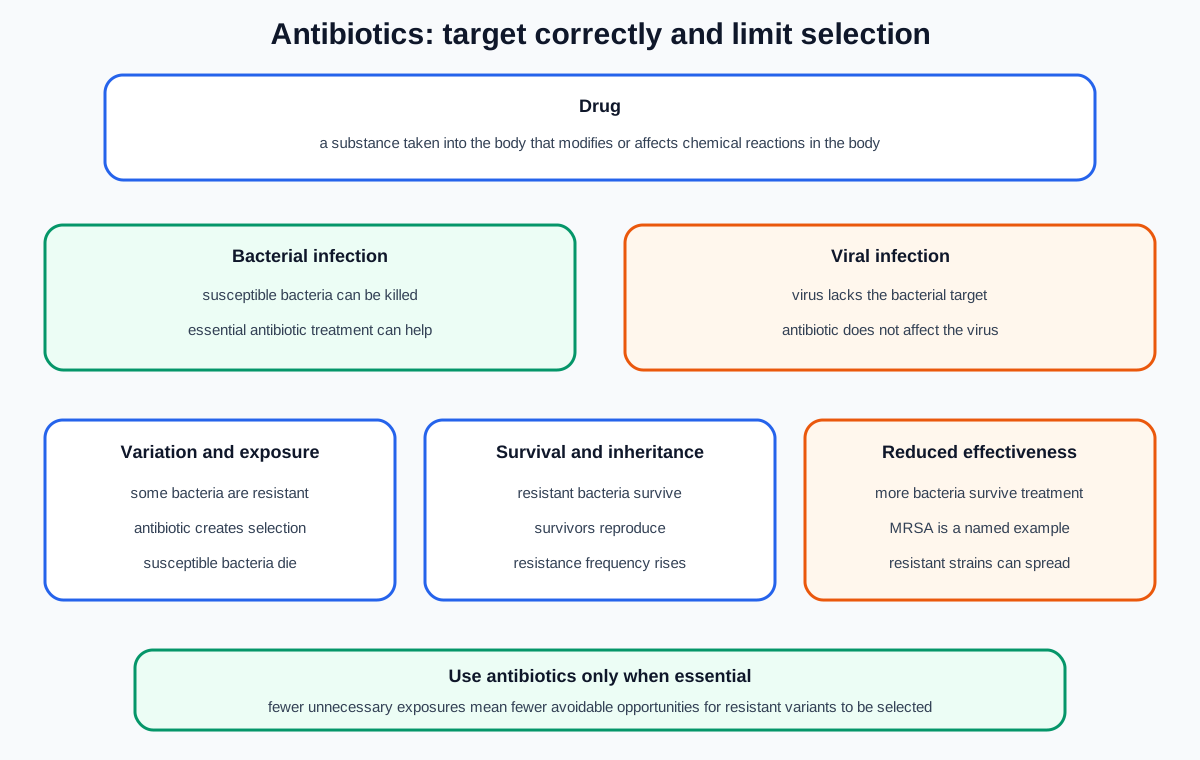
Cambridge IGCSE Combined Science Biology B13 defines a drug, explains the use of antibiotics for bacterial infections, distinguishes bacteria from viruses as antibiotic targets, and develops how essential-only antibiotic use can limit resistant bacteria such as MRSA.
A drug modifies chemical reactions in the body
A drug is any substance taken into the body that modifies or affects chemical reactions in the body.
The definition is broad. It includes substances used medically and does not mean that every drug is illegal.
The substance must be taken into the body and must affect body chemistry. Food contains substances that participate in reactions, but ordinary nutrients are not usually classified by this examination definition as drugs simply because they enter the body.
Do not define a drug only as a harmful or addictive substance. Those properties can describe some drugs but are not the required general definition.
Drug and medicine are not exact synonyms
A medicine can contain a drug used to prevent, diagnose, relieve or treat a condition. The active drug modifies chemical reactions, while a medicine may also contain inactive ingredients and have a controlled formulation.
Some drugs are used as medicines; some are not. Whether a substance has medical value can depend on its intended use and evidence.
This topic does not require a catalogue of legal, recreational or performance-enhancing drugs. Use the official definition and antibiotic application rather than importing unrelated categories.
Avoid saying “all medicines cure disease”. A medicine may relieve symptoms without removing the underlying cause.
Antibiotics are used for bacterial infections
Antibiotics are used to treat bacterial infections.
They act against bacteria. Different antibiotics can affect bacterial processes in different ways, and an antibiotic is useful only if the infecting bacteria are susceptible to it.
Treatment can reduce the bacterial population so symptoms and tissue damage fall and body defences can clear the infection.
Do not say antibiotics treat every type of pathogen. Their specified use is treatment of bacterial infections.
Antibiotics kill bacteria but do not affect viruses
The syllabus states that antibiotics kill bacteria but do not affect viruses.
Bacteria and viruses have different structures and ways of reproducing. Antibiotic targets in bacteria are absent from viruses, so an antibiotic does not treat a viral infection such as one caused by an influenza virus.
Check this topic from memory
Attempt the matching topic bank before reopening the notes. Use each missed idea to decide what to review next.
This boundary is a common application test. The symptom alone does not reliably identify whether an infection is bacterial or viral, so antibiotic decisions require appropriate healthcare assessment.
Do not claim that antibiotics kill the virus hidden inside a cell. The drug lacks the relevant bacterial target.
“Bacterial” does not guarantee that one antibiotic works
Some bacteria are resistant to antibiotics. Resistance means that they survive an antibiotic concentration that would kill susceptible bacteria.
An infection can therefore be bacterial but still fail to respond to a particular antibiotic.
The effectiveness of an antibiotic depends on whether the bacterial population is susceptible, whether the medicine reaches the infection, and whether it is used as directed in the clinical context.
The examination focus is population resistance. Do not describe the patient's body as becoming resistant to the antibiotic.
Resistance reduces antibiotic effectiveness
When resistant bacteria make up more of a population, the antibiotic kills a smaller proportion. Treatment becomes less effective.
This can allow an infection to persist and resistant bacteria to spread to other hosts.
Resistance does not mean the antibiotic liquid has become weaker in the bottle. It means bacterial characteristics allow survival despite exposure.
One antibiotic may be ineffective while another remains effective, but the syllabus point is the overall reduction in effectiveness caused by resistant bacteria.
Resistant variants exist before they are selected
A bacterial population can contain variation. A small number may already have inherited features that give resistance before an antibiotic is used.
The antibiotic creates a selection pressure. Susceptible bacteria are killed, while resistant bacteria are more likely to survive.
The antibiotic does not teach individual bacteria to become resistant because they need it. It changes which existing variants survive and reproduce.
This distinction is essential for a causal explanation of resistance development.
Survivors reproduce and pass on resistance
Resistant bacteria that survive have less competition from susceptible bacteria and can reproduce.
They pass the resistance characteristic to their descendants. Over generations, the proportion of resistant bacteria increases.
If these bacteria spread between people, resistant infections become more common beyond the original patient.
Use the complete chain: variation, antibiotic exposure, susceptible death, resistant survival, reproduction, inheritance and increased frequency.
MRSA is a resistant-bacteria example
MRSA is the named example in the syllabus of resistant bacteria.
It refers to strains of a bacterium that are resistant to an important antibiotic treatment. The key examination significance is that antibiotic resistance makes infections harder to treat and limits treatment options.
Do not describe MRSA as a virus. It is bacterial.
Avoid expanding the abbreviation unless confident that the question asks for it. The mark-bearing point is resistant bacteria and reduced antibiotic effectiveness.
Unnecessary use creates avoidable selection pressure
Using antibiotics when they are not essential exposes bacteria to selection pressure without a sufficient treatment benefit.
For a viral infection, the antibiotic does not affect the virus, but bacteria in or on the body can still be exposed. Susceptible bacteria may be killed while resistant variants survive.
Repeated unnecessary exposure gives more opportunities for resistant bacteria to be selected and increase in frequency.
This is why “antibiotics do not work on viruses” and “unnecessary use promotes resistance” are connected but distinct points.
Essential-only use limits development of resistance
Using antibiotics only when essential reduces the number of occasions on which bacterial populations encounter the selection pressure.
With fewer unnecessary exposures, susceptible bacteria are less often removed in a way that gives resistant variants a reproductive advantage. This can slow the increase and spread of resistant bacteria.
Essential-only use does not guarantee that resistance never develops. Necessary treatment still exposes bacteria, and resistant variants can already exist.
The conclusion should therefore be “limits” or “slows”, not “prevents all resistance”.
Follow appropriate prescribing guidance
Whether an antibiotic is essential, which antibiotic is suitable, and how it should be used are healthcare decisions. A patient should follow current professional and product guidance rather than changing a course independently.
This avoids an oversimplified slogan replacing clinical judgement. Different infections, medicines and patient circumstances can require different decisions.
For examination answers, the official causal point remains selection pressure: avoid antibiotic exposure when there is no essential bacterial-treatment reason.
Do not recommend sharing leftover antibiotics or self-diagnosing a bacterial infection.
Separate individual treatment from population consequences
For an individual with a susceptible bacterial infection, an antibiotic can provide important treatment.
Across a population, every use also creates some selection pressure on exposed bacteria. Good stewardship balances necessary patient benefit against avoidable selection.
This is not an argument to refuse essential treatment. It is an argument to target antibiotic use appropriately.
A strong discussion recognises both scales rather than claiming antibiotics are either always good or always harmful.
Interpret resistance data carefully
A table may show the percentage of bacterial samples resistant to an antibiotic over time. An increase supports the conclusion that resistance has become more common in the sampled population.
It does not by itself identify the exact behaviour or setting that caused the change. Sampling, infection control, antibiotic use and spread of particular strains can all influence the pattern.
Laboratory inhibition zones can compare susceptibility when conditions are controlled. A smaller or absent clear zone can indicate less effect, but dose, diffusion and culture conditions must be comparable.
The B13 theory requirement is the biological interpretation, while extended method design belongs to the practical-skills hub.
Worked application: decide whether the evidence supports antibiotics
A patient has a respiratory illness caused by a virus and asks for antibiotics. The antibiotic would not affect the virus because it targets bacterial features. Unnecessary treatment would still expose bacterial populations in the body, killing susceptible bacteria while resistant variants survive. Those survivors could reproduce and increase the proportion of resistance, reducing future antibiotic effectiveness. The responsible conclusion is not that antibiotics are generally bad: they remain important for essential treatment of susceptible bacterial infections. The decision should follow appropriate healthcare assessment, and the patient should not use shared or leftover medicine. Essential-only use reduces avoidable selection pressure but cannot guarantee that resistance disappears.
Common misconceptions and corrections
Defining a drug as an illegal substance. It is any substance taken into the body that affects chemical reactions.
Defining every drug as harmful. The definition does not require harm.
Saying all medicines are cures. Some relieve symptoms or support management.
Saying antibiotics treat every infection. Their specified use is bacterial infection.
Saying antibiotics kill viruses. They do not affect viruses.
Choosing antibiotics from symptoms alone. Similar symptoms can have different causes.
Saying any antibiotic treats any bacterium. The bacterium must be susceptible.
Saying the patient becomes antibiotic-resistant. Bacteria are resistant.
Saying resistance makes the medicine chemically weaker. Resistant bacteria survive its effect.
Calling MRSA a virus. It is resistant bacteria.
Saying antibiotics deliberately create useful mutations. Resistant variants can exist before exposure.
Saying bacteria choose to adapt. Selection changes survival and reproduction.
Omitting resistant survival. Survivors reproduce and pass resistance on.
Forgetting inheritance. Descendants receive the resistance characteristic.
Describing one bacterium changing as population evolution. The proportion changes across generations.
Saying viral treatment creates no resistance risk. Other bacteria can still be exposed unnecessarily.
Saying any antibiotic use is misuse. Essential bacterial treatment is valuable.
Saying essential-only use eliminates resistance. It limits development and spread.
Refusing necessary treatment to avoid selection. Stewardship balances patient benefit and population risk.
Recommending shared antibiotics. Treatment decisions and medicines are patient-specific.
Recommending leftover antibiotics without assessment. Use requires appropriate guidance.
Treating a correlation graph as complete causal proof. Sampling and other factors matter.
Comparing inhibition zones without controls. Dose and culture conditions affect zone size.
Importing alcohol and tobacco into B13. They are not listed in this Combined Science statement.
Importing dependence as the main definition. The official definition concerns chemical reactions in the body.
Assessment guidance
Write the drug definition with “taken into the body” and “modifies or affects chemical reactions”. Antibiotic questions need bacterial treatment and the explicit statement that viruses are unaffected. Resistance explanations should follow variation, selection pressure, susceptible death, resistant survival, reproduction, inheritance and increased resistant frequency. Name MRSA as an example of resistant bacteria, not a virus. Essential-only use reduces unnecessary selection opportunities, so say it limits development rather than abolishes resistance. In data questions, describe the measured trend before explaining it and separate individual treatment benefit from population-level resistance risk.
Retrieval practice
Reconstruct the drug definition from shuffled phrases. Sort fifty infections or scenarios into supported, unsupported or insufficient-evidence antibiotic decisions without diagnosing patients. Build the full seven-link resistance-selection chain and apply it to MRSA. Interpret resistance-frequency and inhibition-zone data with limitations. Diagnose twenty-five bacteria-virus, individual-population and cause-correlation errors, then write a balanced stewardship paragraph from memory.
Topic ownership
This note owns B13's drug definition, antibiotic treatment of bacterial infections, antibiotic non-effect on viruses, resistant bacteria and essential-only use including MRSA. B10 owns pathogens, transmission and immunity. B16 owns the general natural-selection framework. Alcohol, tobacco, dependence and broad drug classifications are not promoted into this Combined Science B13 boundary.