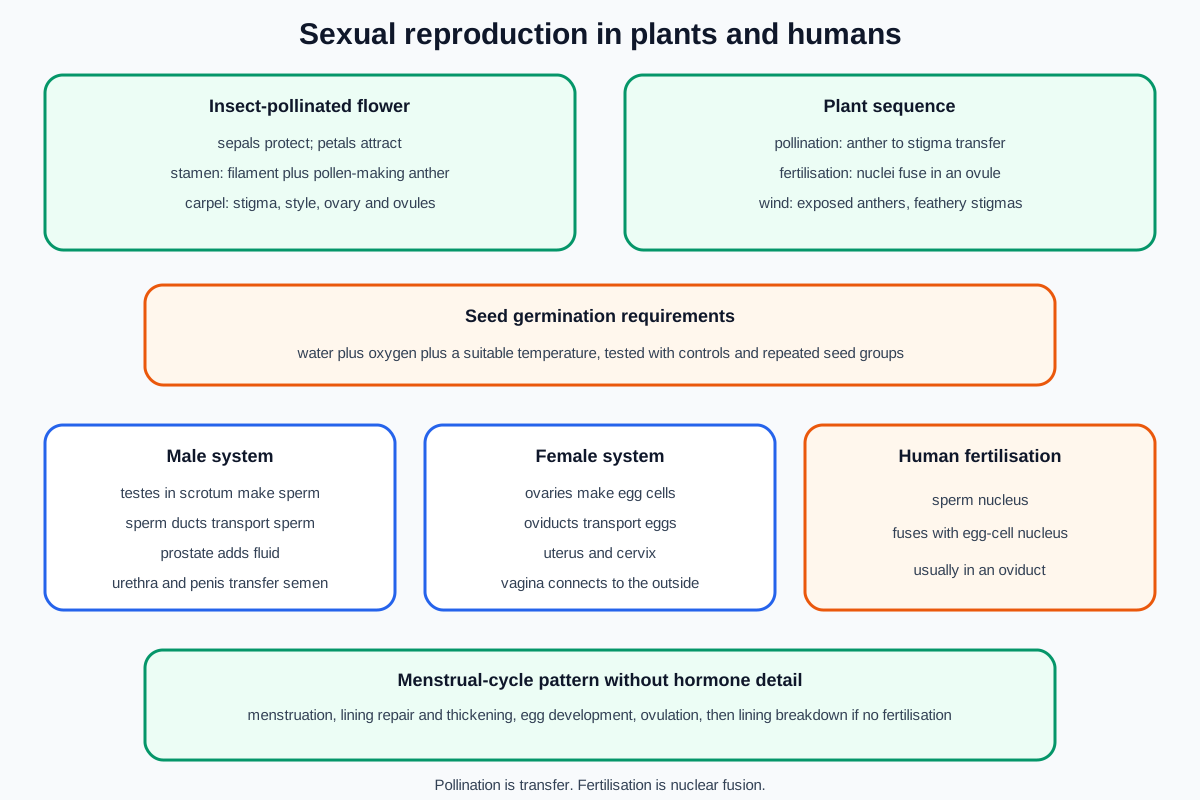
Cambridge IGCSE Combined Science 0653 notes on flower reproduction, seed germination, human reproductive systems, fertilisation and the menstrual cycle.
Cambridge IGCSE Combined Science Biology B14 covers sexual reproduction in plants and humans. It requires flower identification and drawing, pollination and fertilisation, the three germination conditions, male and female reproductive anatomy, nuclear fusion of gametes, and menstrual-cycle changes in ovaries and the uterine lining without sex-hormone knowledge.
Keep the two sexual-reproduction contexts separate
Plant and human sexual reproduction both involve male and female gametes and fusion of nuclei, but their structures and sequences differ.
In a flowering plant, pollen is transferred from anther to stigma before a pollen nucleus fuses with a nucleus in an ovule. In humans, a sperm nucleus fuses with an egg-cell nucleus.
Do not import asexual reproduction into the official B14 requirement. This Combined Science statement begins with sexual reproduction in plants and continues with sexual reproduction in humans.
Use accurate biological vocabulary and treat human reproduction as scientific anatomy and physiology, without judgement or assumptions about individual experience.
Draw and identify an insect-pollinated flower
The required parts are sepals, petals, stamens, filaments, anthers, carpels, style, stigma, ovary and ovules.
In a longitudinal drawing, place sepals outside or below the petals. Stamens surround the central carpel. Each stamen consists of a filament supporting an anther. The central carpel includes a stigma at the top, a style below it and an ovary containing ovules.
Use clear single lines, show the relationship between structures and label with straight ruled lines that do not cross unnecessarily. A biological drawing is not improved by shading or decorative colour.
Identification depends on position and connections, not only on a familiar flower shape.
Sepals protect the developing flower
Sepals enclose and protect the flower while it is in bud.
They usually form the outermost ring beneath the petals. In some flowers they are green and leaf-like, but colour is not a reliable identifying rule in every image.
Do not say sepals make pollen or receive it. Their required role is protection before the flower opens.
In a section, distinguish sepals from petals by their outer position and often smaller form.
Petals attract insect pollinators
Petals can be large, conspicuous or scented and help attract insects to the flower.
Their arrangement can guide an insect into contact with anthers and stigma, increasing the chance of pollen transfer.
Check this topic from memory
Attempt the matching topic bank before reopening the notes. Use each missed idea to decide what to review next.
Petals do not produce pollen. That is the role of anthers.
Avoid saying every petal contains an ovule. Ovules are inside the ovary.
Stamens are the male flower parts
A stamen consists of a filament and anther.
The filament supports the anther in a position where pollen can be collected or transferred by an insect.
The anther produces pollen grains. Pollen contains the male nucleus involved in fertilisation.
Do not label the whole stamen as the anther. Use the component names when a label line points to one part.
Carpels are the female flower parts
A carpel includes stigma, style and ovary. The ovary contains ovules.
The stigma receives pollen grains. In an insect-pollinated flower it is positioned so visiting insects can deposit pollen.
The style supports the stigma and connects it with the ovary. A pollen tube can grow through the style toward an ovule after compatible pollen lands, providing context for the later nuclear fusion.
The ovary contains ovules, and an ovule contains the female nucleus involved in fertilisation. Do not use ovary and ovule as synonyms.
Pollination is transfer, not fusion
Pollination is the transfer of pollen grains from an anther to a stigma.
The definition gives a starting structure, transferred material and receiving structure. Preserve all three.
Pollination can occur without successful fertilisation. Pollen must reach a suitable stigma, and later events must allow a pollen nucleus to reach an ovule.
Do not say pollination is a pollen grain entering the ovary or fusing with an egg. Those descriptions move beyond transfer.
Plant fertilisation is nuclear fusion in an ovule
Fertilisation occurs when a pollen nucleus fuses with a nucleus in an ovule.
The fusion occurs in the ovule, not on the stigma. Pollination must occur first, followed by movement of the male nucleus toward the ovule.
The required definition concerns nuclei, not whole pollen grains merging with the ovary.
Keep the sequence explicit: anther, pollen transfer, stigma, route through the style, ovule and nuclear fusion.
Recognise wind-pollinated anthers
The required wind-flower comparison is limited to identifying and describing anthers and stigmas.
Wind-pollinated anthers are commonly exposed outside the flower and loosely supported so wind can carry away pollen. They may hang from long filaments.
The identifying link is exposure for pollen release into moving air.
Do not replace anther and stigma description with a memorised list of every possible wind-flower adaptation. The official statement names these two structures only.
Recognise wind-pollinated stigmas
Wind-pollinated stigmas are commonly large, feathery and exposed.
The feathery structure provides a large area that can intercept airborne pollen. Exposure places it in moving air.
Do not call the feathery structure an anther. Ask whether the structure releases pollen or receives it.
Use visible evidence from the diagram. “It is wind-pollinated because there are no insects shown” is not a structural description.
Seeds need water for germination
Water rehydrates the seed and allows metabolic reactions to begin. It supports enzyme activity and transport of soluble substances within the germinating seed.
A dry viable seed can remain dormant even when oxygen and temperature are suitable.
Too much water can indirectly reduce oxygen availability if the seed is completely submerged and gas exchange is poor. The required statement is a requirement for water, not unlimited water.
In an investigation, compare moistened seeds with dry seeds while keeping oxygen and temperature suitable.
Seeds need oxygen for germination
Oxygen is required for aerobic respiration, which releases energy for cell division and growth during germination.
A seed supplied with water but deprived of oxygen should germinate less successfully than a comparable seed with air available.
To test oxygen, boiled and cooled water can reduce dissolved oxygen and a surface oil layer can limit oxygen re-entry. This setup needs safe handling and an appropriate control containing water and oxygen.
Do not say carbon dioxide is the required respiratory gas for germination.
Seeds need a suitable temperature
A suitable temperature allows enzyme-controlled reactions and respiration to proceed at an effective rate.
At a low temperature, reactions are slower and germination may be delayed. At an excessively high temperature, enzymes and living tissues can be damaged.
The requirement is a suitable temperature, not the highest possible temperature.
When testing temperature, keep water and oxygen available and compare identical seed groups at controlled temperatures.
Investigate one germination condition at a time
Use seeds of the same species and similar age. Place equal numbers in labelled containers and change only the condition being tested.
A useful set of comparisons includes:
moist seeds with air at a suitable temperature;
dry seeds with air at the same temperature;
moist seeds with oxygen excluded at the same temperature;
moist seeds with air at a low temperature.
The first condition is the positive control showing that the seed batch can germinate. Each other treatment isolates one missing or unsuitable condition.
Record the number germinated using a stated criterion, such as visible radicle emergence, at fixed times. Use several seeds per treatment and replicate containers because individual seeds may not be viable.
Evaluate a germination investigation
Percentage germination is more comparable than raw counts when group sizes differ. Use the number germinated divided by the total number tested, then express the result as a percentage.
Control seed species, seed age, number, observation time, water volume, container and all non-tested conditions.
A single ungerminated seed does not prove the tested condition is unnecessary or harmful. Non-viability and random variation are alternative explanations, which is why replication matters.
Handle hot water safely, label containers, prevent mould exposure and dispose of biological material appropriately. Do not eat experimental seeds.
Identify the male reproductive system
The required male structures are testes, scrotum, sperm ducts, prostate gland, urethra and penis.
Testes produce sperm. They are held in the scrotum outside the main body cavity, where a lower temperature supports sperm production.
Sperm ducts transport sperm from the testes toward the urethra. The prostate gland adds fluid to form part of semen.
The urethra carries semen through the penis during ejaculation and also carries urine at different times. The penis transfers semen into the vagina during sexual intercourse.
Use connections to label male anatomy
In side-view diagrams, identify the testes within the scrotum, then follow each sperm duct upward toward the urethra.
The prostate gland lies around the upper urethral region below the bladder in common diagrams. The urethra continues through the penis.
Do not label the sperm duct as the urethra. The sperm duct joins the route; the urethra is the final shared tube to the outside.
The bladder may appear for orientation but is not in the required B14.2 male list.
Identify the female reproductive system
The required female structures are ovaries, oviducts, uterus, cervix and vagina.
Ovaries produce egg cells. Oviducts carry an egg from an ovary toward the uterus and are the usual location of fertilisation.
The uterus has a lining that changes during the menstrual cycle and can support development after fertilisation. The cervix is the muscular opening or neck at the lower end of the uterus.
The vagina receives the penis and semen during sexual intercourse and forms the passage between the cervix and the outside.
Use symmetry and continuity to label female anatomy
In front-view diagrams, the two ovaries lie on either side of the uterus and connect by oviducts toward its upper region.
The uterus is the central muscular organ. Its lower narrow region is the cervix, and the vagina extends from the cervix to the outside.
Do not call the vagina the uterus. Do not place ovaries inside the uterine cavity.
Diagram orientation and simplification vary, so follow continuous structures instead of relying only on page position.
Human fertilisation is fusion of gamete nuclei
Human fertilisation is the fusion of the nuclei from a male gamete, the sperm, and a female gamete, the egg cell.
The definition requires nuclei and both gametes. “Sperm meets egg” is incomplete because contact does not necessarily mean fusion.
Fertilisation usually occurs in an oviduct. The resulting cell can begin dividing as it moves toward the uterus, but extended embryonic development is outside the named B14.2 statement.
Do not confuse fertilisation with implantation. Implantation is not the required definition here.
The menstrual cycle includes ovarian changes
During a menstrual cycle, an egg develops in an ovary. Around the middle of a typical cycle, an egg is released from the ovary in ovulation.
After ovulation, the ovary undergoes further temporary changes associated with supporting the uterine lining.
If fertilisation does not occur, those ovarian changes reverse and a new cycle begins.
Exact timing varies among individuals and cycles. Do not present one textbook day as universal.
The uterine lining changes through the cycle
At the beginning of the cycle, the uterine lining breaks down and is lost during menstruation.
The lining then repairs and thickens. It develops a blood supply and prepares for possible development after fertilisation.
If fertilisation does not occur, the thickened lining later breaks down, leading to the next menstruation.
The required description connects ovarian events and lining changes. Knowledge of sex hormones is explicitly not required, so do not replace the sequence with hormone names.
Coordinate the ovarian and uterine sequences
Early in the cycle, menstruation occurs while another egg begins developing in an ovary. The uterine lining then repairs and thickens.
Ovulation releases the egg. The lining remains prepared for a time while the egg moves through the oviduct.
Without fertilisation, the temporary ovarian state ends and the lining breaks down. With fertilisation, the cycle does not proceed to normal menstruation in the same way.
Describe patterns rather than treating cycle length and ovulation day as identical for every person.
Worked application: separate plant events and test germination
A student says pollen on a stigma proves that a seed has formed, then places one wet seed in warmth and calls its growth proof that only water is required. Pollen on a stigma shows pollination, not fertilisation; a pollen nucleus must still fuse with a nucleus in an ovule. The germination test also lacks oxygen and temperature comparisons, replication and a viability control. A stronger design uses equal groups of the same seed batch: moist with air at a suitable temperature, dry, oxygen-excluded and cold treatments. Germination is scored by the same radicle criterion. Only the full comparison can support the separate requirements for water, oxygen and a suitable temperature.
Common misconceptions and corrections
Adding asexual reproduction as the topic definition. B14 specifies sexual reproduction in plants and humans.
Calling a biological drawing an artwork. Use clear lines, proportions and labels without shading.
Saying sepals produce pollen. They protect the bud.
Saying petals contain ovules. Ovules are inside the ovary.
Calling the whole stamen an anther. A stamen contains filament and anther.
Saying the filament produces pollen. It supports the anther.
Saying the stigma produces pollen. It receives pollen.
Confusing ovary and ovule. The ovary contains ovules.
Defining pollination as fertilisation. It is transfer from anther to stigma.
Saying fertilisation occurs on the stigma. Nuclear fusion occurs in an ovule.
Calling a feathery wind stigma an anther. Decide whether the structure receives or releases pollen.
Listing every flower adaptation when only anther and stigma are asked. Follow the stated limit.
Saying all seeds need light to germinate. The named conditions are water, oxygen and suitable temperature.
Saying more water always improves germination. Excess water can reduce oxygen availability.
Saying carbon dioxide is required for germination respiration. Oxygen supports aerobic respiration.
Saying the hottest condition is best. Temperature must be suitable.
Using one seed per condition. Non-viability can dominate the result.
Omitting a positive control. Show that the seed batch can germinate.
Comparing unequal groups by raw count. Use percentage germination.
Saying the scrotum produces sperm. Testes produce sperm.
Calling the sperm duct the urethra. They are connected but distinct tubes.
Saying the prostate produces sperm. It adds fluid.
Saying urine and semen pass simultaneously. The urethra carries them at different times.
Saying ovaries are inside the uterus. They lie to either side and connect by oviducts.
Calling the cervix the vagina. The cervix is the lower opening of the uterus.
Defining human fertilisation as sperm touching egg. Their nuclei fuse.
Calling implantation fertilisation. Fertilisation is nuclear fusion.
Saying menstruation is release of an egg. Egg release is ovulation.
Saying the lining remains unchanged. It breaks down, repairs and thickens.
Assuming every cycle has one exact length and ovulation day. Biological timing varies.
Using hormone names as required content. Sex-hormone knowledge is explicitly not required.
Assessment guidance
Flower questions need all ten structures, component relationships and functions; drawing marks depend on clean biological conventions. Keep pollination as anther-to-stigma transfer and plant fertilisation as nuclear fusion in an ovule. Restrict wind-flower description to exposed anthers and large feathery stigmas when asked. Germination investigations require water, oxygen and suitable-temperature comparisons, a positive control, repeated seed groups and one scoring criterion. Reproductive-system labels need continuous anatomical connections and precise functions. Define human fertilisation with sperm and egg nuclei. Menstrual-cycle answers should coordinate egg development, ovulation, menstruation and uterine-lining repair and thickening without hormone detail.
Retrieval practice
Draw and label insect-pollinated flowers from memory, then identify anthers and stigmas in unfamiliar wind flowers. Reconstruct pollination-to-fertilisation order. Design and evaluate the four-condition germination test with percentage calculations. Label rotated male and female reproductive diagrams and build structure-function cards. Arrange ovarian and uterine events on an unnumbered cycle, then diagnose thirty boundary, anatomy and process errors.
Topic ownership
This note owns B14 insect-flower structures and functions, pollination, plant fertilisation, wind-flower anther and stigma description, three germination conditions, male and female reproductive anatomy, human fertilisation and hormone-free menstrual-cycle changes. B12 owns respiration used during germination. Asexual reproduction, implantation, pregnancy development and sex-hormone mechanisms are not promoted into this Combined Science B14 boundary.