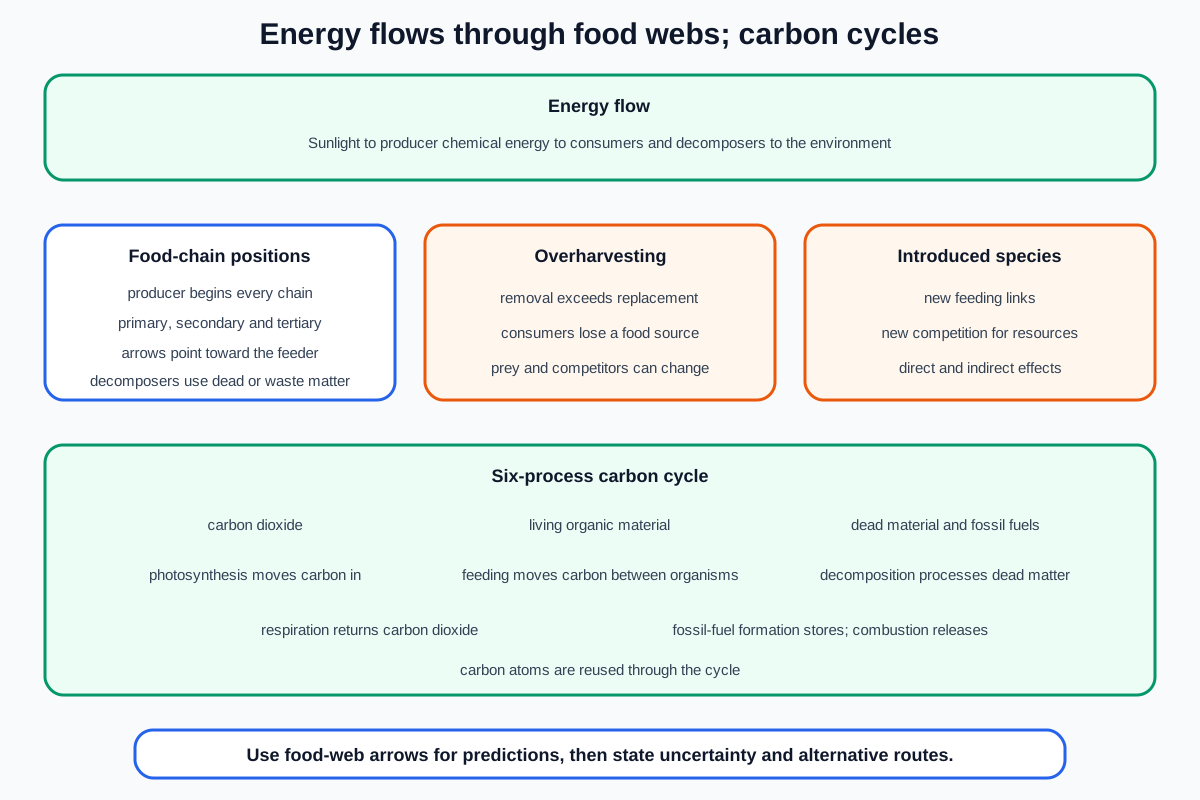
Cambridge IGCSE Combined Science Biology B15 follows energy from sunlight through producers, consumers and decomposers to the environment; constructs and interprets food chains and webs; applies them to overharvesting and introduced species; and traces carbon through six specified processes.
Energy enters biological systems mainly from the Sun
The Sun is the principal source of energy input to biological systems.
Producers capture some light energy through photosynthesis and transfer it into chemical energy in organic nutrients.
The word “principal” allows rare biological systems with other energy sources, but sunlight is the main input for the ecosystems considered here.
Energy enters, flows and is eventually transferred to the environment. It is not recycled in the same way as carbon.
Producers convert light energy into chemical energy
A producer is an organism that makes its own organic nutrients, usually using energy from sunlight, through photosynthesis.
Green plants are common producers. They make glucose and other organic material that contains chemical energy.
“Makes its own food” is a useful shortcut only if you can state the precise idea: organic nutrients are synthesised, usually using light energy through photosynthesis.
A producer is defined by nutrient production, not by being eaten by another organism.
Chemical energy moves through feeding
When one organism feeds on another, organic material and its chemical energy pass to the consumer.
Some of that chemical energy can be released in respiration and used for biological work. Energy is eventually transferred to the environment, including as heat.
Material that becomes dead tissue or waste can be used by decomposers, so energy can continue through another feeding route before final transfer to the environment.
Do not say the same energy returns from the environment to the Sun or producer. Biological energy flow is one-way overall.
A food chain shows energy transfer
A food chain shows the transfer of energy from one organism to the next, beginning with a producer.
For example:
grass → grasshopper → frog → snake
The producer must be first. The next organism obtains energy by feeding on it, and the chain continues through additional consumers.
A food chain is not merely a list of organisms living in the same habitat. Every adjacent pair must have a feeding relationship.
Arrows point in the direction of energy transfer
Check this topic from memory
Attempt the matching topic bank before reopening the notes. Use each missed idea to decide what to review next.
In a food chain, an arrow points from the organism being eaten toward the organism that eats it.
The arrow can be read as “transfers energy to”. Grass → rabbit means chemical energy in grass is transferred to the rabbit when it feeds.
This direction may feel opposite to an arrow showing “attacks”, so use the energy rule rather than drawing arrows from predator to prey.
When checking a chain, start at the producer and follow each arrow into the next consumer.
Consumers obtain energy by feeding
A consumer is an organism that gets its energy by feeding on other organisms.
The definition includes herbivores and carnivores and can include organisms with varied diets.
Consumers do not make all their own organic nutrients through photosynthesis. Their position depends on what they eat in the particular chain.
The same species can occupy different consumer levels in different food chains if its diet changes.
Classify primary, secondary and tertiary consumers
A primary consumer feeds on the producer in a chain.
A secondary consumer feeds on the primary consumer. A tertiary consumer feeds on the secondary consumer.
These labels describe position, not permanent species identity. In one chain a bird may be a primary consumer because it eats seeds; in another it may be a secondary consumer because it eats a herbivorous insect.
Count feeding steps from the producer rather than memorising an animal's usual label.
Herbivores eat plants
A herbivore is an animal that gets its energy by eating plants.
In a simple plant-led food chain, a herbivore is commonly the primary consumer.
The definition names animals, energy acquisition and plant food. Do not define a herbivore only as “not a predator”.
An animal that eats both plant and animal material cannot be described fully as a strict herbivore in every context.
Carnivores eat other animals
A carnivore is an animal that gets its energy by eating other animals.
Carnivores may be secondary or tertiary consumers depending on the food chain.
“Top carnivore” is not automatically the same as tertiary consumer: position depends on the number of feeding steps shown.
Do not use size as the defining feature. A small animal feeding on another animal is still acting as a carnivore.
Decomposers feed on dead or waste material
A decomposer is an organism that gets its energy from dead or waste organic material.
Decomposers act on material from producers and consumers. Their respiration transfers energy to the environment, while their chemical activity contributes to carbon-cycle processes.
The definition is about energy source. It is more precise than saying decomposers “make things disappear”.
Do not place decomposers only at the end of one chain. Dead and waste material can arise at every feeding level.
A food web links food chains
A food web is a network of interconnected food chains.
One organism may have several food sources and several consumers. Shared organisms link the chains into a web.
To extract a chain, begin with a producer and follow arrows through valid feeding steps. To interpret change, inspect all arrows entering and leaving the affected species.
A more connected web can create alternative feeding routes, but it does not guarantee that removal of a species has no effect.
Predict direct effects before indirect effects
If a prey population decreases, its consumers may have less food. If a predator decreases, its prey may face less predation and increase.
Those are direct effects because an arrow connects the species. Indirect effects occur through additional steps, such as increased prey consuming more of its own food.
Predictions should use cautious language because competition, alternative food sources and other environmental factors can alter outcomes.
Do not claim every population change is certain or immediate. A food web supports directional hypotheses under stated assumptions.
Overharvesting removes a food species
Overharvesting means removing organisms faster than their population can be replaced.
When humans overharvest a food species, its population falls. Consumers that feed on it may have less energy available and decline or switch to other prey.
Species eaten by the harvested organism may increase because feeding pressure is reduced. Competitors may also change if resources become more available.
Use the actual web to trace these effects. Do not give a generic statement that every other species falls.
Overharvesting can cause cascading effects
Suppose a fish species feeds on small crustaceans and is eaten by larger fish and seabirds. Heavy harvesting directly reduces the fish population.
Large fish and seabirds may decline or increase feeding on alternatives. Crustaceans may increase and consume more of their own food. Those indirect changes can spread across several paths.
The direction depends on the arrows. A harvested producer, herbivore and predator would create different patterns.
Management decisions need population evidence, replacement rate and the species' food-web role, not only the current catch.
Introduced species create new interactions
A foreign or introduced species is moved into a habitat where it did not previously occur.
It may feed on native organisms, compete with them for food, or become prey for existing consumers. These new links change the food web.
If the introduced species has few effective predators, its population may rise rapidly and place strong pressure on native species.
Not every introduced species has the same impact. Use evidence from the specified web rather than assuming automatic extinction.
Trace introduced-species effects through the web
First identify what the introduced species eats and which native species share those resources.
Direct prey may decrease. Native competitors may receive less food and decrease. Predators that can eat the introduced species may gain another resource and increase.
An increase in one predator can then affect its other prey, creating indirect effects.
Separate observations from predictions. A new arrow shows a possible energy-transfer route; population data are needed to confirm the magnitude of change.
Carbon cycles while energy flows
Carbon atoms move between carbon dioxide, organic material in organisms, dead material and fossil fuels.
The required carbon-cycle processes are photosynthesis, respiration, feeding, decomposition, formation of fossil fuels and combustion.
Unlike energy, carbon is matter and can be reused through these transfers.
Do not add unlisted processes in place of the six required ones. Additional context must not obscure the official cycle.
Photosynthesis moves carbon into organisms
Plants take in carbon dioxide during photosynthesis and use its carbon to make glucose and other organic nutrients.
This transfers carbon from atmospheric or dissolved carbon dioxide into producer biomass.
The process also transfers light energy into chemical energy, but carbon and energy should not be treated as the same entity.
In a carbon-cycle arrow, photosynthesis points from carbon dioxide toward producers.
Feeding transfers carbon between organisms
When a consumer eats another organism, carbon compounds in the food enter the consumer.
Feeding transfers carbon from producers to consumers and between consumers. Some becomes part of new biomass and some is used in respiration.
Food-chain arrows therefore represent both energy transfer and movement of organic material, but the B15 food-chain definition specifically emphasises energy.
Do not say feeding returns carbon dioxide directly to the atmosphere. Respiration performs that step.
Respiration returns carbon dioxide
Respiration breaks down nutrient molecules and produces carbon dioxide in the required aerobic equation.
Producers, consumers and decomposers all respire, returning carbon dioxide to the atmosphere or surrounding water.
Do not show only animals respiring. Plants and decomposers are living organisms with energy needs.
In the carbon cycle, respiration arrows point from living organisms toward carbon dioxide.
Decomposition processes dead organic material
Decomposers obtain energy from dead organisms and waste organic material.
As they respire, carbon in the material can return to the environment as carbon dioxide. Some carbon may remain in material and soils during decomposition.
Decomposition is not combustion. It is biological processing by decomposer organisms.
Connect dead material to decomposers and decomposer respiration to carbon dioxide.
Fossil fuels form over long periods
Some carbon in dead organic material is not fully decomposed and can, under particular conditions over very long periods, contribute to formation of fossil fuels.
This transfers carbon into a long-term geological store.
Fossil-fuel formation is not a rapid replacement process on human timescales.
Do not draw fossil fuels forming directly from atmospheric carbon dioxide without the biological and dead-material stages.
Combustion releases stored carbon
Combustion of fossil fuels transfers carbon from the geological store to carbon dioxide in the atmosphere.
Burning organic material can also release carbon dioxide, but fossil-fuel combustion is the central link paired with fossil-fuel formation in this cycle.
Combustion is a chemical reaction, not respiration by the fuel.
Use an arrow from fossil fuels toward atmospheric carbon dioxide and label it combustion.
Worked application: predict change in a coastal food web
In a coastal web, algae feed snails and small fish; snails and small fish feed seabirds; and people harvest the small fish. If harvesting exceeds replacement, the fish population falls. Seabirds lose one food source and may eat more snails, so snail numbers could fall even though fish no longer compete with them for algae. Algae may increase because fewer fish feed on it, but greater snail feeding could offset that change. If a foreign predator is introduced and eats both fish and snails, both prey face additional pressure. These are evidence-based predictions from arrows, not certainties; alternative foods and population data determine the final magnitude.
Common misconceptions and corrections
Saying energy is recycled. It flows and is eventually transferred to the environment.
Saying the Sun supplies chemical energy directly to consumers. Producers first capture light energy.
Defining a producer as something eaten. It makes its own organic nutrients.
Starting a food chain with a carnivore. It begins with a producer.
Drawing arrows from predator to prey. Arrows show energy transfer toward the feeder.
Calling a habitat list a food chain. Adjacent organisms need feeding links.
Saying consumers make all their own nutrients. They obtain energy by feeding.
Treating consumer level as a fixed species label. It depends on position in a chain.
Calling every primary consumer a carnivore. Plant-feeding primary consumers are herbivores.
Defining herbivores as small animals. They get energy by eating plants.
Defining carnivores as top predators only. They get energy by eating animals.
Saying decomposers use only dead predators. They use dead and waste material from all levels.
Putting decomposers at one fixed chain end. Their resources arise throughout the web.
Calling a food web one long chain. It is a network of interconnected chains.
Predicting only direct effects. Follow additional arrows for indirect effects.
Treating a food-web prediction as certainty. Alternative resources and competition matter.
Defining overharvesting as any harvesting. Removal exceeds population replacement.
Saying every species falls after harvesting. Some prey or competitors may increase.
Assuming every introduced species causes extinction. Impact depends on interactions and evidence.
Ignoring new competition links. Introduced species can share resources with natives.
Saying carbon and energy cycle identically. Carbon cycles; energy flows.
Saying photosynthesis releases carbon dioxide. It transfers carbon dioxide into organic material.
Saying feeding directly releases atmospheric carbon dioxide. Respiration returns it.
Saying only animals respire. Producers and decomposers respire too.
Calling decomposition combustion. It is biological processing of dead or waste material.
Saying fossil fuels form rapidly. Their formation takes very long periods.
Saying combustion is respiration by fuel. It is a chemical burning process.
Importing population limiting factors as required B15 content. They are not listed in this statement.
Replacing the carbon cycle with a general nutrient cycle. Preserve the six specified carbon processes.
Assessment guidance
Energy answers should start with sunlight, show conversion to chemical energy in producers, follow feeding and end with transfer to the environment. Food-chain arrows point toward the feeder and every chain begins with a producer. Classify consumers by position, not species reputation. Food-web impact questions need one direct effect, at least one traced indirect effect and cautious treatment of alternative routes. Apply overharvesting and introduced species to the actual arrows. Carbon-cycle answers must include photosynthesis, respiration, feeding, decomposition, fossil-fuel formation and combustion, with correct reservoirs and directions. Explicitly distinguish recycled carbon from one-way energy flow.
Retrieval practice
Construct twenty valid chains from species lists and justify every arrow. Extract and interpret chains from dense webs, then classify consumers in each route. Predict direct and indirect effects of overharvesting different trophic positions and adding foreign species. Draw the six-process carbon cycle from a blank set of reservoirs. Diagnose thirty arrow, definition, energy-carbon and causation errors, then explain the same web in words.
Topic ownership
This note owns B15 energy flow, food-chain and food-web definitions and interpretation, producer, consumer, herbivore, carnivore and decomposer definitions, consumer levels, overharvesting and foreign-species impacts, and the six-process carbon cycle. B16 owns ecosystem and biodiversity definitions, habitat destruction and conservation. Population limiting factors, trophic-efficiency calculations and general nutrient cycles are not promoted into this Combined Science B15 boundary.