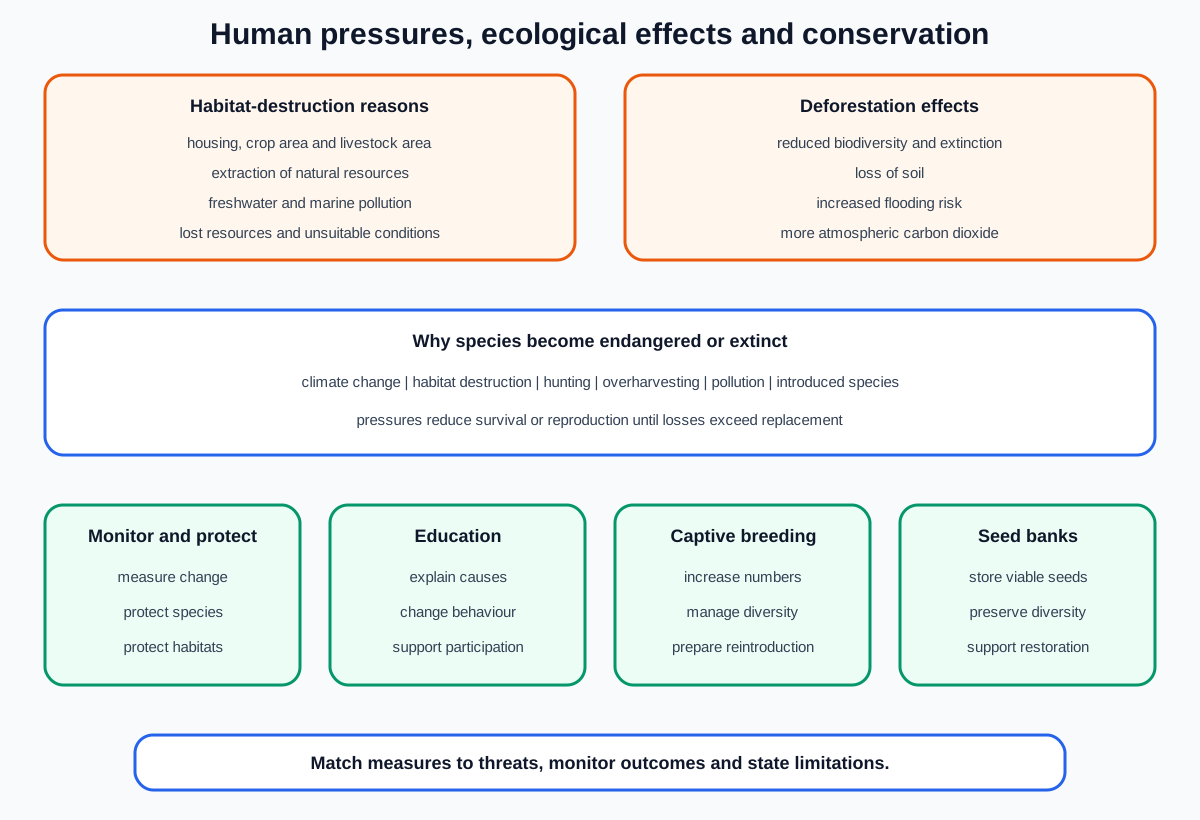
Cambridge IGCSE Combined Science Biology B16 defines ecosystems and biodiversity, explains the specified causes of habitat destruction and four effects of deforestation, outlines six reasons species become endangered or extinct, and evaluates four named conservation approaches.
An ecosystem combines a community and its environment
An ecosystem is a unit containing the community of organisms and their environment, interacting together.
The community includes populations of different species living in the area. The environment includes non-living conditions and resources around them.
Interactions connect the two: organisms feed, compete and reproduce; they use water, gases and minerals; and they alter their surroundings.
Do not define an ecosystem as only a place or only a collection of organisms. The organisms, environment and interactions are all required.
Biodiversity counts different species in an area
Biodiversity is the number of different species that live in an area.
This syllabus definition concerns species richness. Ten species represent greater biodiversity than five species in equal, appropriately surveyed areas, regardless of the total number of individual organisms.
A site with thousands of individuals from one species does not necessarily have high biodiversity.
When comparing areas, sampling effort and area size must be comparable. A larger or more intensively surveyed area may contain more recorded species even if the ecological pattern is similar.
Habitat destruction removes the conditions species need
A habitat provides the place and conditions in which an organism lives.
Habitat destruction removes or severely changes food sources, shelter, breeding sites and physical conditions. Populations may decline when survival and reproduction no longer replace losses.
Species differ in tolerance. A specialist dependent on one habitat may decline more sharply than a generalist able to use alternatives.
Describe a mechanism rather than writing only that destruction “is bad for nature”.
Housing expansion destroys or fragments habitat
Increasing the area used for housing can replace natural habitat with buildings, roads and managed land.
Remaining habitat may be divided into smaller isolated patches. Individuals then have less space and fewer resources, and movement between populations can become harder.
Roads and human activity can also increase disturbance and mortality.
The examination point is the land-area tradeoff. Do not treat every house as having an identical effect; location, design and retained habitat influence magnitude.
Check this topic from memory
Attempt the matching topic bank before reopening the notes. Use each missed idea to decide what to review next.
Increasing the area for crop plant production can clear existing vegetation and replace a diverse community with one or a few crop species.
Native organisms lose feeding and breeding resources. Management practices and pollution can create additional pressures, but land conversion itself is the specified reason.
Crop production supplies human needs, so evaluation should compare ecological cost with purpose and possible mitigation rather than pretending no tradeoff exists.
Keeping habitat corridors, reducing unnecessary clearance and protecting high-value areas can reduce some impact without changing the definition of destruction.
Livestock production also requires land
Increasing the area for livestock production can clear habitat for grazing or for growing animal feed.
Trampling, fencing and altered vegetation can change the remaining habitat, while waste can contribute to pollution if poorly managed.
The required link is expansion of livestock-production area and loss of the original ecosystem.
Do not combine crop and livestock expansion into a vague statement about “farming” if a question asks for distinct reasons.
Natural-resource extraction removes and disturbs habitat
Extraction of natural resources can include removing timber, minerals, rock, fuels or other materials.
The extraction site can directly remove vegetation and soil. Access roads, waste and water changes can extend disturbance beyond the immediate area.
Effects depend on extraction method, scale, location and restoration. A named causal chain is stronger than saying all extraction produces the same damage.
Natural resources support societies, but that benefit does not erase habitat costs. Evaluation can compare alternatives, controls and restoration.
Freshwater pollution can destroy habitat quality
Pollution changes freshwater conditions so that some organisms cannot survive or reproduce successfully.
Toxic substances can harm organisms directly. Organic or nutrient pollution can alter oxygen availability and species composition. A detailed account of eutrophication is explicitly not required.
Pollution can therefore destroy habitat even when the water body is not physically filled or removed.
Match the pollutant to a plausible effect rather than treating all pollutants as identical.
Marine pollution damages coastal and ocean habitats
Marine pollution can introduce toxic chemicals, plastics, oil, sewage or other waste into saltwater environments.
Organisms may be poisoned, entangled, smothered or deprived of suitable feeding and breeding conditions depending on the pollutant.
Pollution can move with water and affect areas beyond its source.
The required statement groups freshwater and marine pollution as reasons for habitat destruction. Use context-specific mechanisms without importing unnecessary process detail.
Deforestation reduces biodiversity
Deforestation removes forest vegetation and the many microhabitats, food sources and interactions it supports.
Species that depend on the forest decline or disappear locally. The number of different species in the area falls, so biodiversity is reduced.
This explanation must connect forest removal to lost requirements and then to fewer species.
Do not use reduced numbers of trees alone as the complete biodiversity explanation. Biodiversity counts different species, not just tree abundance.
Deforestation can cause extinction
If a species loses most or all of the habitat it requires across its range, its population can fall to zero and it becomes extinct.
Small isolated populations are also vulnerable because chance events, low breeding success and limited recolonisation can prevent recovery.
Local loss is not automatically global extinction. Use the scale specified by the question.
Extinction is permanent for the species. It is not the same as temporary migration out of one surveyed site.
Deforestation increases soil loss
Tree roots help bind soil. The canopy and leaf litter reduce the impact of rainfall and slow water movement across the surface.
When trees are removed, soil is more exposed to rain and wind. Surface runoff can carry away fertile topsoil, increasing erosion.
The causal chain is removal of roots and cover, less binding and protection, then greater soil loss.
Do not say tree roots create erosion. Their removal reduces stabilisation.
Deforestation increases flooding risk
Forest canopies intercept rainfall, vegetation takes up water, and roots and soil structure support infiltration.
After deforestation, more water can reach the ground rapidly and move as surface runoff into rivers. River discharge can rise more quickly, increasing flood risk downstream.
Deforestation is not the only cause of flooding. Rainfall amount, soil, slope, drainage and urban surfaces also matter.
Use “increases risk” rather than claiming every cleared site floods after every storm.
Species may lose suitable habitat or experience mismatches in food availability and reproduction. Some can move or adapt, while others cannot do so quickly enough.
Small ranges, isolated habitats and specialised requirements can increase vulnerability.
Link the climate variable to the species requirement rather than stating that every species responds identically.
Habitat destruction drives endangerment
When habitat area or quality falls, populations lose resources and breeding sites. Smaller and more isolated populations face a greater risk of extinction.
This cause can interact with hunting, pollution and climate change. A species weakened by habitat loss may withstand additional pressure poorly.
Habitat destruction can occur through the land-use, extraction and pollution routes already described.
Do not list the phrase twice without adding the survival or reproduction mechanism.
Hunting can exceed replacement
Hunting removes individuals from a population. If removal is faster than reproduction and recruitment, population size declines.
Targeting breeding adults can have a particularly strong effect on future population growth.
The cause is unsustainable pressure, not the mere existence of all hunting in every context.
Regulation and enforcement can help align removal with conservation goals where appropriate.
Overharvesting removes organisms too rapidly
Overharvesting removes a resource species faster than its population can replace losses.
Fishing, plant collection or other extraction can reduce the target population and alter food webs.
Low reproductive rate, delayed maturity and concentrated harvesting can increase vulnerability.
B15 owns detailed food-web consequences, while B16 uses overharvesting as a reason for endangerment or extinction.
Pollution reduces survival and reproduction
Pollution can poison organisms, damage reproductive success, reduce food, alter oxygen or destroy habitat quality.
Persistent pollutants can remain in the environment and expose organisms over long periods.
Effects differ by chemical or material, concentration, exposure route and species sensitivity.
Do not use a detailed eutrophication chain as the only pollution explanation because the official boundary does not require that detail.
Introduced species create new pressures
An introduced species can prey on native organisms, compete for resources, alter habitat or carry disease.
Native species may lack effective defences or may already occupy small ranges, increasing decline risk.
Not every introduced species becomes damaging. Evidence about population growth and interactions is needed.
B15 develops food-web predictions; here the key link is added pressure leading to endangerment or extinction.
Monitoring guides conservation decisions
Monitoring estimates population size, distribution, breeding success, habitat condition and change over time.
Reliable evidence identifies where decline is occurring and whether a conservation action is working.
Methods should suit the species and avoid excessive disturbance. Repeated comparable surveys are more useful than one isolated count.
Monitoring alone does not remove the threat, so it should guide protection and adjustment.
Protecting species and habitats tackles causes
Protection can restrict destructive land use, hunting, harvesting or pollution and preserve important feeding and breeding areas.
Habitat corridors can connect populations, while restoration can improve damaged habitat.
Enforcement, local participation and long-term resources influence whether legal protection changes conditions in practice.
Protecting only individuals while their habitat disappears is unlikely to secure a wild population.
Education changes knowledge and behaviour
Education can explain why a species matters, how human actions create risk and what behaviours reduce pressure.
It can support compliance, reduce demand for harmful products and build local participation in monitoring or habitat protection.
Education is strongest when it is relevant, accessible and paired with practical alternatives.
It does not guarantee behaviour change by itself, especially when economic incentives still reward habitat destruction or illegal harvesting.
Captive breeding increases managed populations
Captive breeding programmes breed endangered animals under protected conditions.
They can increase numbers, maintain a population while threats are addressed, and support later reintroduction where suitable habitat exists.
Programmes must manage genetic diversity, disease, animal welfare and learned behaviours needed for survival.
Captive breeding cannot replace habitat protection. Releasing animals into the same unresolved threat may fail.
Seed banks conserve plant genetic material
Seed banks store seeds from plant species under controlled conditions to preserve viable genetic material.
Stored seeds can support research, future propagation and restoration after loss in the wild.
Collections should represent genetic diversity and require testing, documentation and renewal as viability falls.
Not every plant produces seed suitable for long-term conventional storage, so seed banks complement rather than replace habitat conservation.
Match conservation to the dominant threat
A species threatened mainly by habitat clearance needs habitat protection and restoration. One threatened by hunting needs enforcement and demand reduction. A plant with disappearing wild populations may benefit from habitat protection plus a seed bank.
Captive breeding can buy time for an animal, but reintroduction requires the original pressure to be controlled.
Monitoring should test whether the chosen intervention improves population and habitat indicators.
Strong conservation plans combine measures and acknowledge constraints rather than presenting one method as universally sufficient.
Worked application: build a forest-species conservation plan
A forest bird declines after land is cleared for crops and an introduced predator spreads through the remaining fragments. Monitoring should estimate bird numbers, breeding success, predator distribution and habitat condition using repeated comparable surveys. Protecting remaining forest and restoring corridors tackles habitat loss, while control of the introduced predator addresses a second cause. Education can help land users recognise nests, avoid further clearance and support reporting, but it needs practical land-use alternatives. Captive breeding might protect a small managed population, yet release would fail if forest and predator threats remain. The plan should be revised from evidence rather than assuming one intervention guarantees recovery.
Common misconceptions and corrections
Defining an ecosystem as only organisms. Include their environment and interactions.
Defining an ecosystem as only a place. Include the community.
Defining biodiversity as total individual abundance. It is the number of different species in an area.
Comparing biodiversity from unequal survey effort. Standardise area and sampling.
Combining housing, crops and livestock into one unexplained cause. State distinct land demands.
Saying every extraction method has identical effects. Scale, method and restoration matter.
Treating all pollutants as identical. Match pollutant to mechanism.
Giving detailed eutrophication as required. It is explicitly not required.
Saying deforestation reduces biodiversity only by removing trees. It removes resources for many species.
Calling local absence global extinction. Scale matters.
Saying roots cause soil erosion. Roots help bind soil.
Saying deforestation guarantees flooding. It increases risk through runoff.
Giving only carbon release after deforestation. Reduced photosynthetic uptake also matters.
Saying an endangered species has no living individuals. That describes extinction.
Treating one missed sighting as proof of extinction. Monitoring evidence is needed.
Saying climate change affects every species identically. Vulnerability depends on requirements and capacity to respond.
Calling any hunting overharvesting. Decline occurs when removal exceeds replacement.
Ignoring interacting threats. Habitat loss can amplify hunting, pollution or climate pressure.
Saying every introduced species is damaging. Impact requires interaction evidence.
Saying monitoring alone conserves a species. It guides action but does not remove threats.
Protecting animals while clearing their habitat. Wild survival requires suitable habitat.
Saying education guarantees behaviour change. Incentives and alternatives matter.
Saying captive breeding solves extinction risk alone. Threats must be controlled before release.
Ignoring genetic diversity in captive breeding. A narrow managed population can have long-term limits.
Saying seed banks store adult plants. They store viable seeds and associated records.
Assuming all seeds store equally well. Some species need other approaches.
Using one conservation method for every threat. Match measures to causes.
Importing food-production technologies into B16. They are not listed in this Combined Science statement.
Replacing conservation with a broad sustainability essay. Preserve the four specified approaches.
Assessment guidance
Definitions need the exact unit, community, environment and interaction language for ecosystems, and number of different species in an area for biodiversity. Habitat-destruction answers should separate housing, crop, livestock, extraction, freshwater pollution and marine pollution. Explain each deforestation effect as a causal chain through habitat loss, roots and cover, runoff, photosynthetic uptake, combustion or decomposition. Endangerment questions require all six causes with mechanisms. Conservation answers must stay within monitoring and protection, education, captive breeding and seed banks, then match each measure to the threat and state a limitation. Avoid detailed eutrophication when the syllabus explicitly excludes it.
Retrieval practice
Reconstruct ecosystem and biodiversity definitions exactly and critique ten flawed surveys. Build causal chains for every habitat-destruction reason and all four deforestation effects. Sort case studies among climate change, habitat destruction, hunting, overharvesting, pollution and introduced species. Design combined conservation plans using all four specified approaches, with indicators and limitations. Diagnose thirty scale, causation, definition and overclaiming errors.
Topic ownership
This note owns B16 ecosystem and biodiversity definitions, specified habitat-destruction reasons, all four deforestation effects, the six endangerment causes and the four limited conservation approaches. B15 owns food-web consequences and the carbon cycle. Food-supply technologies, detailed eutrophication and broad sustainability frameworks are not promoted into this Combined Science B16 boundary.