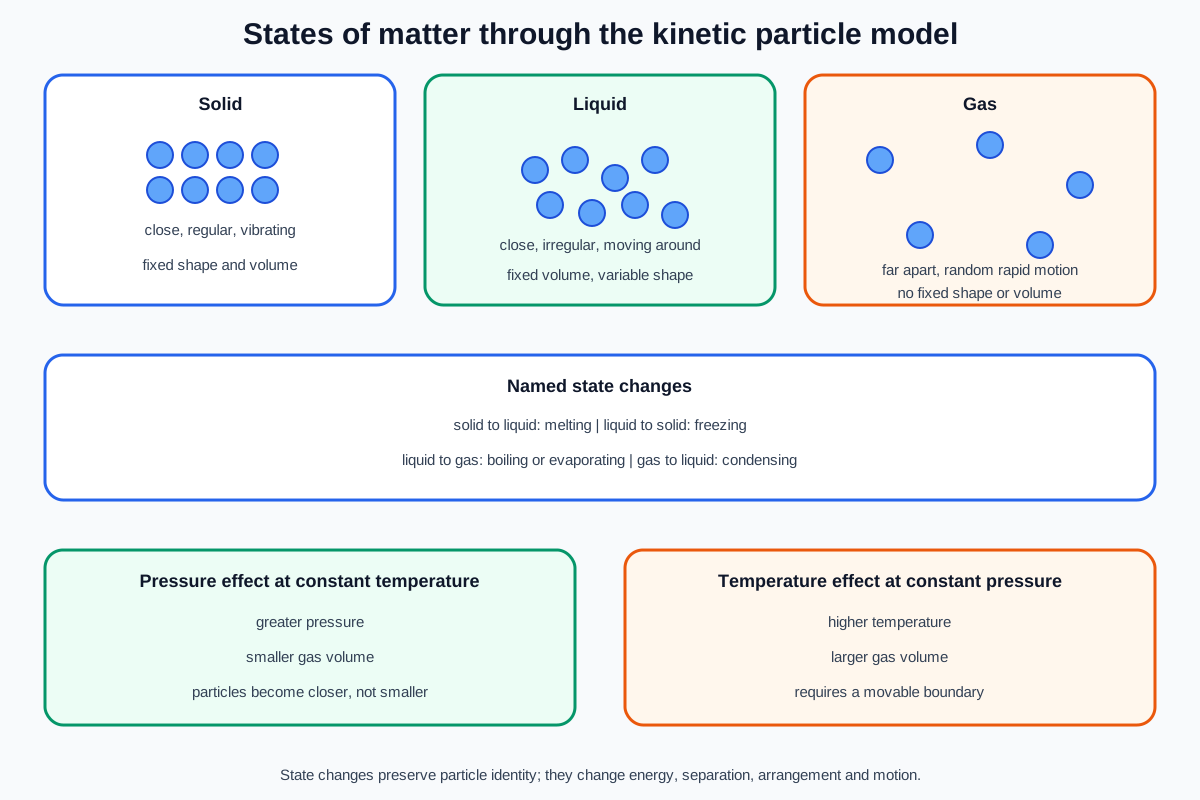
Cambridge IGCSE Combined Science Chemistry C1 distinguishes the observable properties of solids, liquids and gases, explains each state through particle separation, arrangement and motion, develops five changes of state using kinetic particle theory, and predicts how temperature and pressure affect gas volume.
Separate macroscopic properties from particle explanations
Macroscopic properties are what can be observed for a bulk sample: shape, volume, flow and compressibility.
Particle structure explains those observations through separation, arrangement and motion. Particles themselves are not tiny versions of the bulk material with the same macroscopic properties.
A good answer first states the property, then links it to particles. For example, a solid keeps its shape because closely packed particles remain in fixed positions and only vibrate.
Do not use “particles are solid” as an explanation of a solid. The state describes the collective arrangement and motion.
Solids have fixed shape and volume
A solid has a fixed shape and fixed volume under ordinary conditions.
It does not flow to take the shape of its container and is difficult to compress.
The particles are very close together in a regular arrangement. Strong attractions hold them in fixed positions relative to one another.
The particles are not motionless. They vibrate about fixed positions, and their vibration becomes more energetic as temperature increases.
Liquids have fixed volume but variable shape
A liquid has a fixed volume but no fixed shape. It flows and takes the shape of the lower part of its container.
It is difficult to compress because its particles are already close together.
Liquid particles have a close but irregular arrangement. They move around and slide past one another while remaining close.
This movement explains flow. The particles do not separate to fill the entire container as gas particles do.
Gases have no fixed shape or volume
A gas has no fixed shape and no fixed volume. It expands to fill its container.
It is readily compressed because there are large spaces between particles.
Gas particles are far apart with no regular arrangement. They move rapidly and randomly in all directions.
The particles collide with one another and with container walls. The empty space, rather than compressible particles, allows gas volume to decrease under pressure.
Compare separation systematically
Solid particles are very close together. Liquid particles are also close together, while gas particles are far apart.
Check this topic from memory
Attempt the matching topic bank before reopening the notes. Use each missed idea to decide what to review next.
This explains why solids and liquids have nearly fixed volumes but gases can occupy different volumes.
In diagrams of the same substance, keep every particle the same size. Change the spacing and arrangement, not the particle identity.
Do not draw a liquid with the large gaps characteristic of a gas simply because its arrangement is irregular.
Compare arrangement systematically
Solid particles have a regular arrangement. Liquid particles have an irregular arrangement while remaining close. Gas particles have an irregular arrangement and are widely separated.
“Regular” means an ordered repeating pattern, not that every solid must be drawn as a perfect square.
Arrangement differs from motion. A liquid and gas can both be irregular, but their separation and freedom of movement differ greatly.
Use all three features when a question asks for structure rather than relying on one word.
Compare motion systematically
Solid particles vibrate about fixed positions. Liquid particles move around each other. Gas particles move rapidly and randomly throughout the available space.
Heating increases the average kinetic energy of particles in every state.
Motion should be represented with sensible arrows if the diagram requests it. Long random arrows suit gases; short vibration marks suit solids.
Do not say particles in a cold solid stop moving completely under normal syllabus conditions.
Melting changes a solid to a liquid
Melting is the change from solid to liquid.
On heating, particles gain kinetic energy and vibrate more strongly. At the melting temperature, they overcome enough attractive forces to leave fixed positions and move around each other.
The particles remain close, so the substance keeps a nearly fixed volume. Their irregular mobile arrangement gives the liquid a variable shape.
Melting is a physical change. No new substance forms, and the same particles remain present.
Freezing changes a liquid to a solid
Freezing is the change from liquid to solid.
During cooling, particles lose kinetic energy and move less. Attractive forces organise and hold them in fixed positions, where they continue to vibrate.
The resulting solid has a fixed shape and volume.
Freezing and melting are reverse state changes. Do not describe freezing as particles becoming chemically bonded into a new substance in every case.
Boiling changes liquid throughout the sample
Boiling is the change from liquid to gas throughout a liquid at its boiling temperature.
Particles gain enough kinetic energy to overcome attractions and separate widely. Bubbles of the substance's vapour form within the liquid and rise.
At a given pressure, a pure substance has a characteristic boiling point. Changing pressure can alter the boiling temperature, but that extension should not replace the particle explanation.
Do not call every visible bubble oxygen or air. During boiling, bubbles are principally vapour of the boiling substance.
Evaporation occurs at the surface
Evaporation is the change from liquid to gas at the surface and can occur below the boiling temperature.
Particles in a liquid have a range of kinetic energies. Higher-energy particles at the surface can overcome attractions and escape into the gas state.
Evaporation does not require bubbles throughout the liquid. It can occur slowly from an open surface.
Do not treat evaporation and boiling as synonyms. Both form gas, but their location and temperature conditions differ.
Condensing changes gas to liquid
Condensing is the change from gas to liquid.
On cooling, gas particles lose kinetic energy and move more slowly. Attractive forces draw them closer until they form a close, irregular liquid arrangement.
Condensation can occur when vapour contacts a cooler surface. The droplets come from the vapour, not from the solid surface leaking liquid.
Condensing is the reverse of boiling or evaporation in terms of state direction.
State changes do not change particle identity
During melting, boiling, evaporating, freezing and condensing, the substance's particles remain chemically the same.
Their energy, separation, arrangement and motion change. This is why state changes are physical and can be reversed without making the original substance through a chemical reaction.
Mass is conserved in a closed system. Apparent mass loss during evaporation from an open container occurs because vapour leaves the measured system.
Do not draw a liquid molecule splitting into smaller gas molecules during boiling.
Heating increases particle kinetic energy
Temperature is related to the average kinetic energy of particles.
As a substance is heated, its particles move or vibrate more rapidly on average. This can lead to a state change when enough energy is transferred to overcome attractions.
During a state change of a pure substance, transferred energy is used in changing particle separation and attractions rather than producing the usual temperature rise.
The key kinetic-particle chain is energy transfer, increased particle motion, overcome attractions and changed arrangement or separation.
Cooling reduces particle kinetic energy
When energy is transferred from a substance to the surroundings, average particle kinetic energy falls.
Gas particles can then be drawn close enough by attractions to condense. Liquid particles can become fixed in a regular arrangement during freezing.
Cooling does not make particles shrink. Particle separation changes while each particle remains the same size.
Use directional language: the substance loses energy and the surroundings gain it.
Gas pressure comes from wall collisions
Moving gas particles collide with container walls and exert force. The combined force per unit area gives gas pressure.
More frequent or harder collisions increase pressure when other conditions are controlled.
This collision model helps explain the required gas-volume effects. Pressure is not a material stored between particles.
Do not say gas particles stop moving when compressed. They occupy a smaller space and collide with walls more frequently.
Increasing pressure decreases gas volume
For a fixed amount of gas at constant temperature, increasing external pressure decreases its volume.
The particles are forced into a smaller space, but the particles themselves do not become smaller. Their average separation decreases.
Decreasing pressure allows the gas to expand to a larger volume if the container or boundary can move.
Always state the controlled temperature and fixed gas amount. A sealed rigid container cannot simply change volume, so pressure changes instead.
Increasing temperature increases gas volume at constant pressure
For a fixed amount of gas at constant pressure, increasing temperature increases its volume when the container can expand.
Particles gain kinetic energy and move faster. To keep pressure constant, the boundary moves outward so particles have more space and wall-collision frequency per unit area does not rise without limit.
Cooling at constant pressure decreases the gas volume.
Do not state that heating always increases volume. In a sealed rigid container, volume stays fixed and pressure increases instead.
Identify what is controlled in a gas question
Temperature, pressure, volume and amount of gas can interact. A prediction is only secure when the question specifies which variables remain constant.
In a capped syringe with a movable plunger, pushing can increase pressure and reduce volume while temperature is treated as approximately constant.
In a flexible balloon warmed under nearly constant external pressure, gas volume can increase.
In a sealed rigid metal container, heating cannot increase container volume appreciably, so gas pressure rises instead. Do not apply the constant-pressure volume rule blindly.
Interpret particle diagrams
A solid diagram should show close, ordered particles. A liquid should show close, disordered particles concentrated in the container's lower region. A gas should show widely separated particles throughout the container.
Particle count stays the same for a closed sample. Changing the number of particles represents adding or removing matter, not merely changing state.
Use identical particle symbols for different states of one pure substance. A mixture needs distinguishable particle types.
Arrows can show motion but should not imply that solid particles travel freely through the lattice.
Worked application: compare a syringe and a heated balloon
A student seals air in a syringe and pushes the plunger slowly while keeping temperature approximately constant. The gas volume decreases because greater pressure forces the same particles into a smaller space; the particles do not shrink. In a separate flexible balloon warmed while external pressure remains nearly constant, particles gain kinetic energy and move faster. The balloon expands, giving them more space so pressure remains close to the surroundings. These observations do not conflict. The syringe comparison changes pressure at controlled temperature, while the balloon comparison changes temperature at roughly controlled pressure. Heating gas in a rigid sealed container would raise pressure instead of appreciably increasing volume.
Common misconceptions and corrections
Saying solid particles do not move. They vibrate about fixed positions.
Drawing large gaps in a liquid. Liquid particles remain close.
Saying gas particles fill space by expanding individually. They move farther apart.
Drawing different particle sizes for one substance's states. Identity and size remain the same.
Calling irregular arrangement the only liquid-gas difference. Separation differs greatly.
Saying solids cannot change volume at all. Use “fixed” or difficult to compress in the model context.
Saying liquids have fixed shape. They take their container's shape.
Saying gases have fixed volume. They fill the available container.
Calling compressibility particle crushing. Empty space between gas particles decreases.
Defining melting as liquid to solid. It is solid to liquid.
Saying melting creates a new substance. It is a physical state change.
Saying freezing stops all particle motion. Solid particles continue vibrating.
Calling every vapour formation boiling. Evaporation occurs at a surface below boiling point.
Calling boiling a surface-only process. Bubbles form throughout the liquid.
Saying boiling bubbles are always air. They are mainly vapour of the substance.
Saying condensation droplets came through a surface. Vapour formed the droplets.
Saying particles shrink during cooling. Separation and motion change.
Saying temperature is the amount of heat stored. It relates to average kinetic energy.
Calling pressure a substance between particles. It results from wall collisions.
Saying compression stops gas motion. Collision frequency increases in less space.
Saying higher pressure increases gas volume. At constant temperature it decreases volume.
Saying heating always expands a gas. Constant pressure and a movable boundary are required.
Ignoring gas amount. Comparisons assume a fixed amount unless stated otherwise.
Changing particle count during a closed-system state change. Count is conserved.
Importing diffusion as required C1 content. It is not listed in this Combined Science statement.
Assessment guidance
Property questions should compare shape, volume, flow and compressibility before using particles. Structure answers need all three axes: separation, arrangement and motion. State-change explanations should name direction, energy transfer, kinetic-energy change, attractions and the resulting particle pattern. Distinguish evaporation at the surface from boiling throughout the liquid. Gas-volume questions require the fixed amount and controlled variable: pressure up means volume down at constant temperature; temperature up means volume up at constant pressure with a movable boundary. Particle diagrams must preserve size, identity and count for the same closed sample.
Retrieval practice
Build a property and particle table for all three states from memory. Draw the same substance as solid, liquid and gas with consistent particle count. Explain all five state changes in both macroscopic and kinetic terms. Sort thirty scenarios into melting, boiling, evaporating, freezing or condensing. Predict gas volume or pressure changes only after naming controls, then diagnose twenty-five particle-size, direction, energy and variable-control errors.
Topic ownership
This note owns C1.1 solid, liquid and gas properties; particle separation, arrangement and motion; melting, boiling, evaporating, freezing and condensing; kinetic particle explanations; and temperature and pressure effects on gas volume. C6 owns reaction rates and collision applications. Diffusion and quantitative gas laws are not promoted into this Combined Science C1 boundary.