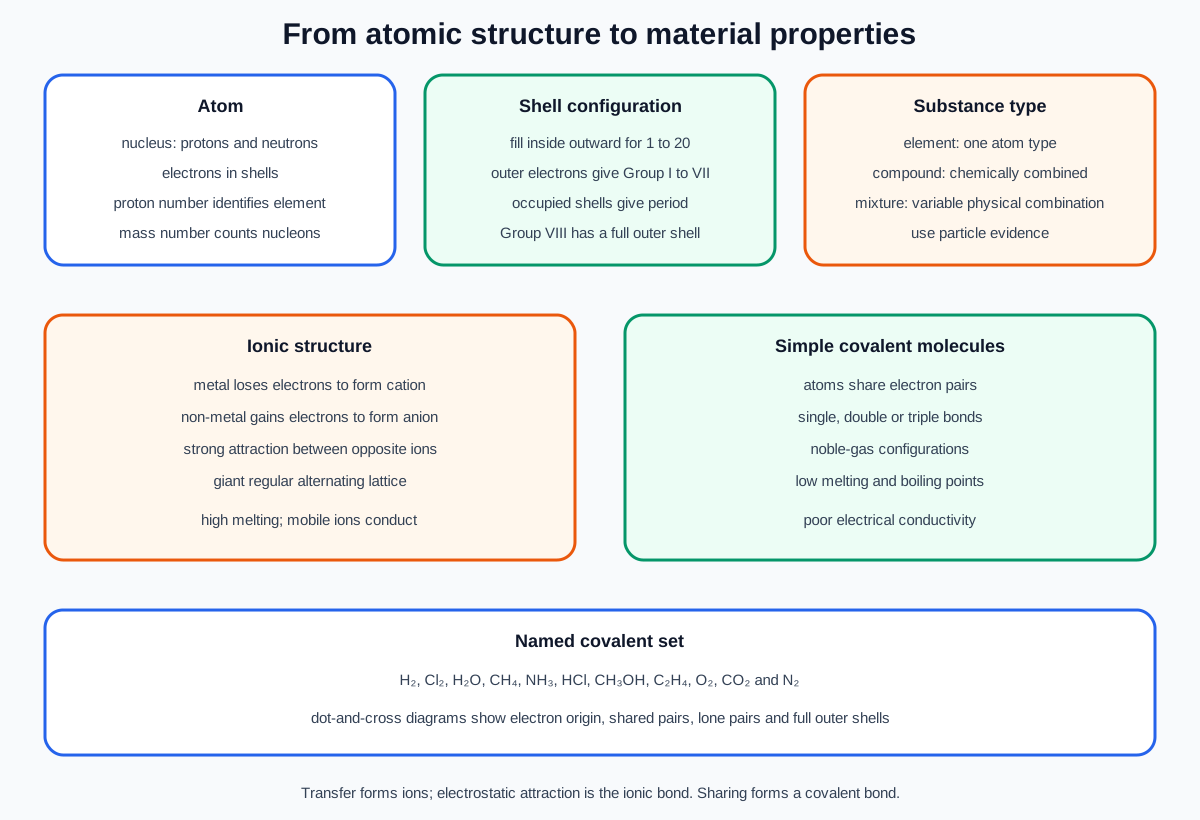
Cambridge IGCSE Combined Science Chemistry C2 distinguishes elements, compounds and mixtures; develops atomic structure and electronic configurations for proton numbers 1 to 20; connects group and period to shells; and compares ionic lattices with the eleven named simple covalent molecules.
An element contains one type of atom
An element is a substance containing only one type of atom.
Every atom of an element has the same proton number. Different elements have different proton numbers.
An element may exist as individual atoms or as molecules containing the same type of atom, such as H₂ or Cl₂. Being molecular does not automatically make a substance a compound.
An element cannot be separated into simpler substances by chemical means.
A compound contains chemically combined elements
A compound contains atoms of two or more different elements chemically combined in fixed proportions.
Its properties differ from those of its constituent elements. Sodium chloride, for example, is not a physical blend of sodium metal and chlorine gas.
Separating a compound requires chemical change because bonds or electrostatic attractions within its structure must be changed.
A chemical formula represents the fixed ratio or molecular composition, but formula deduction and equations belong to C3.
A mixture contains substances not chemically combined
A mixture contains two or more substances together without chemical bonding between them as one new pure substance.
Composition can vary, and each component retains characteristic properties. Components can be separated by physical methods chosen from differences such as boiling point, solubility or particle size.
No single fixed formula represents an entire mixture.
Do not say every mixture is visibly non-uniform. Solutions can look uniform while remaining mixtures.
Compare element, compound and mixture evidence
An element has one atom type. A compound has different atom types chemically joined in fixed proportions. A mixture has substances together in variable proportions without forming one chemically bonded substance.
Particle diagrams make the distinction concrete. Identical single symbols or same-element molecules represent an element. Identical particles containing different linked symbols represent a pure compound. More than one particle type together represents a mixture.
A diagram containing two separate elements is a mixture, not a compound, unless unlike atoms are joined in the same particles or ionic structure.
Check this topic from memory
Attempt the matching topic bank before reopening the notes. Use each missed idea to decide what to review next.
Use bonding and particle identity rather than whether two colours appear.
An atom has a tiny central nucleus
An atom consists of a central nucleus containing protons and neutrons, surrounded by electrons in shells.
Almost all the atom's mass is concentrated in the nucleus because protons and neutrons each have relative mass 1, while an electron has a very small relative mass.
The nucleus is positively charged because it contains protons and neutral neutrons. Electrons are negatively charged.
Do not place protons or neutrons in electron shells.
Know the three relative charges
A proton has relative charge +1. A neutron has relative charge 0. An electron has relative charge -1.
An atom is electrically neutral when its number of electrons equals its number of protons.
Changing the number of electrons forms an ion. Changing the proton number would change the element.
Charge is not the same as relative mass. Keep the two tables separate in memory.
Know the three relative masses
A proton has relative mass 1. A neutron has relative mass 1. An electron has relative mass approximately 1/1836 and is often treated as negligible compared with a proton or neutron.
The mass number therefore counts protons and neutrons, not electrons.
Relative mass has no ordinary gram unit in this comparison.
Do not give the electron a relative mass of -1. That is its charge.
Proton number identifies the element
Proton number, also called atomic number, is the number of protons in the nucleus of an atom.
It identifies the element. An atom with 8 protons is oxygen; one with 11 protons is sodium.
In a neutral atom, proton number also equals the number of electrons. In an ion, electron number differs but proton number remains unchanged.
Do not calculate proton number by adding protons and neutrons.
Mass number counts nucleons
Mass number, also called nucleon number, is the total number of protons and neutrons in the nucleus of an atom.
Number of neutrons equals mass number minus proton number.
For an atom with mass number 23 and proton number 11, there are 11 protons, 12 neutrons and, if neutral, 11 electrons.
Mass number is a whole-number count for one nucleus, not the decimal relative atomic mass shown in many Periodic Table entries.
Fill electron shells for proton numbers 1 to 20
For the first twenty elements, place electrons into shells from the inside outward. The first shell holds up to 2, the second up to 8, and the third is treated as holding up to 8 before the fourth begins in this syllabus range.
Examples include helium 2, carbon 2,4, neon 2,8, sodium 2,8,1, chlorine 2,8,7, argon 2,8,8, potassium 2,8,8,1 and calcium 2,8,8,2.
The entries add to the proton number for a neutral atom.
Do not put an electron into a new shell before the inner shell used by this model is full.
Use configuration as a self-check
Add all shell entries. The total must equal electron number.
For a neutral atom, that total equals proton number. For an ion, adjust the electron total by the charge while leaving proton number unchanged.
The number of comma-separated entries gives occupied shells. The final entry gives outer-shell electrons.
This provides a quick cross-check with the element's period and group.
Group VIII has a full outer shell
Group VIII noble gases have a full outer electron shell in the syllabus notation.
Helium has a full first shell with 2 electrons. Neon and argon have 8 in their outer shell.
This stable configuration is the outcome reached when many other atoms form ions or covalent bonds.
Do not force helium to have eight electrons; its first shell is full at two.
Group number gives outer-shell electrons
For Groups I to VII, the group number equals the number of outer-shell electrons.
Sodium has configuration 2,8,1 and is in Group I. Chlorine has 2,8,7 and is in Group VII.
Use the outer shell only. The total electron number does not give the group.
This rule supports predictions of common ion formation but does not replace a full dot-and-cross diagram.
Period number gives occupied shells
The period number equals the number of occupied electron shells.
Magnesium has configuration 2,8,2, so it has three occupied shells and lies in Period 3.
Potassium has 2,8,8,1 and lies in Period 4.
Do not count the number of electrons in the outer shell to find the period.
Cations form by electron loss
A positive ion is called a cation. It forms when an atom loses one or more electrons.
After electron loss, the ion has more protons than electrons and therefore a net positive charge.
A Group I atom commonly loses one outer electron to reach a noble-gas configuration, forming a 1+ ion. A Group II atom commonly loses two and forms a 2+ ion.
The nucleus does not lose protons during ordinary ion formation.
Anions form by electron gain
A negative ion is called an anion. It forms when an atom gains one or more electrons.
After electron gain, the ion has more electrons than protons and therefore a net negative charge.
A Group VII atom commonly gains one electron to complete its outer shell, forming a 1- ion. A Group VI atom commonly gains two and forms a 2- ion.
Do not say a negative ion lost negative charge. It gained negatively charged electrons.
Ionic bonding begins with electron transfer
Ionic bonding forms between metallic and non-metallic elements through electron transfer and attraction between the resulting ions.
Metal atoms lose electrons to form cations. Non-metal atoms gain those electrons to form anions. Both reach noble-gas electronic configurations in the examples used here.
For sodium chloride, sodium transfers one outer electron to chlorine. Sodium becomes a 1+ ion and chloride a 1- ion.
Electron transfer forms the ions; electrostatic attraction holds the ionic structure together.
An ionic bond is electrostatic attraction
An ionic bond is a strong electrostatic attraction between oppositely charged ions.
The attraction acts in all directions through a giant ionic lattice, not only between one pre-selected pair.
Do not define the bond as electron transfer alone. Transfer explains ion formation; attraction is the bond.
Like charges repel, while alternating positive and negative ions maximise attraction in the regular lattice.
Draw ionic dot-and-cross diagrams
Use dots for electrons originally from one atom and crosses for electrons originally from the other. The symbol choice does not show different kinds of electron; it shows origin.
Draw each resulting ion in square brackets with its charge outside. Show complete outer shells after transfer.
For a Group I and Group VII example, one electron moves from each metal atom to each non-metal atom. For magnesium chloride, one magnesium atom transfers two electrons, one to each of two chlorine atoms.
Check total charge is zero for the compound and electron origins are visible.
Ionic compounds form giant lattices
An ionic compound has a giant lattice: a regular arrangement of alternating positive and negative ions.
Sodium chloride is the required example. Each ion is surrounded by oppositely charged ions in a repeating three-dimensional structure.
There are no separate sodium chloride molecules in this model. The formula gives the simplest ion ratio needed for electrical neutrality.
The many strong attractions throughout the lattice determine its properties.
Ionic compounds have high melting and boiling points
Ionic compounds have high melting points and boiling points.
Large amounts of energy are needed to overcome the strong electrostatic attractions between oppositely charged ions throughout the giant lattice.
Melting does not destroy the ions. It allows them to move relative to one another after enough attractions are overcome.
Do not explain high melting point by one strong bond inside a molecule; an ionic compound is a giant lattice.
Ionic conductivity depends on ion mobility
Ionic compounds conduct electricity well when molten or aqueous, but conduct poorly when solid.
In a solid lattice, ions are charged but held in fixed positions and cannot carry charge through the material.
When molten, ions are free to move. In aqueous solution, separated hydrated ions can move through the water. Their motion carries electric charge.
Do not say electrons flow through an ionic solution as the main charge carriers.
Ionic compounds are generally water-soluble
Ionic compounds are generally soluble in water.
Water can separate and surround ions, allowing them to disperse through the solution.
“Generally” matters because not every ionic compound has high solubility. C7 and C12 give specific solubility and analysis contexts.
Dissolving is not the same as melting. An aqueous solution contains ions dispersed in water.
Covalent bonds share electron pairs
A covalent bond is formed when a pair of electrons is shared between two atoms, leading to noble-gas electronic configurations.
Each shared pair is attracted to both nuclei and counts toward the outer shell of each bonded atom.
A single covalent bond contains one shared pair, a double bond two shared pairs and a triple bond three shared pairs.
Atoms do not become full ions when forming an ordinary simple covalent molecule.
Draw covalent dot-and-cross diagrams
Show outer-shell electrons and use dots and crosses to identify which atom contributed each electron.
Place shared pairs in the overlap or between atomic symbols. Include unshared outer electrons, often called lone pairs, where present.
Hydrogen reaches a full first shell with two electrons. Carbon, nitrogen, oxygen and chlorine reach eight outer electrons in the listed examples.
Count electrons around each atom and check the number supplied by each neutral atom.
Six core molecules use single bonds
The six core examples are H₂, Cl₂, H₂O, CH₄, NH₃ and HCl.
H₂ contains one shared pair. Cl₂ contains one shared pair and three lone pairs on each chlorine. HCl has one shared pair between hydrogen and chlorine.
In H₂O, oxygen forms two single bonds and has two lone pairs. In NH₃, nitrogen forms three single bonds and has one lone pair. In CH₄, carbon forms four single bonds.
Do not omit lone pairs from a dot-and-cross diagram when electronic configurations are requested.
Methanol combines carbon, oxygen and hydrogen
CH₃OH is a named supplementary example. Its bonding can be represented as three carbon-hydrogen bonds, one carbon-oxygen bond and one oxygen-hydrogen bond.
Carbon has four shared pairs around it. Oxygen has two shared pairs and two lone pairs. Each hydrogen has one shared pair.
The formula order helps identify the O-H connection but does not replace a bonding diagram.
Do not draw carbon with five bonds or oxygen with three ordinary bonds in this molecule.
Ethene and oxygen contain double bonds
C₂H₄ is ethene. The two carbon atoms share two pairs with each other, forming a double bond, and each carbon forms two single bonds to hydrogen.
O₂ contains a double bond between its two oxygen atoms. Each oxygen also has two lone pairs in the dot-and-cross diagram.
A double line or two shared pairs represents a double bond. It is not two separate molecules touching.
Check that each carbon and oxygen reaches eight outer electrons through shared and unshared pairs.
Carbon dioxide contains two double bonds
CO₂ has the arrangement O=C=O in its simple bonding representation.
Carbon shares two pairs with each oxygen, giving two double covalent bonds. Each oxygen has two lone pairs.
The molecule contains one carbon atom and two oxygen atoms. Do not confuse the coefficient in an equation with the subscript in a molecular formula.
Formula and equation construction are assessed in C3, while C2 owns the electron-sharing model.
Nitrogen contains a triple bond
N₂ contains three shared electron pairs between its two nitrogen atoms, forming a triple covalent bond.
Each nitrogen also has one lone pair, giving a noble-gas outer configuration.
A triple bond is not three atoms. It is three pairs shared between the same two atoms.
Use six electrons in the bonding region and preserve the remaining lone pair on each nitrogen.
Simple molecular substances have low melting and boiling points
Simple molecular compounds have low melting points and boiling points.
Strong covalent bonds hold atoms together inside each molecule, but weaker attractions act between separate molecules. Melting or boiling simple molecular material overcomes these intermolecular attractions rather than breaking every covalent bond.
Relatively little energy is required compared with separating ions throughout a giant ionic lattice.
Do not call the covalent bonds weak merely because the substance has a low boiling point.
Simple molecular substances conduct poorly
Simple molecular compounds have poor electrical conductivity.
Their molecules are neutral and they do not normally contain freely moving ions or delocalised electrons that can carry charge through the substance.
Melting a simple molecular substance does not automatically create ions, so it generally remains a poor conductor.
Do not transfer the molten-ionic conductivity rule to molecular substances.
Use structure to identify an unknown
A high-melting solid that conducts when molten but not when solid is consistent with an ionic lattice. Fixed ions explain solid non-conduction; mobile ions explain molten conduction.
A low-boiling substance that remains a poor conductor is consistent with simple molecules. Weak intermolecular attractions explain the state change, while lack of mobile charged particles explains poor conductivity.
Solubility alone is less decisive because ionic compounds are only generally water-soluble and molecular solubility varies.
Use several observations and a linked particle explanation rather than one memorised property.
Worked application: infer bonding from three tests
Substance X is a high-melting solid. It does not conduct electricity as a solid, but its aqueous solution conducts. These observations support a giant ionic lattice: strong attractions require much energy to overcome, ions are fixed in the solid, and dissolved ions move through water to carry charge. Substance Y boils at a low temperature and does not conduct as either liquid or gas. This is consistent with simple molecules because only weak intermolecular attractions are overcome during boiling and no mobile charged particles are present. The data support structure types, not exact identities, and water solubility alone would not prove that X is ionic.
Common misconceptions and corrections
Calling every same-element molecule a compound. H₂ and Cl₂ remain elements.
Calling a compound a variable blend. Its elements are chemically combined in fixed proportions.
Saying a solution is not a mixture because it looks uniform. Uniform mixtures exist.
Identifying compounds by two colours alone. Check whether unlike atoms are joined.
Putting electrons in the nucleus. They occupy shells around it.
Giving a neutron charge of -1. Its relative charge is zero.
Giving an electron relative mass of -1. That is its charge.
Defining proton number as protons plus neutrons. That is mass number.
Including electrons in mass number. Count protons and neutrons only.
Using decimal relative atomic mass as one atom's mass number. Mass number is a whole-number nucleus count.
Filling an outer shell before the inner model shell. Fill from inside outward.
Giving helium eight outer electrons. Its first shell is full at two.
Using total electrons as the group number. Use outer-shell electrons for Groups I to VII.
Using outer electrons as the period number. Count occupied shells.
Saying cations gain electrons. They form by electron loss.
Saying anions lose electrons. They form by electron gain.
Changing proton number during ion formation. Only electron number changes.
Defining ionic bonding as transfer alone. The bond is electrostatic attraction.
Drawing ionic compounds as separate molecules. They form giant lattices.
Omitting brackets or charges in ionic dot-and-cross diagrams. Show complete ions.
Saying solid ions are uncharged. They are charged but immobile.
Saying electrons carry current through molten ionic material. Mobile ions carry charge.
Saying every ionic compound is soluble. They are generally soluble.
Defining a covalent bond as transfer. It is a shared electron pair.
Omitting lone pairs. Show complete electronic configurations.
Calling a double bond two atoms. It contains two shared pairs.
Calling a triple bond three molecules. It contains three shared pairs between two atoms.
Saying covalent bonds are weak because boiling point is low. Intermolecular attractions are overcome.
Saying molten molecular compounds conduct like molten salts. They lack mobile ions.
Importing isotopes as required C2 content. They are not listed in this Combined Science statement.
Importing formula deduction into C2. It belongs to C3.
Assessment guidance
Particle diagrams must distinguish atom type, chemical joining and multiple particle types. Atomic questions require separate charge and mass facts, exact proton and mass-number definitions, and correct neutron and neutral-electron calculations. For proton numbers 1 to 20, total shell entries, group and period should cross-check. Ionic answers must separate electron transfer from electrostatic attraction, show brackets and charges, and link lattice structure to melting, conductivity and general solubility. Covalent diagrams need every shared and lone electron for all eleven named molecules. Property comparisons should name the particles, attraction being overcome and presence or absence of mobile charge carriers.
Retrieval practice
Classify fifty particle diagrams as element, compound or mixture and justify each decision. Build the charge, mass, location and counting table for subatomic particles. Generate and cross-check configurations for proton numbers 1 to 20. Draw ionic dot-and-cross diagrams for Group I, II, VI and VII combinations. Reproduce all eleven named covalent diagrams, then diagnose thirty-one lattice, electron, bond and property errors.
Topic ownership
This note owns C2.1 element, compound and mixture differences; C2.2 atomic structure, particle data, proton and mass numbers, configurations 1 to 20 and group-period rules; C2.3 ions, ionic bonding, lattice and properties; and C2.4 the eleven named covalent molecules and simple molecular properties. Isotopes, formula deduction, equations and state symbols are not promoted into C2 because C3 owns those formula and equation skills.