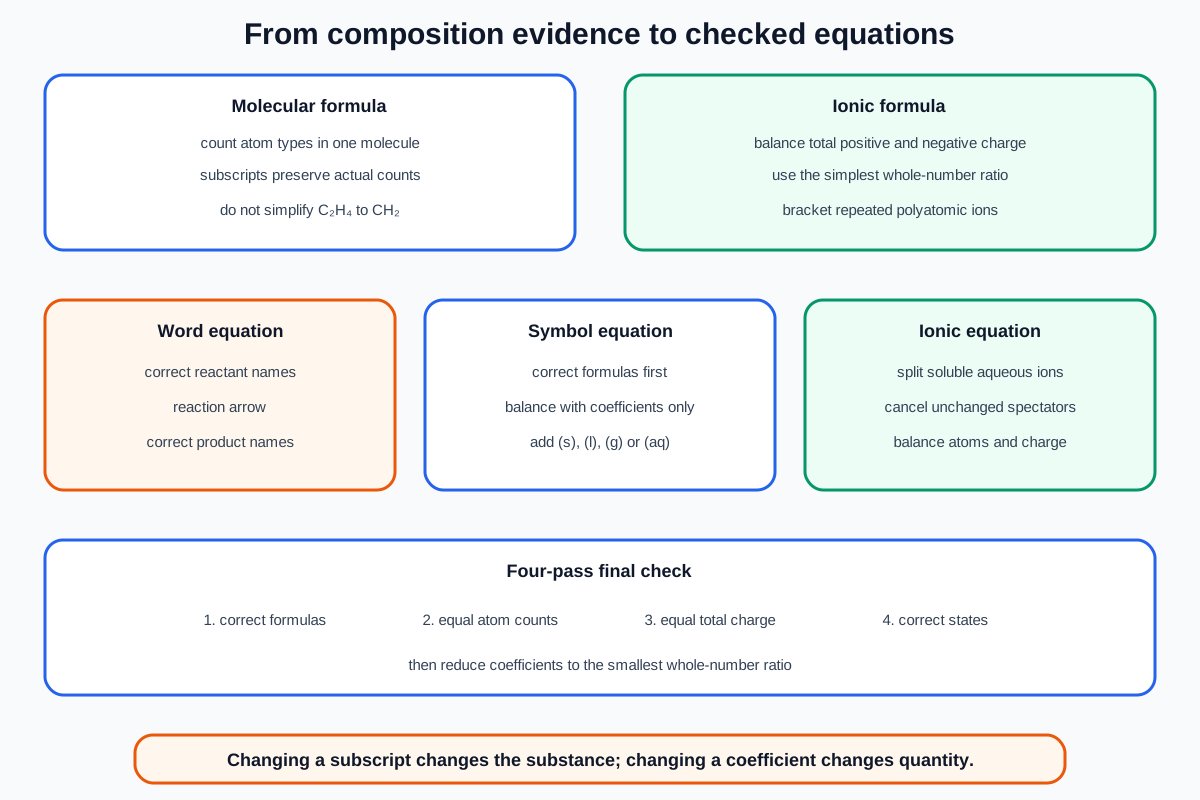
Cambridge IGCSE Combined Science 0653 notes on molecular and ionic formulas, word equations, balanced symbol equations, state symbols and ionic equations.
Cambridge IGCSE Combined Science Chemistry C3 is a formula-and-equation topic. It requires formulas named across the syllabus, molecular formulas from particle models, ionic formulas from ratios or charges, word equations, balanced symbol equations with state symbols, and ionic equations.
A chemical formula communicates composition
A chemical formula uses element symbols and subscripts to show the types and relative or actual numbers of atoms or ions in a substance.
The formula must preserve correct capital letters. Co represents cobalt, while CO represents carbon monoxide. CL is not the symbol for chlorine; Cl is.
A subscript applies only to the element or bracketed group immediately before it. In H₂O, there are two hydrogen atoms and one oxygen atom.
Do not add a subscript 1. A missing subscript already means one.
Learn formulas in their chemical context
The syllabus requires formulas of elements and compounds named throughout the subject content.
Some elements exist as monatomic substances in formula use, while several non-metals are commonly written as diatomic molecules, including H₂, N₂, O₂, F₂, Cl₂, Br₂ and I₂.
Named compounds must be recalled accurately when they appear in reactions, tests and electrolysis contexts.
Build formula knowledge topic by topic rather than treating C3 as a detached list. Check each formula against the bonding or charge model where possible.
Molecular formula gives atom types and counts
The molecular formula of a compound is the number and type of atoms in one molecule.
For example, H₂O states that one molecule contains two hydrogen atoms and one oxygen atom. CO₂ contains one carbon atom and two oxygen atoms.
The definition applies to a molecule, so it should not be used as though a giant ionic lattice were one molecule.
Do not confuse a molecular formula with a displayed bonding diagram. The formula gives composition, not the arrangement of bonds.
Deduce molecular formula from a model
Identify the element represented by each colour or symbol, then count atoms in one complete molecule.
Write element symbols with the number of each atom as a subscript. A model containing two carbon atoms, six hydrogen atoms and one oxygen atom in each molecule has formula C₂H₆O.
Count one molecule only if the diagram contains several identical molecules. A coefficient outside the formula would describe the number of molecules, not composition of one.
Do not simplify the actual atom counts in a molecular formula. C₂H₄ is not reduced to CH₂ because one molecule really contains two carbon and four hydrogen atoms.
Check this topic from memory
Attempt the matching topic bank before reopening the notes. Use each missed idea to decide what to review next.
A subscript is part of a formula and gives atom count or ion ratio within one chemical entity. A coefficient is written before a formula and gives the number of entities in an equation.
In 2H₂O, the coefficient 2 means two water molecules. Each contains two hydrogen atoms and one oxygen atom, giving four hydrogen atoms and two oxygen atoms in total.
Changing a coefficient changes quantity. Changing a subscript changes chemical identity.
This is why equations are balanced with coefficients, never by rewriting correct formulas.
Ionic formulas must be electrically neutral
An ionic compound contains positive and negative ions in a ratio that gives zero overall charge.
Sodium ions are 1+ and chloride ions are 1-, so sodium chloride has a 1:1 ratio and formula NaCl.
Magnesium ions are 2+ and chloride ions are 1-, so two chloride ions balance one magnesium ion, giving MgCl₂.
The formula shows the simplest whole-number ion ratio in the giant lattice, not a separate molecule.
Deduce ionic formula from charges
Write the cation first and the anion second. Find the smallest whole numbers of each ion that make total positive charge equal total negative charge.
For aluminium ions, 3+, and oxide ions, 2-, the least common charge total is 6. Two aluminium ions give +6 and three oxide ions give -6, so the formula is Al₂O₃.
For calcium ions, 2+, and hydroxide ions, 1-, two hydroxide ions are needed. Because hydroxide is a group, use brackets: Ca(OH)₂.
Reduce ratios to their simplest whole numbers and never write charges within the neutral compound formula.
Deduce ionic formula from a model
Count positive and negative ions in the smallest repeating ratio shown.
A model with two 1+ cations for every one 2- anion gives formula M₂X if M and X are the supplied symbols.
Check that the charge total is zero. If a large diagram shows four cations and two anions, simplify the 4:2 count to 2:1 for the formula.
Do not count only one row or edge if the key indicates a repeating three-dimensional lattice. Use the relative numbers represented by the complete model or stated unit.
Brackets protect a repeated polyatomic ion
When more than one of a polyatomic ion is required, put the ion formula in brackets before the subscript.
Calcium nitrate contains Ca²⁺ and NO₃⁻, so its formula is Ca(NO₃)₂. The subscript 2 applies to the whole nitrate ion.
Without brackets, CaNO₃₂ would communicate the wrong atom count and is not valid notation.
Do not add brackets when only one group is present, unless a supplied convention specifically requires them.
A word equation names reactants and products
A word equation shows how named reactants form named products.
Reactants appear on the left, products on the right, and an arrow shows reaction direction.
For combustion of magnesium:
magnesium + oxygen → magnesium oxide
A word equation does not need formulas or coefficients, but every substance name must be chemically correct.
Construct word equations from observations
Identify starting substances, then determine products from the reaction description and chemical knowledge.
If hydrochloric acid reacts with magnesium to form magnesium chloride and hydrogen, write:
Do not use an equals sign. A chemical equation shows conversion, not ordinary numerical equality.
Conditions can be written near the arrow when required, but they are not reactants unless consumed.
Symbol equations conserve every atom
A symbol equation replaces names with correct formulas and must be balanced.
For magnesium combustion:
2Mg(s) + O₂(g) → 2MgO(s)
There are two magnesium atoms and two oxygen atoms on each side.
Balancing represents conservation of atoms. Chemical reactions rearrange atoms; they do not create or destroy them.
Balance equations with coefficients only
First write correct formulas. Count each element on both sides. Add the smallest whole-number coefficients that make every atom count equal.
Recount after every change because one coefficient affects every element in that formula.
For hydrogen combustion, begin H₂ + O₂ → H₂O. Balancing gives 2H₂ + O₂ → 2H₂O.
Never turn H₂O into H₂O₂ to balance oxygen. Hydrogen peroxide is a different substance.
Use a repeatable balancing order
Start with an element appearing in one formula on each side. Leave elements appearing in several substances until later where practical.
Treat an unchanged polyatomic ion as a unit if it remains intact on both sides. Balance hydrogen and oxygen later in many equations.
Remove common factors from all coefficients to give the simplest ratio.
Final checks must include every element and, for ionic equations, total charge.
Interpret coefficients as particle ratios
In 2H₂ + O₂ → 2H₂O, two hydrogen molecules react with one oxygen molecule to form two water molecules.
The ratio is 2:1:2. It is not a direct mass ratio because the particles have different masses.
For ionic solids, a coefficient counts formula units in the symbolic ratio rather than discrete molecules.
The 0653 C3 boundary does not require mole or reacting-mass calculations. Interpret the symbolic particle relationship without importing those calculations.
State symbols identify physical form
The four state symbols are:
(s) for solid;
(l) for liquid;
(g) for gas;
(aq) for aqueous, meaning dissolved in water.
State symbols follow the formula and use lowercase letters in brackets.
Do not use (aq) merely because water is present. The substance itself must be dissolved as an aqueous solute.
State symbols depend on reaction conditions
The same substance can have different state symbols under different conditions.
Water is commonly H₂O(l) at room conditions but H₂O(g) as steam. Sodium chloride can be NaCl(s), NaCl(l) when molten, or represented through aqueous ions when dissolved.
Use the information in the question, known solubility and reaction context.
Do not guess state symbols from formula appearance. Chemical notation alone does not prove physical state.
Construct a complete symbol equation
Translate every correct name into a formula, balance with coefficients, then add state symbols.
For magnesium with hydrochloric acid:
Mg(s) + 2HCl(aq) → MgCl₂(aq) + H₂(g)
Check magnesium, hydrogen and chlorine atom counts. Then check that each state matches the described conditions and observations.
Do not add charges to neutral molecular acid formulae in the full symbol equation unless writing the separated ionic form.
Ionic equations show reacting particles
An ionic equation removes aqueous ions that remain unchanged and shows the particles undergoing chemical change.
For neutralisation between a strong acid and alkali, the net ionic equation is:
H⁺(aq) + OH⁻(aq) → H₂O(l)
Hydrogen ions and hydroxide ions form water. Other aqueous ions present can remain unchanged and are spectators.
An ionic equation must balance both atoms and total electrical charge.
Derive an ionic equation step by step
Begin with a balanced symbol equation with states. Split soluble aqueous ionic compounds into their ions. Do not split solids, liquids, gases or simple molecular substances.
Cancel identical aqueous ions appearing on both sides. These are spectator ions.
Write the remaining species with coefficients, charges and states, then check atoms and net charge.
Do not cancel an ion if its state, coefficient or chemical form changes.
Precipitation ionic equations form a solid
When aqueous silver ions react with aqueous chloride ions, solid silver chloride forms:
Ag⁺(aq) + Cl⁻(aq) → AgCl(s)
The left side has total charge zero and the solid product is neutral. Atom counts also balance.
The state change from aqueous ions to a solid is central evidence for the reaction.
Other ions in the original solutions are spectators if they remain aqueous and unchanged.
Ionic equations differ from ionic formulas
An ionic formula gives the neutral ratio of ions in a compound, such as MgCl₂.
An ionic equation shows a reaction between ionic species, including charges, coefficients, arrows and state symbols.
Do not call Mg²⁺ + 2Cl⁻ a complete reaction merely because the charge balances. It may represent composition rather than an observed chemical change.
Use the question context to decide whether you are constructing a formula, full equation or net ionic equation.
Check equations in four passes
First check formulas: every substance identity must be correct. Second check atoms: counts match for each element. Third check charge: total charge matches for ionic equations. Fourth check states: every symbol matches conditions.
Only then reduce coefficients to their smallest whole-number ratio.
This sequence catches most errors without random coefficient changes.
An equation can balance atoms but still be chemically wrong because a formula, product or state is incorrect.
Worked application: build full and ionic equations
Dilute hydrochloric acid reacts with aqueous sodium hydroxide to form aqueous sodium chloride and water. The word equation names acid + alkali → salt + water. The balanced symbol equation is HCl(aq) + NaOH(aq) → NaCl(aq) + H₂O(l). Splitting the soluble aqueous substances gives H⁺, Cl⁻, Na⁺ and OH⁻ ions. Sodium and chloride ions appear unchanged on both sides, so they are spectators and cancel. The ionic equation is H⁺(aq) + OH⁻(aq) → H₂O(l). Both atoms and total charge balance. No mole or mass calculation is needed for this C3 task.
Common misconceptions and corrections
Writing element symbols with random capital letters. Capitalisation changes meaning.
Adding subscript 1. One atom is shown by no subscript.
Calling every elemental substance monatomic. Several named non-metals are diatomic.
Defining molecular formula as a bond arrangement. It gives atom types and counts in one molecule.
Reducing C₂H₄ to CH₂ as a molecular formula. Preserve actual atoms in one molecule.
Confusing a coefficient with a subscript. Coefficient counts entities; subscript defines composition.
Calling an ionic formula a molecule. It gives the simplest lattice ratio.
Writing an ionic formula with net charge. A compound formula is neutral.
Balancing charges without using the smallest ratio. Reduce to simplest whole numbers.
Omitting brackets around repeated polyatomic ions. The subscript must apply to the whole ion.
Using an equals sign in a word equation. Use a reaction arrow.
Putting conditions among reactants. Write them by the arrow where needed.
Balancing before correcting formulas. Correct chemical identity comes first.
Changing subscripts to balance. Use coefficients only.
Leaving coefficients with a common factor. Give the simplest ratio.
Calling coefficients a mass ratio. They show a particle or formula-unit ratio here.
Writing (a) instead of (aq). Aqueous uses (aq).
Calling every liquid solution (l). Dissolved solutes are aqueous.
Using (aq) for molten salt. Molten is (l).
Guessing states from formulas alone. Use conditions and solubility.
Splitting a solid into ions in an ionic equation. Split soluble aqueous ionic substances only.
Splitting water into ions in a neutralisation product. Keep H₂O(l) intact.
Keeping spectator ions in the net ionic equation. Cancel unchanged aqueous ions.
Cancelling a species whose state changes. It participates in the reaction.
Checking atoms but not charge. Ionic equations require both.
Calling an ion list an equation. A reaction needs an arrow and chemical change.
Importing relative mass calculations into C3. They are not listed in this Combined Science boundary.
Importing mole calculations into C3. Interpret coefficients without moles.
Importing concentration and gas-volume calculations. They are not required here.
Assessment guidance
Formula questions require precise symbols, actual molecular atom counts or the simplest charge-neutral ionic ratio. Keep coefficients and subscripts conceptually separate. Construct word equations from correct names before translating into formulas. Balance symbol equations only with coefficients and add states from conditions, not guesswork. Interpret coefficients as the symbolic particle relationship without importing mass or mole arithmetic. For ionic equations, start from a balanced state-labelled equation, split only soluble aqueous ionic substances, cancel unchanged spectators, and check both atoms and charge. A final four-pass check should cover formulas, atoms, charge and states.
Retrieval practice
Recall every formula as it appears across the 0653 Chemistry topics. Deduce fifty molecular formulas from models and fifty ionic formulas from charges or ion diagrams. Translate reaction descriptions into word equations, then balanced state-labelled symbol equations. Derive neutralisation and precipitation ionic equations while naming spectators. Diagnose twenty-nine errors involving capitals, brackets, subscripts, coefficients, states, splitting and charge balance.
Topic ownership
This note owns C3.1 formulas named in the content, molecular-formula definition and model deduction, ionic-formula deduction from ratios or charges, word equations, balanced symbol equations, state symbols and ionic equations. C2 owns bonding and structure. Relative masses, moles, reacting quantities, concentration and gas-volume calculations are not promoted into this Combined Science C3 boundary.