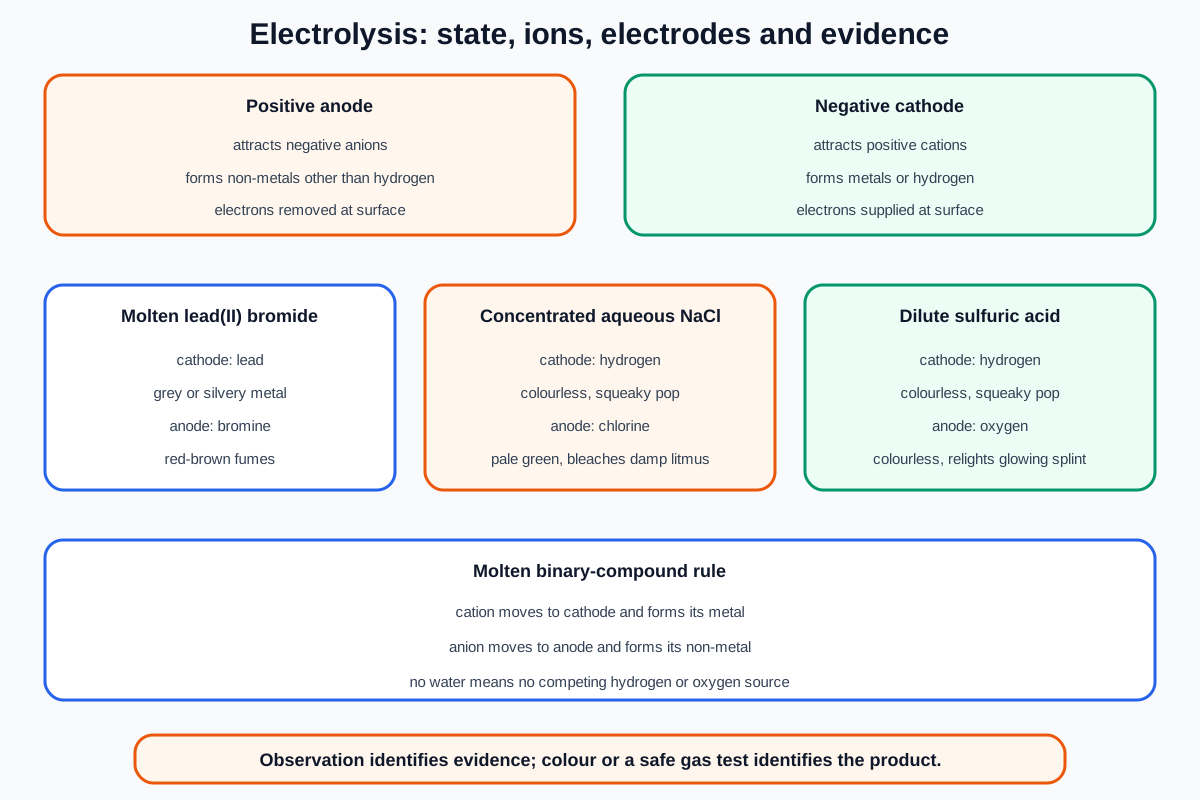
Cambridge IGCSE Combined Science Chemistry C4 defines electrolysis, identifies anode, cathode and electrolyte, develops the products and observations for three prescribed inert-electrode cells, and predicts products when a binary ionic compound is molten.
Electrolysis decomposes an ionic compound
Electrolysis is the decomposition of an ionic compound, when molten or in aqueous solution, by the passage of an electric current.
The definition requires an ionic compound, mobile ions and electric current. “Splitting with electricity” is too vague unless the substance and physical condition are stated.
Decomposition means that products form from the electrolyte. It is a chemical change, not merely melting or dissolving.
A solid ionic compound does not undergo electrolysis because its ions are held in fixed lattice positions and cannot move to electrodes.
The electrolyte contains mobile ions
The electrolyte is the molten or aqueous substance that undergoes electrolysis.
When an ionic compound is molten, its ions are free to move. In aqueous solution, dissolved ions move through water.
The electrolyte conducts by ion movement. Electrons carry current through the external wires and electrodes, but not through the bulk electrolyte as the main carriers.
Do not call the power supply the electrolyte. It provides the potential difference.
The anode is positive
In a simple electrolytic cell, the anode is the positive electrode.
It attracts negative ions, or anions. Non-metal products other than hydrogen form at the anode in the general syllabus rule.
Electrons are removed from particles at the anode in useful explanatory models, although half-equation construction is not a separate C4 requirement.
Use the memory link “anode attracts anions” only after confirming this is an electrolytic cell.
The cathode is negative
In a simple electrolytic cell, the cathode is the negative electrode.
It attracts positive ions, or cations. Metals or hydrogen form at the cathode.
Electrons are supplied to particles at the cathode.
Do not reverse polarity using rules from a different type of electrochemical cell. For this electrolysis topic, cathode is negative.
Inert electrodes conduct without becoming products
The prescribed cells use inert platinum or carbon, also called graphite, electrodes.
An inert electrode provides a conducting surface for electron transfer but is not intended to react significantly or supply ions to the products.
Check this topic from memory
Attempt the matching topic bank before reopening the notes. Use each missed idea to decide what to review next.
This allows products to be predicted from the electrolyte rather than from a reactive electrode.
“Inert” does not mean electrically inactive. The electrode must conduct current.
Ion movement completes the internal circuit
Cations move toward the negative cathode. Anions move toward the positive anode.
At the electrode surfaces, charged particles form neutral products through electron transfer. Product formation removes selected ions and allows current to continue while the power supply operates.
The ions do not all drift to one electrode. Charge determines direction.
Current stops if the circuit is broken or if the material does not contain mobile charge carriers.
Molten compounds contain only their own ions
A molten binary ionic compound contains positive ions from one element and negative ions from the other.
The cation forms its metal at the cathode. The anion forms its non-metal at the anode.
There is no water to provide competing hydrogen or oxygen products.
This makes molten binary compounds the most direct product-prediction context in C4.
Molten lead(II) bromide gives lead at the cathode
Molten lead(II) bromide contains lead(II) ions and bromide ions.
Lead(II) ions move to the negative cathode and gain electrons to form lead metal.
The cathode observation is a grey or silvery deposit or molten bead of lead, depending on the operating temperature.
Do not predict hydrogen because the electrolyte is molten, not aqueous.
Molten lead(II) bromide gives bromine at the anode
Bromide ions move to the positive anode and form bromine.
The observation is red-brown or brown fumes near the anode.
The overall products are lead and bromine, showing decomposition of lead(II) bromide.
Bromine fumes are toxic and lead compounds are hazardous, so this is not a casual open-bench activity. Follow controlled laboratory procedures, ventilation and disposal requirements.
Concentrated aqueous sodium chloride has four ion sources
Concentrated aqueous sodium chloride contains sodium ions and chloride ions from the salt, together with hydrogen and hydroxide ion availability from water.
Water creates competition that is absent from a molten electrolyte.
At the cathode, hydrogen forms instead of sodium. At the anode, concentrated chloride conditions favour chlorine.
Do not apply the molten binary rule directly to an aqueous solution.
Hydrogen forms at the sodium chloride cathode
At the negative cathode, hydrogen gas forms.
Observe colourless bubbles. A small safely collected sample gives a squeaky pop with a lighted splint.
Sodium metal does not form from concentrated aqueous sodium chloride in this cell.
The remaining solution becomes alkaline as sodium ions and hydroxide ions remain, but the required electrode product is hydrogen.
Chlorine forms at the sodium chloride anode
At the positive anode, chlorine gas forms from concentrated aqueous sodium chloride.
Chlorine is pale green and bleaches damp litmus paper after an initial acidic colour change may be seen.
Do not describe the bleaching as simple colourless bubbling without the chemical test evidence.
Chlorine is toxic. Use only small-scale controlled demonstration conditions with effective ventilation and never inhale the gas.
Dilute sulfuric acid supplies an aqueous conducting medium
Dilute sulfuric acid contains mobile ions and allows electrolysis of the aqueous system with inert electrodes.
Hydrogen forms at the cathode and oxygen forms at the anode.
The acid supports conductivity and is not described as producing sulfur at an electrode in this prescribed cell.
Both products are colourless gases, so tests distinguish them.
Hydrogen forms at the dilute-acid cathode
At the negative cathode, hydrogen gas forms as colourless bubbles.
A small safely collected sample gives a squeaky pop with a lighted splint.
Hydrogen is flammable. Keep amounts small and away from uncontrolled ignition sources.
Do not use a glowing splint as the positive hydrogen test; that test belongs to oxygen.
Oxygen forms at the dilute-acid anode
At the positive anode, oxygen gas forms as colourless bubbles.
A glowing splint relights in a collected sample.
The gas volume is commonly smaller at the oxygen electrode than at the hydrogen electrode under comparable collection because water gives hydrogen and oxygen in a 2:1 particle ratio. Quantitative gas measurement is supporting evidence, not a separate calculation requirement here.
Do not call oxygen a metal because it forms at an electrode.
Compare the three prescribed cells
Molten lead(II) bromide gives lead at the cathode and bromine at the anode.
Concentrated aqueous sodium chloride gives hydrogen at the cathode and chlorine at the anode.
Dilute sulfuric acid gives hydrogen at the cathode and oxygen at the anode.
State, concentration and ion sources explain the different outcomes. Memorising products without those distinctions makes aqueous and molten predictions easy to reverse.
Predict a molten binary compound systematically
First confirm that the compound is ionic, binary and molten. Identify its cation and anion.
Send the cation to the cathode and name the metal product. Send the anion to the anode and name the non-metal product.
For molten magnesium chloride, magnesium ions form magnesium metal at the cathode and chloride ions form chlorine gas at the anode.
For a diatomic non-metal such as chlorine or bromine, write the elemental product correctly in a symbol equation.
Link observations to products
An observation is what is seen or measured: bubbles, colour, deposit or test result. A product identity is the chemical interpretation.
“Bubbles form” does not identify hydrogen, oxygen or chlorine. Add an appropriate test or characteristic colour.
A metallic deposit supports a metal product, but appearance alone may not distinguish every metal.
Write observation first when asked, then conclude the product using evidence.
Use safe gas tests
Test hydrogen with a lighted splint only after collecting a small sample away from the main apparatus. A squeaky pop is positive.
Test oxygen with a glowing splint. Relighting is positive.
Test chlorine with damp litmus paper under controlled ventilation. Bleaching supports chlorine.
Never smell gases directly, and do not mix the splint tests. Risk controls must match flammability, toxicity, hot molten salts and corrosive solutions.
Evaluate an electrolysis setup
Both electrodes should be connected to the direct-current supply, immersed without touching and made from the specified inert material.
Gas collection apparatus must be positioned over the correct electrode and initially free of misleading trapped gas where comparison matters.
Keep electrode surface area, immersion depth, current, time, electrolyte concentration and temperature controlled for quantitative comparisons.
A failed observation may result from a broken circuit, solid rather than molten electrolyte, poor contact, exhausted power supply or product loss.
Worked application: predict and verify molten magnesium chloride
Molten magnesium chloride contains only mobile magnesium ions and chloride ions. Magnesium ions move to the negative cathode, gain electrons and form magnesium metal. Chloride ions move to the positive anode, lose electrons and form chlorine gas. A metallic product at the cathode and pale-green bleaching gas at the anode support the prediction. Hydrogen should not be reported because no water is present. The compound must be molten so ions can move, and inert electrodes prevent an electrode material becoming an alternative product source. Hot corrosive melt and toxic chlorine require controlled apparatus, ventilation and trained supervision rather than an open classroom procedure.
Common misconceptions and corrections
Defining electrolysis as any use of electricity. It decomposes a molten or aqueous ionic compound.
Saying a solid ionic compound electrolyses normally. Its ions cannot move.
Calling the power supply the electrolyte. The electrolyte is the decomposed substance.
Saying electrons carry current through the solution. Mobile ions carry charge internally.
Calling the anode negative. It is positive in this electrolytic cell.
Calling the cathode positive. It is negative.
Sending cations to the anode. They move to the cathode.
Sending anions to the cathode. They move to the anode.
Saying inert electrodes do nothing. They conduct and provide reaction surfaces.
Applying aqueous competition to a molten binary compound. Only compound ions are present in the melt.
Predicting hydrogen from molten lead(II) bromide. Lead forms at the cathode.
Predicting oxygen from molten lead(II) bromide. Bromine forms at the anode.
Calling bromine fumes green. Bromine is red-brown or brown.
Predicting sodium from aqueous sodium chloride. Hydrogen forms at the cathode.
Predicting oxygen from concentrated brine. Chlorine forms at the anode.
Calling chlorine colourless. It is pale green and bleaches damp litmus.
Predicting sulfur from dilute sulfuric acid. Hydrogen and oxygen form.
Using a glowing splint for hydrogen. Hydrogen gives a squeaky pop with a lighted splint.
Using a lighted splint as the oxygen test. Oxygen relights a glowing splint.
Calling bubbles a complete product identification. Add colour or gas-test evidence.
Writing observations as equations. Separate evidence from interpretation.
Ignoring electrolyte state. Molten and aqueous conditions can produce different products.
Letting electrodes touch. This can short-circuit the cell.
Smelling electrode gases. Use controlled tests and ventilation.
Importing electroplating as required C4 content. It is not listed here.
Importing Faraday calculations. Quantitative charge laws are outside this boundary.
Assessment guidance
Definitions need decomposition, ionic compound, molten or aqueous condition and electric current. Label anode positive, cathode negative and electrolyte as the decomposed medium. Product questions require the correct state and concentration before applying ion rules. Memorise product, electrode and observation for all three prescribed cells, including safe distinguishing tests. For molten binary prediction, identify cation and anion, move them to opposite electrodes and name metal and non-metal products. Explanations should distinguish ion movement inside the electrolyte from electron flow in the external circuit and observations from product identities.
Retrieval practice
Label twenty rotated electrolysis cells with polarity, ion direction and charge carriers. Reconstruct the product-observation-test table for molten lead(II) bromide, concentrated aqueous sodium chloride and dilute sulfuric acid. Predict electrode products for thirty molten binary compounds. Diagnose twenty-six state, polarity, ion, gas-test and safety errors, then explain why the aqueous sodium chloride products differ from the molten binary rule.
Topic ownership
This note owns C4.1 electrolysis definition, anode, cathode and electrolyte identification, inert-electrode products and observations for the three prescribed cells, the general cathode and anode product rule and molten binary-compound prediction. C3 owns equation construction. Electroplating, extraction economics and Faraday calculations are not promoted into this Combined Science C4 boundary.