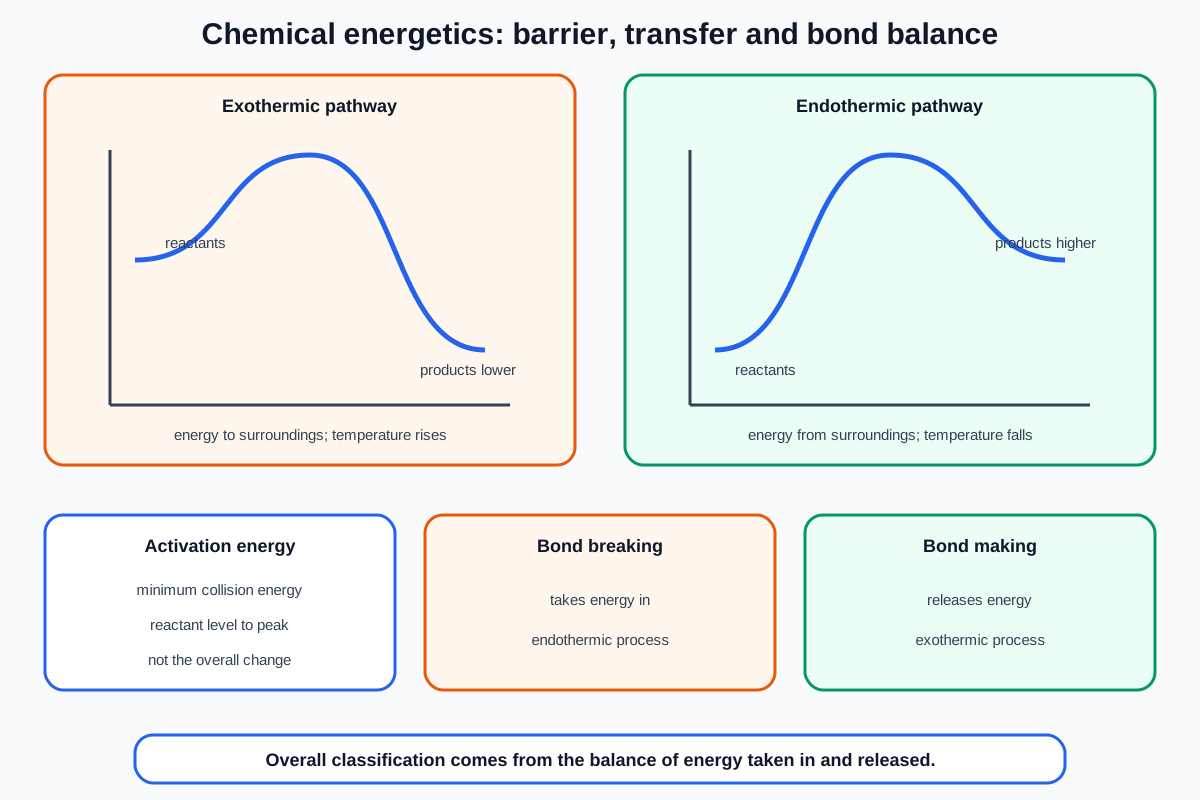
Cambridge IGCSE Combined Science Chemistry C5 distinguishes exothermic and endothermic reactions through thermal-energy transfer, defines activation energy, interprets and draws reaction pathway diagrams, and connects overall energy change to endothermic bond breaking and exothermic bond making.
Define the system and surroundings
The reacting chemicals form the system. Everything outside them, including solution, container, thermometer and air, forms the surroundings.
Energy-transfer direction is described between system and surroundings.
A temperature measurement is usually made in the surroundings, not directly inside an abstract reaction pathway.
Without this distinction, “energy goes out” is ambiguous. State where energy starts and where it is transferred.
Exothermic reactions warm the surroundings
An exothermic reaction transfers thermal energy to the surroundings, leading to an increase in the temperature of the surroundings.
The system loses energy overall while the surroundings gain it.
Combustion is a common context, but classification depends on transfer direction rather than a memorised reaction name.
Do not define exothermic as “a reaction that gets hot” alone. Temperature rise is the observed consequence of energy transfer to the surroundings.
Endothermic reactions cool the surroundings
An endothermic reaction takes in thermal energy from the surroundings, leading to a decrease in the temperature of the surroundings.
The system gains energy overall while the surroundings lose it.
A cooling mixture can therefore provide evidence for an endothermic process when alternative heat transfers are controlled.
Do not say endothermic means no reaction occurs. Chemical change can proceed while taking energy from the surroundings.
Temperature direction is evidence, not the definition
In a simple insulated experiment, a temperature rise supports an exothermic classification and a temperature fall supports an endothermic classification.
The definition remains thermal-energy direction. Heat exchange with the cup, thermometer and air can reduce or distort the observed change.
Compare a stable initial temperature with the highest or lowest value reached after mixing, using a consistent method.
Do not call a reaction thermally neutral simply because poor insulation produced a small measured change.
Activation energy is a collision threshold
Activation energy, Ea, is the minimum energy that colliding particles must have to react.
Check this topic from memory
Attempt the matching topic bank before reopening the notes. Use each missed idea to decide what to review next.
Particles can collide without reacting if their collision energy is below Ea.
On a reaction pathway diagram, activation energy is the vertical energy difference from the reactant level to the top of the pathway peak.
It is not the overall energy change and not the energy contained in all reactants.
Reaction pathways show energy through progress
A reaction pathway diagram has energy on the vertical axis and progress of reaction on the horizontal axis.
The curve begins at the reactant energy level, rises to a peak and ends at the product energy level.
The horizontal axis does not normally represent clock time. It represents progress from reactants to products.
Labels, levels and vertical arrows carry the chemical meaning; the decorative curve shape between them is secondary.
Read an exothermic pathway
In an exothermic pathway, products are at a lower energy level than reactants.
The overall energy-change arrow points downward from reactant level to product level. This corresponds to net energy transfer from system to surroundings.
The pathway still rises first because colliding particles need activation energy before products can form.
Do not draw an exothermic reaction as downhill from the first instant with no activation barrier.
Read an endothermic pathway
In an endothermic pathway, products are at a higher energy level than reactants.
The overall energy-change arrow points upward from reactant level to product level. The system has taken in energy overall.
Activation energy is still measured from reactants to the pathway peak, not from products.
Do not assume the higher final level is the activation energy. They represent different energy differences.
Draw the axes and levels first
Label the vertical axis energy and the horizontal axis progress of reaction.
Draw and label a horizontal reactant level on the left and product level on the right. Place products lower for exothermic or higher for endothermic.
Draw a smooth pathway rising to one peak and ending at the product level.
This order prevents a common mistake where the intended energy direction conflicts with the final labels.
Add the activation-energy arrow correctly
Draw Ea vertically from the reactant energy level to the top of the peak.
Label it activation energy or Ea. The arrow should not begin at the bottom of the graph unless that is also the reactant level.
For a reverse reaction, the relevant activation energy would begin at the other reactant level, but use the direction specified in the question.
Do not measure Ea from products to reactants on a forward pathway.
Add the overall energy change correctly
Draw the overall energy-change arrow vertically between the reactant and product levels.
For an exothermic reaction, it points down from reactants to products. For an endothermic reaction, it points up.
Its size is the vertical difference between the two levels, not the height of the peak.
Label the arrow clearly and keep it separate from Ea.
Bond breaking is endothermic
Breaking chemical bonds requires energy to overcome attractions between bonded atoms.
Bond breaking is therefore an endothermic process.
This does not mean a reaction containing bond breaking must be endothermic overall. Reactions also make new bonds.
Do not say broken bonds release their stored energy in this syllabus model.
Bond making is exothermic
Making chemical bonds releases energy, so bond making is an exothermic process.
As product bonds form, energy is transferred from the reacting system.
Overall reaction energy depends on the balance between energy taken in to break reactant bonds and energy released when product bonds form.
Do not say making stronger bonds requires the energy that explains an exothermic reaction. Bond formation releases energy.
Explain an exothermic reaction with bonds
For an exothermic reaction, more energy is released by making product bonds than is taken in to break reactant bonds.
The difference is transferred to the surroundings, raising their temperature.
Products therefore appear at a lower energy level than reactants on the pathway diagram.
Use all three links: bond balance, transfer to surroundings and lower product level.
Explain an endothermic reaction with bonds
For an endothermic reaction, more energy is taken in to break reactant bonds than is released by making product bonds.
The extra energy comes from the surroundings, whose temperature falls.
Products therefore appear at a higher energy level than reactants.
Do not omit bond making; both processes occur even when the overall reaction is endothermic.
Keep Ea separate from overall energy change
Activation energy determines the minimum collision energy needed to start a successful reaction pathway.
Overall energy change compares reactant and product energy levels.
An exothermic reaction can have a large activation energy. It may need ignition before releasing more energy than was supplied initially.
Do not claim that a large Ea makes a reaction endothermic.
Interpret supplied numerical levels
If reactants are shown at energy level 120, the peak at 200 and products at 70 in arbitrary units, Ea is 80 and the overall change is a decrease of 50.
The lower products identify the reaction as exothermic.
Use subtraction between the correct levels. Peak minus reactants gives Ea; products minus reactants gives signed overall change if a sign convention is requested.
This topic requires drawing from supplied information but not numerical bond-energy calculations.
Evaluate a temperature experiment
Use an insulated container with a lid where suitable, measure a stable initial temperature, mix reactants consistently and record temperature frequently until the maximum or minimum is passed.
Keep reactant volumes, concentrations, starting temperatures and apparatus consistent when comparing reactions. Repeat and calculate a mean change.
Heat loss makes an exothermic rise smaller; heat gain from the room makes an endothermic fall smaller. A directional evaluation is stronger than “human error”.
Apply chemical-specific eye, skin and ventilation controls rather than assuming energetic measurements are harmless.
Worked application: interpret an unfamiliar pathway
A supplied pathway places reactants at 90 units, a peak at 170 units and products at 125 units. The activation energy is 80 units because it is measured from reactants to the peak. Products are 35 units above reactants, so the reaction is endothermic and takes in thermal energy from the surroundings, which should cool in a simple insulated test. The diagram does not show that bond making is endothermic: bond breaking always takes in energy and bond making releases it. Here, breaking reactant bonds requires more energy than product-bond formation releases. The 170-unit peak is not the overall energy change.
Common misconceptions and corrections
Defining exothermic as “contains heat”. It transfers thermal energy to surroundings.
Defining endothermic as “cold chemicals”. It takes energy from surroundings.
Forgetting the surroundings' temperature direction. Exothermic raises it; endothermic lowers it.
Treating a measured temperature change as the definition. It is evidence for transfer direction.
Ignoring heat exchange with apparatus. It reduces measured extremes.
Defining activation energy as all reactant energy. It is the minimum collision energy for reaction.
Calling Ea the energy released. It is the barrier from reactants to the peak.
Using time as the pathway horizontal axis. Use progress of reaction.
Drawing products above reactants for exothermic. They are lower.
Drawing products below reactants for endothermic. They are higher.
Removing the peak from an exothermic pathway. It still has activation energy.
Drawing Ea from products. Measure from forward reactants to the peak.
Drawing overall change to the peak. Compare reactants with products.
Leaving reactants and products unlabelled. Both labels are required.
Saying bond breaking releases energy. It takes energy in.
Saying bond making takes energy in. It releases energy.
Calling every bond-breaking reaction endothermic overall. Bond making also contributes.
Omitting bond breaking from an exothermic explanation. Compare both processes.
Omitting bond making from an endothermic explanation. Both occur.
Saying large Ea means endothermic. Ea and overall change are different.
Assuming ignition energy equals energy released. It only crosses the barrier.
Subtracting products from peak for forward Ea. Use peak minus reactants.
Calling any small change thermally neutral. Consider measurement limitations.
Writing “human error” without direction. Name heat loss, heat gain or measurement lag.
Importing bond-energy calculations into C5. They are not listed in this boundary.
Assessment guidance
Definitions must name thermal-energy direction and the resulting surroundings temperature change. Pathway diagrams need labelled energy and progress axes, reactant and product levels, a peak, Ea from reactants to peak, and overall change between reactants and products. Lower products mean exothermic; higher products mean endothermic. Keep activation barrier separate from net change. Bond explanations must state that breaking takes energy, making releases it, and compare their magnitudes. Temperature investigations need stable baselines, insulation, repeatable mixing, maximum or minimum capture and directional heat-transfer evaluation.
Retrieval practice
Classify fifty transfer statements as exothermic or endothermic and correct their system-surroundings language. Draw paired pathways from blank axes and from supplied numerical levels. Calculate Ea and overall level difference from twenty diagrams. Explain each diagram through bond breaking and making, then diagnose twenty-five arrow, level, definition, experiment and calculation-boundary errors.
Topic ownership
This note owns C5.1 exothermic and endothermic transfer definitions, reaction-pathway interpretation and drawing, activation energy, and the endothermic bond-breaking and exothermic bond-making statements. C6 owns collision theory and catalyst effects on rate. Numerical bond-energy and calorimetry calculations are not promoted into this Combined Science C5 boundary.