Cambridge IGCSE Combined Science 0653 notes on physical and chemical change, rates, collision theory, catalysts, rate experiments and oxygen-based redox.
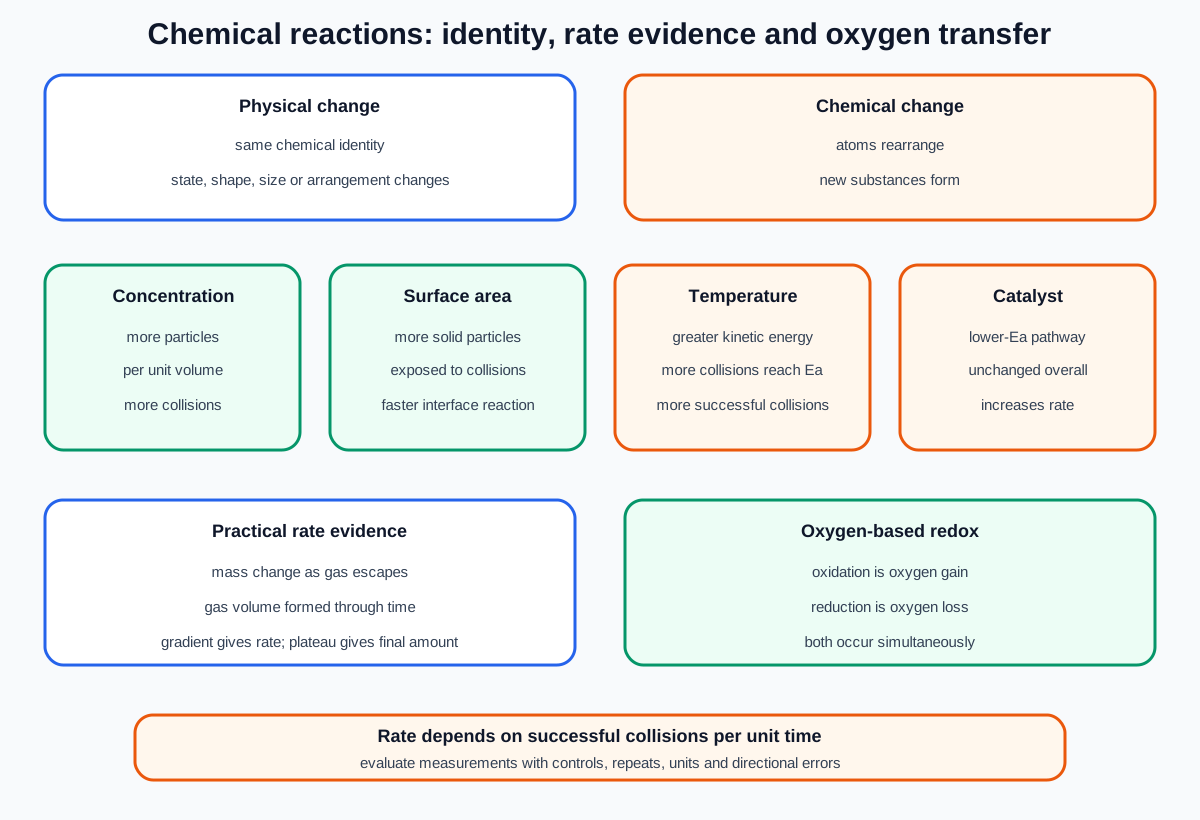
Cambridge IGCSE Combined Science Chemistry C6 distinguishes physical from chemical change, explains four rate factors through collision theory, develops mass-change and gas-formation investigations and graph interpretation, and identifies simultaneous oxidation and reduction through oxygen gain and loss.
Physical change preserves chemical identity
A physical change alters state, shape, size or arrangement without forming a new substance.
Melting, freezing, boiling and condensing are physical changes because particle identity remains the same. Dissolving can also be physical when the solute can be recovered unchanged.
Physical changes are often reversible by physical methods, but reversibility alone is not a perfect definition.
Use evidence about substance identity rather than saying only that the change “looks different”.
Chemical change forms new substances
A chemical change rearranges atoms and forms one or more new substances with different chemical properties.
Possible evidence includes a new gas, precipitate, sustained colour change, temperature change or light. Each observation needs context because boiling can also produce bubbles and mixing coloured substances can cause dilution.
Chemical equations represent reactants becoming products while conserving atoms.
Do not call every irreversible classroom event chemical without evidence of new substances.
Distinguish observations from conclusions
“The mixture became warmer” is an observation. “An exothermic chemical reaction occurred” is an interpretation supported by that observation and other evidence.
“Bubbles formed” could mean gas production or boiling. Identify temperature, products and gas tests before concluding.
A precipitate is a new insoluble solid formed from a solution and is stronger chemical-change evidence than undissolved starting powder.
Use the pattern: observation, chemical interpretation, limitation.
Reaction rate measures change per unit time
Rate of reaction describes how quickly reactants are used or products are formed.
It can be measured as decrease in reactant mass, increase in product amount, gas volume formed or another suitable change divided by time.
Rate requires both a change and a time interval. A final amount alone does not give rate.
Keep units attached, such as grams per second or cubic centimetres per minute.
Collision theory explains reaction rate
Particles must collide to react. A collision is successful when particles have at least the activation energy, Ea, and any required effective arrangement.
Check this topic from memory
Attempt the matching topic bank before reopening the notes. Use each missed idea to decide what to review next.
Reaction rate increases when successful collisions occur more frequently.
The required collision-theory language includes particles per unit volume, collision frequency, kinetic energy and activation energy.
Do not say every collision forms products.
Higher concentration increases rate
Increasing solution concentration places more reactant particles in each unit volume.
Particles are closer on average, so collisions occur more frequently. More successful collisions occur per unit time and rate increases.
Lower concentration has fewer particles per unit volume and a lower collision frequency.
Concentration does not primarily increase particle speed. At controlled temperature, kinetic-energy distribution is unchanged.
Investigate concentration fairly
Use several measured concentrations while keeping reactant volume, amount of the other reactant, temperature, apparatus and mixing method controlled.
Measure gas volume, mass loss or time to a defined endpoint as appropriate. Repeat each concentration and calculate a mean.
If time to endpoint is used for the same fixed chemical change, a shorter time means a faster rate. Do not compare times for different endpoint amounts.
Prepare dilutions accurately and keep total solution volume consistent where the design requires it.
Greater solid surface area increases rate
Breaking a solid into smaller pieces increases its total exposed surface area while keeping mass constant.
More solid particles are available at the surface for collisions with solution or gas particles. Collision frequency at the reacting interface rises, so rate increases.
Powder usually reacts faster than equal-mass large lumps under otherwise identical conditions.
Surface area does not increase particle kinetic energy.
Investigate surface area fairly
Compare equal masses of the same solid as large pieces, smaller chips and powder. Keep solution concentration and volume, temperature, apparatus and mixing controlled.
Particle-size categories need to be reproducible. Sieves or measured dimensions provide stronger evidence than “small” and “large”.
Powders can create dust and very rapid reactions, so choose safe scale and containment.
Do not compare one large lump with a larger mass of powder; mass would be a confounding variable.
Higher temperature increases rate
At higher temperature, particles have greater average kinetic energy and move faster.
They collide more frequently. More importantly, a larger proportion of collisions have energy equal to or greater than Ea.
Both effects increase the frequency of successful collisions and therefore the rate.
Do not explain temperature only as “more collisions”. The activation-energy proportion is the stronger distinguishing mechanism.
Investigate temperature fairly
Bring reactants to a measured temperature before mixing, then use the same volumes, concentrations, solid mass and surface area at every setting.
Use a controlled water bath where suitable and allow equilibration. Measure rate by the same method and interval, repeat and calculate means.
Temperature can drift during reaction, so monitor it rather than assuming the water-bath label equals reaction temperature.
Avoid unsafe temperatures, pressure buildup and direct heating of sealed gas-producing apparatus.
A catalyst increases rate and remains unchanged
A catalyst increases the rate of a reaction and is unchanged at the end of the reaction.
It provides an alternative reaction pathway with lower activation energy. A larger proportion of particle collisions can then be successful at the same temperature.
The catalyst participates in intermediate steps but is regenerated overall.
“Unchanged” does not mean it cannot become temporarily coated, dispersed or physically difficult to recover in an imperfect experiment.
Adding and removing a catalyst changes rate
Adding a suitable catalyst increases rate. Removing it, where practical, removes the lower-Ea pathway and reduces rate.
A catalyst does not increase reactant concentration or give particles more kinetic energy.
It does not change the chemical identity or theoretical final amount of product from fixed limiting reactants in a complete reaction.
Not every substance catalyses every reaction. Suitability is reaction-specific.
Investigate catalyst effect fairly
Compare the same reaction with a measured amount of catalyst and without it, or with different catalyst amounts if that is the stated question.
Keep reactant quantities, concentrations, temperature, solid surface area and apparatus controlled.
Measure gas production or mass change through time rather than only the final product amount.
Avoid claiming the catalyst was consumed merely because its measured recovery is lower; handling loss and incomplete separation are alternatives.
Measure rate by mass change
Place a gas-producing reaction vessel on a balance with a cotton-wool plug where suitable. The plug reduces spray while allowing gas to escape.
Record total mass at regular intervals. As gas leaves, measured mass decreases.
Calculate mass lost from the initial value and plot mass or mass loss against time.
This method is unsuitable if the escaping gas is hazardous or if evaporation and splashing create significant unrelated mass loss.
Measure rate by gas formation
Connect the reaction vessel to a gas syringe or collect gas by a suitable displacement method.
Record gas volume at regular intervals. A gas syringe gives direct volume readings but connections must be airtight and the plunger must move freely.
Start timing consistently at mixing, seal quickly and avoid counting initially trapped air as product gas.
Choose a method compatible with gas solubility and hazard.
Compare initial and average rates
Average rate over an interval equals change in measured quantity divided by time taken.
On a product-volume graph, gradient gives rate. A steeper positive gradient means faster product formation.
Initial rate can be estimated from a tangent at time zero. Average rate uses a chord between two points.
Do not calculate gradient from axes without using the graph scale and units.
Interpret curve shape
Rate is usually fastest near the start because reactant concentrations are greatest. The graph is steep.
As reactants are used, successful collisions become less frequent and the curve becomes less steep.
A product graph reaches a plateau when no more measured product forms. A mass graph may level when no more gas escapes.
The plateau indicates reaction completion or exhaustion of the relevant limiting reactant, not that particles have stopped moving.
Separate rate from final amount
Two experiments can reach the same plateau but at different times. They produced the same final amount but had different rates.
Changing concentration while keeping moles of a limiting reactant constant can change rate without changing final gas amount.
Changing the amount of limiting reactant can change both rate pattern and final amount.
Do not say the steeper curve always has a higher plateau.
Evaluate rate data
Use repeats to assess consistency and calculate means. Identify anomalies from disagreement with repeats or the wider pattern, not simply because a point is inconvenient.
State a limitation, its likely effect and a specific improvement. A leak makes recorded gas volume too low; an airtight seal addresses that cause.
Delayed sealing loses early gas and underestimates initial rate. Automated sensors or a reaction-start mechanism can reduce delay.
Keep raw data, units and excluded values transparent.
Redox combines oxidation and reduction
A redox reaction involves simultaneous oxidation and reduction.
Within this Combined Science boundary, oxidation is gain of oxygen and reduction is loss of oxygen.
Oxygen transferred from one reactant must go somewhere, so the two changes occur together.
Do not identify oxidation without checking which substance loses oxygen and is reduced.
Identify oxidation by oxygen gain
When magnesium reacts with oxygen to form magnesium oxide, magnesium gains oxygen and is oxidised.
The substance gaining oxygen is the one undergoing oxidation.
Combustion commonly includes oxidation, but use the formula or names to track oxygen.
Do not define oxidation as “a substance reacts” without oxygen gain in this required model.
Identify reduction by oxygen loss
When copper(II) oxide reacts with hydrogen to form copper and water, copper(II) oxide loses oxygen and is reduced.
Hydrogen gains that oxygen to form water and is oxidised. Both processes make the reaction redox.
Track oxygen atoms from reactant to product rather than deciding from colour alone.
Reduction does not mean the mass of every sample must fall in an open apparatus; it specifically means oxygen loss here.
Use Roman numerals only for ion naming
Names such as iron(II), iron(III) and copper(II) use oxidation numbers to identify ion charge in the compound name.
The C6 statement limits oxidation-number use to naming ions. It does not require a general oxidation-state calculation framework.
Iron(II) refers to Fe²⁺ and iron(III) to Fe³⁺ in the named ion context.
Do not replace the oxygen-gain and oxygen-loss redox definitions with an imported electron-transfer system for this topic.
Worked application: compare two gas-volume curves
Two equal masses of calcium carbonate react with equal volumes of the same acid at one temperature. Experiment A uses powder and B uses large chips. A reaches 60 cm³ of gas in 40 seconds; B reaches the same plateau in 110 seconds. A is faster because powder exposes more solid surface, increasing collision frequency at the interface and successful collisions per second. The equal plateaus show the same final gas amount, not equal rates. A gas leak would lower a plateau rather than merely flatten the early slope. Repeats, airtight connections and consistent timing are needed before attributing the difference to surface area alone.
Common misconceptions and corrections
Calling every state change chemical. Particle identity remains unchanged.
Calling every irreversible event chemical. Look for new-substance evidence.
Treating bubbles as automatic gas-reaction proof. Boiling can also bubble.
Defining rate as final amount. Rate is change per unit time.
Saying every collision reacts. Collisions need at least Ea.
Saying concentration increases particle speed. It increases particles per unit volume.
Omitting collision frequency from concentration answers. More crowded particles collide more often.
Saying surface area changes particle energy. It exposes more particles.
Comparing unequal solid masses. Keep mass constant.
Explaining temperature only through collision count. Include kinetic energy and Ea proportion.
Saying a catalyst raises temperature. It provides a lower-Ea pathway.
Saying a catalyst is consumed. It is unchanged overall at the end.
Saying a catalyst increases final yield from fixed complete reactants. It changes rate.
Assuming any powder is a catalyst. Catalyst action is chemically specific.
Sealing a gas-producing mass-loss apparatus. Gas must escape safely.
Using mass loss for a hazardous gas without controls. Method must suit the gas.
Ignoring leaks in gas collection. They lower recorded volume.
Starting timing after substantial gas forms. Delayed starts lose initial-rate evidence.
Calling a steeper line a larger final amount. Gradient and plateau are different.
Using a secant as an instantaneous rate without saying so. A tangent estimates instantaneous rate.
Saying a plateau means no particles move. It means no further measured change.
Removing anomalies without evidence. Use repeats and transparent criteria.
Defining redox as oxidation only. Oxidation and reduction are simultaneous.
Saying oxidation is oxygen loss. It is oxygen gain.
Saying reduction is oxygen gain. It is oxygen loss.
Identifying redox from colour alone. Track oxygen between substances.
Using Roman numerals as atom counts. They identify ion charge in names.
Importing equilibrium into C6. Reversible equilibrium is not listed here.
Importing pressure as a required rate factor. The named factors are concentration, surface area, temperature and catalyst.
Importing electron-transfer redox as required. This boundary uses oxygen gain and loss.
Assessment guidance
Physical-versus-chemical answers need evidence about new substance formation. Rate explanations should move from the changed factor to particles per unit volume, exposed surface, kinetic energy or Ea, then collision frequency and successful collisions per unit time. Practical answers need a justified mass-loss or gas-volume method, controlled variables, consistent start, repeats, units, safety and directional errors. Graph questions must separate gradient from plateau and average from instantaneous rate. Redox answers should identify both substances and state oxygen gained and lost. Keep Roman numerals to ion naming and do not import equilibrium or electron-transfer frameworks.
Retrieval practice
Classify forty changes with observation and identity evidence. Build four factor-collision-theory chains without memorised shortcuts. Design mass-loss and gas-syringe investigations for concentration, surface area, temperature and catalyst comparisons. Interpret twenty rate curves using gradients, tangents, plateaus and error direction. Track oxygen through thirty reactions, naming both oxidation and reduction, then diagnose thirty boundary and mechanism errors.
Topic ownership
This note owns C6.1 physical and chemical change, C6.2 four rate factors, catalyst definition, collision theory, mass-change and gas-formation methods and graph interpretation, and C6.3 oxygen-based redox with Roman numerals limited to ion naming. C5 owns pathway energetics. Equilibrium, pressure as a named rate factor and electron-transfer redox are not promoted into this Combined Science C6 boundary.