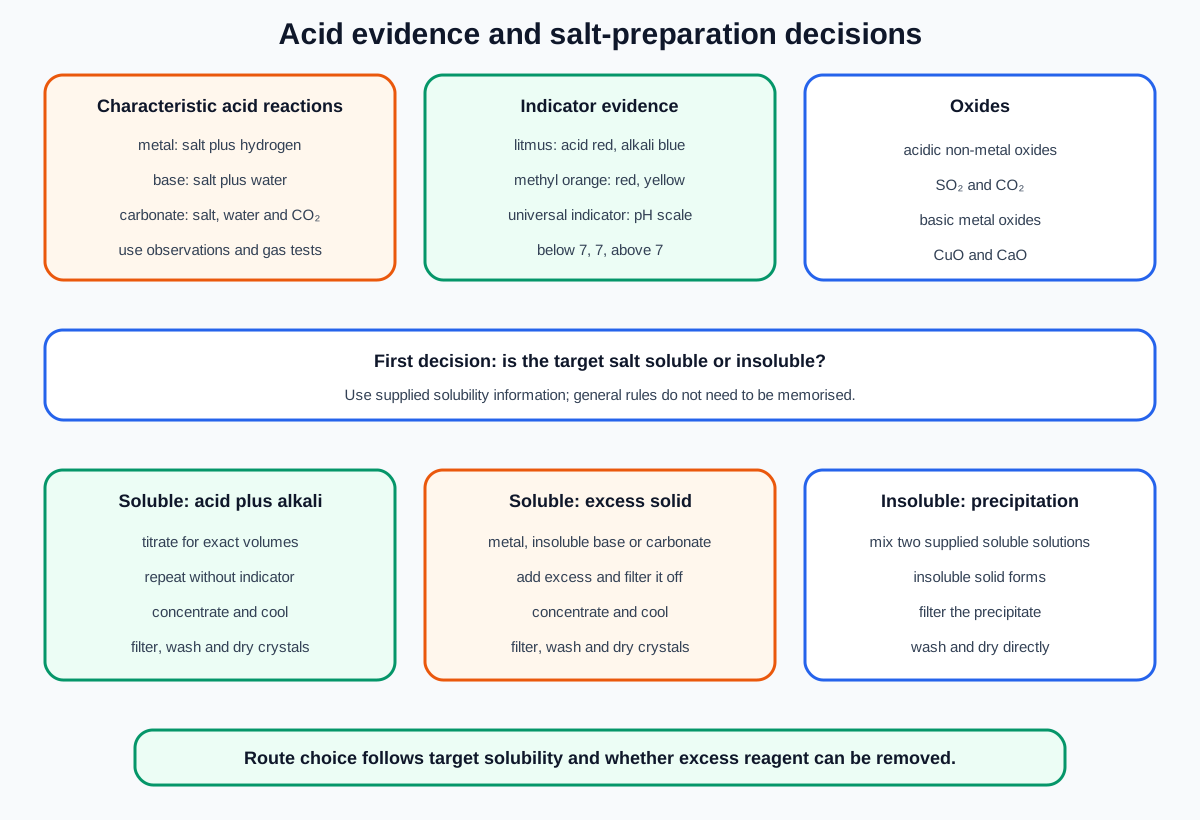
Cambridge IGCSE Combined Science Chemistry C7 develops characteristic acid and base reactions, litmus, methyl-orange and universal-indicator evidence, acidic and basic oxides, and preparation, separation and purification routes for soluble and insoluble salts.
Acids react characteristically with metals
An acid reacting with a suitable metal produces a salt and hydrogen:
acid + metal → salt + hydrogen
Fizzing indicates gas formation, and a safely collected small sample of hydrogen gives a squeaky pop with a lighted splint.
The acid determines the salt family: hydrochloric acid forms chlorides, sulfuric acid forms sulfates and nitric acid forms nitrates.
Not every metal reacts at a useful rate with every dilute acid. Use the reaction information and reactivity context supplied.
Acids react with bases
An acid reacting with a base produces a salt and water:
acid + base → salt + water
This is neutralisation. A metal oxide or hydroxide can act as the base.
If the base is an insoluble solid, its disappearance during reaction and a temperature change may be observed. Add excess when preparing a soluble salt so no acid remains.
Do not predict hydrogen from acid plus base. Water is the second product.
Acids react with carbonates
An acid reacting with a carbonate produces a salt, water and carbon dioxide:
Use only a small amount in tests because an indicator can contaminate a salt-preparation product.
Bases are metal oxides or hydroxides
In this syllabus definition, bases are oxides or hydroxides of metals.
Examples include copper(II) oxide, calcium oxide, sodium hydroxide and calcium hydroxide.
Bases react with acids to produce salt and water.
Do not define every metal compound as a base. The specified classes are metal oxides and hydroxides.
Alkalis are soluble bases
An alkali is a soluble base.
Every alkali is a base, but an insoluble base is not an alkali. Sodium hydroxide solution is alkaline; solid copper(II) oxide is a base but is not described as an alkali.
Solubility explains why excess alkali cannot simply be removed by filtration during salt preparation.
Do not use “base” and “alkali” as exact synonyms.
Universal indicator compares pH
Universal indicator gives a range of colours corresponding approximately to pH.
Acidic solutions have pH below 7, neutral solutions have pH 7, and alkaline solutions have pH above 7.
Typical colours move from red through orange and yellow in acidic conditions, green near neutral, then blue and purple in alkaline conditions.
A lower pH represents greater relative acidity; a higher pH represents greater relative alkalinity for the compared solutions.
Interpret colour through the supplied scale
Universal-indicator formulations and printed colour scales can vary slightly. Match the observed colour to the scale supplied in the question.
Do not report an exact decimal pH from a broad colour band. Indicator paper gives an approximate comparison.
A green result supports neutrality near pH 7, while red and purple indicate opposite ends of the scale.
Keep “neutral” separate from “colourless”; universal indicator is coloured at neutrality.
Acidic oxides are linked to non-metals
Sulfur dioxide, SO₂, and carbon dioxide, CO₂, are the required acidic oxide examples.
They are oxides of non-metals. Acidic oxides can react with bases in acid-base contexts.
The general classification links non-metallic character with acidic oxides.
Do not call carbon dioxide a base because it contains oxygen.
Basic oxides are linked to metals
Copper(II) oxide, CuO, and calcium oxide, CaO, are the required basic oxide examples.
They are metal oxides and react with acids to form salts and water.
The general classification links metallic character with basic oxides.
Amphoteric-oxide exceptions belong to separate Chemistry and are not required in this Combined Science statement.
Salt preparation begins with target solubility
First decide whether the required salt is soluble or insoluble, using information supplied in the question. General solubility rules do not need to be memorised for C7.
A soluble salt is prepared in solution and then crystallised. An insoluble salt is formed as a precipitate and filtered directly.
For a soluble salt, choose between titration and an excess solid according to whether unreacted material can be removed.
This decision prevents incompatible method steps from being mixed.
Use titration for acid plus alkali
Both acid and alkali are soluble, so an excess of either would remain dissolved and could not be removed by filtration.
Use titration with an indicator to determine the exact neutralising volumes. Repeat the preparation using those volumes without indicator to avoid contaminating the salt.
Then heat gently to concentrate the solution, allow it to cool so crystals form, filter the crystals, wash them with a little cold distilled water and dry them.
Do not use the indicator-containing trial as the pure preparation batch.
Use an excess suitable metal for some soluble salts
Warm the dilute acid gently where appropriate. Add the metal in small portions until no more reacts and some remains.
Excess metal ensures all acid is consumed. Filter to remove the unreacted solid.
Concentrate the filtrate, cool to crystallise, then filter, wash and dry the crystals.
Choose a metal that reacts safely and suitably with the acid. The route is not appropriate when the named metal does not react with the dilute acid.
Use an excess insoluble base
Add an insoluble metal oxide or hydroxide to warm dilute acid until no more reacts and excess solid remains.
The excess consumes all acid. Filter it off, leaving salt solution as the filtrate.
Concentrate, cool, crystallise, filter, wash with a small amount of cold distilled water and dry.
Do not confuse insoluble base with soluble alkali. Only the insoluble excess can be filtered away.
Use an excess insoluble carbonate
Add an insoluble carbonate to dilute acid in portions. Fizzing occurs as carbon dioxide forms.
Continue until fizzing stops and some solid remains, showing that acid has been consumed and carbonate is in excess.
Filter, concentrate the filtrate, cool to crystallise, then filter, wash and dry the crystals.
Allow vigorous effervescence to settle before adding more solid to prevent overflow and material loss.
Filtering separates excess solid
After an excess-metal, base or carbonate reaction, the residue is unreacted solid and the filtrate contains soluble salt.
Keep the filtrate for crystallisation. Discarding it would discard the desired product.
Rinse the reaction vessel and filter residue with a small amount of distilled water if recovery matters, while avoiding excessive dilution.
Filtration cannot remove dissolved excess alkali, which is why titration is needed for acid plus alkali.
Concentrating prepares for crystallisation
Heat the salt solution gently to evaporate some water and approach saturation.
Do not evaporate to dryness. Strong heating can cause spitting, decomposition or formation of poor product, and it prevents controlled crystal growth.
A small sample forming crystals on a cool glass rod or surface can indicate sufficient concentration where that procedure is taught.
Use appropriate eye protection and avoid leaning over hot solution.
Cooling forms crystals
As the concentrated solution cools, solubility commonly decreases and crystals form.
Slow cooling can support larger, better-formed crystals. Disturbing or rapidly evaporating the solution can produce small crystals or powder.
Filter the formed crystals from the remaining solution.
The remaining liquid is the mother liquor and still contains dissolved salt, so recovery is rarely complete.
Wash and dry crystals correctly
Wash crystals with a small amount of cold distilled water to remove soluble impurities on their surfaces.
Cold water and small volume limit loss of desired soluble salt.
Dry crystals between filter papers or by another suitable gentle method.
Washing with large amounts of warm water lowers yield by dissolving product.
Precipitation makes an insoluble salt
Choose two soluble solutions that provide the ions of the required insoluble salt. Mix them so the precipitate forms.
Filter to collect the insoluble solid, wash it with distilled water to remove soluble spectator ions and dry it.
No crystallisation is needed because the desired product is already an insoluble solid.
General solubility rules need not be memorised; use the solubility information or reactants supplied.
Write precipitation evidence clearly
An observation might be that a coloured or white solid forms from two solutions. The conclusion is that an insoluble product has precipitated.
A net ionic equation can show the ions forming the solid, while spectator ions remain aqueous.
The starting salts must be soluble enough to supply mobile ions in solution.
Do not begin with two insoluble solids and expect effective ion mixing by precipitation.
Separate theory and practical ownership
C7 theory owns the decision logic, reaction families, indicators, pH, oxide classification and required preparation sequences.
The dedicated Combined Science practical hub owns extended apparatus handling, titre quality, heating technique, filtration geometry, uncertainty and full risk assessment.
Theory still includes enough procedural reasoning to answer written C7 questions.
Do not merge the theory note with a generic laboratory manual or move chemical route selection out of theory.
Worked application: choose three salt routes
To prepare copper(II) sulfate crystals from dilute sulfuric acid and insoluble copper(II) oxide, add excess oxide to warm acid, filter off the excess, concentrate the filtrate, cool, then filter, wash and dry the crystals. To prepare a soluble sodium salt from an acid and sodium hydroxide, use titration because both reactants are soluble; repeat exact volumes without indicator before crystallising. To prepare a supplied insoluble salt, mix two specified soluble solutions, filter the precipitate, wash and dry it. Target solubility and removability of excess reagent select the route; memorised general solubility rules are not required.
Common misconceptions and corrections
Predicting oxygen from acid plus metal. Hydrogen forms.
Predicting hydrogen from acid plus base. Water forms with the salt.
Omitting water from acid plus carbonate. Products are salt, water and carbon dioxide.
Calling any bubbles hydrogen. Use the reaction and a gas test.
Saying acids turn red litmus blue. Acids turn blue litmus red.
Saying alkalis turn blue litmus red. Alkalis turn red litmus blue.
Giving methyl orange litmus colours. It is red in acid and yellow in alkali.
Calling pH 7 acidic. It is neutral.
Reading exact decimal pH from a broad colour. Universal indicator is approximate.
Calling neutral universal indicator colourless. It is typically green.
Calling every base an alkali. Only soluble bases are alkalis.
Calling every metal compound a base. The stated bases are metal oxides or hydroxides.
Calling CO₂ a basic oxide. It is an acidic non-metal oxide.
Calling CuO an acidic oxide. It is a basic metal oxide.
Importing amphoteric oxides as required. They are outside this Combined Science boundary.
Choosing a salt method before checking target solubility. Solubility selects crystallisation or precipitation.
Using excess alkali and filtering it. Dissolved excess passes through filter paper.
Using titration when excess insoluble solid can be removed. Use the simpler excess route.
Stopping solid addition before excess remains. Acid may contaminate the product.
Discarding filtrate after excess-solid reaction. It contains the soluble salt.
Keeping the indicator-containing titration batch. Repeat exact volumes without indicator.
Evaporating the solution to dryness. Concentrate and cool to crystallise.
Crystallising an insoluble precipitate. Filter it directly.
Skipping washing of a precipitate. Soluble ions remain on its surface.
Washing soluble crystals with much hot water. Product dissolves and yield falls.
Calling mother liquor pure water. It contains dissolved salt and impurities.
Memorising general solubility rules as a C7 requirement. The syllabus explicitly says they are not needed.
Importing strong and weak acid theory. It is not listed here.
Importing proton-donor definitions. They are outside this boundary.
Importing hydration and water of crystallisation. They are not required in C7.
Assessment guidance
Acid-reaction questions need the correct product family and gas evidence. Indicator answers must preserve each named colour pair, while universal indicator compares approximate pH, neutrality and relative acidity or alkalinity. Base and alkali definitions require metal oxide or hydroxide and solubility. Classify SO₂ and CO₂ as acidic non-metal oxides and CuO and CaO as basic metal oxides. For salt preparation, state target solubility, justify titration, excess solid or precipitation, and trace product through filtering, concentrating or washing and drying. Explain why each separation removes a named impurity.
Retrieval practice
Complete and classify thirty acid reaction descriptions and gas tests. Recall litmus, methyl-orange and universal-indicator evidence from blank scales. Sort bases from alkalis and classify the four named oxides. Choose routes for twenty supplied salts without relying on memorised solubility rules. Reconstruct every preparation sequence, identify residue and filtrate contents, and diagnose thirty method, colour, product and purification errors.
Topic ownership
This note owns C7.1 characteristic acid and base reactions, litmus, methyl orange and universal-indicator pH comparison; C7.2 the four named acidic and basic oxides; and C7.3 all soluble-salt and precipitation routes. The practical hub owns extended apparatus and evaluation. Strong and weak acids, proton transfer, amphoteric oxides, general solubility rules and hydration are not promoted into this Combined Science C7 boundary.