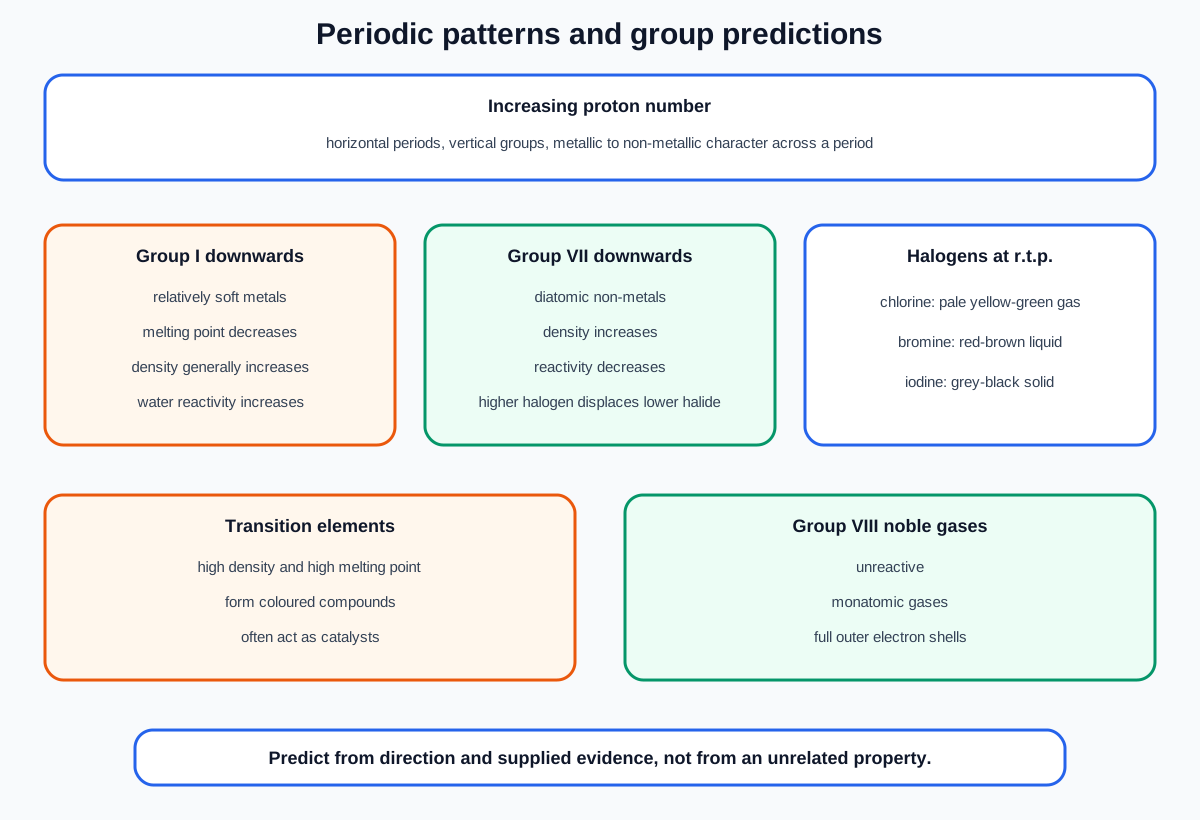
Cambridge IGCSE Combined Science Chemistry C8 develops Periodic Table arrangement, metallic-to-non-metallic change across a period, data-led group predictions, the exact Group I and VII trends, halogen displacement, four transition-element properties and noble-gas unreactivity.
The Periodic Table is ordered by proton number
The Periodic Table arranges elements in order of increasing proton number, also called atomic number.
Proton number increases from one element to the next. It identifies the element because it counts protons in the nucleus.
The arrangement places chemically related elements in vertical groups and repeating sequences in horizontal periods.
Do not say the modern table is ordered by relative atomic mass. Proton number is the controlling order.
Periods are horizontal rows
A period is a horizontal row in the Periodic Table.
For the first twenty elements, period number equals the number of occupied electron shells.
Properties change across a period as proton number and outer-electron structure change.
Do not confuse period with group or count outer electrons to determine period.
Groups are vertical columns
A group is a vertical column. Elements in a group show related chemical behaviour.
For Groups I to VII in the simple electron model, group number equals outer-shell electron number. This shared pattern helps explain similar reactions.
Properties also change gradually down a group, allowing predictions from supplied information.
Do not assume every property is identical within a group. Trends describe directional change.
Metallic character decreases across a period
Across a period from left to right, elements change from metallic toward non-metallic character.
Elements on the left are generally metals, while non-metals occur toward the right.
This is a broad character trend, not a statement that every adjacent pair changes abruptly.
Use table position and supplied properties together when classifying an unfamiliar element.
Identify trends from information
A trend is a consistent general change in a property across an ordered set.
Arrange supplied elements by position, compare values or observations, then state whether the property increases, decreases or remains broadly similar.
Use the word “general” where exceptions or irregular data exist. Prediction should follow the evidence range rather than inventing exact values.
Check this topic from memory
Attempt the matching topic bank before reopening the notes. Use each missed idea to decide what to review next.
Do not select only two convenient points while ignoring contradictory supplied data.
Group I contains relatively soft alkali metals
Lithium, sodium and potassium are Group I alkali metals and are relatively soft.
They can be cut more easily than many common structural metals, with safe controlled handling. Fresh surfaces can appear shiny before reacting with air.
Softness is a relative physical property, not evidence that the substances are non-metals.
Group I substances are reactive, so demonstrations require small quantities and appropriate barriers.
Group I melting point decreases down the group
The general melting-point trend from lithium to sodium to potassium is decreasing down Group I.
An unfamiliar Group I element below potassium would be predicted to have a lower melting point than potassium, subject to the trend and supplied evidence.
Melting point is a physical property and should not be used as the mechanism for water reactivity.
Do not reverse the trend simply because density generally increases.
Group I density generally increases down the group
Density shows a general increase down Group I in the syllabus treatment.
Prediction questions may supply data that show an irregular point, so describe the general pattern rather than forcing perfect uniformity.
Density is mass per unit volume and is distinct from relative atomic mass.
Do not use density increase to explain reaction rate with water.
Group I reactivity with water increases
Reactivity with water increases down Group I from lithium to sodium to potassium.
The reactions form a metal hydroxide and hydrogen. Observations become more vigorous down the group.
Atoms lower in the group have more occupied shells. Increased distance and shielding weaken attraction between the nucleus and outer electron, so that electron is lost more easily.
Do not say lower elements react faster because they are denser or have lower melting points.
Predict another Group I element
Use its position relative to known members. An element below potassium should be relatively soft, generally denser, lower-melting and more reactive with water.
State directions rather than unsupported exact numbers. If supplied data conflict with one general trend, acknowledge the evidence.
A prediction should name the comparison: “more reactive than potassium”, not just “very reactive”.
Safety expectations also strengthen down the group because reaction vigour increases.
Group VII halogens are diatomic non-metals
Chlorine, bromine and iodine are Group VII halogens. They are non-metals and exist as diatomic molecules: Cl₂, Br₂ and I₂.
Each atom has seven outer-shell electrons and tends to gain one electron in reactions to form a 1- halide ion.
The molecule-to-ion change matters in displacement equations.
Do not call a halogen molecule a halide ion. Chlorine differs from chloride.
Halogen density increases down the group
The general density trend from chlorine to bromine to iodine is increasing down Group VII.
This accompanies visible state changes at room temperature and pressure, but density itself does not explain reactivity.
Predict a halogen below iodine to be denser than iodine using the stated trend.
Do not confuse greater density with greater chemical reactivity, which changes in the opposite direction.
Halogen reactivity decreases down the group
Reactivity decreases from chlorine to bromine to iodine.
An atom lower in Group VII has more occupied shells. Greater distance and shielding weaken attraction for an incoming electron, so gaining an electron becomes harder.
Chlorine is therefore more reactive than bromine, which is more reactive than iodine.
Do not apply the increasing Group I reactivity trend to Group VII.
Know the three appearances at r.t.p.
At room temperature and pressure:
chlorine is a pale yellow-green gas;
bromine is a red-brown liquid;
iodine is a grey-black solid.
These are the required elemental appearances. Halide solutions are not assumed to have the same colours as their parent halogens.
Colour and state should both be stated when the question asks for appearance.
A more reactive halogen displaces a less reactive halide
A more reactive halogen displaces a less reactive halogen from its halide ions.
Chlorine displaces bromide and iodide ions. Bromine displaces iodide ions but not chloride. Iodine displaces neither chloride nor bromide.
The added halogen gains electrons and is reduced to halide ions. The displaced halide ions lose electrons and form their halogen.
Do not predict displacement when the added halogen is less reactive.
Explain chlorine and bromide displacement
Chlorine is more reactive than bromine and gains electrons more readily.
Chlorine molecules take electrons from bromide ions, forming chloride ions and bromine molecules:
chlorine + bromide ions → chloride ions + bromine
An orange or red-brown bromine colour can appear depending on concentration and solvent context.
Use a displacement decision rule
Locate the added halogen and the halide's parent element in the group.
If the added halogen is above the halide's parent, displacement occurs. If it is below, no reaction occurs.
Then name the new halide ion and the displaced elemental halogen.
Use observations only after predicting chemistry; colour intensity can be affected by concentration and mixing.
Predict another Group VII element
An element below iodine should be a denser, less reactive diatomic non-metal than iodine according to the required trends.
Its melting and boiling behaviour may support a physical-state prediction if relevant data are supplied, but only density and reactivity are named general trends here.
It would not displace iodide ions if it is less reactive than iodine.
Do not invent an exact colour or state without data beyond the required trend.
Transition elements have high density
Transition elements are metals with high densities compared with the general metals in the syllabus contrast.
This property can support uses where compact mass or robust metallic structure matters, but C8 requires description rather than a catalogue of applications.
“High” is a general group characteristic, not an identical value for every element.
Do not describe transition elements as low-density Group I metals.
Transition elements have high melting points
Transition elements generally have high melting points.
This distinguishes them from the decreasing and relatively low melting behaviour of the named Group I metals.
The requirement is descriptive. Detailed metallic-bond strength trends across the block are not needed.
Avoid absolute wording because group properties are generalisations.
Transition elements form coloured compounds
Transition elements form coloured compounds.
Colour observations can help identify ions in C12 tests, but a colour alone is not always unique proof.
The element as a metal and its compounds need not have the same colour.
Do not say every compound of every transition element has the same colour.
Transition elements often act as catalysts
Transition elements and their compounds often act as catalysts.
A catalyst increases reaction rate and is unchanged overall at the end. C6 owns the rate and activation-energy explanation.
“Often” does not mean every transition element catalyses every reaction.
The four required characteristics should be recalled together: high density, high melting point, coloured compounds and catalytic activity.
Noble gases are unreactive monatomic gases
Group VIII noble gases are unreactive, monatomic gases.
Monatomic means they exist as individual atoms rather than diatomic molecules under ordinary conditions.
They have full outer electron shells. Helium has a full first shell of two; the later examples have eight outer electrons.
The full shell is stable, so noble-gas atoms have little tendency to gain, lose or share electrons.
Predict noble-gas behaviour from configuration
An unknown element with a full outer shell at the end of a period is expected to show noble-gas-like low reactivity.
It should be monatomic rather than forming the diatomic molecules characteristic of halogens.
Do not say noble gases contain no electrons. Their unreactivity comes from a complete outer shell.
Avoid claiming absolutely no reactions are possible; “unreactive” is the syllabus description.
Worked application: identify a halogen and predict displacement
Element X is a red-brown liquid at room temperature and lies between chlorine and iodine in Group VII. It is bromine. Its density is greater than chlorine's but lower than iodine's, while its reactivity is lower than chlorine's but higher than iodine's. Adding X to iodide solution causes displacement because bromine gains electrons more readily than iodine, forming bromide ions and iodine. Adding X to chloride solution gives no displacement because chlorine is more reactive. The reasoning uses group position and electron attraction; the liquid state does not itself cause the reaction. X is diatomic Br₂, not a bromide ion.
Common misconceptions and corrections
Saying the table is ordered by atomic mass. It uses increasing proton number.
Calling vertical columns periods. They are groups.
Calling horizontal rows groups. They are periods.
Saying period gives outer-electron count. It gives occupied shells in the simple model.
Saying all group properties are identical. Trends describe general change.
Ignoring supplied data when identifying a trend. Use the evidence range.
Calling Group I non-metals because they are soft. They are metals.
Saying Group I melting point increases downward. It decreases.
Saying Group I density decreases downward. The required general trend increases.
Saying Group I reactivity decreases downward. Water reactivity increases.
Explaining Group I reactivity by density. Use shielding and outer-electron loss.
Calling halogens monatomic. They are diatomic non-metals.
Calling chloride chlorine. One is an ion; the other is an element.
Saying halogen density decreases downward. It increases.
Saying halogen reactivity increases downward. It decreases.
Using Group I electron-loss reasoning unchanged for halogens. Halogens gain an electron.
Calling chlorine colourless. It is pale yellow-green.
Calling bromine a gas at r.t.p. It is a red-brown liquid.
Calling iodine a purple liquid at r.t.p. It is a grey-black solid.
Predicting bromine displaces chloride. Bromine is less reactive than chlorine.
Predicting iodine displaces bromide. Iodine is less reactive.
Saying displacement is caused by density. It depends on relative reactivity.
Using halide-solution colour as elemental appearance. They are different species.
Calling transition elements low-density metals. They generally have high density.
Calling their melting points low. They generally have high melting points.
Saying transition compounds are always colourless. Coloured compounds are characteristic.
Saying every transition element catalyses every reaction. Catalysis is frequent but specific.
Calling noble gases diatomic. They are monatomic.
Saying noble gases have no electrons. They have full outer shells.
Importing wider periodic trends as required C8 content. Preserve the named trends only.
Assessment guidance
Arrangement answers need increasing proton number, horizontal periods and vertical groups, plus metallic-to-non-metallic change across a period. Trend questions should state direction, cite supplied comparisons and predict cautiously. For Group I, preserve soft metals, decreasing melting point, increasing density and increasing water reactivity. For Group VII, preserve diatomic non-metals, increasing density, decreasing reactivity and all three appearances. Displacement explanations require relative position and electron gain. Transition questions need all four characteristics. Noble-gas answers need unreactive, monatomic gas and full outer-shell explanation.
Retrieval practice
Label blank table regions and infer period, group and character from configurations. Reconstruct the three Group I trends and make evidence-bounded predictions. Recall every halogen appearance and complete the full displacement matrix with explanations. Generate property cards for transition elements and noble gases. Diagnose thirty trend, species, colour, displacement and electronic-configuration errors without importing unnamed periodic trends.
Topic ownership
This note owns C8.1 table arrangement, character change and supplied group trends; C8.2 Group I; C8.3 Group VII appearances, trends and displacement; C8.4 four transition-element characteristics; and C8.5 noble gases. C2 owns shell configuration and C6 owns catalyst rate theory. Wider periodic trends and detailed transition-metal chemistry are not promoted into this Combined Science C8 boundary.