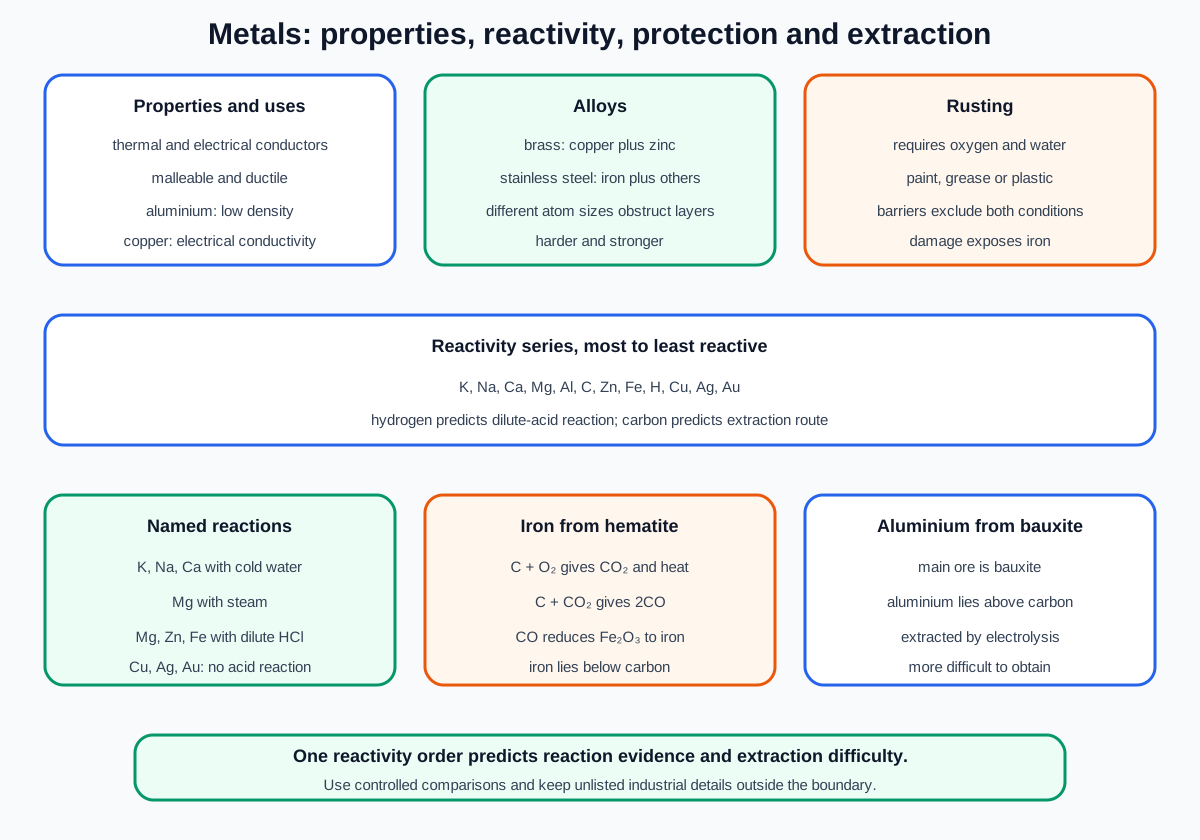
Cambridge IGCSE Combined Science 0653 notes on metal properties and uses, alloys, reactivity, rust prevention, blast-furnace iron and aluminium extraction.
Cambridge IGCSE Combined Science Chemistry C9 connects metal and non-metal properties to uses, explains alloy structure, applies the exact reactivity series to water, steam and acid evidence, develops rust conditions and barriers, and compares blast-furnace iron with aluminium electrolysis.
Metals usually conduct thermal energy well
Metals are generally good thermal conductors, while non-metals are generally poor thermal conductors.
This makes metals useful where heat must pass through a material, although the required C9 uses focus on other properties.
The comparison is general. A question can supply an exception or require evidence about a particular substance.
Do not turn a general property into an exception-free definition of a metal.
Metals usually conduct electricity well
Metals are generally good electrical conductors. Non-metals are generally poor conductors.
Mobile electrons in metallic structure carry charge through the solid. This differs from an ionic solution, where mobile ions carry charge.
Electrical conductivity supports aluminium and copper cable uses.
Do not explain solid-metal conduction through positive metal ions moving through the structure.
Metals are malleable and ductile
Malleable materials can be hammered or pressed into shape. Ductile materials can be drawn into wires.
Metals are generally malleable and ductile. Solid non-metals are more often brittle.
These properties allow manufacturing without the material shattering.
Do not use malleable and ductile as synonyms: one concerns shaping or sheets, the other wires.
Metals generally have higher melting and boiling points
Metals generally have higher melting points and boiling points than non-metals.
This broad comparison supports use under conditions where a material must remain solid, but individual values vary.
Group I metals and some other elements show why the word “generally” matters.
Use supplied evidence rather than rejecting a classification because of one atypical property.
Metals react with dilute acids according to reactivity
A metal above hydrogen in the reactivity series can react with dilute acid to form a salt and hydrogen.
More reactive metals generally react more vigorously under comparable concentration, surface area and temperature.
Metals below hydrogen do not react with dilute hydrochloric acid in the named comparisons.
Rate evidence is valid only when experimental conditions are controlled.
Check this topic from memory
Attempt the matching topic bank before reopening the notes. Use each missed idea to decide what to review next.
Carbon and hydrogen are reference points even though they are not metals. Hydrogen predicts dilute-acid reaction; carbon helps predict extraction.
Preserve the order exactly rather than keeping only the metals used in one experiment.
Potassium, sodium and calcium react with cold water
Potassium, sodium and calcium react with cold water, forming their metal hydroxides and hydrogen.
Potassium is more reactive than sodium, and sodium is more reactive than calcium in the stated series. Reaction vigour follows that order under suitable comparison.
Hydrogen causes fizzing and can be tested safely on a small collected sample. The hydroxide makes the remaining solution alkaline.
These reactions require controlled small-scale demonstrations because potassium and sodium can react dangerously.
Magnesium reacts with steam
Magnesium reacts with steam to form magnesium oxide and hydrogen:
magnesium + steam → magnesium oxide + hydrogen
The named product with steam is the oxide, not magnesium hydroxide.
Magnesium lies below calcium but above aluminium in the series.
Use appropriate heating, eye protection and safe gas handling in a demonstration.
Magnesium, zinc and iron react with dilute hydrochloric acid
Magnesium, zinc and iron lie above hydrogen and react with dilute hydrochloric acid to form their chlorides and hydrogen.
Under comparable conditions, magnesium is more vigorous than zinc, and zinc more vigorous than iron.
Observe metal disappearance, fizzing and possible temperature rise. Confirm hydrogen with a squeaky-pop test on a small collected sample.
Control surface area, acid concentration and temperature before using rate as reactivity evidence.
Copper, silver and gold do not react with dilute hydrochloric acid
Copper, silver and gold lie below hydrogen in the series.
They do not displace hydrogen from dilute hydrochloric acid in the required comparison, so no hydrogen effervescence is expected.
No visible reaction is still useful evidence when apparatus and conditions are suitable.
Do not conclude that these metals never react with any substance.
Deduce an order from experimental results
Record every reaction and non-reaction under controlled conditions.
A more vigorous cold-water or acid reaction supports greater reactivity when quantities and surface area are comparable. A metal reacting with steam but not cold water occupies a different range from one reacting rapidly with cold water.
Use multiple comparisons to build a partial order, then place only relationships supported by evidence.
Do not invent an exact position when two metals were never connected by a comparison.
Rusting requires oxygen and water
Iron rusts when both oxygen and water are present.
If water is excluded, rusting does not occur. If oxygen is excluded, rusting does not occur.
A controlled investigation needs iron under both conditions as the positive comparison and separate treatments excluding each condition.
Salt can alter rate but is not one of the two required conditions.
Painting creates a barrier
Paint covers iron and prevents oxygen and water reaching the metal surface.
The coating works only while it remains sufficiently continuous. Scratching exposes iron and allows rusting where both requirements reach it.
Painting does not remove existing rust chemically.
Prepare the surface properly before applying a barrier in practical contexts.
Greasing creates a barrier
Grease forms a water-resistant layer that excludes oxygen and water.
It is useful where a coating can be renewed and where moving parts should not be sealed with rigid paint.
The protection must remain on the exposed iron surface.
Do not say grease converts iron into a less reactive metal.
Plastic coating creates a barrier
Plastic coating physically separates iron from oxygen and water.
It can be durable and electrically insulating, depending on the application.
Damage to the coating creates an exposed site where rust can begin.
The required mechanism is exclusion, not sacrificial reaction.
Reactivity controls ease of extraction
More reactive metals form more stable compounds and are generally more difficult to obtain from their ores.
Metals below carbon can be obtained from some oxides by reduction with carbon or carbon monoxide. Metals above carbon require a more powerful method such as electrolysis in the required model.
Position predicts chemical difficulty, while industrial choice can also depend on energy and ore processing.
Do not decide extraction method from density or melting point.
Hematite contains iron(III) oxide
Iron is extracted from hematite by reduction of iron(III) oxide in the blast furnace.
Iron lies below carbon, so carbon-derived carbon monoxide can remove oxygen from the oxide.
Reduction means oxygen loss in the C6 definition.
The required Combined Science process is limited to three carbon and carbon-monoxide steps.
Coke burns to provide heat and carbon dioxide
Carbon in coke burns in oxygen:
C + O₂ → CO₂
This exothermic reaction provides heat and produces carbon dioxide.
Do not call this the direct hematite-reduction step. It prepares the hot furnace conditions and carbon dioxide for the next reaction.
Each equation has a distinct purpose.
Carbon dioxide forms carbon monoxide
Carbon dioxide reacts with more hot carbon:
C + CO₂ → 2CO
The carbon monoxide produced is the reducing agent for iron(III) oxide.
Balance the equation with two carbon monoxide molecules.
Do not skip this step and claim coke only supplies heat.
Carbon monoxide reduces iron(III) oxide
Carbon monoxide removes oxygen from iron(III) oxide:
Fe₂O₃ + 3CO → 2Fe + 3CO₂
Iron(III) oxide is reduced to iron. Carbon monoxide gains oxygen and is oxidised to carbon dioxide.
Atom counts and oxygen transfer both confirm the equation.
Limestone and slag chemistry are not named in this Combined Science extraction boundary.
Aluminium comes from bauxite by electrolysis
Bauxite is the main ore of aluminium.
Aluminium lies above carbon in the reactivity series, so its compound is not reduced by carbon in the required model. Aluminium is extracted by electrolysis.
Electrolysis uses electrical current to decompose molten or suitable dissolved ionic material and produce aluminium at the cathode.
Detailed purification, cryolite and electrode chemistry are outside the C9.6 statement.
Compare iron and aluminium extraction
Iron lies below carbon and is obtained from hematite through carbon-monoxide reduction in a blast furnace.
Aluminium lies above carbon and is obtained from bauxite through electrolysis.
The more reactive aluminium is harder to extract chemically and the electrical route requires substantial energy.
Do not write electrolysis for every metal ore or carbon reduction for a metal above carbon.
Worked application: infer reactivity and extraction
Metal M reacts with dilute hydrochloric acid more slowly than zinc but more vigorously than iron under controlled conditions. This places M between zinc and iron in the evidence set. It lies above hydrogen, so it forms hydrogen with dilute acid, and below carbon, so an oxide of M could potentially be reduced using carbon or carbon monoxide in the syllabus model. Aluminium cannot be M because aluminium lies above carbon. The conclusion depends on equal surface area, acid concentration and temperature; otherwise rate may not measure reactivity fairly. A non-reaction alone would set a boundary but might not identify one exact metal.
Common misconceptions and corrections
Saying every metal has a higher melting point than every non-metal. It is a general comparison.
Explaining solid-metal conduction through moving positive ions. Mobile electrons carry charge.
Calling malleable the same as ductile. Shaping differs from wire drawing.
Giving conductivity as the aircraft reason. Low density is required.
Omitting low density for overhead aluminium cables. Both density and conductivity matter.
Calling aluminium completely unreactive. The use states corrosion resistance.
Calling an alloy a compound. It is a mixture.
Calling brass pure copper. It contains copper and zinc.
Calling stainless steel pure iron. It contains other elements.
Omitting hardness from cutlery use. Hardness and rust resistance are required.
Drawing alloy components as separate blocks. Different atom sizes mix in the structure.
Saying different atom sizes help layers slide. They obstruct sliding.
Removing carbon and hydrogen from the reactivity series. They are required reference points.
Reversing sodium and calcium. Sodium is above calcium.
Making an oxide from Group I cold-water reactions. The named products are hydroxide and hydrogen.
Making magnesium hydroxide with steam. Magnesium oxide forms.
Predicting copper plus dilute hydrochloric acid. Copper is below hydrogen.
Treating uncontrolled rate as reactivity evidence. Control surface area and acid conditions.
Ignoring a valid non-reaction. It constrains the order.
Saying rust requires oxygen only. Water is also required.
Saying salt is essential for rusting. Oxygen and water are the required conditions.
Saying paint removes rust. It acts as a barrier.
Saying barriers work after any scratch. Damage exposes iron.
Calling plastic coating sacrificial protection. Its required role is exclusion.
Choosing extraction from density. Use reactivity position.
Reducing aluminium oxide with carbon. Aluminium lies above carbon.
Saying coke only produces carbon monoxide. It first burns to give heat and CO₂.
Calling CO₂ the hematite reducing agent. Carbon monoxide reduces it.
Omitting coefficients in the iron equation. Use 3CO, 2Fe and 3CO₂.
Importing limestone and slag as required. They are outside this boundary.
Calling cryolite the aluminium ore. Bauxite is the named ore.
Importing aluminium half-equations as required C9 content. They are not listed here.
Physical-property comparisons need conductivity, malleability, ductility and melting or boiling trends with general-language caution. Use answers must link every named material to its exact functional property. Alloy explanations need mixtures, named compositions, different-sized atoms and obstructed layer sliding. Reactivity answers should quote the exact series and distinguish cold-water, steam and hydrochloric-acid sets using controlled evidence. Rust questions require both oxygen and water and barrier exclusion. Extraction answers need reactivity position, all three blast-furnace equations and roles, plus bauxite and electrolysis for aluminium without importing unlisted industrial details.
Retrieval practice
Rebuild the full metal and non-metal comparison and four required use links. Identify alloys from twenty particle diagrams and explain hardness. Recite the exact reactivity series, then predict every named cold-water, steam and acid outcome. Deduce partial orders from mixed reaction and non-reaction evidence. Design rust controls, compare barriers, reconstruct the three blast-furnace equations and explain why aluminium needs electrolysis.
Topic ownership
This note owns C9.1 metal and non-metal properties and named reactions, C9.2 four uses, C9.3 alloy composition and structure, C9.4 the exact series and reaction sets, C9.5 oxygen-water rusting and three barriers, and C9.6 limited iron and aluminium extraction. The practical hub owns extended reaction setups. Displacement, aluminium passivation, sacrificial protection, limestone, slag, cryolite and electrode half-equations are not promoted into this Combined Science C9 boundary.