Combined Science Chemistry C10: Chemistry of the Environment
Combined Science Chemistry C10: Chemistry of the Environment
Study guide/
Cambridge IGCSE Combined Science 0653 notes on water tests and treatment, air composition, pollutant sources and effects, climate and acid-rain strategies.
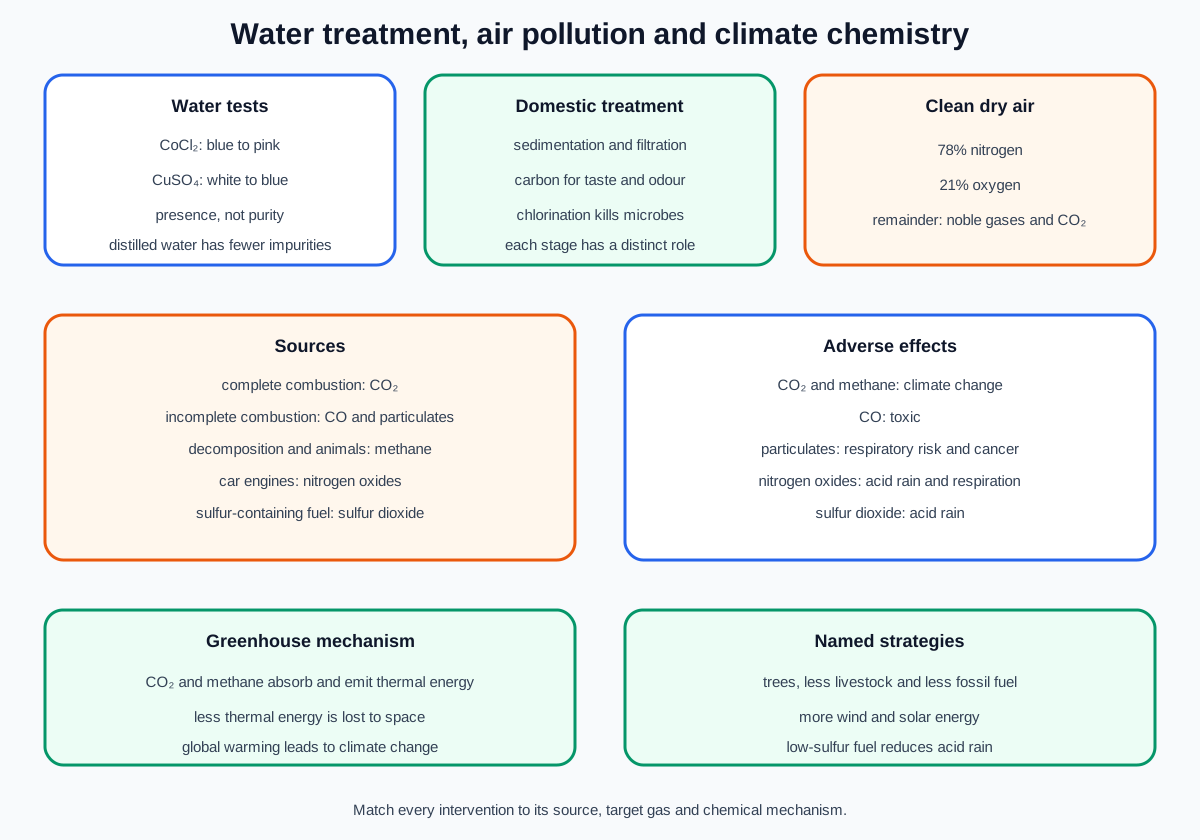
Cambridge IGCSE Combined Science Chemistry C10 develops two chemical tests for water, distilled-water use, three domestic-treatment stages, clean dry air composition, exact pollutant source-effect chains, climate and acid-rain strategies, and the carbon-dioxide and methane greenhouse mechanism.
Anhydrous cobalt(II) chloride tests for water
Anhydrous cobalt(II) chloride is blue. In the presence of water it turns pink.
The observation is blue to pink. “Anhydrous” means without water in the reagent before the test.
Use a small sample and avoid unnecessary contact because cobalt compounds require appropriate hazard controls.
A positive result shows water is present; it does not prove the sample is pure water.
Anhydrous copper(II) sulfate also tests for water
Anhydrous copper(II) sulfate is white. In the presence of water it turns blue.
The observation is white to blue.
Keep the reagent dry before use or it may already have changed colour and produce an invalid test.
Again, the result identifies water presence, not purity or suitability for drinking.
Distilled water has fewer chemical impurities
Distilled water is used in practical chemistry rather than tap water because it contains fewer chemical impurities.
Tap-water ions could react, change pH, form precipitates or interfere with observations. Using distilled water reduces these uncontrolled variables.
“Fewer impurities” is the official claim. Do not promise absolute chemical purity after storage or handling.
Distillation use in the laboratory is different from domestic water treatment for a public supply.
Sedimentation removes larger suspended solids
In domestic water treatment, water is allowed to stand so denser suspended solids settle.
The clearer water can be separated from accumulated sediment.
Sedimentation does not remove every small particle, dissolved substance or microbe.
It prepares water for further filtration and treatment.
Filtration removes remaining solids
Water passes through filter material that traps suspended solid particles.
Filtration improves clarity but is not, by itself, a guarantee that all dissolved chemicals or microbes have been removed.
Sedimentation and filtration are grouped as solid-removal stages.
Do not call ordinary filtration a method for removing every dissolved ion.
Carbon removes tastes and odours
Check this topic from memory
Attempt the matching topic bank before reopening the notes. Use each missed idea to decide what to review next.
Water treatment uses carbon to remove substances responsible for unwanted tastes and odours.
These substances can adsorb onto the carbon surface.
Adsorption means attachment to a surface, not absorption into the full bulk material.
Carbon treatment does not replace chlorination's microbial-control role.
Chlorination kills microbes
Chlorination kills microbes that could cause disease.
This disinfection stage follows physical solid removal and taste or odour treatment in the required sequence.
The dose must be controlled so treatment is effective and the supply remains suitable for use.
Clear water can still contain microbes, so appearance alone does not prove safety.
Clean dry air is mostly nitrogen and oxygen
Clean, dry air contains approximately 78% nitrogen, N₂, and 21% oxygen, O₂.
The remaining approximately 1% is a mixture of noble gases and carbon dioxide, CO₂.
“Dry” excludes variable water vapour from this composition. “Clean” indicates the pollutants considered later are not included as major components.
Do not write 78% oxygen and 21% nitrogen.
Complete combustion produces carbon dioxide
Complete combustion of carbon-containing fuels is the named carbon-dioxide source.
With sufficient oxygen, carbon in the fuel is converted to carbon dioxide.
Higher atmospheric carbon-dioxide levels increase global warming, which leads to climate change.
Carbon dioxide is not classified here as acutely toxic like carbon monoxide; its specified adverse effect is climate-related.
Incomplete combustion produces carbon monoxide
Carbon monoxide forms during incomplete combustion of carbon-containing fuels when oxygen supply is insufficient.
Carbon monoxide is a toxic gas. It reduces the blood's capacity to transport oxygen by binding strongly to haemoglobin.
It can be colourless and odourless, so absence of visible smoke does not prove safety.
Ventilation, appliance maintenance and complete combustion reduce risk, although those are contextual controls rather than named C10 strategies.
Incomplete combustion also produces particulates
Particulates, including soot, can form during incomplete combustion of carbon-containing fuels.
Inhalation increases risk of respiratory problems and cancer.
Particle size and exposure influence where material deposits in the breathing system.
Do not give acid rain as the specified particulate effect.
Methane has two named sources
Methane forms from decomposition of vegetation and from waste gases produced during digestion in animals.
Higher atmospheric methane levels increase global warming, leading to climate change.
Methane is a greenhouse gas even though it is present at a much lower concentration than nitrogen or oxygen.
Do not confuse animal digestive methane with carbon monoxide from incomplete combustion.
Car engines produce oxides of nitrogen
Car engines are the named source of oxides of nitrogen.
High engine temperatures allow nitrogen and oxygen from air to react.
Oxides of nitrogen contribute to acid rain and respiratory problems.
Do not assign sulfur dioxide's sulfur-containing-fuel source to nitrogen oxides.
Sulfur-containing fossil fuels produce sulfur dioxide
Combustion of fossil fuels containing sulfur compounds produces sulfur dioxide.
Sulfur dioxide contributes to acid rain.
The sulfur impurity or compound in the fuel supplies the sulfur; ordinary carbon dioxide does not turn into sulfur dioxide.
Using low-sulfur fuels reduces sulfur-dioxide emissions and therefore reduces acid-rain effects.
Keep every source-effect pair distinct
Carbon dioxide and methane contribute to increased global warming and climate change.
Carbon monoxide is toxic. Particulates increase respiratory-problem and cancer risk. Oxides of nitrogen cause acid rain and respiratory problems. Sulfur dioxide causes acid rain.
A pollutant may have additional real-world effects, but examination answers should preserve these required pairs.
Build a two-column source-effect table rather than transferring one mechanism to all pollutants.
Greenhouse gases interact with thermal energy
Earth's surface receives energy and emits thermal energy toward the atmosphere and space.
Carbon dioxide and methane absorb some emitted thermal energy. They then emit thermal energy in different directions, including back toward the surface and lower atmosphere.
This absorption and emission, sometimes described with reflected or returned thermal energy in the syllabus model, reduces net thermal-energy loss to space.
The atmosphere and surface therefore warm until energy transfer balances at a higher temperature.
Global warming leads to climate change
Global warming is the increase in Earth's average temperature associated here with higher greenhouse-gas levels.
Climate change includes longer-term changes in temperature patterns, rainfall, ice, sea level and extremes.
One local cold day does not disprove a global long-term trend.
Do not say greenhouse gases create energy. They change the transfer and loss of thermal energy.
Planting trees can reduce climate effects
Growing trees removes carbon dioxide from air through photosynthesis and stores carbon in biomass.
Protection and long-term survival matter. Cutting or burning the trees can return stored carbon.
Tree planting can contribute to mitigation but does not cancel unlimited fossil-fuel emissions.
State the carbon-dioxide mechanism rather than saying trees merely “make air clean”.
Reducing livestock farming can reduce methane
Reducing livestock farming can lower methane emissions from animal digestion and associated waste.
The strategy targets a named methane source.
Evaluation should recognise food supply, livelihoods and alternative land use without losing the chemical mechanism.
Do not claim all agriculture emits the same amount or type of gas.
Decreasing fossil-fuel use reduces carbon dioxide
Using less fossil fuel reduces complete-combustion carbon-dioxide emissions.
It can also reduce sulfur dioxide, nitrogen oxides, carbon monoxide and particulates depending on the fuel and combustion process.
Energy efficiency, transport choices and replacing combustion can contribute.
The required climate link is reduced carbon dioxide input to the atmosphere.
Renewable energy replaces fuel combustion
Increasing wind and solar energy can reduce demand for fossil-fuel combustion during operation.
This lowers carbon-dioxide emissions from electricity generation and can reduce associated air pollutants.
Manufacture, storage and infrastructure still have environmental impacts, so “zero impact” is too absolute.
The strategy works most directly when renewable output displaces fossil energy.
Low-sulfur fuels reduce acid rain
Using fuels with lower sulfur content produces less sulfur dioxide during combustion.
Lower sulfur-dioxide emissions reduce formation of acid rain and its effects.
This strategy does not directly remove oxides of nitrogen, the other named acid-rain pollutant.
Match the intervention to sulfur at the fuel source.
Evaluate strategies as a portfolio
No single strategy controls every pollutant or greenhouse-gas source.
Tree planting addresses carbon dioxide already in air. Reduced livestock targets methane. Reduced fossil use and renewable energy avoid carbon-dioxide emissions. Low-sulfur fuel specifically targets sulfur dioxide.
Strong evaluation names target gas, mechanism, likely scale and limitation.
Do not rank strategies using slogans without evidence about actual emissions displaced.
Worked application: diagnose a town's emissions plan
A town replaces part of its coal-fired electricity with wind power, specifies low-sulfur fuel for remaining combustion and supports tree restoration. Wind generation reduces fossil-fuel burning, so less carbon dioxide enters the atmosphere. Low-sulfur fuel specifically lowers sulfur-dioxide emissions and acid-rain effects but does not remove methane from livestock or all nitrogen oxides from engines. Growing trees removes some carbon dioxide through photosynthesis if the forest survives. The plan therefore targets several pathways, but its success must be measured through displaced fuel, sulfur content, forest survival and emissions data. Calling the plan “pollution free” would ignore remaining sources and infrastructure impacts.
Common misconceptions and corrections
Saying cobalt chloride changes pink to blue for water. Anhydrous blue turns pink.
Saying anhydrous copper sulfate starts blue. It starts white and turns blue.
Treating a positive water test as a purity test. It proves presence only.
Calling distilled water absolutely impurity-free. It has fewer chemical impurities than tap water.
Saying sedimentation removes dissolved ions. It settles suspended solids.
Saying filtration kills all microbes. Chlorination is the named disinfection stage.
Saying carbon chlorinates water. It removes tastes and odours.
Assuming clear water is safe. Invisible microbes may remain.
Reversing nitrogen and oxygen percentages. Air is about 78% nitrogen and 21% oxygen.
Including water vapour in clean dry air. Dry composition excludes it.
Saying complete combustion produces carbon monoxide. It produces carbon dioxide.
Saying incomplete combustion produces only carbon monoxide. It can also produce particulates.
Calling carbon monoxide visibly smoky. It is colourless; particulates make smoke.
Giving acid rain as carbon monoxide's effect. Carbon monoxide is toxic.
Giving climate change as the only particulate effect. Respiratory problems and cancer are specified.
Saying methane comes from car engines. Named sources are decomposition and animal digestion.
Saying nitrogen oxides come from sulfur in fuel. They form in car engines from air at high temperature.
Saying sulfur dioxide comes from any fuel regardless of sulfur. Sulfur compounds are required.
Saying carbon dioxide causes acid rain in the required list. Its named effect is global warming and climate change.
Saying sulfur dioxide causes cancer in the required list. Its named effect is acid rain.
Saying all outgoing thermal energy is trapped permanently. Net loss to space is reduced.
Saying greenhouse gases generate thermal energy. They absorb and emit it.
Using one cold day to reject warming. Climate is long-term and global.
Saying trees permanently remove carbon regardless of fate. Burning or decay can return carbon.
Saying reduced livestock targets sulfur dioxide. It targets methane.
Saying renewables have no environmental impact. They reduce combustion emissions when displacing fossil energy.
Saying low-sulfur fuel removes nitrogen oxides. It targets sulfur dioxide.
Importing ozone depletion into C10. It is not listed in this boundary.
Importing catalytic-converter chemistry as required. It is outside the stated strategies.
Assessment guidance
Water-test answers need reagent starting colour, final colour and the limit that presence is not purity. Domestic treatment requires solid removal by sedimentation and filtration, carbon for taste and odour, and chlorination for microbes. Air composition should include percentages, formulas and the remaining gases. For pollutants, preserve each exact source-effect chain. Greenhouse explanations need absorption and emission of thermal energy and reduced loss to space, not energy creation. Strategy answers must name the target source and mechanism: trees, livestock reduction, fossil reduction, wind or solar substitution, and low-sulfur fuel.
Retrieval practice
Reconstruct both water tests and diagnose contaminated-reagent results. Order and explain the three domestic-treatment functions. Write clean dry air composition from memory. Build a five-row source and six-effect pollutant matrix, then apply it to unfamiliar scenarios. Draw the greenhouse thermal-energy pathway and compare all five named strategies by target gas, mechanism, limitation and evidence. Correct thirty source, effect and energy-transfer errors.
Topic ownership
This note owns C10.1 both water tests, distilled-water rationale and three domestic-treatment stages, plus C10.2 air composition, all named sources and effects, five strategies and the limited carbon-dioxide and methane greenhouse mechanism. The practical hub owns extended test handling. Ozone depletion, photochemical smog and catalytic-converter chemistry are not promoted into this Combined Science C10 boundary.