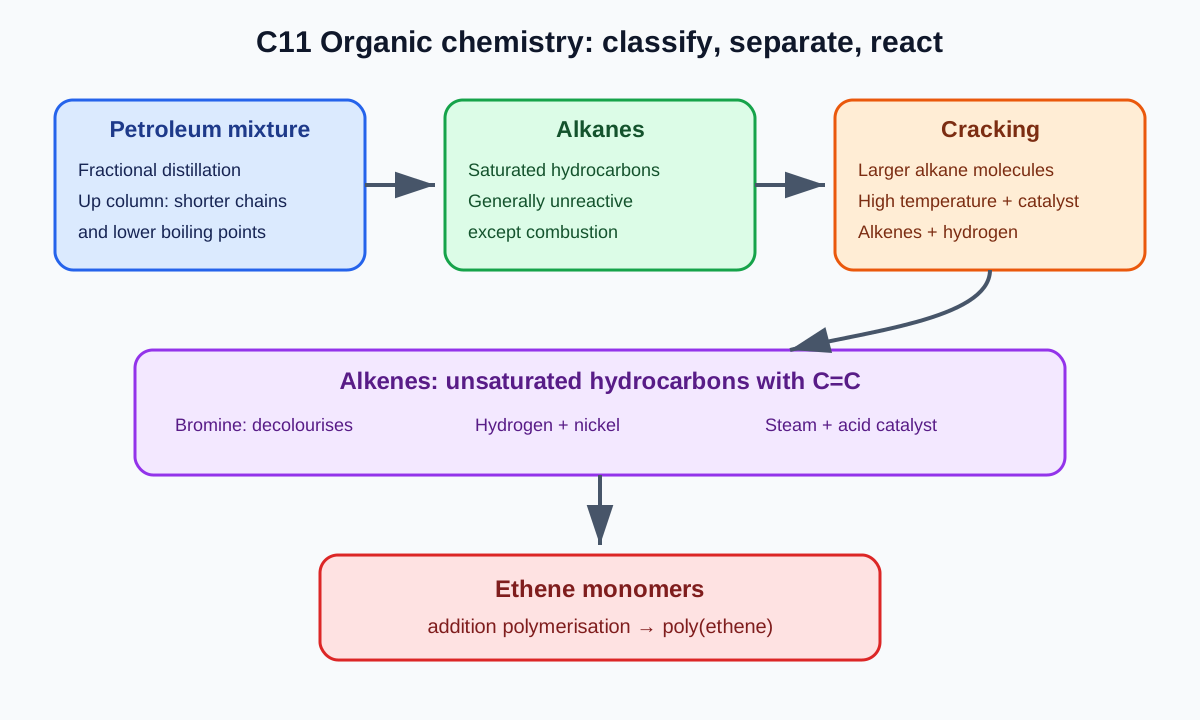
Cambridge IGCSE Combined Science Chemistry C11 introduces the language used to classify carbon compounds, the separation and uses of petroleum fractions, the contrasting reactions of alkanes and alkenes, cracking, and the formation of poly(ethene). This note stays within the 0653 C11 boundary: alcohols, carboxylic acids, fermentation and condensation polymers are not part of this topic.
Saturated compounds contain only single carbon-carbon bonds
A saturated compound has molecules in which every carbon-carbon bond is a single bond. The definition concerns bonds between carbon atoms, not bonds between carbon and hydrogen.
An alkane is therefore saturated because its carbon skeleton contains only single covalent bonds. A molecule is not made saturated simply by adding the word hydrocarbon to its name.
At this level, use the bonding evidence stated in a formula or structure. Do not infer saturation from whether the substance is a liquid, a fuel or a fossil-fuel component.
Unsaturated compounds contain a non-single carbon-carbon bond
An unsaturated compound has molecules in which one or more carbon-carbon bonds are not single bonds. In C11, the important example is the carbon-carbon double bond in an alkene.
The double bond creates a site at which addition reactions can occur. That difference in bonding explains why bromine distinguishes an alkene from an alkane under the stated conditions.
Do not define unsaturated as “containing less hydrogen” without mentioning the carbon-carbon bonding. Hydrogen count can be a consequence, but it is not the required definition.
A homologous series is a chemical family
A homologous series is a family of similar compounds with similar chemical properties. Its members have the same general formula and display a trend in physical properties.
The syllabus does not require recall of specific general formulas. The important reasoning is that a shared structural pattern produces similar chemistry, while increasing molecular size can produce a gradual physical trend.
“Similar” does not mean every physical property is identical. A trend can include a steady change in boiling point across successive members.
Coal, natural gas and petroleum are fossil fuels
The three named fossil fuels are coal, natural gas and petroleum. Methane is the main constituent of natural gas.
Fossil fuels formed from ancient biological material over very long timescales. Their classification does not mean that every hydrocarbon is itself taken directly from a fossil-fuel deposit.
Keep material and constituent distinct: natural gas is the mixture or fuel, while methane is its main constituent.
Check this topic from memory
Attempt the matching topic bank before reopening the notes. Use each missed idea to decide what to review next.
A hydrocarbon is a compound containing only hydrogen and carbon atoms. Both parts matter: it must be a compound, and no other element can be present.
Petroleum is a mixture of hydrocarbons. It is not one pure hydrocarbon and does not have one fixed boiling point.
A compound containing carbon, hydrogen and oxygen is organic in a broad sense, but it is not a hydrocarbon because oxygen is also present.
Fractional distillation separates petroleum
Petroleum is heated so that much of it vaporises. The vapours enter a fractionating column that is hotter near the bottom and cooler near the top.
Hydrocarbons condense in different regions according to their boiling points. Substances with higher boiling points condense lower in the column; those with lower boiling points rise further and condense higher.
Each collected fraction is still a mixture of hydrocarbons with similar boiling points. Fractional distillation separates physically: it does not break covalent bonds or create new molecules.
Fraction properties change up the column
From the bottom to the top of the fractionating column, hydrocarbon chain length decreases and boiling point becomes lower.
These two stated trends must run in the same direction in an answer: top means shorter chains and lower boiling points; bottom means longer chains and higher boiling points.
Avoid importing viscosity, colour, flammability or volatility trends when the question is testing the limited C11.2 supplement statement. Those may appear in wider chemistry courses but are not the required 0653 pair here.
Refinery gas is used for heating and cooking
The refinery gas fraction contains very small hydrocarbon molecules and is collected near the top of the column.
Its named use is gas for heating and cooking.
State the fraction and use together. “Fuel” alone is less precise than the required heating and cooking application.
Gasoline or petrol fuels cars
The gasoline, also called petrol, fraction is used as fuel in cars.
Do not confuse petrol as a fuel with petroleum, the original mixture separated by fractional distillation.
The alternative names gasoline and petrol refer to the same named fraction in this syllabus.
Naphtha is a chemical feedstock
Naphtha is used as a chemical feedstock. A feedstock is starting material supplied to chemical processes to make other useful chemicals.
This use is different from directly burning a fraction as a transport or cooking fuel.
The syllabus requires the function, not a memorised list of every product that industry can make from naphtha.
Diesel oil or gas oil fuels diesel engines
The diesel oil, also called gas oil, fraction is used as fuel in diesel engines.
It condenses lower in the column than petrol because its molecules are generally longer and have higher boiling points.
Do not assign diesel oil to petrol engines merely because both are transport fuels.
Bitumen is used for making roads
Bitumen is the heavy fraction associated with the bottom of the column and is used for making roads.
Its position is consistent with longer chains and higher boiling points.
Bitumen should not be placed at the cool top of the column, and refinery gas should not be placed at the hot bottom.
Alkanes are saturated hydrocarbons
Alkanes contain carbon and hydrogen only, so they are hydrocarbons. Their carbon-carbon bonds are single covalent bonds, so they are saturated.
They are generally unreactive. The stated exception is combustion, in which an alkane reacts with oxygen and releases energy.
Do not make “unreactive” absolute. The syllabus wording deliberately says generally unreactive except in terms of combustion.
Alkenes are unsaturated hydrocarbons
Alkenes contain a carbon-carbon double covalent bond. They contain carbon and hydrogen only, so they are hydrocarbons, and the double bond makes them unsaturated.
Their characteristic chemistry in C11 is addition. Reactant atoms add across the double bond and the carbon-carbon connection becomes single.
The reactive feature is the carbon-carbon double bond, not simply the presence of carbon.
Aqueous bromine distinguishes saturation
Add aqueous bromine to the hydrocarbon sample and mix under suitable test conditions. An unsaturated hydrocarbon such as an alkene decolourises the aqueous bromine, changing it from orange or brown to colourless.
A saturated hydrocarbon such as an alkane does not produce this decolourisation under the test conditions, so the bromine colour remains.
Record both starting and final observations. “It changes colour” is incomplete because it does not identify the result.
Cracking makes smaller molecules
Cracking converts larger alkane molecules into smaller molecules, including alkenes and hydrogen. It uses a high temperature and a catalyst.
The products are useful because alkenes can undergo addition reactions and polymerisation. Cracking is a chemical reaction, unlike the physical separation of petroleum fractions.
Do not describe cracking as merely boiling petroleum. Boiling separates existing particles; cracking changes molecules by breaking and rearranging covalent bonds.
Bromine adds across an alkene double bond
In the bromine test, bromine undergoes an addition reaction with the alkene. Atoms from bromine add to the two carbon atoms that formed the double bond.
The carbon-carbon double bond becomes a single bond in the product, which explains why the bromine colour disappears.
Use this reaction to connect observation to structure: decolourisation is evidence for unsaturation under the stated conditions.
Hydrogen adds with a nickel catalyst
Hydrogen reacts with an alkene in the presence of a nickel catalyst. Hydrogen atoms add across the double bond and produce a saturated product.
The catalyst provides a faster reaction pathway and is not consumed overall. Nickel is the named catalyst and should be included when conditions are requested.
Do not claim that hydrogen substitution occurs. This is addition because the double bond is used and one product forms from the reacting molecules.
Steam adds with an acid catalyst
Steam reacts with an alkene in the presence of an acid catalyst. The elements of water add across the carbon-carbon double bond.
The required focus is the addition pattern and the acid-catalyst condition. Detailed industrial pressures or alcohol-manufacturing comparisons are outside this Combined Science C11 boundary.
Keep steam addition distinct from hydrogen addition: acid catalyst belongs with steam, while nickel belongs with hydrogen.
Polymers are large molecules made from monomers
A polymer is a large molecule built from many smaller molecules called monomers.
The monomers join repeatedly to form a long molecular chain. “Many monomers” describes the building process; it does not mean the final polymer is merely an unbonded mixture.
Use the terms polymer and monomer accurately in both definitions and diagrams.
Ethene forms poly(ethene) by addition polymerisation
Ethene is an alkene monomer. During addition polymerisation, many ethene molecules join as their carbon-carbon double bonds open to form the carbon-carbon single-bond backbone of poly(ethene).
No small molecule is removed in this example, which is why the process is called addition polymerisation.
When interpreting a representation, preserve the two-carbon repeating pattern and show that the chain continues. The C11 requirement is the formation of poly(ethene), not an inventory of multiple polymers.
Worked application: trace a petroleum route to a polymer
A refinery separates petroleum into fractions before sending some naphtha-derived larger alkanes for cracking. Fractional distillation is a physical separation based on boiling-point ranges, so the hydrocarbons themselves remain chemically unchanged during that stage. Cracking is different: high temperature and a catalyst convert larger alkane molecules into smaller molecules, including an alkene and hydrogen. If the alkene is ethene, many ethene monomers can undergo addition polymerisation. Their carbon-carbon double bonds open and link into poly(ethene). A bromine test would decolourise with the ethene before polymerisation, providing evidence of unsaturation, but the saturated polymer backbone no longer contains those alkene double bonds.
Common misconceptions and corrections
Calling every carbon compound a hydrocarbon. A hydrocarbon contains hydrogen and carbon only.
Calling petroleum one compound. It is a mixture of hydrocarbons.
Calling methane the whole of natural gas. It is the main constituent.
Defining saturated as containing lots of hydrogen. All carbon-carbon bonds must be single.
Defining unsaturated without mentioning carbon-carbon bonds. At least one is not single.
Saying homologous-series members have identical physical properties. They display a trend.
Trying to recall a specific general formula when none is required. Recognise the shared formula pattern.
Saying fractional distillation breaks molecules. It separates by boiling-point range.
Calling every fraction pure. Each fraction is a mixture with similar boiling points.
Putting the coolest region at the column bottom. The top is cooler.
Putting short chains at the bottom. Chain length decreases upward.
Putting high boiling points at the top. Boiling points become lower upward.
Confusing petrol with petroleum. Petrol is one fraction; petroleum is the starting mixture.
Using naphtha only as a transport fuel. Its named use is chemical feedstock.
Using bitumen for cooking. Its named use is road making.
Calling alkanes completely unreactive. They undergo combustion.
Calling alkenes saturated. Their carbon-carbon double bond makes them unsaturated.
Saying aqueous bromine turns blue. It changes from orange or brown to colourless with an alkene.
Giving decolourisation for an alkane under the test conditions. Its colour remains.
Calling cracking another name for distillation. Cracking is a chemical reaction.
Omitting the high temperature or catalyst from cracking. Both are required conditions.
Saying cracking only makes alkanes. It manufactures alkenes and hydrogen from larger alkanes.
Calling alkene reactions substitution. The named reactions are addition.
Putting nickel with steam addition. Nickel is used with hydrogen.
Putting an acid catalyst with hydrogen addition. The acid catalyst is used with steam.
Calling a monomer a large chain. A monomer is the smaller building molecule.
Calling a polymer an unbonded monomer mixture. It is one large molecule built from many monomers.
Saying poly(ethene) forms by condensation. It is an addition polymerisation example.
Saying a small molecule must be removed. No small molecule is lost in addition polymerisation.
Importing ethanol and ethanoic-acid chemistry into this topic. They are outside 0653 C11.
Assessment guidance
Definitions should mention the exact bond or elemental composition, not a vague property. Petroleum answers must distinguish a physical separation from cracking and correctly pair all five fractions with their uses. For column trends, state decreasing chain length and lower boiling points from bottom to top. Bromine-test responses need reagent, starting colour, final colour and the contrasting alkane result. Addition questions should match bromine, hydrogen with nickel, and steam with acid catalyst. Polymer answers need a large molecule, many monomers, ethene and addition polymerisation, while avoiding unsupported alcohol or acid chemistry.
Retrieval practice
Define saturated, unsaturated, hydrocarbon, homologous series, monomer and polymer from memory. Draw a bottom-to-top fractionating column and place all five fractions, uses and the two stated trends. Compare distillation with cracking. Reconstruct the bromine test and all three alkene additions with conditions. Explain how ethene becomes poly(ethene), then correct thirty boundary and mechanism errors.
Topic ownership
This note owns C11.1 terminology, C11.2 fossil fuels and petroleum fractions, C11.3 alkane bonding and combustion reactivity, C11.4 the bromine test, cracking and three alkene additions, and C11.5 polymer definitions and poly(ethene). Extended experimental handling belongs in the practical hub. Alcohols, carboxylic acids, fermentation, esterification, condensation polymers and named general formulas are not promoted into this Combined Science boundary.