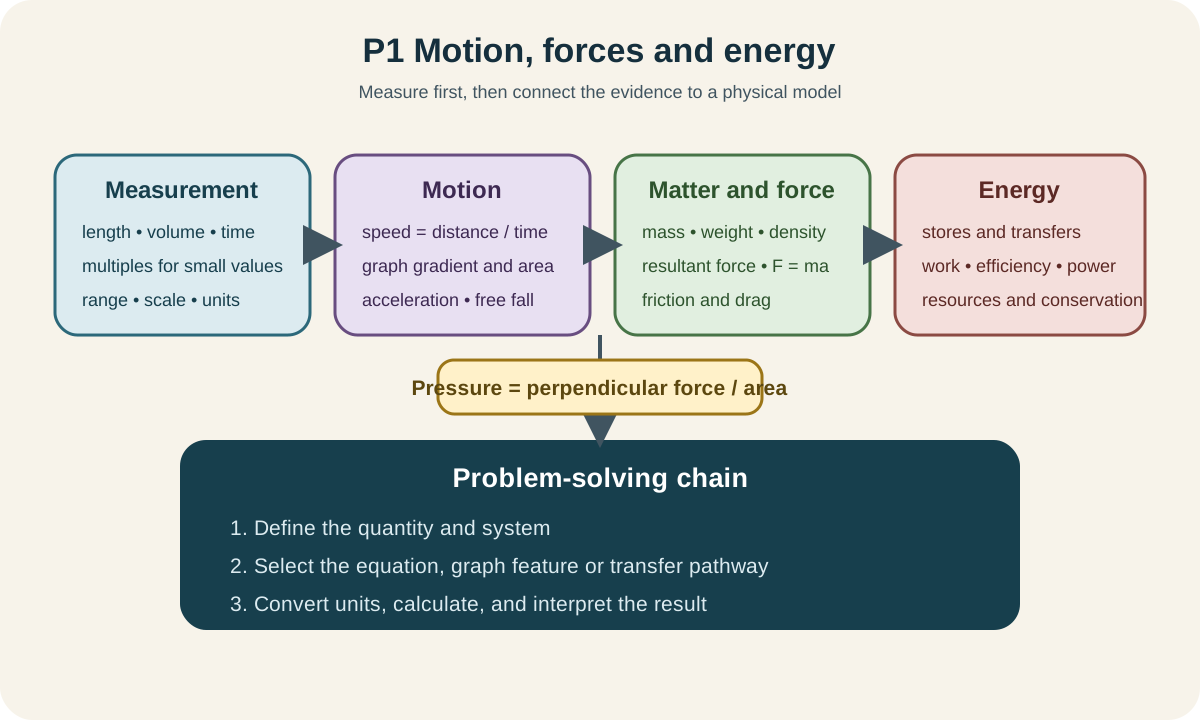
Cambridge IGCSE Combined Science 0653 Physics P1 connects measurement to motion, forces and energy accounting. The topic moves from raw length, volume and time readings to graphs, mass, weight, density, resultant force, energy transfers, resources, work, efficiency, power and pressure. Keep the quantity, unit and physical meaning together at every step.
P1.1 Measure length and volume with a suitable scale
Place a ruler beside the length, align it with the direction being measured and view the scale perpendicularly. If the end is damaged, begin at a clear non-zero mark and subtract the initial reading from the final reading.
Use a measuring cylinder for liquid volume. Read at eye level and use the correct scale division. For an irregular solid that sinks, record initial and final liquid volumes; their difference is the object's volume.
Record the supported precision. A scale with millimetre divisions does not justify an arbitrary string of decimal places.
Measure several repeats when one is too small
For a small distance such as the thickness of one sheet, measure many identical sheets together and divide by their number. Pack them without gaps or compression that would change the total.
For a short periodic interval, time several complete oscillations and divide by the number of oscillations. Start and stop at the same phase and use a fixed reference point.
Measuring multiples increases the measured total relative to the scale or reaction-time limitation. It does not remove a zero error or a consistently wrong cycle count.
P1.2 Speed measures distance per time
Speed is distance travelled per unit time:
v=ts
Check this topic from memory
Attempt the matching topic bank before reopening the notes. Use each missed idea to decide what to review next.
Use compatible units before calculating. If distance is in metres and time is in seconds, speed is in metres per second.
Average speed uses the total distance travelled and total time taken:
average speed=total time takentotal distance travelled
Do not average two speeds unless the time or distance conditions make that operation valid. Return to total distance and total time.
Distance-time graphs show position-change rate
Time is normally on the horizontal axis and distance on the vertical axis. A horizontal section shows rest because distance does not change. A straight sloping section shows constant speed.
For a straight section, speed is the gradient:
speed=change in timechange in distance
A steeper distance-time gradient means a greater speed. A changing gradient indicates changing speed, but the Core requirement is qualitative interpretation of rest and constant-speed regions plus calculation from straight sections.
Speed-time graphs separate speed from acceleration
A horizontal line above zero shows constant speed. A line at zero shows rest. An upward slope shows acceleration, while a downward slope shows deceleration.
At Supplement level, acceleration for straight-line motion is change in speed per unit time:
a=ΔtΔv
The gradient of a straight speed-time section gives acceleration. Deceleration is negative acceleration when the chosen positive direction and graph convention are used consistently.
Area under a speed-time graph gives distance
At Supplement level, the area between a speed-time graph and the time axis gives distance travelled for constant speed and constant acceleration.
Split the region into rectangles and triangles. Preserve the units: multiplying metres per second by seconds produces metres.
This is a speed-time graph, so it does not encode negative direction. Do not infer displacement direction from a graph that shows speed only.
Free fall has approximately constant acceleration near Earth
Near Earth's surface, free-fall acceleration is approximately:
g=9.8m⋅s−2
This value applies to the idealised gravitational acceleration described by the syllabus. Air resistance can change the acceleration of a real falling object.
Do not confuse g as acceleration with gravitational field strength expressed in newtons per kilogram. They are equivalent in value near Earth but describe different quantity relationships.
P1.3 Mass and weight are different quantities
Mass measures the quantity of matter in an object and is measured in kilograms. Weight is the gravitational force on a mass and is measured in newtons.
Gravitational field strength is gravitational force per unit mass:
g=mW
Rearranging gives W=mg. Near Earth's surface, g is approximately 9.8N⋅kg−1.
Mass does not disappear in a weaker field. Weight changes because the gravitational force per unit mass changes.
P1.4 Density compares mass with volume
Density is mass per unit volume:
ρ=Vm
Use a balance for mass. For a regular solid, measure the necessary dimensions and calculate volume. For a liquid, subtract the empty container mass from the combined mass and divide by the measured liquid volume. For an irregular sinking solid, use liquid displacement for volume.
Keep units consistent. Common units include kilograms per cubic metre and grams per cubic centimetre.
Density data predict floating and sinking
Use the supplied density data to compare an object with the surrounding liquid. An object less dense than the liquid can float; one more dense sinks in the simple cases assessed here.
Do not compare mass alone. A large low-density object may float while a small high-density object sinks.
Trapped air, surface bubbles or an object that does not submerge fully can invalidate a displacement measurement. The method must match the stated object.
P1.5 A resultant force changes motion
Forces can change an object's size, shape or motion. When several forces act along one straight line, choose a positive direction, attach signs and add them to find the resultant.
Balanced forces give zero resultant force. An object then remains at rest or continues moving in a straight line at constant speed. Zero resultant force does not mean no forces are present.
An unbalanced resultant produces acceleration in the resultant-force direction.
Use the force-mass-acceleration relationship
At Supplement level:
F=ma
Here F is the resultant force, not an arbitrary one of several forces. For a fixed mass, a larger resultant produces a larger acceleration. For a fixed resultant, a larger mass produces a smaller acceleration.
Use newtons, kilograms and metres per second squared in a direct SI calculation.
Friction and drag oppose relative motion
Friction acts between surfaces and may impede relative motion. It can also produce heating. Drag acts on an object moving through a liquid or gas, including air resistance.
Friction can be useful, such as providing grip, or unwanted, such as wasting energy as heating. State the context before judging it.
Drag depends on the motion and surrounding fluid. It is not automatically equal to weight. Equality can occur in a particular constant-speed falling condition, but it is not the definition of drag.
P1.6 Energy is stored and transferred
The required stores are kinetic, gravitational potential, chemical, elastic strain, nuclear, electrostatic and internal thermal.
Energy is transferred between stores by forces doing mechanical work, electrical currents doing electrical work, heating, and electromagnetic, sound or other waves.
Describe a process by naming the starting store, transfer pathway and receiving store. Avoid saying that energy is simply "used up."
Conservation accounts for every transfer
Energy cannot be created or destroyed. The total energy before and after a process is conserved, although some energy may be transferred into less useful stores in the surroundings.
Simple flow diagrams can show input split into useful and unwanted transfers. Cambridge 0653 does not require Sankey diagrams here, so do not treat their construction as a syllabus requirement.
Conservation does not mean every transfer is equally useful or reversible.
Calculate kinetic and gravitational potential energy
At Supplement level, kinetic energy is:
Ek=21mv2
Doubling speed makes kinetic energy four times as large when mass stays constant.
Change in gravitational potential energy is:
ΔEp=mgΔh
Use vertical height change, not distance along a slope. Choose the sign or state gain and loss consistently with the question.
Work done equals energy transferred
Mechanical or electrical work done equals energy transferred. For a constant force acting through a distance in its direction:
W=Fd=ΔE
Work and energy are measured in joules. If the force is not acting through the stated distance in the required way, do not insert numbers mechanically.
The symbol W may mean work in one equation and weight in another context. Read the definition and unit.
Energy resources use different transfer chains
Fossil fuels and biofuels release energy that can heat water in a boiler; steam may turn a turbine connected to a generator. Nuclear fission and geothermal resources can also supply thermal transfer for turbine generation.
Hydroelectric dams, waves, tides and wind use moving water or air to drive mechanical systems and generators. Solar cells generate electrical power directly from light. Solar thermal collectors use radiation from the Sun to heat water.
Describe the actual chain instead of saying every resource "makes energy."
Compare resources with scoped criteria
Compare availability, predictability, fuel requirement, emissions during operation, land or habitat effects, waste, start-up response and long-term supply only where the question provides or expects the relevant context.
Radiation from the Sun is the main source for the listed energy resources except geothermal, nuclear and tidal. Wind, waves, hydroelectric flow, fossil fuels and biofuels ultimately depend on solar-driven processes.
The Sun releases energy by nuclear fusion, while nuclear reactors release energy by nuclear fission. Detailed fusion and fission mechanisms are not required in this topic.
Efficiency compares useful output with total input
Efficiency may be calculated from energy or power:
efficiency=total energy inputuseful energy output×100%
efficiency=total power inputuseful power output×100%
Keep numerator and denominator in the same type of quantity and compatible units. Efficiency cannot exceed 100 percent for the defined system.
Power is the rate of energy transfer
Power is work done per unit time or energy transferred per unit time:
P=tW=tΔE
One watt is one joule per second. A more powerful device transfers energy faster; it does not necessarily transfer more energy overall unless the operating times are compared.
P1.7 Pressure is force per area
Pressure varies directly with perpendicular force and inversely with contact area:
p=AF
Pressure is measured in pascals, where one pascal is one newton per square metre. Convert areas carefully because squaring a length conversion changes the factor twice.
A sharp edge produces high pressure by applying a force over a small area. Wide tyres or snowshoes reduce pressure by spreading force over a larger area. This P1 boundary does not add liquid-depth pressure equations.
Worked application: connect a lift to motion and energy
A 600kg lift starts from rest, accelerates upward, then moves at constant speed before slowing at the next floor. During the constant-speed section, its acceleration and resultant force are zero, but upward cable force and downward weight are still present and balanced. Raising it by 8.0m increases gravitational potential energy by ΔEp=mgΔh. Using g=9.8N⋅kg−1, the gain is 600×9.8×8.0=47,040J. If this useful transfer takes 12s, useful power is 3,920W. A larger electrical input is required because some energy is transferred to internal thermal stores and sound.
Common misconceptions and corrections
Starting every ruler measurement at zero. A clear non-zero start can be used if the readings are subtracted.
Timing one rapid oscillation. Time several complete oscillations and divide.
Averaging speeds without using total distance and time. Return to the definition of average speed.
Calling a flat distance-time line constant speed. It shows rest.
Using distance-time area as distance. Distance comes from its vertical coordinate; gradient gives speed.
Using speed-time gradient as speed. The gradient gives acceleration.
Using speed-time area as acceleration. The area gives distance.
Treating deceleration as always positive. In the stated convention it is negative acceleration.
Assuming free fall means constant speed. It has approximately constant acceleration when drag is neglected.
Giving mass in newtons. Mass is in kilograms.
Giving weight in kilograms. Weight is a force in newtons.
Saying mass changes when gravity changes. Weight changes; mass remains.
Using g without its contextual unit. Acceleration and field strength use different units.
Comparing masses to decide floating. Compare densities.
Leaving container mass in liquid density. Subtract the empty container mass.
Using external dimensions for a hollow object's material volume. Use the volume relevant to the question.
Saying balanced forces mean no forces. They mean zero resultant.
Saying a moving object must have a forward resultant. Constant straight-line speed needs zero resultant.
Putting one force into F=ma. Use the resultant force.
Assuming friction is always harmful. It can provide grip and braking.
Saying energy is used up. It is transferred between stores.
Calling a pathway an energy store. Heating and waves are transfer pathways.
Saying conservation means all energy remains useful. Unwanted transfers still conserve total energy.
Using distance along a slope in mgΔh. Use vertical height change.
Forgetting the square on speed in kinetic energy. The dependence is v2.
Calling work a force. Work is energy transferred.
Saying all generators contain fuel. Wind and water can drive generators without combustion.
Saying solar cells heat water. Solar thermal collectors heat water; cells generate electrical power.
Confusing fusion in the Sun with fission in reactors. They are different nuclear processes.
Dividing total output by useful input for efficiency. Useful output is divided by total input.
Mixing energy and power in an efficiency ratio. Use energy with energy or power with power.
Saying higher power always means more energy. Time also matters.
Using square centimetres directly with newtons to claim pascals. Convert area to square metres.
Saying a larger area creates larger pressure at fixed force. It creates smaller pressure.
Adding fluid-depth pressure formulas to this P1 boundary. The required equation is force per area.
Assessment guidance
Write the governing definition or equation before substituting, convert to compatible units and give the final quantity with its unit. On graphs, name the graph type before interpreting gradient or area. Distinguish mass from weight and a single force from the resultant. In energy questions, identify stores and transfer pathways, then account for useful and unwanted outputs without claiming energy disappears. Resource comparisons should use the stated criterion rather than a universal ranking. For density and pressure, check whether volume or area conversion is required. Supplement equations should be applied only with the variables and conditions defined in the question.
Retrieval practice
Measure a small thickness and pendulum period using multiples. Sketch distance-time and speed-time graphs for rest, constant speed, acceleration and deceleration, then calculate one gradient and one area. Solve linked mass-weight, density, resultant-force, kinetic-energy, gravitational-energy, work, efficiency, power and pressure problems. Explain three energy-resource chains and diagnose thirty-five errors involving units, graph meaning, balanced forces, stores, pathways and area conversion.
Topic ownership
This note owns official Combined Science 0653 sections P1.1 to P1.7: measurement, motion, mass and weight, density, force effects, energy, work, energy resources, efficiency, power and force-per-area pressure. It does not promote momentum, moments, elasticity calculations or fluid-depth pressure into the required P1 boundary. Executable apparatus methods and evaluation remain in the practical hub.