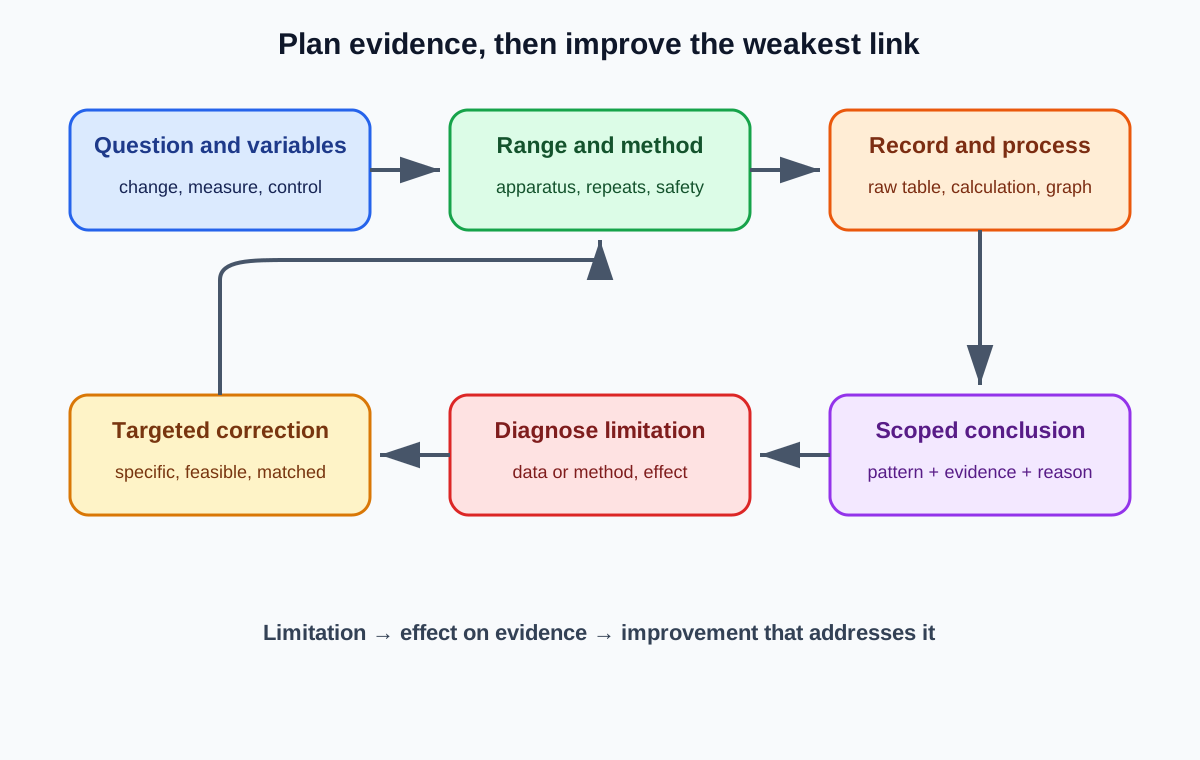
Cambridge IGCSE Co-ordinated Sciences 0654 planning questions require more than a list of variables. A defensible plan turns a question into a safe, reproducible investigation, states how evidence will be recorded and processed, and predicts a result with reasoning. Evaluation then diagnoses the evidence and method before proposing a correction that addresses the actual weakness.
State an operational independent variable
The independent variable is the factor deliberately changed by the investigator. Name the actual quantity, not a vague label.
For a reaction-rate investigation, “concentration of acid in mol per cubic decimetre” is operationally clearer than “change the acid”. For a spring investigation, use the load or force applied rather than “the spring”.
State how the variable is produced or adjusted so another student could reproduce the selected values.
Define a measurable dependent variable
The dependent variable is observed or measured in response to the independent variable.
An endpoint must connect to apparatus and units. “Reaction rate” might be obtained from gas volume per unit time or from the time required to reach a fixed visible endpoint. “Plant response” might be measured as gas volume, bubble count over a fixed time or distance grown.
Do not name an inferred concept when the method actually records a quantity.
Control alternative explanations
Control variables are factors that could affect the dependent variable and are held constant so the intended relationship can be tested validly.
For each important control, say how it is kept constant and why it matters. In a concentration-rate investigation, keep reactant volume and temperature constant because either could change collision frequency or total product.
“Keep everything else the same” is not enough. Select the variables with a plausible effect and operationalise their control.
Distinguish control variables from control experiments
A control variable is held constant across test conditions. A control experiment removes or replaces the proposed causal factor while keeping other conditions comparable.
Boiled biological material can test whether a response depends on living activity. A reaction mixture without one reactant can show whether that reactant is needed for the observed change.
Not every investigation needs a separate control experiment. Include one when it answers a specific alternative explanation.
Choose enough values to reveal a pattern
The official planning requirements ask for an appropriate number and range of independent-variable values.
Check this topic from memory
Attempt the matching topic bank before reopening the notes. Use each missed idea to decide what to review next.
Use enough values to distinguish a trend, curve, threshold or optimum. Five well-spaced values often reveal more than a treated and untreated pair, but context, safety and available time govern the final design.
A pilot investigation can identify a range that produces measurable but not instantaneous or impractically slow responses.
Make the range safe and informative
The minimum and maximum should cover a scientifically useful interval without damaging apparatus, organisms or people.
Intervals can be equal for straightforward trend detection. Closer spacing may be justified near a suspected change, optimum or intercept.
Do not claim the true optimum when only broad intervals were tested. The best tested value is not necessarily the exact optimum.
Select apparatus and justify it
Choose apparatus for the quantity, expected range, precision and practical conditions.
A gas syringe is justified when it contains and directly measures gas volume. A volumetric pipette is justified when one accurate fixed volume is needed. A digital sensor may reduce subjective judgement if it measures the required variable in a valid way.
“More accurate” is not a justification unless the feature that improves the measurement is explained.
Write an ordered and reproducible method
Specify apparatus, quantities, concentrations, dimensions, sequence, timing and endpoint. Explain how the independent variable is set, how the dependent variable is measured and how controls are maintained.
Define when measurement begins and ends. State how apparatus is reset or samples are replaced between trials.
The plan should not require the reader to invent missing values or infer which reading is recorded.
Plan repeats and independent replicates
Repeating a measurement under the same condition reveals random spread and allows a representative mean where appropriate.
Independent biological replicates sample variation among organisms or tissue pieces more effectively than repeatedly observing one specimen. In chemistry and physics, rebuilding or resetting can test whether a result depends on one setup.
Predefine the repeat structure. Do not repeat only until preferred values appear.
Plan the raw results table
State how results will be recorded before describing a conclusion. A table should contain the independent variable first, repeat dependent-variable readings, units in headings and a processed value such as a mean or rate where justified.
Raw readings must remain visible. A mean without its components hides spread and anomalies.
Use consistent precision within a measurement column when the same apparatus is used.
Match processing to the question
Describe the calculation, graph or comparison used to answer the question.
Rates can be calculated from change per time. Reciprocal time is meaningful only when every trial reaches the same fixed endpoint. Percentage change can compare samples with different initial values. A graph can reveal whether variables are proportional, linear, curved or reach a plateau.
State axes and what feature, such as gradient or intercept, will be interpreted.
Make a reasoned prediction
A prediction states the expected result for the planned conditions. Reasoning links that result to relevant science.
For increasing reactant concentration, predict faster product formation because more reacting particles occupy a given volume and successful collisions occur more frequently. For wire length and resistance, predict increasing resistance because charge carriers encounter more opposition along a longer path.
A prediction is not a conclusion because results have not yet been collected.
Link hazard, risk and precaution
A hazard is a source of harm. Risk describes how the harm could occur. A precaution is an action that reduces that risk.
For hot water, the risk is a burn, so use suitable handling and a controlled bath. For corrosive solution, the risk is skin or eye damage, so wear eye protection and avoid contact. For mains electricity, use an appropriate low-voltage laboratory supply where specified.
Avoid generic “be careful” statements and unrelated precautions.
Form a scoped conclusion from evidence
A conclusion states the observed relationship, cites representative processed evidence and uses relevant science to explain it.
Say whether evidence supports the prediction within the tested range. Do not extend a trend to conditions, substances or organisms not investigated.
Correlation is weaker evidence of causation if important variables were not controlled.
Evaluate data quality separately from method quality
Data evaluation considers scatter, anomalies, repeat agreement, sample size, range and whether the pattern is clear.
Method evaluation considers variable control, apparatus resolution, reaction or human timing, leaks, heat loss, endpoint judgement, contamination and specimen variation.
Keeping these categories distinct helps prevent “repeat it” from becoming a universal response.
Distinguish accuracy and precision
Accuracy describes closeness to a true value. Precision concerns the closeness of repeated values or the fineness with which a measurement can be expressed.
Repeatability asks whether the same method under the same conditions gives similar results. Reproducibility asks whether similar results occur under changed conditions, methods or experiments.
The syllabus provides this language for consistent use, but candidates are not required to recall the exact formal definitions.
Distinguish random and systematic error
Random error produces unpredictable variation among readings. Repeats, a mean and a less subjective endpoint can reduce its influence.
Systematic error shifts readings consistently in one direction. A balance with a zero offset or a miscalibrated thermometer can bias every result.
Repeating a biased measurement does not remove the bias. Zero, calibrate or replace the instrument, or correct readings when justified.
Identify uncertainty in the conclusion
Uncertainty may arise because readings have limited resolution, a graph has scatter, a range is narrow or important controls were imperfect.
Explain how the issue limits the claim. Widely scattered values can make the exact gradient uncertain; an unmeasured temperature change can weaken a claimed concentration effect.
Avoid declaring the whole experiment useless when a narrower conclusion remains supported.
Write limitation, effect and improvement chains
A strong improvement begins with a specific weakness, explains its effect on evidence and gives a feasible correction.
If heat escapes from an uninsulated reaction vessel, the recorded maximum temperature rise may be too small; use insulation and a lid while preserving safe gas release. If parallax affects a liquid level, read at eye level against a fixed scale or use an appropriate sensor.
The correction must preserve the original question rather than replace it with another investigation.
More repeats are useful only for the right problem
Repeats help estimate and reduce the influence of random variation and can expose anomalies.
They do not control temperature, repair a leak, increase scale resolution, remove selection bias or correct a zero error.
Before proposing repeats, identify whether random spread is the limiting issue and say how repeated values will be combined.
Use subject-specific evaluation
In Biology, evaluate organism variation, standardisation, ethical handling and subjective endpoints. In Chemistry, evaluate reagent quantities, contamination, heat exchange, gas loss and endpoint timing. In Physics, evaluate zero errors, parallax, alignment, friction, contact resistance and instrument loading where relevant.
Generic phrases score weakly because they do not show how the particular setup affects the result.
Worked application: plan and evaluate a cooling investigation
To test how exposed surface area affects cooling, use identical containers with equal volumes of water at the same initial temperature and expose different measured surface areas while keeping container material, room position and measurement interval constant. Record temperature with the same thermometer at fixed times and repeat each condition. Plot temperature against time or compare temperature decrease over a fixed interval. Hot water presents a burn risk, so use moderate instructed temperatures and stable containers. If starting temperatures differ, cooling comparisons are confounded; use a controlled water bath and begin each run at the same checked temperature rather than merely increasing repeats.
Common misconceptions and corrections
Calling the measured response the independent variable. It is the dependent variable.
Naming a concept instead of a measurable outcome. State the reading and unit.
Listing controls without saying how. Give the constant value or procedure.
Listing controls without saying why. Link each to the dependent variable.
Calling a control experiment a control variable. They have different roles.
Adding a control experiment to every plan. Use one only when it tests an alternative.
Using only two values to identify a curve. Choose enough values across a range.
Assuming the highest tested result is the exact optimum. It is only the best tested value.
Expanding a range beyond safe conditions. Safety constrains design.
Writing “use accurate apparatus”. Name and justify the instrument.
Omitting quantities from a method. Reproducibility requires operational detail.
Leaving timer start and stop undefined. Tie both to physical events.
Changing several independent factors together. The causal comparison becomes confounded.
Repeating only until results agree. Predefine repetitions.
Treating repeated readings from one organism as independent replicates. They do not sample organism variation.
Replacing raw readings with an average. Preserve both.
Putting units in every table cell. Put them in headings.
Using reciprocal time for different endpoints. It requires the same fixed change.
Drawing a graph without naming axes. Link axes to variables and units.
Writing a prediction after seeing results. That is retrospective interpretation.
Calling a hazard a risk. Name source, possible harm and precaution.
Using goggles as a correction for measurement error. Safety and data quality differ.
Writing “be careful”. Give a concrete safe action.
Claiming the prediction is proved. State whether evidence supports it.
Generalising beyond the tested range. Scope the conclusion.
Treating accuracy and precision as synonyms. They describe different qualities.
Saying repeats remove systematic error. Correct calibration or method bias.
Calling every unusual value human error. Identify a plausible mechanism.
Deleting anomalies silently. Retain and justify handling.
Suggesting more repeats for an uncontrolled variable. Control it first.
Saying “use better equipment”. Name the feature and effect.
Giving an improvement without a limitation. Build a linked chain.
Changing the research question in the improvement. Repair the existing test.
Using one generic evaluation for all sciences. Diagnose the actual apparatus and context.
Recalling measurement definitions word for word as the main task. Apply the terms correctly instead.
Assessment guidance
Planning responses need operational variables, a safe informative range, control methods with reasons, justified apparatus, ordered quantities, repeats, a recording structure, processing, prediction and matched safety. State a control experiment only when it isolates a proposed cause. Conclusions must cite evidence and stay within scope. Evaluations should clearly separate data quality from method quality and identify random or systematic mechanisms. The strongest improvement is a limitation-effect-correction chain that names exactly how the revised apparatus or procedure strengthens the original investigation.
Retrieval practice
For one Biology, Chemistry and Physics question, write an operational independent variable, dependent variable and three control-reason pairs. Add five values, repeats, a control experiment only where justified, a risk statement, raw table and processing plan. Then classify twelve flaws as random, systematic, validity or range problems and produce one limitation-effect-improvement chain for each.
Topic ownership
This note owns the official AO3 planning and method-evaluation requirements, including variables, range, controls, apparatus justification, risk, recording plan, processing, prediction, errors and targeted improvements. Practical 3 develops measurement, tables and graphs, while practicals 4 to 7 supply subject contexts. Practical 8 consolidates apparatus, safety and improvements without replacing the planning logic here.